Tag: fluid dynamics

  • Hunting By Whisker

    Hunting By Whisker

    Seals and sea lions often hunt fish in waters too dark or turbid to rely on eyesight. Instead, they follow their whiskers, using the turbulence generated by a fish’s wake. The vortices shed by the fish cause the seal’s whiskers to vibrate, giving them sensory information. To better understand what a seal can derive from this, a recent experiment looked at what a thin whisker can pick up from an upstream cylinder.

    As expected, the strength of the whisker’s vibration fell off the farther away the cylinder was. But the researchers found that, if they moved the cylinder quickly — like a fish trying to dart away — the vibration of the whisker was stronger. They also found that the whisker was sensitive to misalignment. If the cylinder was placed ahead and to the side of the whisker, the whisker would still vibrate but would do so around a different equilibrium position. That result implies that a seal can get information both about the fish’s speed and direction, simply from the twitch of its whiskers. (Image credit: seal – K. Luke, illustration – P. Gong et al.; research credit: P. Gong et al.; via APS Physics)

    Illustration of a seal following a fish versus the experiment, a whisker following a cylinder's wake.
    Illustration of a seal following a fish versus the experiment, a whisker following a cylinder’s wake.
  • Featured Video Play Icon

    Can Water Solve a Maze?

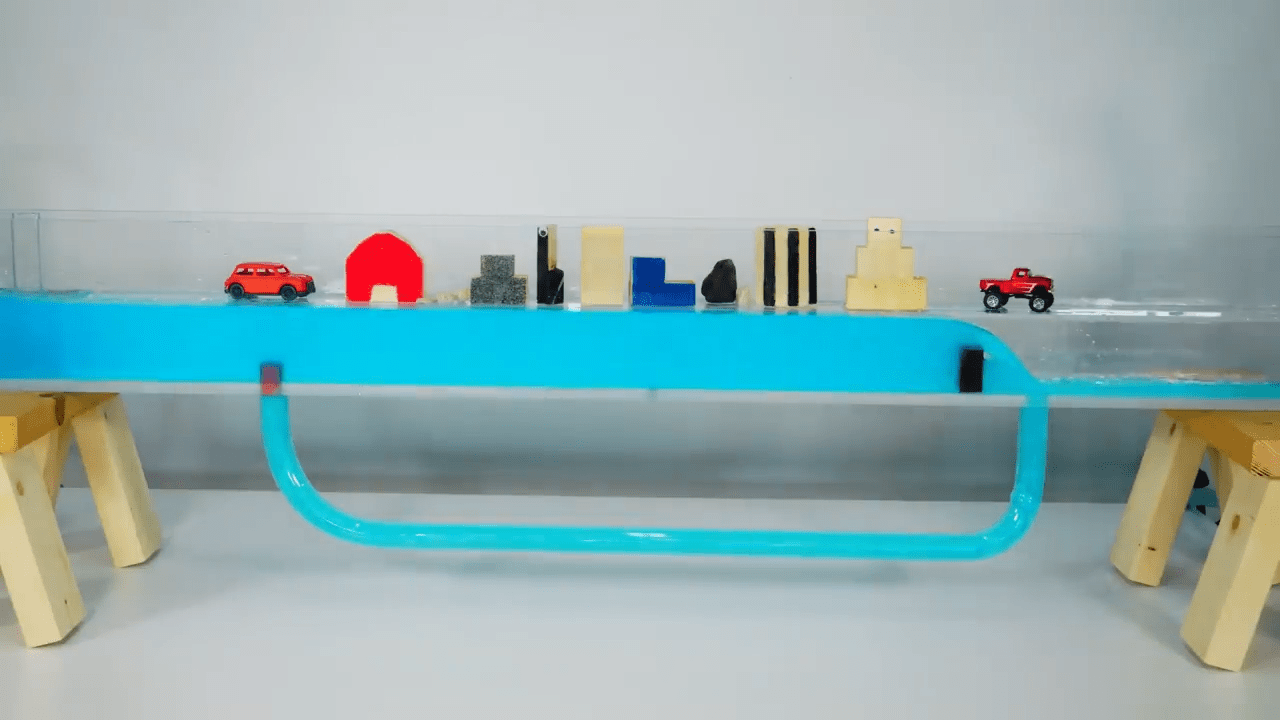
    Inspired by a simulation, Steve Mould asks a great question in this video: can water solve a maze? Yes — with some caveats. Steve makes two different maze patterns — a simple and a complex path — in two different sizes. With the small, simple-path version, the water immediately follows the correct path without taking any wrong turns. What keeps it on the right path seems to be a combination of air pressure and surface tension. In the dead-end passages, the air has nowhere to go in order to allow the water in. So the pressure of the trapped air and the narrowness of the passages (which allows surface tension to help hold the water in place) keeps the water out of the false paths.

    With the larger mazes, the water is able to take some false turns as it seeks the lowest possible path. But after awhile the incorrect region fills and the water takes the next lowest path available, which eventually leads it to the outlet.

    Toward the end of the video, Steve notes that the large mazes sometimes stop flowing, even though water is still in the reservoir. I’ll quibble slightly here with his explanation, though; I don’t think surface tension is playing as much of a role in this stoppage as friction. The water is basically being driven through a long, narrow pipe, which means quite a lot of friction between it and the walls. Just as you need a certain driving pressure to keep water in a pipe flowing, the maze needs a high enough driving pressure to keep the water going. The point at which drainage stops is the point where the upstream pressure (caused by the depth of the reservoir above the maze) is equal to the pressure lost due to friction in the pipe. All in all, it’s a very cool experiment and a video well-worth watching! (Video and image credit: S. Mould)

  • Runescapes

    Runescapes

    Drying fluids can leave behind all kinds of fascinating patterns, as we’ve seen before with whiskey, coffee, and even blood. Here researchers study patterns left behind by lipids, dyes, and other fluids. They place their mixture in a rotating flask kept in a warm bath. For a few hours, the fluids mix, chemically react, and evaporate. The complex interactions that take place in that time leave behind fascinating, rune-like patterns, seen here under a microscope. It’s a bit like looking at photos of Martian landscapes! (Image credit: M. Murali and L. Shen)

  • Featured Video Play Icon

    A Toad’s Sticky Saliva

    Frogs and toads shoot out their tongues to capture and envelop their prey in a fraction of a second. They owe their success in this area to two features: the squishiness of their tongues and the stickiness of their saliva. The super squishy toad tongue deforms to touch as much of the insect as possible. That shape-changing helps deliver the saliva, which is an impressively fast-acting, shear-thinning fluid. Under normal circumstances, the saliva is sticky and about as viscous as honey. But the shear from the tongue’s impact makes the saliva flow like water, spreading across the insect’s body. Then it morphs back into its viscous, sticky self, providing enough adhesive power that the insect can’t escape the toad pulling its tongue back in. (Video credit: Deep Look/KQED; research credit: A. Noel et al.)

  • Featured Video Play Icon

    Long-Lived Bubbles

    Without surfactants to stabilize them, bubbles don’t last long at room temperature. But adding a little heat changes the picture. When heated, the bubbles get stabilized by a thermal gradient that lifts fluid toward the bubble’s peak, where it cools and gathers. Eventually, the cold fluid grows heavy enough to sink down the side of the bubble (in either a constant stream or occasional drips); with warm fluid getting pulled up to replace it (via the Marangoni effect), the process repeats and the bubble lives on. (Video credit: S. Nath et al.; see also)

  • Swimming With Corkscrews

    Swimming With Corkscrews

    For many microswimmers, like bacteria or spermatozoa, swimming through common fluids is like moving through mud. Unless they can produce enough thrust to overcome a fluid’s yield-stress, they are effectively stuck in a solid. A recent study breaks down exactly what a microswimmer has to manage, assuming they use a helical, corkscrew-like tail for propulsion.

    The first barrier is creating enough force to be able to rotate in the fluid, but that alone is not enough to ensure forward motion. Once rotating, the swimmer’s thrust has to be large enough to deform the fluid around it. Without that, the swimmer is stuck. And, finally, once they’re moving, the swimmer’s tail pitch determines how fast they can move and whether the fluid’s characteristics slow it down.

    The researchers hope their work can shed light on propulsion for bacteria in the body, as well as larger creatures like burrowing earthworms and fruit-invading parasites. (Image credit: SwedishStockPhotos; research credit: F. Nazari et al.; via APS Physics)

  • Abel Prize Winner Luis Caffarelli

    Abel Prize Winner Luis Caffarelli

    Tomorrow mathematician Luis Caffarelli will receive the Abel Prize — one of the highest honors in mathematics — in part for his work in fluid dynamics. Caffarelli is one of the authors of a partial proof of regularity for the Navier-Stokes equations, the equations governing fluid motion. A full proof of regularity and smoothness — essentially showing that the equations never break down or blow up to infinity — is one of the open Millennium Problems. Caffarelli is the first mathematician born and educated in South America to receive the Abel Prize. Congratulations to Professor Caffarelli! (Image credit: N. Zunk/University of Texas at Austin; via Nature; submitted by Kam-Yung Soh)

  • “Fusion of Helios”

    “Fusion of Helios”

    Built from approximately 90,000 individual images, “Fusion of Helios” reveals the wisp-like corona of our Sun. Astrophotographers Andrew McCarthy and Jason Guenzel joined forces to combine eclipse images with data from NASA to build this fusion of art and science. Jets of plasma, known as spicules, dot the sun’s surface, and a towering tornado of plasma shoots off one side. For scale, that vortex stretches as far as 14 Earths stacked atop one another. (Image credit: A. McCarthy and J. Guenzel; via Colossal)

  • Oil-Covered Bubbles Popping

    Oil-Covered Bubbles Popping

    When bubbles burst, they release smaller droplets from the jet that rebounds upward. Depending on their size, these droplets can fall back down or get lofted upward on air currents that spread them far and wide. Thus, knowing what kind of bubbles produce small, fast droplets is important for understanding air pollution, climate, and even disease transmission.

    The jet from a bubble of clean water.
    The jet from a bubble of clean water is broad and slow, releasing fewer and larger drops.

    In a recent study, researchers compared droplets made by clean, water-only bubbles, and the ones generated from water bubbles with a thin layer of oil coating them. The clean bubbles created jets that were broad and relatively slow moving; this motion produced a few large drops that quickly fell back down.

    The jet from an oil-covered bubble.
    The jet from an oil-covered bubble is skinny and fast-moving. It produces many small droplets.

    In contrast, the oil-slicked bubbles made a narrow, fast-moving jet that broke into many small droplets. These droplets could stay aloft for longer periods, indicating that contaminated water can produce more aerosols than clean. (Image credit: top – J. Graj, bursting – Z. Yang et al.; research credit: Z. Yang et al.; submitted by Jie F.)

  • Featured Video Play Icon

    Acoustic Cameras

    Acoustic cameras use arrays of microphones to isolate where sounds are coming from. As Steve Mould shows in this video, they have some incredibly cool properties. They can show engineers which part of a device is producing particular sound frequencies, which is handy, for example, when trying to quiet a vacuum cleaner or learn which wheels on a train need maintenance. They can also show how sound moves around a room; near the end of the video, you can see the echo from a clap flashing around a room. Check out the full video for more! (Video credit: S. Mould)