Some 4,100 light years away in the Sagittarius constellation, a stellar nursery births new stars. Known as Messier 8, or the Lagoon Nebula, this region is one of the most visible nebulas from Earth. It is filled with turbulent gases and dark strands of dust. Near the centerline of the image is the bright, hourglass shape of the NGC 6530 star cluster. Its intense ultraviolet light ionizes surrounding gases, creating the distinctive red glow surrounding the nebula. (Image credit: J. Drudis and C. Sasse; via APOD)
Tag: fluid dynamics

Leidenfrost Collapse
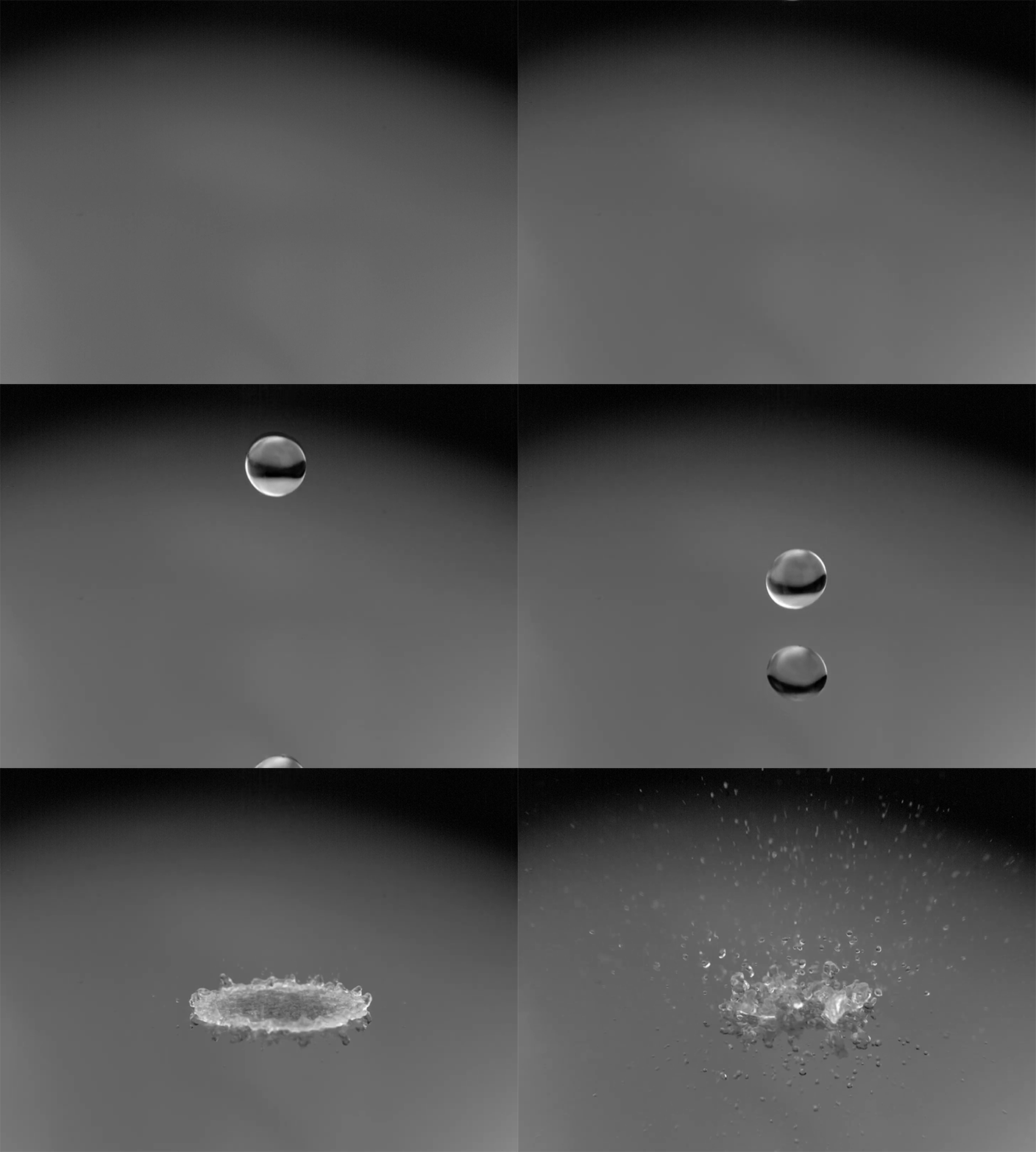
When a droplet encounters a surface much hotter than its boiling point, it forms a thin layer of vapor that insulates the liquid from the surface. But this Leidenfrost effect can’t last forever. Eventually, the vapor layer destabilizes and the drop touches the surface, causing explosive boiling that destroys the drop.
To determine how the layer destabilizes, researchers simulated the breakdown. To their surprise, they found that inertial forces in the micron-thin vapor layer were critical for destabilization. The gas inertia caused reductions in pressure that pulled the liquid toward the surface. Usually at these small scales, we’d ignore inertial effects and focus instead on viscosity, but, for Leidenfrost drops, that simplification doesn’t work. (Image credit: L. Gledhill; research credit: D. Harvey and J. Burton)

“Animaris Rex”


Eighteen meters long and powered only by the wind, artist Theo Jansen’s latest Strandbeest strolls the sand in this short video. Its complex movements — a swinging gait in some places and a caterpillar-like wave in others — are mesmerizing and life-like enough to almost make you wonder if the contraption truly is alive. See some of Jansen’s previous creations here. (Video and image credit: T. Jansen et al.; via Colossal)
Blood Flow in a Fin
This award-winning video shows blood flowing through the tail fin of a small fish. Cells flow outward in a central vessel, then split to either side for the return journey. In this microscopic video, the speed of individual cells seems quite fast, even though the vessels themselves are only wide enough for the blood cells to move in single file. Flow at the microscale can be counterintuitive like that. (Video and image credit: F. Weston for the 2023 Nikon Small World in Motion Competition; via Colossal)


Food-Based Fluid Dynamics


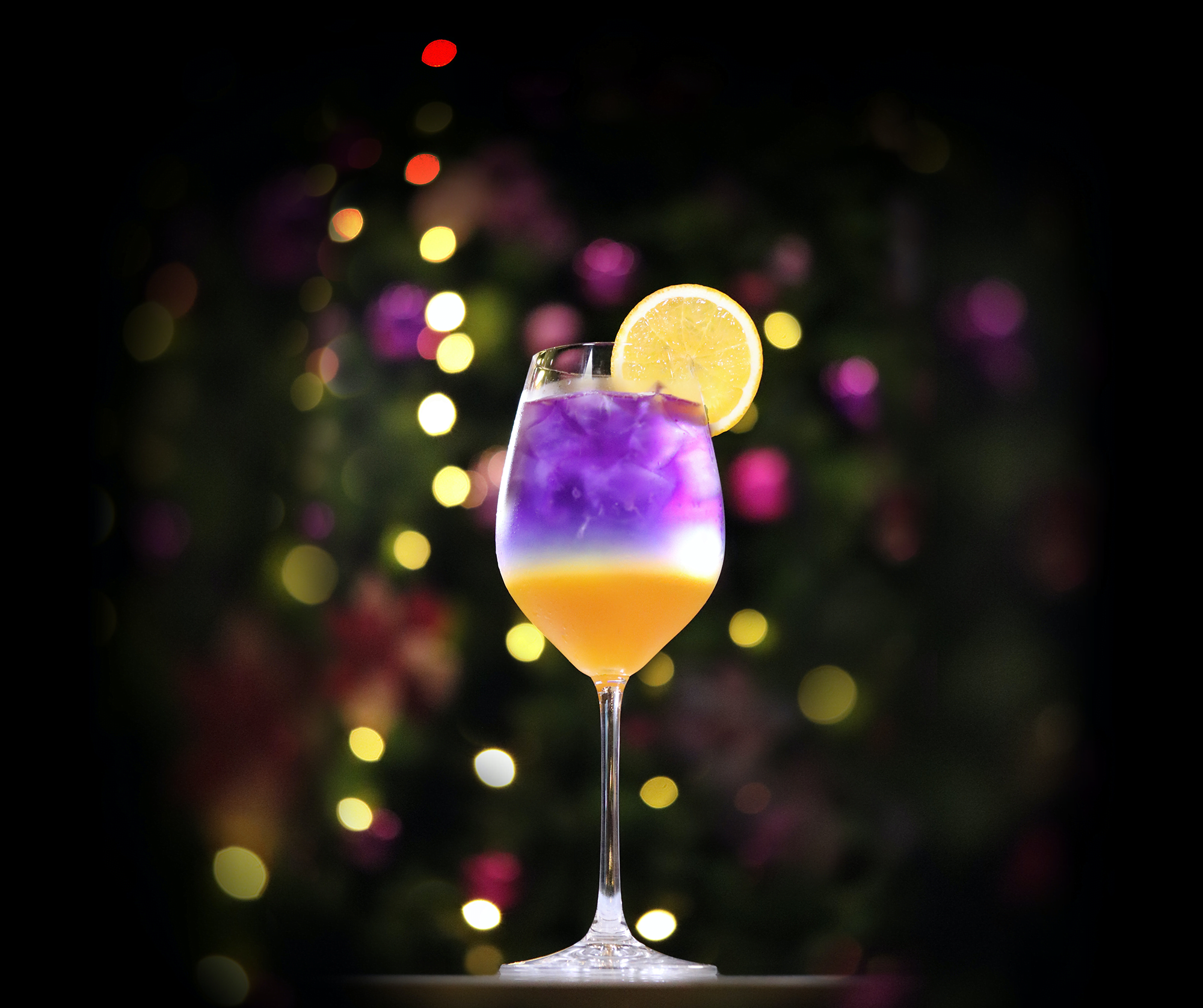
The kitchen is a rich source of fluid physics. From cocktails to coffee, from crepes to tempura, food is full of physics. In fact, it’s not hard to relate almost any fluid phenomenon you can imagine to something that goes on in the kitchen. That’s why scientists managed to write a 77-page review article of culinary fluid dynamics. It’s even structured after a menu, carrying readers from the kitchen sink and cocktails all the way through a meal and the process of washing up afterward! (Image credit: top – S. Hsu, others – A. Mathijssen et al.; research credit: A. Mathijssen et al.; via APS Physics)

“Shaken, Not Stirred”


James Bond notoriously orders his martinis “shaken, not stirred,” a request bartenders fulfill by shaking the cocktail over ice in a separate shaker. But what if you shake the martini glass itself? That’s the question that inspired this lovely mixology.
By shaking the martini glass gently back and forth (along the directions shown by the arrows in each image), the team created different mixing patterns within the glass. With a little food dye and pearl dust, they visualized the flows they found. By changing the viscosity of the cocktail and the speed of the swish, they made everything from a four-leaf clover to a cadre of ghosts. It seems that martini glasses hold a flow for every occasion! (Image and research credit: X. Song et al.; submitted by Zhao P.)

GFM poster, describing the experiments used to create these picturesque martinis. 
Eroding the Sphinx
One theory suggests that the Great Sphinx of Giza formed — in part — naturally as a result of erosion, and ancient Egyptians added features to the bedrock formation. To test the plausibility of the theory, researchers made a miniature sphinx, consisting of a clay mound with a single, harder inclusion to represent the Sphinx’s head, and placed their construction in a water tunnel. As the water eroded away the clay, the head appeared, and flow around this harder-to-erode region formed some of the body and paws of the reclining Sphinx.
The experiment suggests that it is plausible for part of the Sphinx to have formed naturally, as a result of erosion. But plausibility is not proof, and given the lack of a contemporary inscription explaining the statue’s origin, the goals and methods of the people who built it around 2500 B.C.E. will remain a matter of archaeological debate. (Image credit: S. Boury et al.)

“Chaosmosis”


After many years of featuring work from the Gallery of Fluid Motion, I’m excited to announce a new public exhibition of art drawn from the competition: “Chaosmosis: Assigning Rhythm to the Turbulent.” Works in the exhibit come from both scientists and artists; each piece makes visible the fluid motions that surround us.
The exhibit is located at the National Academy of Sciences in Washington, DC through February 23, 2024. Entry is free, but only available between 9 a.m. and 5 p.m. on weekdays. For more, check out the exhibit’s webpage and press release (pdf) and the Instagram accounts for CPNAS and the exhibit.
I’m looking forward to seeing the exhibit when I’m at the APS DFD meeting next month, but if you can’t make it to DC before the exhibit ends, don’t worry! This is just the first stop for the new traveling GFM exhibit. (Image credits: various, see individual images’ titles)

Viscoelasticity and Bubbles
Bursting bubbles enhance our drinks, seed our clouds, and affect our health. Because these bubbles are so small, they’re easily affected by changes at the interface, like surfactants, Marangoni effects, or, as a recent study shows, viscoelasticity.

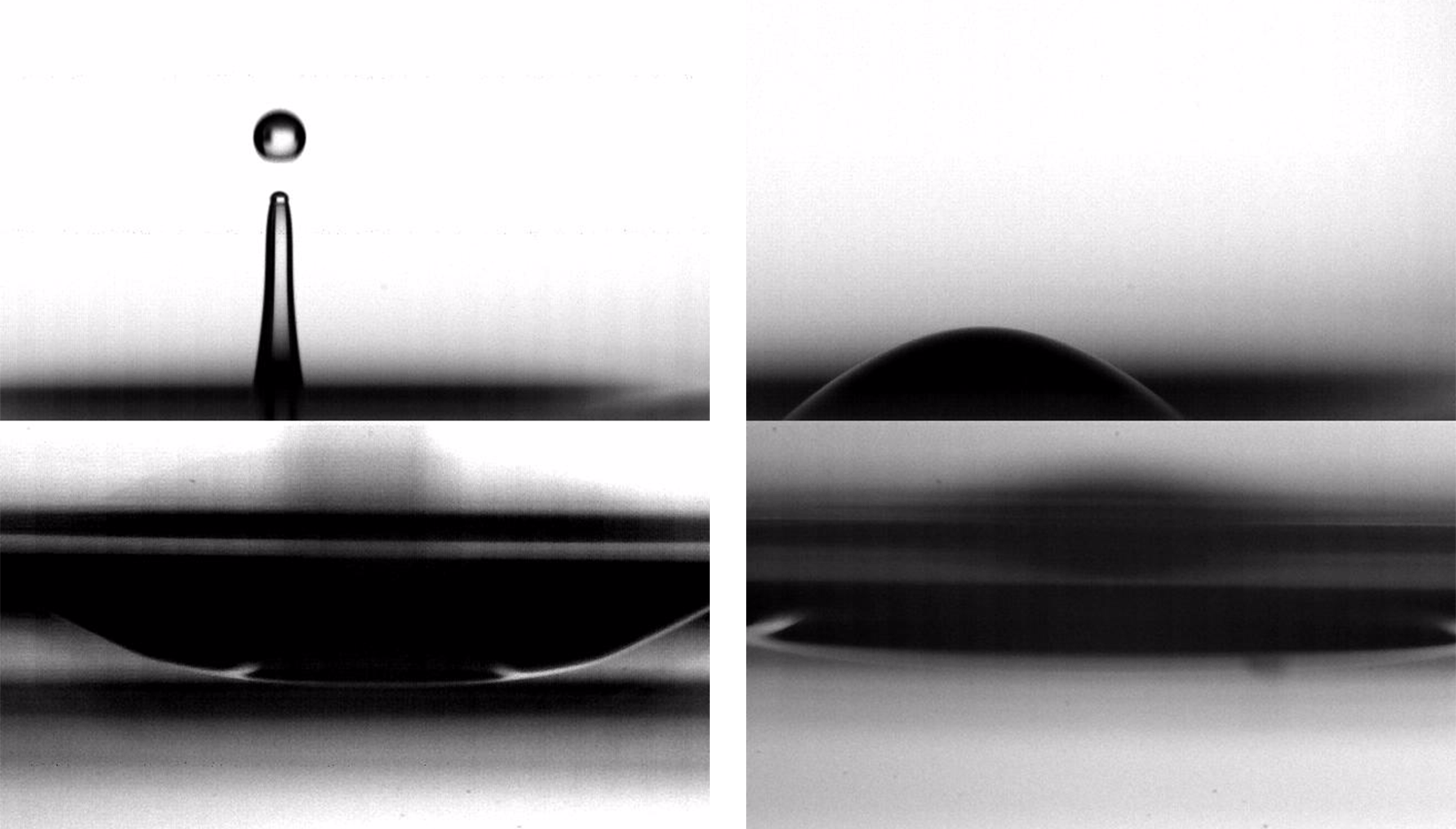
A bubble released in pure water pops at the surface, creating a rebounding jet and a daughter droplet. In clean water, a bubble’s burst generates a rebounding jet that shoots off one or more daughter droplets, as seen in the animation above. But when researchers added proteins that modify only the water’s surface, they found something very different. As seen below, the bursting bubble no longer generated a jet, and, instead of forming droplets, it made a single, tiny daughter bubble. The difference, they found, comes from the added viscoelasticity of the surface. The long protein molecules resist getting stretched, which damps out the tiny waves that surface tension usually produces on the collapsing bubble cavity. (Image and research credit: B. Ji et al.; submission by Jie F.)
When the surface of water is viscoelastic, a bursting bubble creates no jet and a daughter bubble instead of a drop. 
Red Sprites
Sprites, or red sprites, are high-altitude electrical discharges in the atmosphere. Although sometimes called upper-atmospheric lightning, sprites are a cold plasma phenomenon. They often occur in clusters, as in this photo by Angel An, which won in the Skyscapes category of the 2023 Astronomy Photographer of the Year competition. Sprites, which last only a millisecond or so, take place during intense thunderstorms, but, unlike our more familiar lightning, sprites move upward from the storm toward the ionosphere. They can occur on Venus, Saturn, and Jupiter as well, although sprites have only been observed directly on Earth and Jupiter. (Image credit: A. An; via Colossal)