Tag: disease transmission

  • Simulating a Sneeze

    Simulating a Sneeze

    Sneezing and coughing can spread pathogens both through large droplets and through tiny, airborne aerosols. Understanding how the nasal cavity shapes the aerosol cloud a sneeze produces is critical to understanding and predicting how viruses could spread. Toward that end, researchers built a “sneeze simulator” based on the upper respiratory system’s geometry. With their simulator, the team mimicked violent exhalations both with the nostrils open and closed — to see how that changed the shape of the aerosol cloud produced.

    The researchers found that closed nostrils produced a cloud that moved away along a 18 degree downward tilt, whereas an open-nostril cloud followed a 30-degree downward slope. That means having the nostrils open reduces the horizontal spread of a cloud while increasing its vertical spread. Depending on the background flow that will affect which parts of a cloud get spread to people nearby. (Image and research credit: N. Catalán et al.; via Physics World)

    Fediverse Reactions
  • Drying Unaffected by Humidity

    Drying Unaffected by Humidity

    Water evaporates faster in dry conditions than in humid ones, but the same isn’t true of paint. Instead, paint’s drying time is largely independent of the day’s humidity. That’s because of paint’s long chains of polymers. As water in the paint evaporates, these polymers are drawn to the surface, forming a viscoelastic layer that hinders evaporation and keeps the drying rate independent up to about 80 percent humidity.

    Illustration depicting evaporation of water (left) and evaporation of a polymer solution (right). As water evaporates from the polymer solution, it draws polymers to the surface, where they form a layer that hinders evaporation and makes its rate independent of humidity.
    Illustration depicting evaporation of water (left) and evaporation of a polymer solution (right). As water evaporates from the polymer solution, it draws polymers to the surface, where they form a layer that hinders evaporation and makes its rate independent of humidity.

    The polymer layer explains why evaporation isn’t affected by humidity at longer times, but researchers also saw humidity-independent evaporation early in their experiments. Under a microscope, they discovered a thin gel layer (top image) covering the air-polymer interface. They propose that this fast-forming layer further hinders evaporation. Their findings may be significant for virus-laden respiratory droplets, which also contain polymers. (Image and research credit: M. Huisman et al.; see also J. Salmon et al.; via APS Physics)

  • Linking Size and Origin in Droplets

    Linking Size and Origin in Droplets

    Respiratory diseases like measles, flu, tuberculosis, and COVID-19 are all transmitted by droplets. Some are tiny and airborne, capable of traveling long distances. Other drops are larger and only capable of traveling short distances. A new review paper consolidates what we know about these droplets and categorizes them by size and origin.

    It turns out that a droplet’s size can tell us where it originated in the body. The largest type of droplets come from our mouths, lips, and tongues. Some form from filaments of saliva that stretch across our mouths and burst during exhalation. Others originate in our nasal passages where a sneeze can destabilize the mucus film there. These types of droplets are best suited to transmitting diseases that reside in the upper respiratory tract. Coughing, sneezing, singing, and speaking all produce these droplets, but breathing does not.

    In contrast, the smallest classes of droplets come from the bronchial passages of the lungs, where films form after exhalation closes a passage. When we inhale again, the passage reopens, the film breaks up, and tiny droplets flow further into the lungs before getting exhaled. Breathing alone is enough to create and spread these tiny droplets, which are well-suited to spreading diseases that reside deep in the lungs, like tuberculosis.

    In between these extremes are medium-sized droplets created from movement around our vocal cords. The formation mechanism for these droplets is least understood, but they are connected to breathing, coughing, speaking, singing, and so on.

    Ultimately, understanding the mechanics of disease transmission is about knowing how to best prevent transmission. Knowing the size of droplets responsible for transmission lets us prioritize responses that work. For example, if large droplets are the primary transmission mechanism, loose-fitting masks and face masks will stop the spread. But for smaller droplets, ventilation measures and well-fitted N-95 respirators are the better choice. (Image credit: Anton; research credit: M. Pöhlker et al.; via APS Physics)

  • Imitating a Cough

    Imitating a Cough

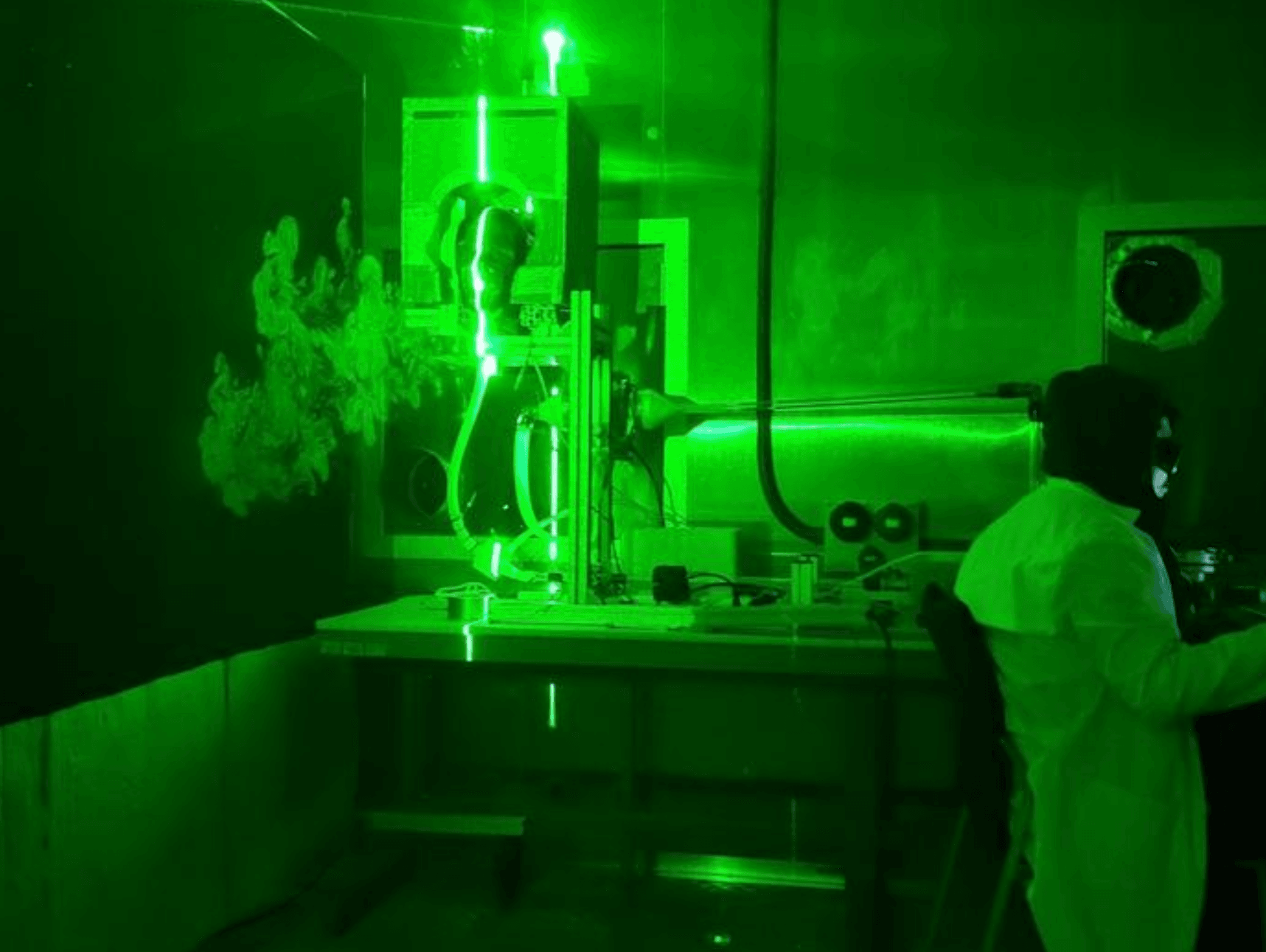
    Coughing and sneezing create violent air flows in and around our bodies. As that fast air rushes over mucus layers in our lungs, throat, and sinuses, the resulting flow breaks up the mucus into droplets. To explore the details of that process, researchers built a “cough machine” that sends a rush of air over a thin film of water mixed with glycerol. The setup allows them to observe the physics in a way that’s nearly impossible in a human cough or sneeze.

    Imitating a cough: high-speed video shows how a thin film made of water and glycerol breaks down in a strong airflow. Parts of the film inflate into hollow bags that form thinner weak spots. When the film breaks in those places, it forms rims and ligaments that break up into droplets.
    Imitating a cough: high-speed video shows how a thin film made of water and glycerol breaks down in a strong airflow. Parts of the film inflate into hollow bags that form thinner weak spots. When the film breaks in those places, it forms rims and ligaments that create a spray of droplets.

    As seen above, air flowing past shears the viscous fluid, stretching it out. The leading edge of the film destabilizes and breaks into large drops, but it’s what comes next that really gets things going. Areas of the film inflate to form hollow bags. When sections of the bag thin to about 1 micron, the film ruptures and the bags burst. This triggers a cascade of instabilities in the film’s rim that ultimately rip the film into a spray of tiny aerosol droplets. The researchers found that, despite their tiny size, these droplets collectively carry a large volume of liquid, making them all the more important for understanding transmission of respiratory illnesses. (Image credit: top – A. Piacquadio, experiment – P. Kant et al.; research credit: P. Kant et al.)

  • Gathering Safely

    Gathering Safely

    One effect of the COVID-19 pandemic is a renewed interest in the physics of disease transmission and what measures can protect us from airborne respiratory illnesses. This recent study looks at how meetings — whether in classrooms, conferences, or care facilities — can transmit infections. Their mathematical model is able to handle many variables — room size, number of people, length of meeting, breaks between sessions, masking, ventilation, and so on. Without prescribing any one policy, the authors aim to inform decision makers so that they can choose what methods (testing, masking, ventilation, etc.) work best for their event.

    That said, they find that ventilation and periodic breaks between meetings are highly effective in reducing a room’s viral load. Leaving enough time between sessions for ventilation to clear the room was as effective (or more effective) than masking and moderate isolation of those infected. Tools like these are vital in enabling gatherings that keep participants safe. (Image credit: Product School; research credit: A. Dixit et al.; submitted by Kam-Yung Soh)

  • Airflow in the Opera

    Airflow in the Opera

    Like so many other performers, the singers and musicians of New York’s Metropolitan Opera House were left without a way to safely perform when the SARS-CoV-2 pandemic began in early 2020. In search of safe ways to perform and rehearse, the Met turned to researchers at nearby Princeton University, who worked directly with the performers to explore aerosol production and airflow in the context of professional opera.

    Through visualization and other experiments, the team found that the highly-controlled breathing of opera singers actually posed a lower risk for spreading pathogens than typical speaking and breathing. Most of a singer’s voiced sounds are sustained vowels, which produce a slow, buoyant jet that remains close to a singer. The exception are consonants, which created rapid, forward-projected jets.

    In the orchestra, the researchers found that placing a mask over the bell of wind instruments like the trombone reduced the speed and spread of air. One of the highest risk instruments they found was the oboe. Playing the oboe requires a long, slow release of air, but between musical phrases, oboists rapidly exhale any remaining air from their lungs and take a fresh breath. That rapid exhale creates a fast, forceful jet of air that necessitates placing the oboist further from others. (Image credit: top – P. Chiabrando, others – P. Bourrianne et al.; research credit: P. Bourrianne et al.; via APS Physics; submitted by Kam-Yung Soh)

  • Turbulent Puffs

    Turbulent Puffs

    When a burst of air gets expelled into still surroundings — like when a person coughs — it forms a turbulent puff like the one seen here. Puffs can be surprisingly long-lasting, though these miniature clouds slow down and expand over time. How they behave is critical to understanding the spread of pollution as well as how respiratory illnesses like COVID-19 travel. In this study, researchers found that buoyancy is also a critical factor. When the puff is warmer than its surroundings, it rises higher, lasts longer, and travels further. That might help explain why respiratory illnesses like the flu spread more readily in the winter than in warmer months. (Image and research credit: A. Mazzino and M. Rosti; via Physics World; submitted by Kam-Yung Soh)

  • Controlling Aerosols Onstage

    Controlling Aerosols Onstage

    Few industries saw more disruption from the pandemic than the performing arts. To help orchestras return to the concert hall in a way that keeps performers and audience members safe, researchers have simulated air flow and aerosols around musicians onstage. Some instruments — like the trumpet — are super-spreaders when it comes to aerosol production, and, in the conventional organization of orchestras, those aerosols have to travel through other sections of the orchestra before reaching air vents, putting more musicians at risk.

    (Upper left) Aerosol concentration for an orchestra performing in their original arrangement, with doors to the hall closed; (Upper right) Aerosol concentration in the modified musician arrangement, with doors open; (Bottom row) Time-averaged aerosol concentration in the breathing zone of performers for (left) the original arrangement and (right) with modified seating.
    (Upper row) Aerosol concentration for the orchestra’s original seating arrangement (left) and in the modified arrangement (right). (Bottom row) Time-averaged concentration of aerosol particles in the breathing zone of each musician in the original (left) and modified arrangements (right).

    Using Large Eddy Simulation, researchers looked at alternate seating arrangements for the Utah Symphony that could mitigate these risks. By rearranging the musicians so that instruments that produce lots of aerosols are closer to the air vents and open doors, the team reduced the average concentration of aerosols around musicians by a factor of 100, giving the performers a chance to return to the stage far more safely. (Image credit: top – M. Nägeli, simulation – H. Hedworth et al.; research credit: H. Hedworth et al.; via NYTimes; submitted by Kam-Yung Soh)

  • Airborne Aerosol Transmission of COVID-19

    Airborne Aerosol Transmission of COVID-19

    Early in the COVID-19 pandemic health officials resisted the idea that the novel coronavirus was transmissible through tiny aerosol droplets rather than larger, non-buoyant droplets. One case that made headlines and helped shift opinion was that of an outbreak among patrons of a Guangzhou restaurant traced to a single, pre-symptomatic patient zero. The pattern of who became sick at the carrier’s table and those nearby made little sense unless the restaurant’s air flow played a role in spreading the virus.

    https://www.youtube.com/watch?v=WaZiCqQmO4g

    This paper studies the incident in detail, using an in-house computational fluid dynamics (CFD) code to simulate both airflow in the restaurant and the paths aerosol droplets would follow in that environment. It takes into account flow from the air conditioner and the warm air rising from customers. The study’s predictions of which areas would have the highest concentrations of virus-laden aerosols matches well with the actual pattern of the outbreak. The authors hope that tools like theirs can help prevent future outbreaks by indicating the most dangerous paths for transmission and measures that can block those. (Image credit: Center for Disease Control; video, research, and submission credit: H. Liu et al.)

  • Cutting Coronavirus Risk in Cars

    Cutting Coronavirus Risk in Cars

    Even in a pandemic, it’s sometimes necessary to share a car with someone outside one’s bubble. When that’s the case, it’s important to know how to limit risks of coronavirus exposure. For this study, researchers used computational fluid dynamics to simulate flow around and inside a Prius-like four-door sedan with a driver and a single passenger located in the rear passenger-side seat. Assuming the air conditioner was on and the car was moving at 50 miles per hour, the researchers found that the baseline flow of air inside the car moves from the back of the cabin toward the front. With the windows closed, the simulation suggested that 8-10% of the aerosol particles exhaled by one passenger could reach the other.

    Opening the car’s windows increases the ventilation and reduces exposure risk. The best configuration the researchers found opened two windows: the front passenger-side window and the rear driver-side window. By opening the window opposite each person, the airflow in the car creates a sort of curtain between the two that reduces aerosol exposure to only 0.2-2% of what’s exhaled by the other occupant. (Image credit: rideshare – V. Xok, CFD – V. Mathai et al.; research credit: V. Mathai et al.; via NYTimes; submitted by Kam-Yung Soh)

    Computed streamlines for flow through a sedan with a driver and one rear passenger, with each opposite window opened.