Working with living creatures can’t always reveal their mechanics. That’s one reason engineers like building biorobots. Here, researchers built 1-guilla, an eel-like swimmer, and studied how its body motions affected its swimming. Eels are anguilliform swimmers that use a traveling wave moving along their body from head to tail for propulsion. In the video (and paper), they break down the robot’s motion step by step — looking at amplitude, wavelength, and tail angle — to find the optimal values for maximizing speed and, separately, efficiency in swimming. (Video and image credit: A. Anastasiadis et al.; research credit: A. Anastasiadis et al.)
While vacuums can do pretty wild things to liquids, the title of this Slow Mo Guys video is a bit misleading. They’re not so much exploding gold in a vacuum as they are shredding it during repressurization. Regardless, the visuals are pretty awesome. They place thin foils in a vacuum chamber, pump it down, and then film what happens when they reopen the valve and pressurize the chamber. Flow-wise, that introduces a strong air jet that flows downward in the center of the chamber and causes a recirculating flow up the sides. For the foils, this sudden flow is devastating, shredding the material so thoroughly that it looks like a splash. (Video and image credit: The Slow Mo Guys)
Yellowstone National Park is always fascinating and surreal, but especially so in winter when volcanically-heated geysers and springs meet frigid, snowy weather. This short film from Drew Simms shows the park and its wildlife in the depths of winter. The bison rely on thick, shaggy fur coats to trap heat and keep dry. Steam and mist mingle around springs and giant plumes rise from geysers. What a strange and beautiful landscape! (Video and image credit: D. Simms)
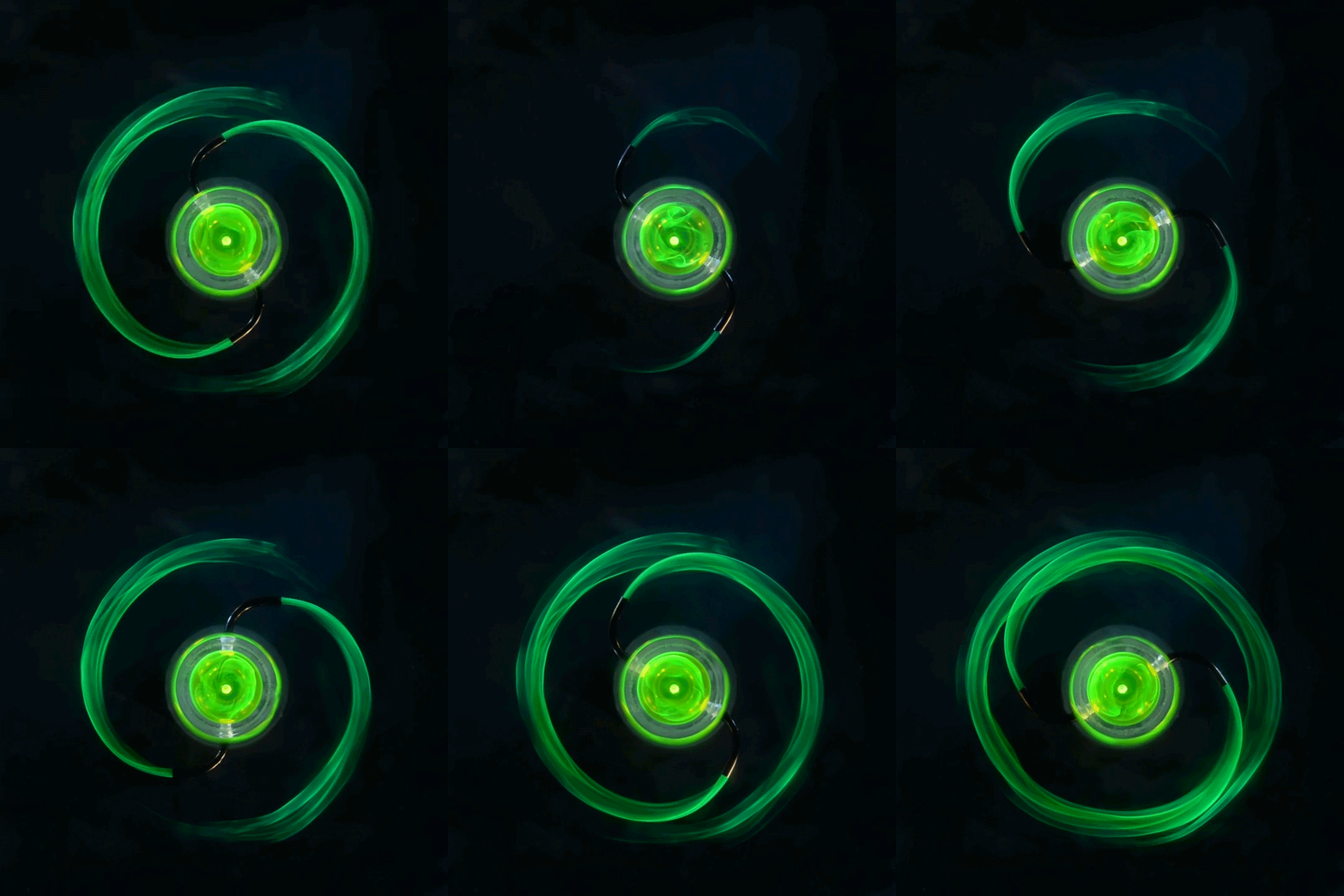
In graduate school, my advisor introduced us to a particularly vexing fluid dynamical thought experiment known as the Feynman sprinkler. After observing an S-shaped sprinkler that rotated when water shot out its arms, physicist Richard Feynman wondered what would happen if the device were placed in a tank of water with the flow reversed. If the sprinkler was sucking in water, would it rotate and, if so, in what direction?
This seemingly simple question has confounded physicists ever since, in part because you can make believable arguments for multiple different results. Attempts to build the apparatus experimentally produced differing results, too — often due to variables that don’t appear in the thought experiment, like friction in the sprinkler’s bearing. But, at long last, a group posits they have the final answer to the problem.
They cleverly built their sprinkler so that it floats in its tank, with the addition or removal of water from the sprinkler controlled by a second siphon-connected tank. With no solid-solid contacts, the sprinkler can rotate with very little friction.
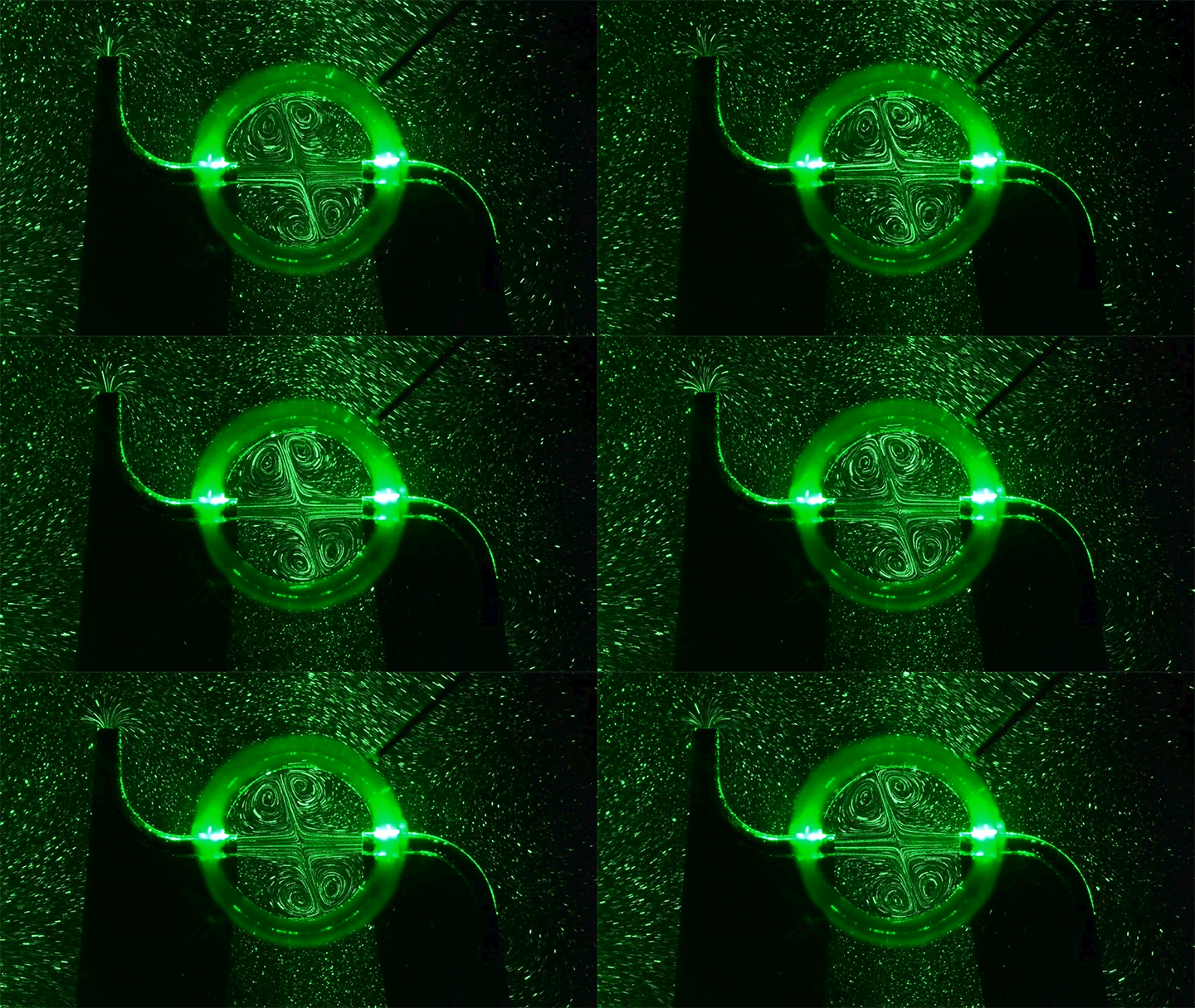
Flow visualization of the sprinkler in reverse (suction) mode. For image clarity, the device is held in place to prevent spinning. Notice how the jets coming into the hub glance off one another and form counter-rotating vortex pairs at an angle. This asymmetry is the source of the sprinkler’s rotation when allowed to move.
The team found that sucking water into the sprinkler does, indeed, reverse the sprinkler’s rotation, but it’s not a simple reversal of the forward sprinkler’s flow. To see why, check out the video above, which visualizes flow inside the sprinkler during suction. For clarity, the device is held fixed in place during flow visualization. Notice that the two arms of the sprinkler sit directly opposite one another in the hub. Thus, you’d expect their two jets to collide and form counter-rotating vortices along a vertical axis. But the vortex pairs are offset from the centerline.
This asymmetry takes place because the velocity profiles of flow across the hub inlets are skewed. Instead of the largest velocity occurring on the centerline of the inlet, each occurs slightly to one side. So when the jets collide, they do so off-center and impart a torque to the sprinkler. The reason for the skewed profiles at the inlets lies further upstream in the curved arms of the sprinkler. Centrifugal force from turning the corner leaves a mark on the flow, leading, ultimately, to the skewed velocity profiles, offset jets, and spinning sprinkler. (Image and research credit: K. Wang et al.; via APS Physics)
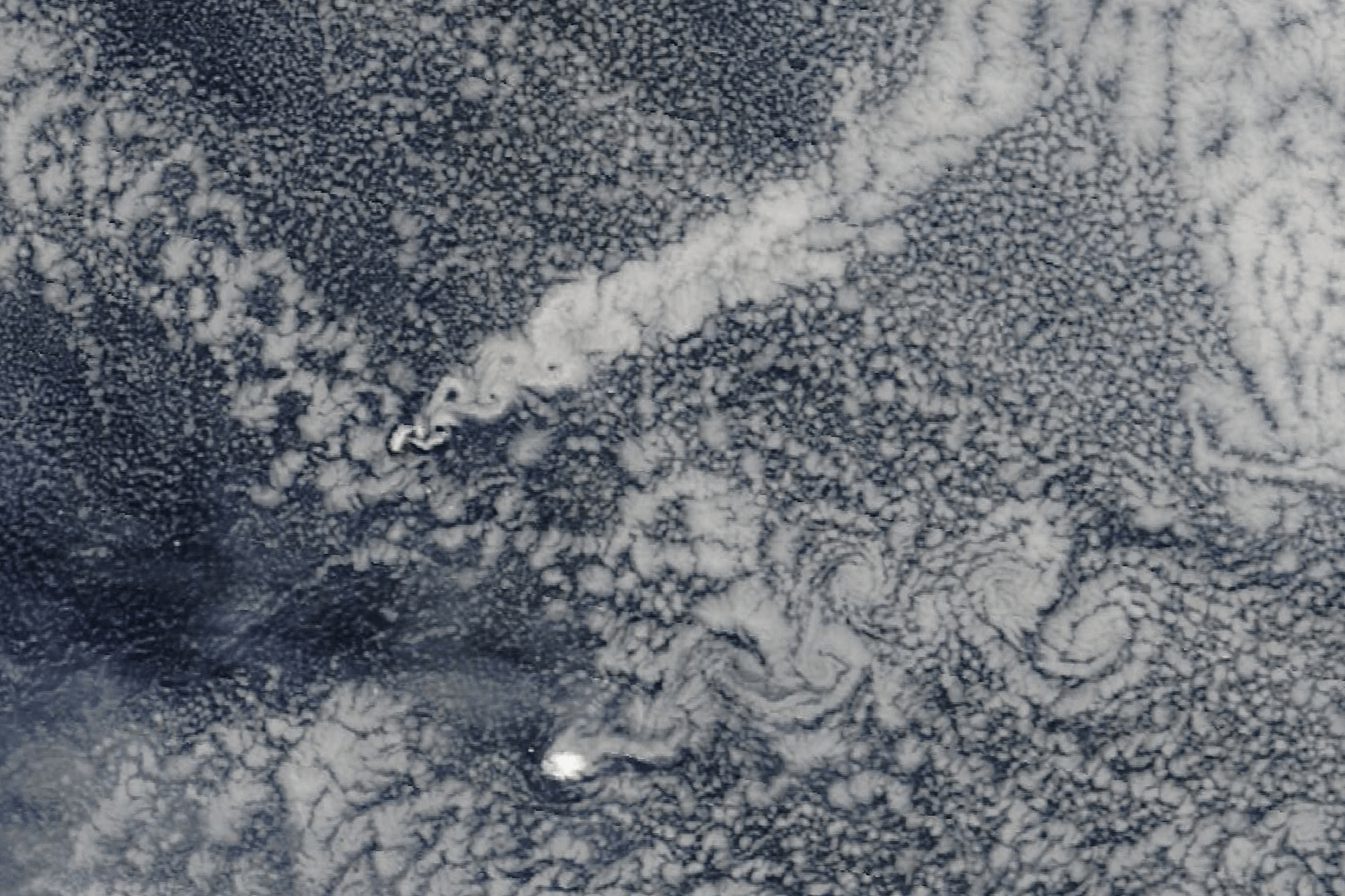
In the remote South Atlantic, north of the Antarctic Circle, sit the volcanic Zavodovski and Visokoi islands. Though only roughly 500 and 1000 meters tall, respectively, each island disrupts the atmosphere nearby, often generating cloudy wakes. In today’s pair of images, the northerly Zavodovski has a particularly bright cloud wake, thanks to sulfate aerosols degassing from its volcano, Mount Curry. Though it’s hard to pick out the effect in the natural-color image above, the false-color version below shows the bright wake clearly. The filtering on this image turns snow and ice — like that on Visokoi’s peak — red and makes the water vapor of clouds white. The sulfates from Mount Curry act as nucleii for water droplets, forming many small, reflective drops that stand out against the rest of the sky. (Image credit: W. Liang; via NASA Earth Observatory)
This false-color satellite image highlights the volcanic seeding by filtering snow and ice as red and water vapor in clouds as white.
In their natural habitat, fire ants experience frequent floods and so developed the ability to form rafts. Entire colonies will float out a flood in a two-ant-thick raft anchored to whatever vegetation they can find. Because ants in the upper layer of the raft are constantly milling about, the rafts have some ability to “self-heal” as they’re stretched.
Pulling slowly gives the ants time to “heal” their stretching raft.
In these experiments, researchers slowly (above) and quickly (below) stretched ant rafts to see how they responded. Given a slow enough stretch, the ants were able to adjust and keep the raft together until it doubled in length. In contrast, a faster stretching rate overwhelmed the raft by the time it was 30% longer. (Image credit: top – Wikimedia Commons, others – C. Chen et al.; research credit: C. Chen et al.; via APS Physics)
Pulling quickly breaks an ant raft because the ants cannot react fast enough to heal the raft.
Condensation forms beads of water on a surface. When suddenly cooled, those drops begin to freeze into frost. This video looks at the process in optical and in infrared, revealing the patterns of spreading frost and the tiny ice bridges that link one freezing drop to the next. (Video and image credit: D. Paulovics et al.)
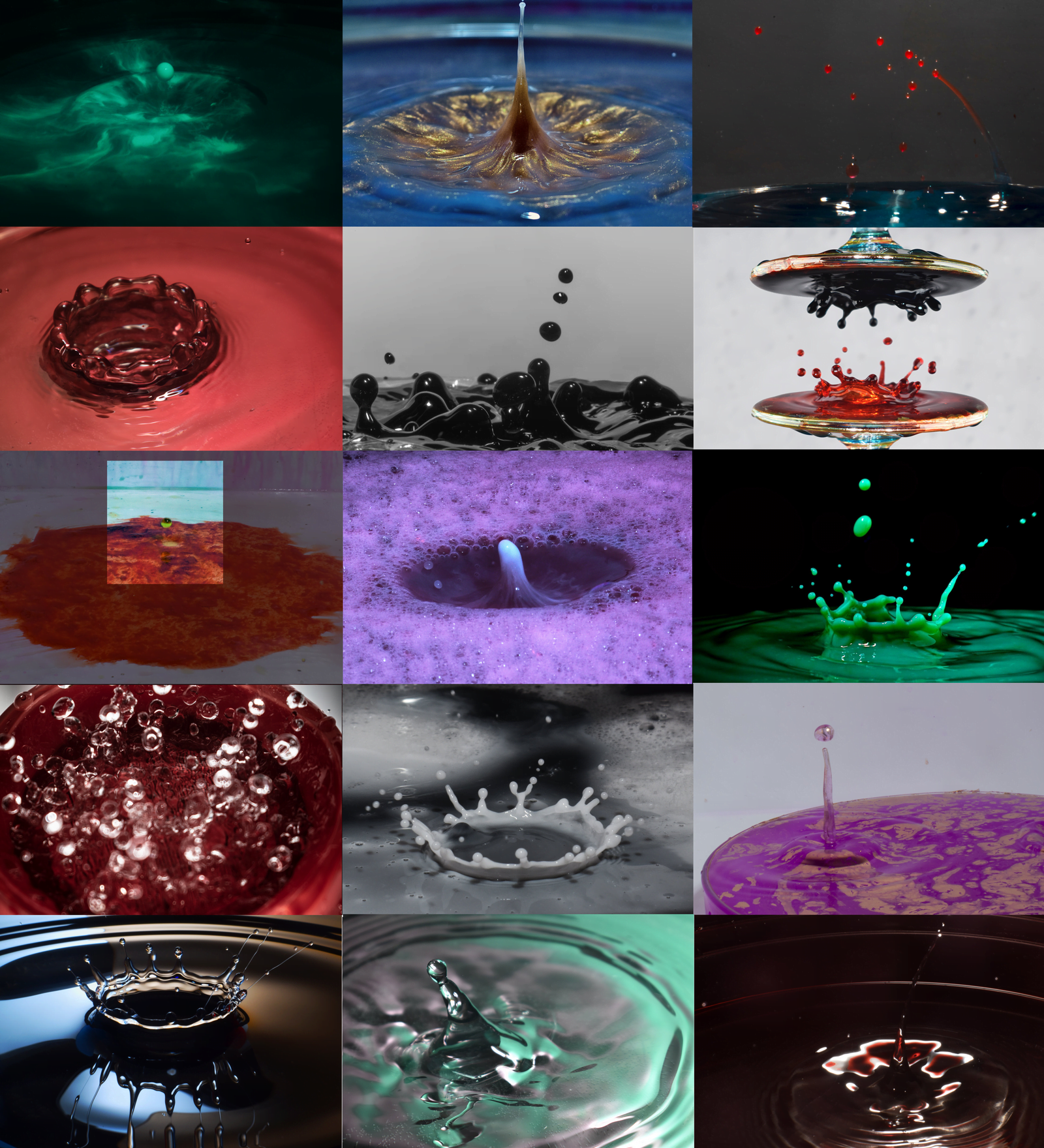
In the 1930s, Harold Edgerton used strobed lighting to capture moments too fast for the human eye, including his famous “Milk-Drop Coronet”. Recreating his set-up is far easier today, thanks to technologies like Arduino boards that make timing the drop-strobe-camera sequence simple. This poster is a collage of Edgerton-like images captured by students at Brown University. Even nearly a century after Edgerton, there are countless variations on this beautiful slice of physics: all from the splash of a simple drop striking a pool. (Image credit: R. Zenit et al.)
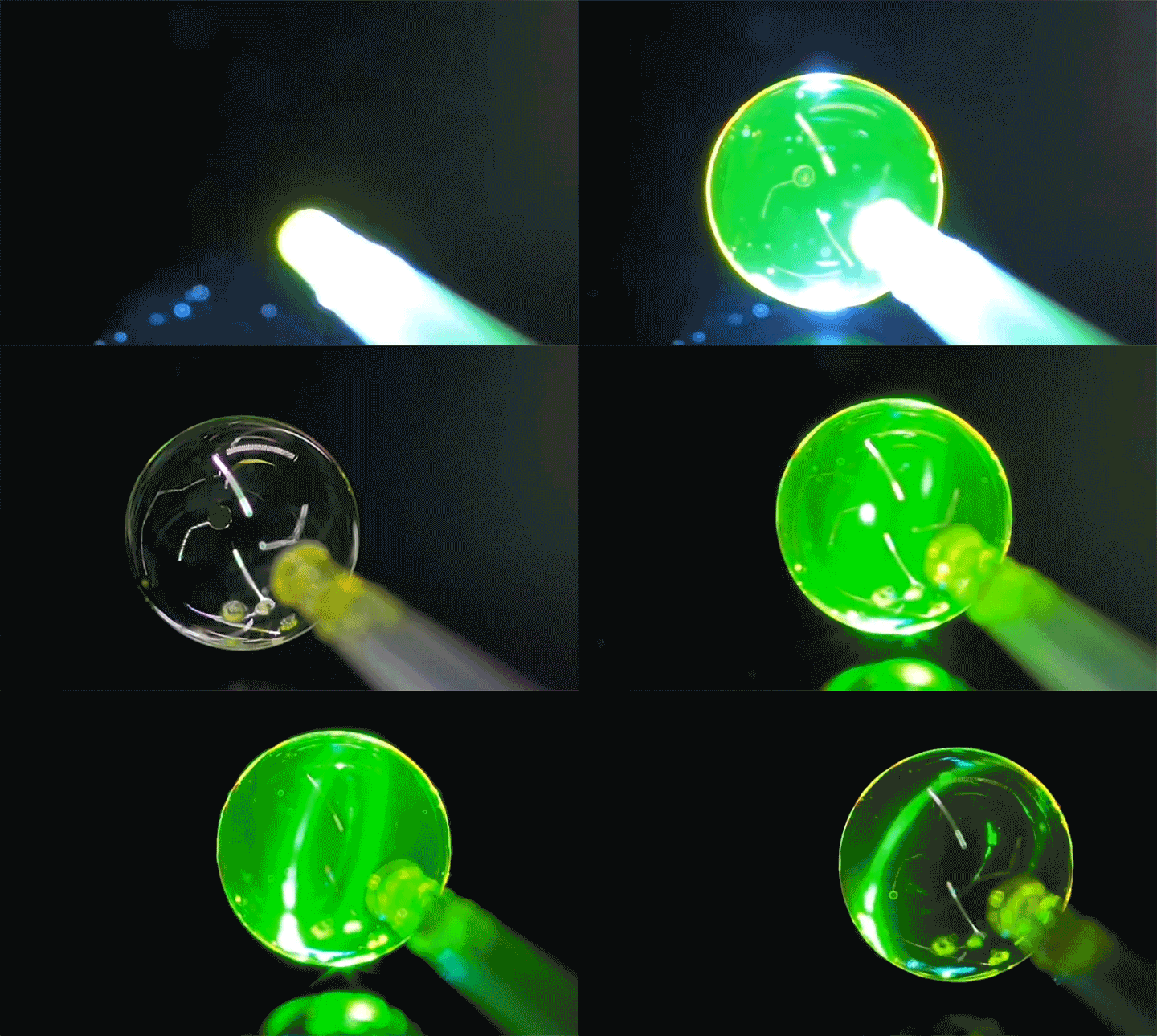
The thin shells of bubbles interact with light in fascinating ways; that is, of course, the source of their brilliant colors. In this recent study, researchers discovered that bubbles can serve as tunable lasers. A laser has three major components: an energy source, an optical resonator, and a gain medium that amplifies light in the resonator. For bubble lasers, an external pump laser provides energy and the bubble’s thin shell acts as a resonator. Fluorescent dye in the bubble serves as the gain medium.
Once formed, the bubble lasers are incredibly sensitive to electric fields and pressure changes, making them excellent sensors. For added stability, the team is using smectic liquid crystal bubbles, which, unlike soap bubbles, don’t evaporate easily. (Video, image, and research credit: Z. Korenjak and M. Humar; via APS Physics)
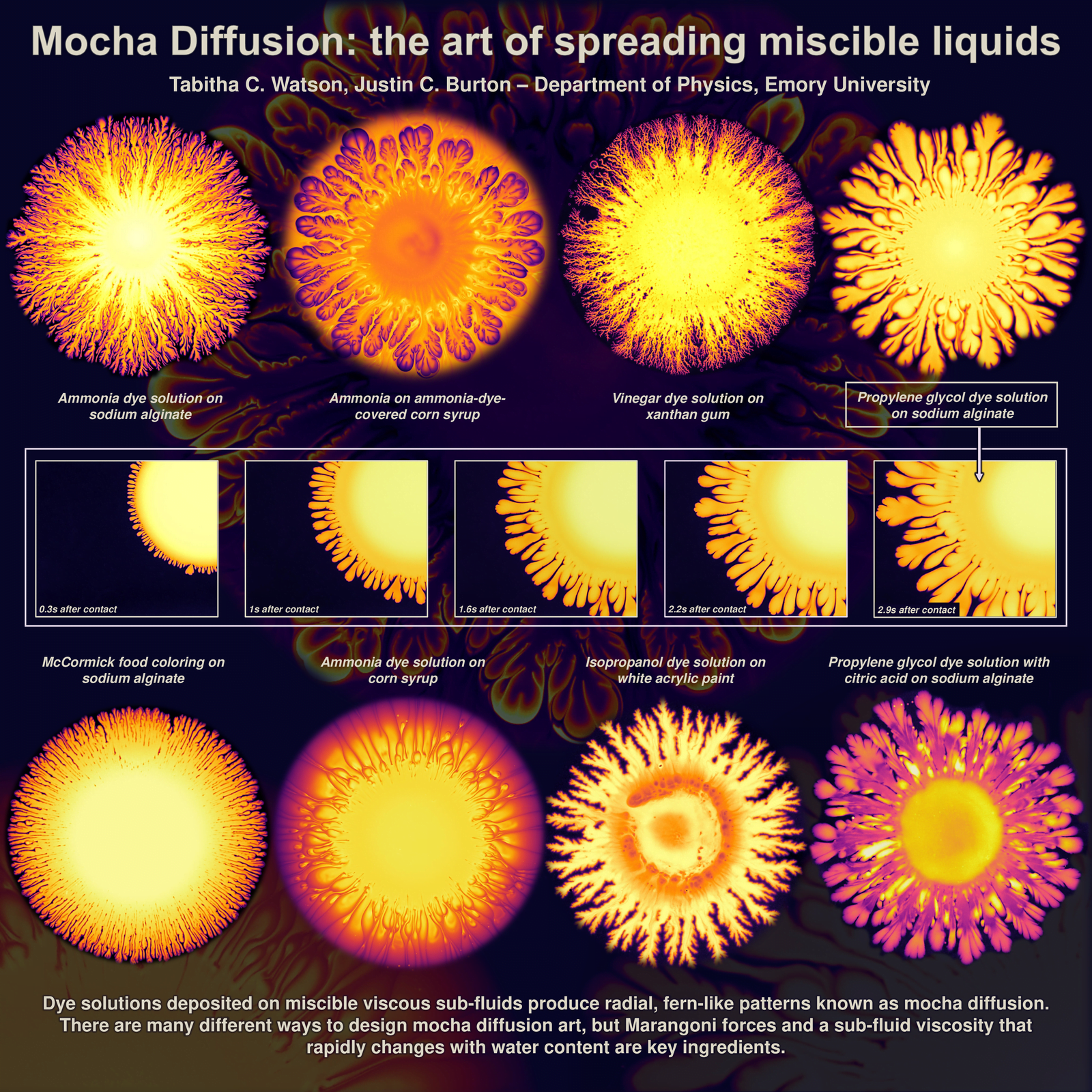
These firework-like patterns spread when dyes are added atop a viscous but miscible lower fluid layer. Here, researchers use lower layers like corn syrup and xanthan gum; then they spread dye mixtures including ammonia and vinegar atop those layers. Because the upper and lower layers of fluid are miscible and can diffuse into one another, they together form elaborate patterns. The mixing of the two layers creates gradients in surface tension that can drive the flow and create these mocha diffusion patterns. (Image credit: T. Watson and J. Burton)