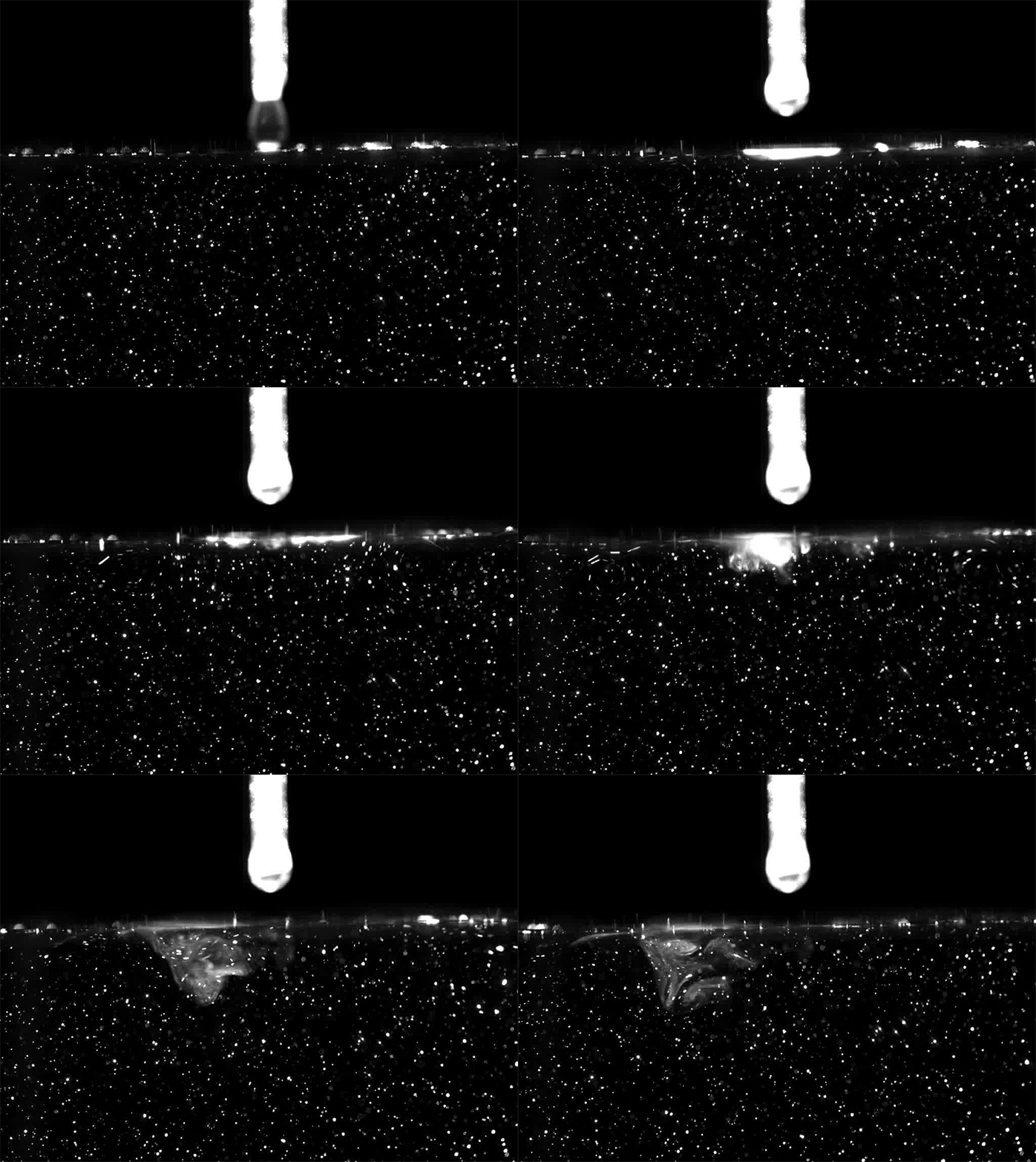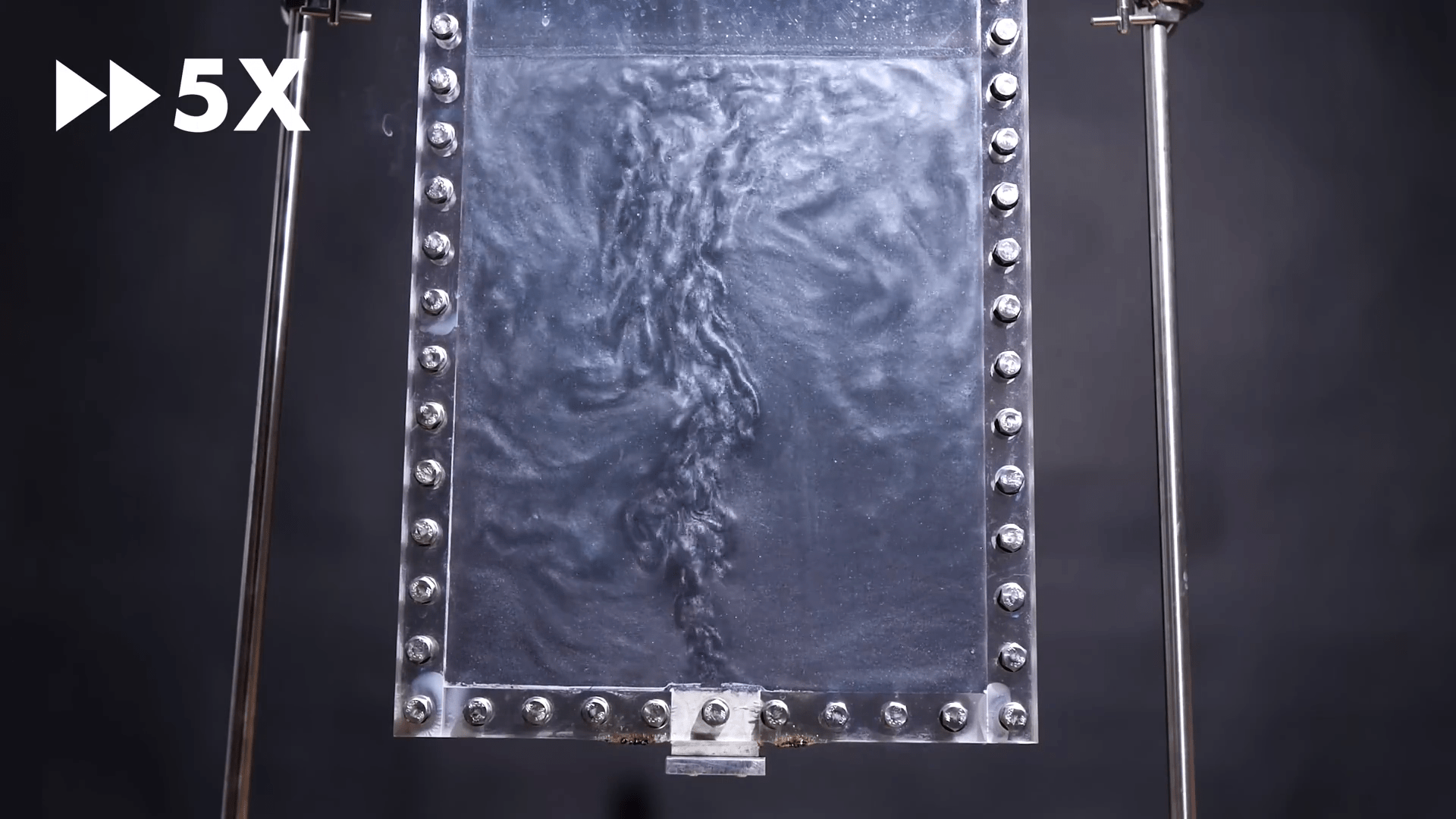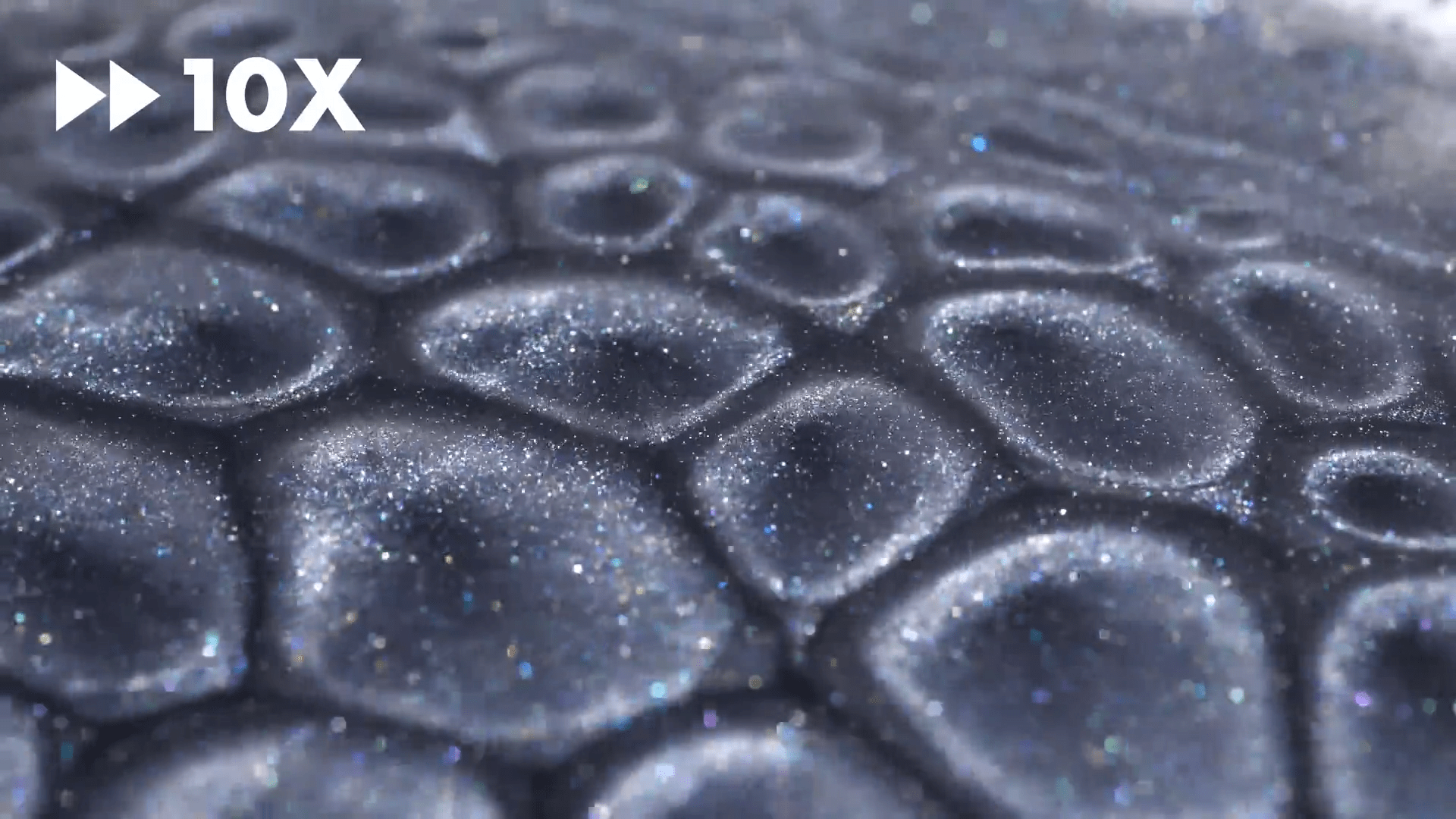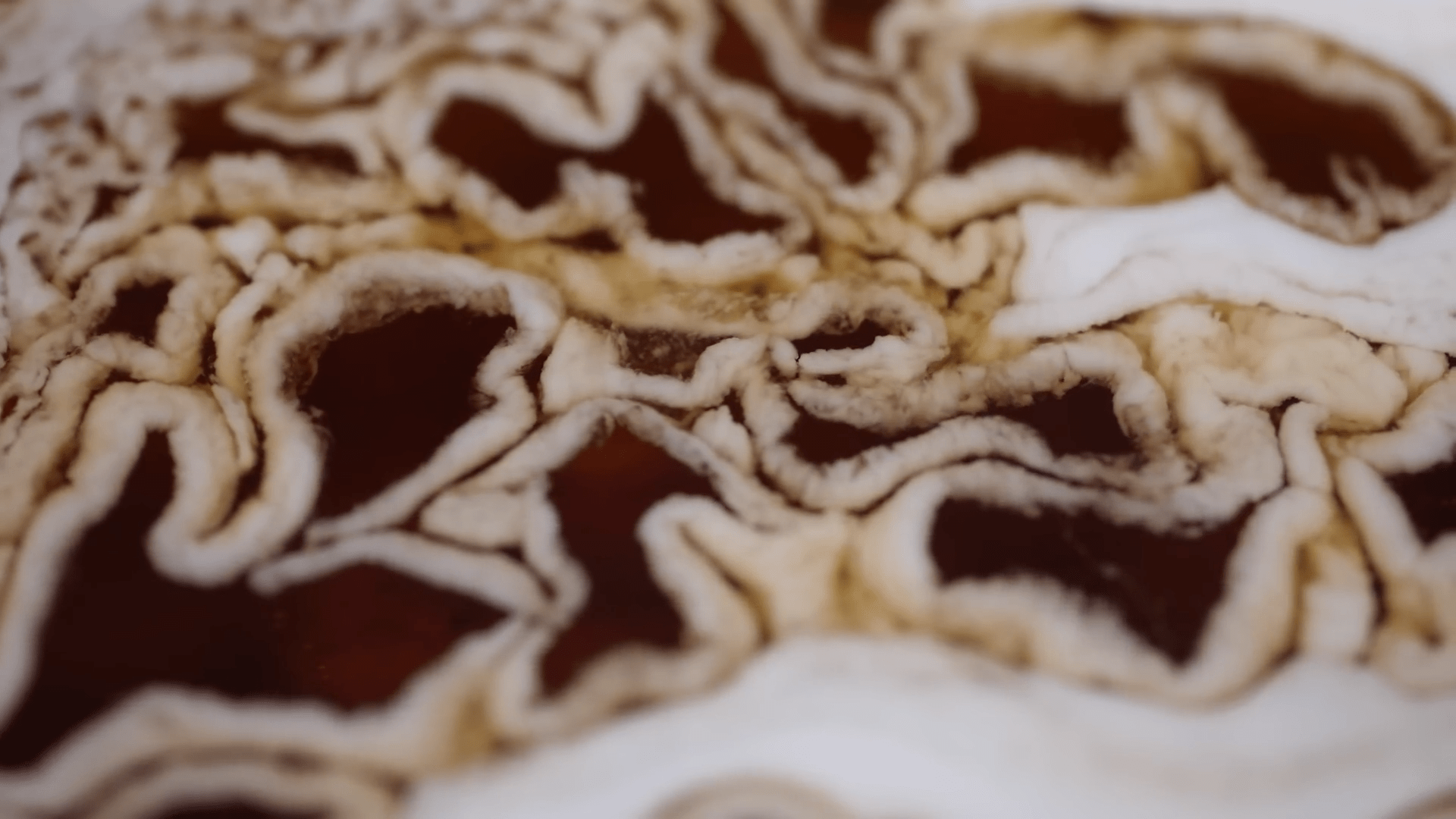
Vibration is one method for breaking a drop into smaller droplets, a process known as atomization. Here, researchers simulate this break-up process for a drop in microgravity. Waves crisscrossing the surface create localized craters and jets, making the drop resemble the Greek mythological figure of Medusa. With enough vibrational amplitude, the jets stretch to point of breaking, releasing daughter droplets. (Image and research credit: D. Panda et al.)
Tag: fluid dynamics

Controlling Finger Formation
When gas is injected into thin, liquid-filled gaps, the liquid-gas interface can destabilize, forming distinctive finger-like shapes. In laboratories, this mechanism is typically investigated in the gap between two transparent plates, a setup known as a Hele-Shaw cell. In the past, researchers looking to control the instability have explored how surface tension, viscosity, and the elasticity of the gap itself affect the flows. But a new set of studies look at the compressibility of the gas being injected.
The team found that viscous fingers formed later the higher the gas’s compressibility. That provides a potential control knob for people trying to exploit the mechanism, especially geologists. For geologists trying to extract oil, viscous fingering is detrimental, but, on the flip side, viscous fingers are desirable when injecting carbon dioxide for sequestration. With these results, users can tweak their injection characteristics to match their goals. (Image credit: C. Cuttle et al.; research credit: C. Cuttle et al. and L. Morrow et al.; via APS Physics)

Ciliary Pathlines
For tiny creatures, swimming through water requires techniques very different than ours. Many, like this sea urchin larva, use hair-like cilia that they beat to push fluid near their bodies. The flows generated this way are beautiful and complex, as shown above. Importantly for the larva, the flows are asymmetric; that’s critical at these scales since any symmetric back-and-forth motion will keep the larva stuck in place. (Image credit: B. Shrestha et al.)

Ice Damages With Liquid Veins
Water expands when it freezes, a fact that’s often blamed for ice-cracked roads. But expansion isn’t what gives ice its destructive power. In fact, liquids that contract when freezing also break up materials like pavement and concrete. A recent study pinpoints veins between ice crystals as the source of this infrastructure-cracking power.
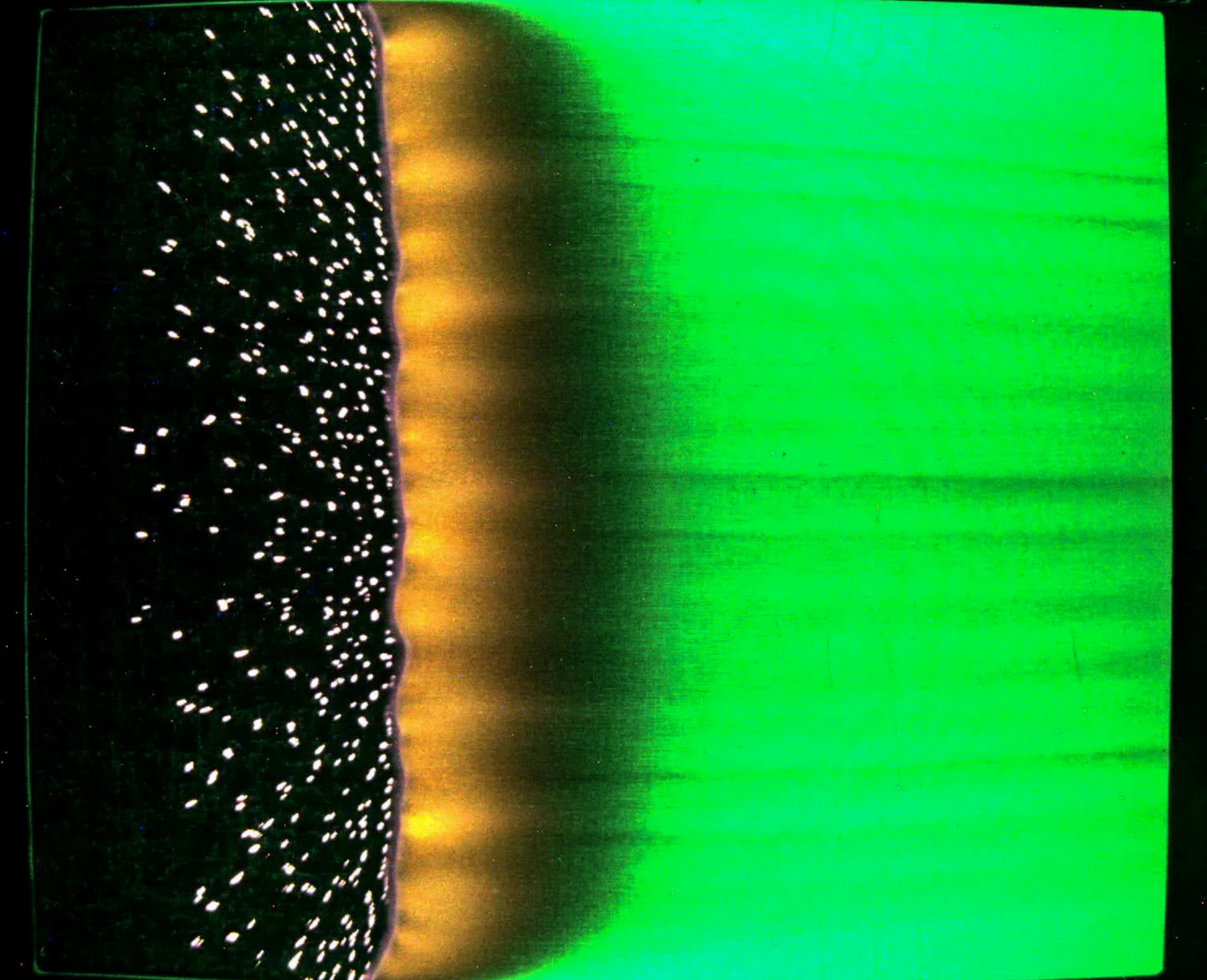
Ice doesn’t like to stick on most surfaces, so when it forms, there’s often a narrow gap between the ice and a solid surface. That gap fills with water, and that water, it turns out, doesn’t just sit there. Instead, grooves between ice crystals act like tiny straws that are frigid on the icy end and warmer on the end connected to water. As ice forms on the cold end, it creates a negative pressure gradient that draws liquid up the groove. This ‘cryosuction’ keeps pumping water into the ice, where it freezes and further expands the icy zone, as seen in the image below.

Under a microscope, fluorescent particles show water (right side) getting pulled into an ice groove (left). If the ice is made up of a single crystal, this growth rate is very slow. But most ice is polycrystalline — made up of many crystals, all separated by these liquid-filled grooves. That, researchers found, is a recipe for fast growth and quickly-expanding ice capable of breaking concrete and other structures. (Image credits: pothole – I. Taylor, experiment – D. Gerber et al.; research credit: D. Gerber et al.; via APS Physics)

Dancing to Chopin
Droplets of paint whirl to Chopin’s “Nocturne Op. 9 No. 2” in this short film from artist Thomas Blanchard. The glitter particles in the paints act as seed particles that highlight the flow within and around each drop. It’s a beautiful dance of surface tension, advection, and buoyancy. (Image and video credits: T. Blanchard; via Colossal)

Inside a Zebrafish Heart
This glimpse inside a 5-day-old zebrafish’s heart shows why they’re often used as a model organism in cardiac studies. The fish’s heart rate is similar to humans and its two-chamber heart — one atrium and one ventricle, both seen here — serves as a simplified version of ours. Check out the slowed-down section of the video to clearly see blood filling and expanding one chamber before it’s pumped onward. Perhaps the most unusual feature of the zebrafish’s heart is its ability to regenerate; after amputation of up to 20% of its ventricle, the fish can fully regenerate its heart. That’s a pretty incredible recovery, especially when you consider that the heart has to keep pumping the entire time! (Video credit: M. Weber/2023 Nikon Small World in Motion Competition)

Granular Gaps
Push air into a gap filled with a viscous fluid, and you’ll get the branching, dendritic pattern of a Saffman-Taylor instability. Here, researchers use a similar set-up: injection into a narrow gap between transparent planes to explore something quite different. In this experiment, the gap was initially filled with a mixture of air and tiny hydrophobic glass beads. When the team injected a viscous mixture of water and glycerol, new patterns emerged. At low injection rates, a single finger structure formed. But at high injection rates, a whole spoke-like pattern formed. (Image and research credit: D. Zhang et al.; via Physics Today)

Test Firing a Rocket Engine
Watching a rocket engine start up in slow motion is always fun. This Slow Mo Guys video shows a test fire of one of Firefly’s engines, which is capable of 45,000 pounds of thrust. Gav walks us through the process of preparing to film the test as well as what his footage shows.
Green flames mark ignition of the initial fuel, and bursts of flame jerk back and forth as shock waves pass through the engine. That’s a necessary part of establishing supersonic flow through the bell-shaped diffuser at the end of the engine. Once the exhaust reaches supersonic speeds, expelling it creates a diamond-like pattern of standing shock waves and expansion fans that ultimately equalize the exhaust jet’s pressure to that of the surrounding atmosphere. (Video and image credit: The Slow Mo Guys)

The Jumping Jump
Turn on your kitchen sink, and the falling jet may form a circle of shallow flow where it strikes the sink. This fast-moving region of flow, surrounded by a wall of water, is a hydraulic jump. A recent study delves into a previously-missed phenomenon of this flow: intermittent disruption and reappearance.

An oscillating hydraulic jump, viewed from below. The team found that, within a narrow range of jet and surface sizes, a hydraulic jump will periodically appear and disappear. The effect comes from the hydraulic jump itself; waves from the jump propagate outward, hit the edge of the circular plate, and reflect inward. When the incoming and outgoing waves interfere, it floods the jump zone, making it disappear briefly. (Image credit: sink – Nik, jump – A. Goerlinger et al.; research credit: A. Goerlinger et al.; via APS Physics)

“Emerald Roots”
As charged particles from the solar wind bombard the upper atmosphere, a glowing plasma forms and dances in the sky. The green light of the plasma reflects off moistened sand, rippled by the passage of wind and tide. Each component seems simple, but this striking image contains hidden depths of fluid dynamics. Magnetohydrodynamics govern the aurora’s dance; the sand’s self-organization mirrors dune physics; and even the rocky outcropping in the background was carefully shaped by erosive forces from wind and water. Truly, fluid dynamics are found everywhere. (Image credit: L. Tenti; via 2023 Astronomy POTY)