Tag: fluid dynamics

  • “Shaken, Not Stirred”

    “Shaken, Not Stirred”

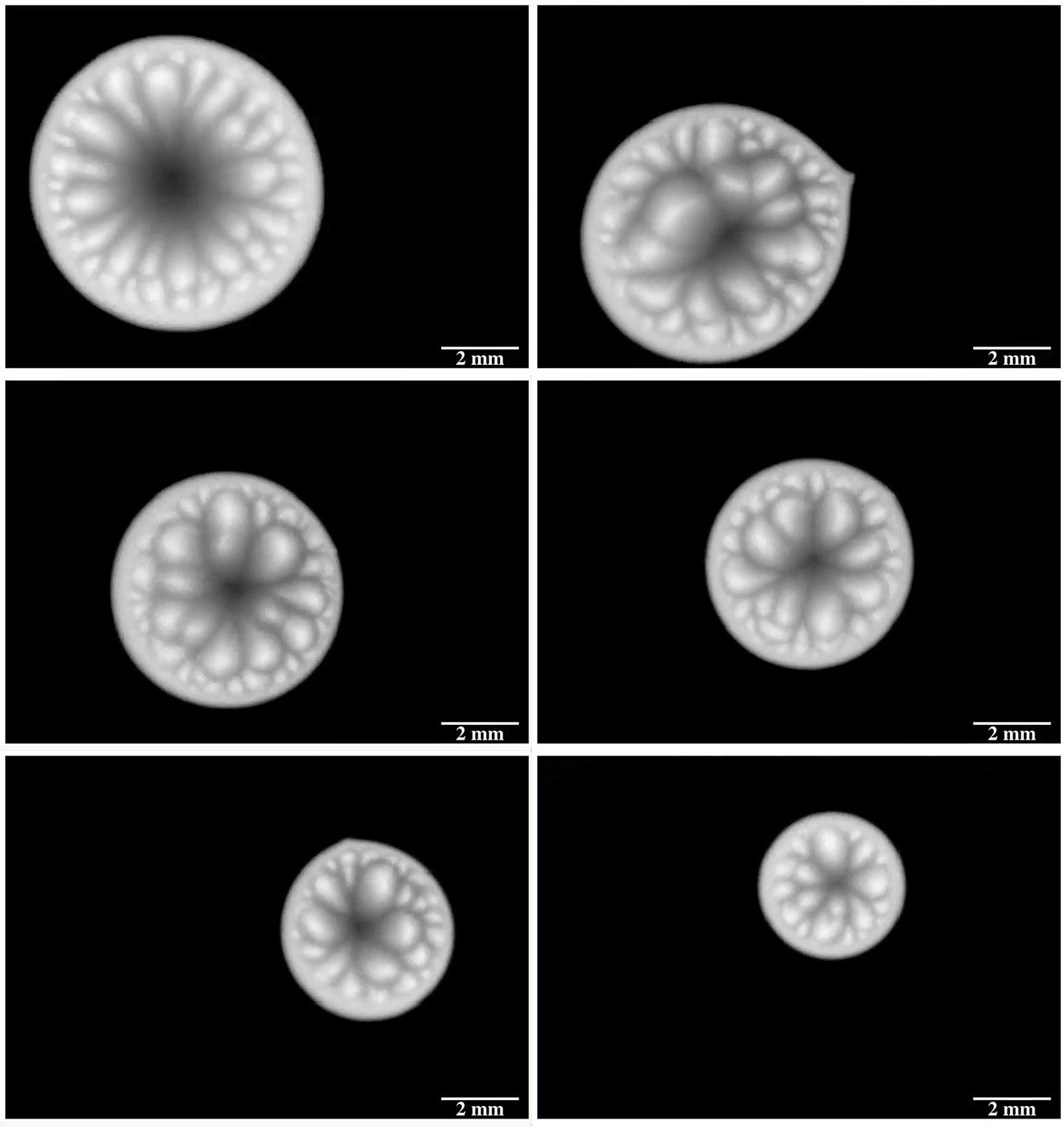
    James Bond notoriously orders his martinis “shaken, not stirred,” a request bartenders fulfill by shaking the cocktail over ice in a separate shaker. But what if you shake the martini glass itself? That’s the question that inspired this lovely mixology.

    By shaking the martini glass gently back and forth (along the directions shown by the arrows in each image), the team created different mixing patterns within the glass. With a little food dye and pearl dust, they visualized the flows they found. By changing the viscosity of the cocktail and the speed of the swish, they made everything from a four-leaf clover to a cadre of ghosts. It seems that martini glasses hold a flow for every occasion! (Image and research credit: X. Song et al.; submitted by Zhao P.)

    GFM poster, describing the experiments used to create these picturesque martinis.
    GFM poster, describing the experiments used to create these picturesque martinis.
  • Eroding the Sphinx

    Eroding the Sphinx

    One theory suggests that the Great Sphinx of Giza formed — in part — naturally as a result of erosion, and ancient Egyptians added features to the bedrock formation. To test the plausibility of the theory, researchers made a miniature sphinx, consisting of a clay mound with a single, harder inclusion to represent the Sphinx’s head, and placed their construction in a water tunnel. As the water eroded away the clay, the head appeared, and flow around this harder-to-erode region formed some of the body and paws of the reclining Sphinx.

    The experiment suggests that it is plausible for part of the Sphinx to have formed naturally, as a result of erosion. But plausibility is not proof, and given the lack of a contemporary inscription explaining the statue’s origin, the goals and methods of the people who built it around 2500 B.C.E. will remain a matter of archaeological debate. (Image credit: S. Boury et al.)

  • “Chaosmosis”

    “Chaosmosis”

    After many years of featuring work from the Gallery of Fluid Motion, I’m excited to announce a new public exhibition of art drawn from the competition: “Chaosmosis: Assigning Rhythm to the Turbulent.” Works in the exhibit come from both scientists and artists; each piece makes visible the fluid motions that surround us.

    The exhibit is located at the National Academy of Sciences in Washington, DC through February 23, 2024. Entry is free, but only available between 9 a.m. and 5 p.m. on weekdays. For more, check out the exhibit’s webpage and press release (pdf) and the Instagram accounts for CPNAS and the exhibit.

    I’m looking forward to seeing the exhibit when I’m at the APS DFD meeting next month, but if you can’t make it to DC before the exhibit ends, don’t worry! This is just the first stop for the new traveling GFM exhibit. (Image credits: various, see individual images’ titles)

  • Viscoelasticity and Bubbles

    Viscoelasticity and Bubbles

    Bursting bubbles enhance our drinks, seed our clouds, and affect our health. Because these bubbles are so small, they’re easily affected by changes at the interface, like surfactants, Marangoni effects, or, as a recent study shows, viscoelasticity.

    A bubble released in pure water pops at the surface, creating a rebounding jet and a daughter droplet.
    A bubble released in pure water pops at the surface, creating a rebounding jet and a daughter droplet.

    In clean water, a bubble’s burst generates a rebounding jet that shoots off one or more daughter droplets, as seen in the animation above. But when researchers added proteins that modify only the water’s surface, they found something very different. As seen below, the bursting bubble no longer generated a jet, and, instead of forming droplets, it made a single, tiny daughter bubble. The difference, they found, comes from the added viscoelasticity of the surface. The long protein molecules resist getting stretched, which damps out the tiny waves that surface tension usually produces on the collapsing bubble cavity. (Image and research credit: B. Ji et al.; submission by Jie F.)

    When the surface of water is viscoelastic, a bursting bubble creates no jet and a daughter bubble instead of a drop.
    When the surface of water is viscoelastic, a bursting bubble creates no jet and a daughter bubble instead of a drop.
  • Red Sprites

    Red Sprites

    Sprites, or red sprites, are high-altitude electrical discharges in the atmosphere. Although sometimes called upper-atmospheric lightning, sprites are a cold plasma phenomenon. They often occur in clusters, as in this photo by Angel An, which won in the Skyscapes category of the 2023 Astronomy Photographer of the Year competition. Sprites, which last only a millisecond or so, take place during intense thunderstorms, but, unlike our more familiar lightning, sprites move upward from the storm toward the ionosphere. They can occur on Venus, Saturn, and Jupiter as well, although sprites have only been observed directly on Earth and Jupiter. (Image credit: A. An; via Colossal)

  • Bravo!

    Bravo!

    Applauding is a familiar activity, but, as you stand for an encore in the concert hall, do you think about how you hold your hands and how that affects your clap? That question prompted two scientists to embark on an acoustical exploration of clapping. By testing 11 different ways to hold their hands during clapping, the duo found some interesting results.

    The loudest clap — achieving an average of 85 decibels — held the hands at 45 degrees to one another, with palms partially overlapping (A2 in the figure). But the clap that most pleased the ear was a little different (A1+). It kept the 45 degree orientation, but the palms overlapped fully with a domed shape between them. In that configuration, the palms form a little resonance chamber that makes the clap sound deeper and richer. (Image credits: top – G. Latorre, others – N. Papadakis and G. Stavroulakis; research credit: N. Papadakis and G. Stavroulakis; via Physics World)

    Scientists studied the sounds made from clapping in 11 different hand configurations.
    Scientists studied the sounds made from clapping in 11 different hand configurations.
  • Snake Tracks

    Snake Tracks

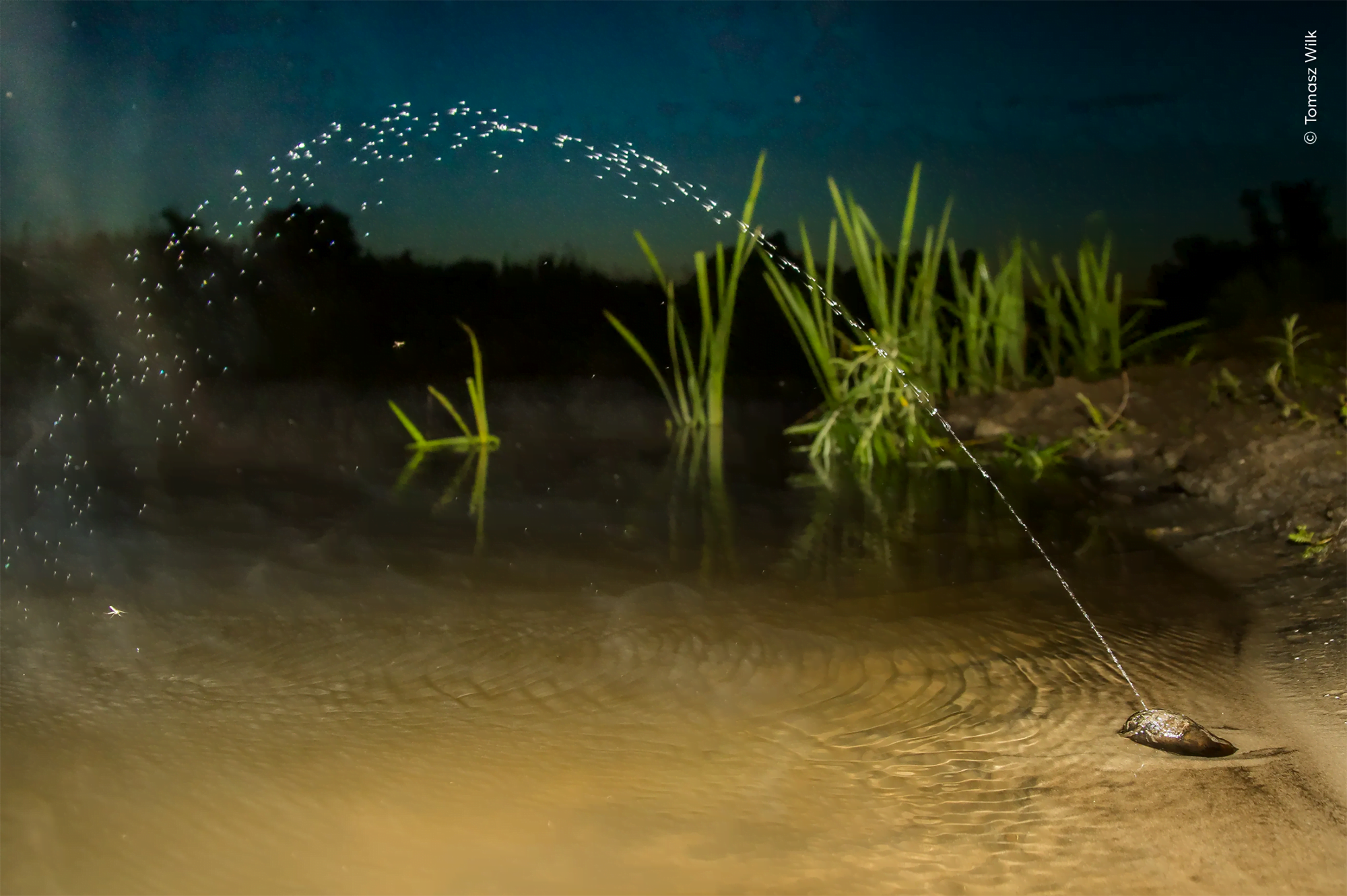
    Moving across sand is quite challenging for bipedal creatures like us, but other animals have their ways. Photographer Paul Lennart Schmid caught this snake on the move, with impressions of its passage still in the sand. X-ray observations of snakes moving in sand show that they swim through the granular medium. Snakes are quite efficient in their swimming, moving most of their body through the tunnel created by their head, thereby reducing their overall effort. (Image credit: P. Schmid; via Nature TTL POTY)

  • Spreading Spores

    Spreading Spores

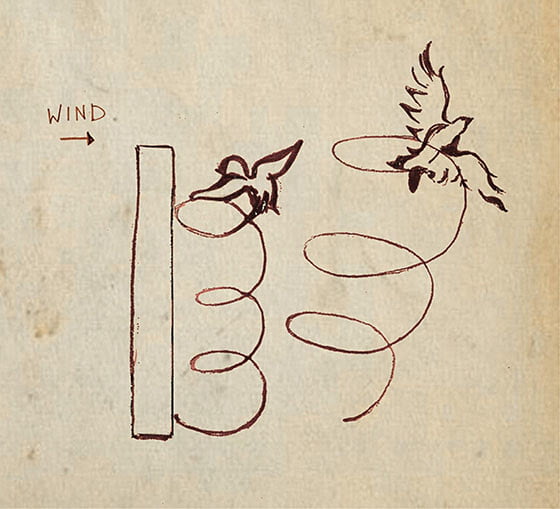
    Mushrooms are the fruiting bodies of much bigger, largely underground fungi. Being fruit, mushrooms have the job of spreading spores so that the fungus can reproduce. Some mushrooms rely on the wind; others create their own wind. Still others use vortex rings to carry their spores higher. Who knew such fascinating and beautiful physics lies along the forest floor? (Image credit: top – A. Papatsanis, bottom – I. Potyó; via Wildlife POTY)

    Photo by Imre Potyó.
  • Dancing Peanuts

    Dancing Peanuts

    Bartenders in Argentina sometimes entertain patrons by tossing a few peanuts into their beer. Initially, the peanuts sink, but after a few seconds they rise, wreathed in bubbles. Once on the surface, they roll, causing the bubbles to pop, and the peanut sinks once again. The cycle repeats, sometimes for as long as a couple hours.

    There are a couple physical processes governing this dance. The first is bubble nucleation. Most beers are carbonated; they contain dissolved carbon dioxide gas that remains in solution while the beer is under pressure. Once poured, that storage pressure is gone and bubbles start to form in the liquid. The shape of the peanut means that bubbles form more easily on it than on the glass walls or in the liquid. And once the peanut is covered in bubbles, buoyancy comes into play. The bubbles attached to the peanut reduce its density relative to the surrounding fluid, enabling the peanut to rise up and float.

    This same process is seen with other objects in carbonated fluids, too, such as blueberries in beer and lemon seeds in carbonated water. But it’s also reflected elsewhere in nature. For example, magnetite crystals are thought to float in magma due to a similar nucleation of dissolved gases on their surface. (Image and research credit: L. Pereira et al.; via APS Physics)

  • Frozen Ripples

    Frozen Ripples

    Normally, freezing is a slow enough process that transient phenomena like ripples get smoothed out. But with the right conditions, even ripples can get frozen in time. This picture shows a backyard bird bath after a frigid winter storm passed overnight. For much of that time, the wind was active enough to keep the bath’s water from freezing. But when freezing did start, it happened so rapidly that the wavelets generated by the wind got frozen in place, too. Here’s a similar-looking effect (also in Colorado, ironically) that’s thought to have formed entirely differently. (Image credit: K. Farrell; via EPOD; submitted by Kam-Yung Soh)