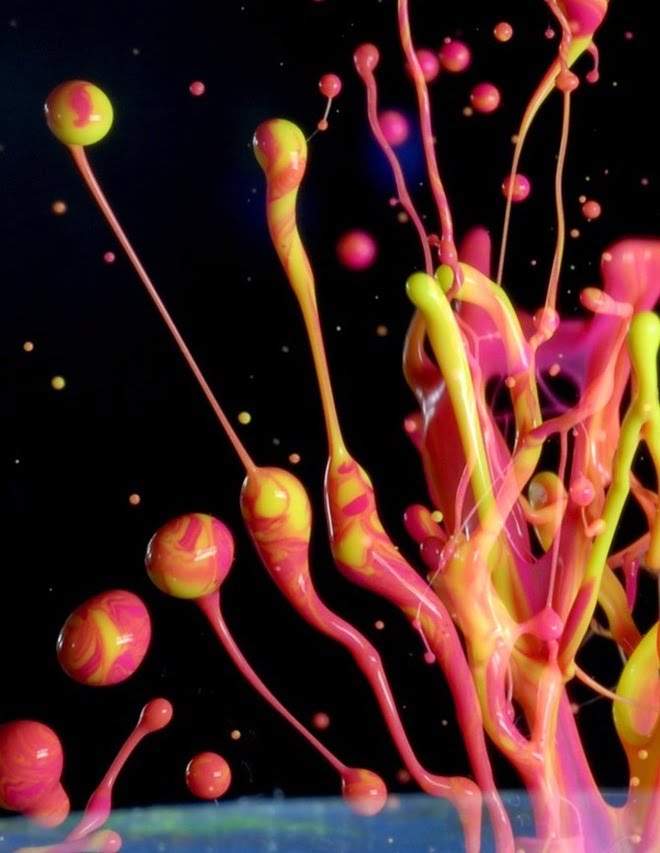
Two fluid jets with diameter 0.85 mm collide, creating a fantastical and unstable fluid structure. Fluid mechanics and art overlap. #
Tag: fluid dynamics

Carboy Combustion
Lighting a thin layer of ethyl alcohol in a jug produces some beautiful pulse jets and a moving wall of flame that shifts and flows according to the changing pressures inside the jug. Like the video’s author, we do NOT recommend trying this combustion demo yourself.
As for the video’s questions, firstly, blowing into the jar helps the flame because humans do not exhale pure CO2. With regard to the second question, the interior of the jug is initially thinly coated in ethyl alcohol vapor. Combustion starts at the top of the jug and the sheet of flame moves downward as the fuel at the top is spent. As that flame moves downward, however, it’s heating the air inside the jug, which expands and is forced out the opening. When the flame goes out in the upper part of the jug, that does not mean all of the fuel has combusted, simply that the ratio of air/fuel is insufficient for continued combustion. I suspect the flame persists at this opening because the air/fuel mixture is concentrated at that point. Any residual ethyl alcohol in the container is forced out through that narrow opening, and the resulting concentration of fuel there may be high enough to keep the flame burning there. (idea submitted by davidbenque #)

Shuttlecock Flow Viz
The flow around a shuttlecock is visualized in a water channel using fluorescent dye illuminated by laser light ultraviolet LEDs. Note the recirculation zone on the upper shoulder. Experimenters can match flow characteristics in water to that in air by matching the Reynolds numbers. (Photo credit: Rob Bulmahn)
Updated, thanks to information from the photographer. Thanks!
Starting Vortices
Whenever a wing stops or starts in a fluid, it produces a vortex. This 2D numerical simulation shows an airfoil repeatedly starting and stopping, shedding a vortex each time. Note how the line of vortices drifts downward in the wake; this is an indication of downwash. (submitted by jessecaps)
Skydiving Indoors
Vertical wind tunnels like this one simulate the experience of skydiving with air speeds up to 270 km/h (168 mph). Here expert freefallers perform a routine similar to synchronized skydiving. By changing the angle and shape of their body with respect to the air flow, they are able to control their lift and drag to produce complex motion in three dimensions.
Un-Mixing a Fluid Demo
Not only is this demonstration one of my favorites, it’s a reader favorite, too. Even though I posted it nearly a year ago, I’ve had it resubmitted over and over. Here’s what I originally wrote:
Laminar flow (as opposed to turbulence) has the interesting property of reversibility. In this video, physicists demonstrate how flow between concentric cylinders can be reversed such that the initial fluid state is obtained (to within the limits of molecular diffusion, of course!)
For more examples, see the first half of this video.
The results of those videos might be surprising, but they highlight the difference between laminar flow and turbulence. In laminar flow, the motion of the dye is caused by molecular diffusion and momentum diffusion, the latter of which is exactly reversible. In turbulence, much of the fluid motion is tied up in momentum convection, which is irreversible. This is why you can “unstir” the glycerin but not the milk in your coffee.

Paint Vibrations
Paint vibrated on a loud speaker explodes in multi-colored jets and droplets. Most paints are shear-thinning non-Newtonian fluids (like ketchup, shampoo, or whipped cream), meaning that their viscosity decreases as they are sheared. This allows them to flow more readily once they are perturbed. #

Saturn’s Storm Stretches All the Way Around
This picture captured by Cassini in February shows a storm on Saturn stretching all the way around the planet. Unlike Earth and Jupiter, which have numerous storms virtually all the time, Saturn tends to store energy in its atmosphere for decades and then release it all at once in mega-storms like this one. #
Vertical Axis Wind Turbines
Conventional wind turbines feature horizontal axis propellers which must be placed far apart from one another to avoid wake interference. Researchers have found that using vertical axis wind turbines specially arranged to utilize the wake of one turbine to improve the efficiency of its neighbor can produce far more energy per square meter of land. The inspiration for this arrangement came from fish, which also derive benefits from the drafting that occurs in their schools. #

Osborne Reynolds and Transition

How and when flow through a pipe becomes turbulent has been a conundrum for fluid mechanicians since the days of Osbourne Reynolds (~1870s):
Typically, the laminar-to-turbulence transition is studied mathematically by linearizing the Navier-Stokes equations, the governing equations of fluid dynamics, then perturbing the system. These perturbations will gradually disappear in laminar flow, but if the flow is turbulent, they’ll grow and produce chaotic motion. The transition, then, is the critical point between these two.
However, for pipe flows, this linearized approach shows that the perturbations decay for all Reynolds numbers, even though this doesn’t happen in actual experiments. In the real world, as the Reynolds number increases, small, turbulent puffs begin to split and interact, and their lifetimes increase. Eventually, these puffs carry enough turbulence to transition the flow entirely. # (submitted by David T)