
Accidental releases of combustible gases in unconfined spaces can be difficult to recreate in a laboratory environment. Here researchers simulate the conditions using detonation inside a soap film bubble. Combustible gases are pumped inside the soap film and then a spark creates ignition. The resulting flame propagation is visualized using high-speed schlieren photography, making the density gradients in the flame visible. When the mixture of hydrogen fuel to air is balanced, the flame is spherically symmetric with a high flame speed. In contrast, weaker mixtures of fuel/air produce slow flame speeds and mushroom-like flames that leave behind unreacted fuel. This is due to buoyant effects; the time scale associated with buoyancy is smaller than that of the flame speed and chemical reactions when the fuel/air mixture is lean. (Video credit: L. Leblanc et al.)
Tag: fluid dynamics

Accidental Painting
Artist D. A. Siqueiros sometimes used a technique he referred to as “accidental painting” in his work, in which he would pour a layer of one color of paint and then pour a second color over it. The two colors would mix in striking patterns. Here researchers recreate the technique and analyze the fluid dynamics of it. Each paint has a slightly different density thanks to the pigments used to color them. When a denser paint is poured over a less dense one (as in the white on black in the video), this activates the Rayleigh-Taylor instability. The white paint will tend to sink down below the black paint due to gravity. At the same time, the spreading of the two paints also affects the shapes and patterns through mixing and diffusion. (Video credit: S. Zetina and R. Zenit)
Donut-Shaped Bubbles
Here researchers simulate rain-like droplet impacts with large drops of water falling into a tank from several meters. The momentum of such an impact is significantly higher than many other droplet impact examples we’ve featured. In this case, the coronet, or crown-like splash, caused by the collision collapses quickly, closing the fluid canopy around a trapped bubble of air. The remains of the coronet fall inward, preventing the development of the usual Worthington jet associated with droplet impacts. Instead, the air bubble takes on an unstable donut-like shape. (Video credit: M. Buckley et al.)

Green Fingers
Differences in surface tension between two layers of fluid can cause fascinating finger-like instabilities. Here glycerol is spread in a thin film on a silicon wafer. Then a wire coated in oleic acid, which has a lower surface tension than glycerol, was touched to the wafer. As the oleic acid spreads across the film surface, Marangoni and capillary stresses cause variations in the film thickness, which results in the dendritic patterns seen here. (Photo credit: B. Fischer et al.)

“Millefiori”

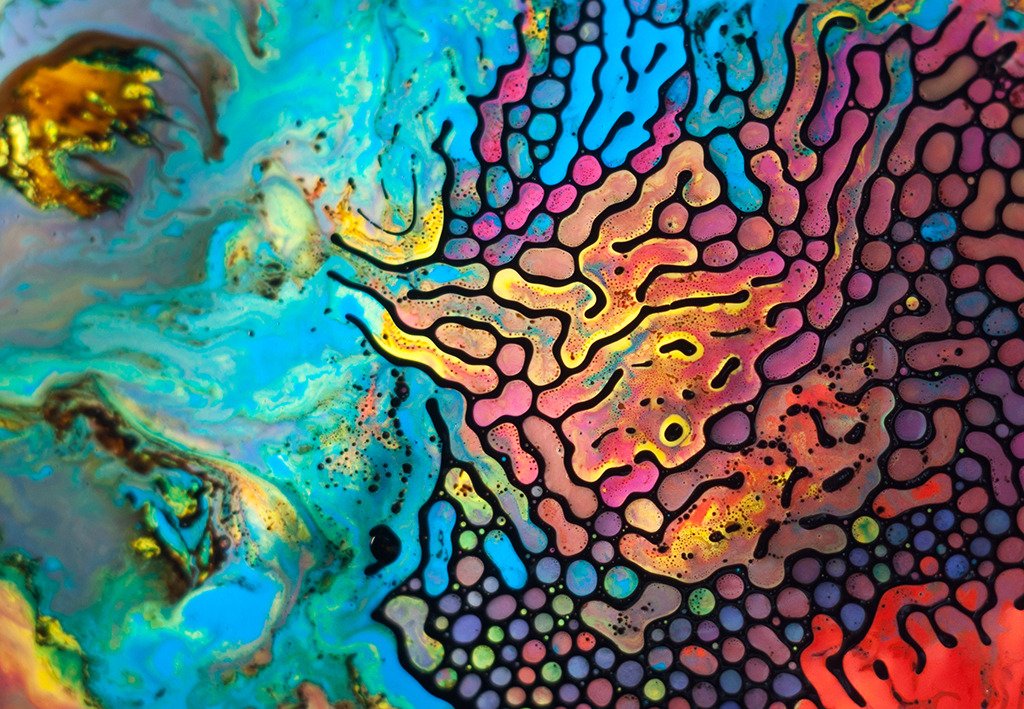
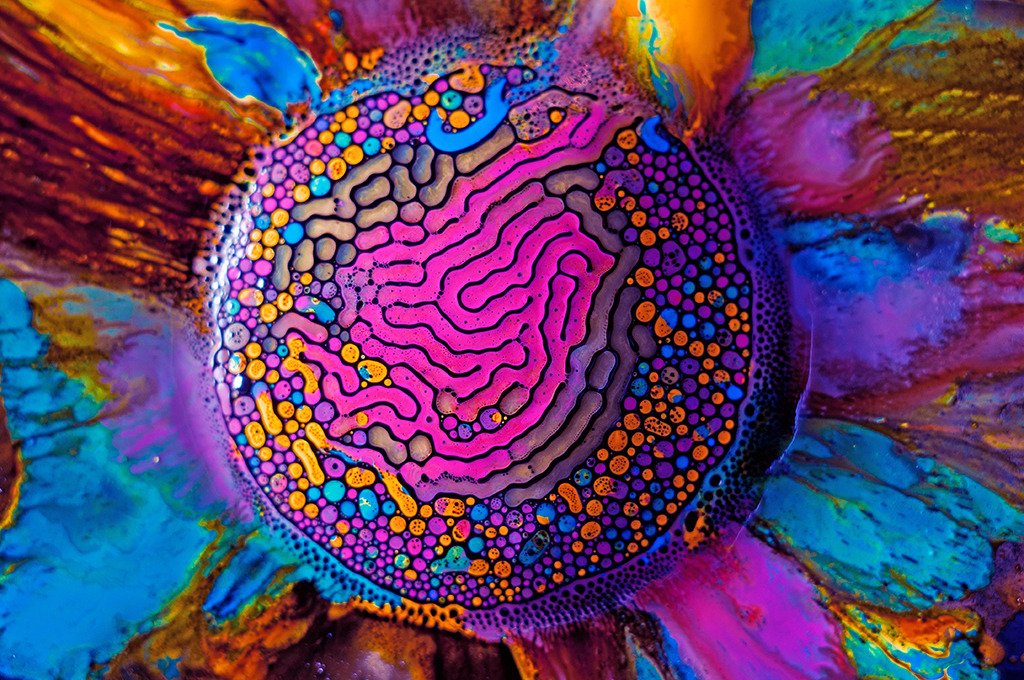
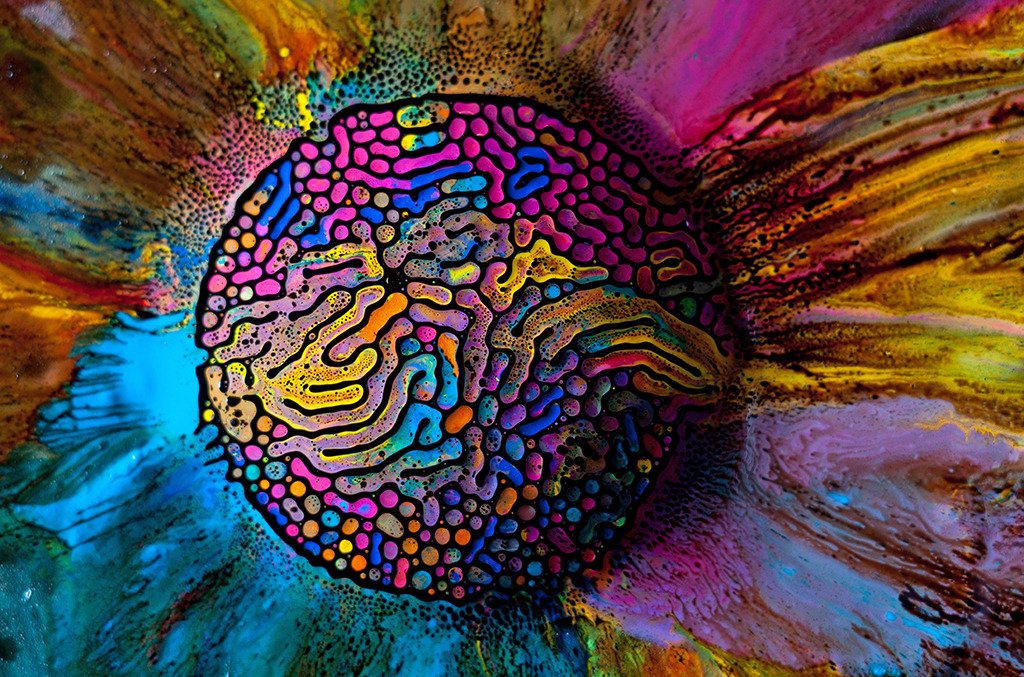
In “Millefiori” artist Fabian Oefner mixes watercolors with ferrofluids to create bright fluid microcosms. Each photograph represents an area about the size of a thumbnail. Ferrofluids contain iron-based nanoparticles suspended in a carrier fluid and thus respond to magnetic fields. They can form sharp points, labyrinthine mazes, or even brain-like patterns depending on the magnetic field and the substances surrounding them. For more on this art project, see this interview with the artist. (Photo credit: Fabian Oefner)
Dribbling Droplets
Ethanol droplets on a hot copper plate bounce under the influence of electrostatic forces from a charged rod. The temperature of the plate is high enough that the droplet is supported by a thin vapor film, which is what keeps it from wetting the plate. Ethanol does not have the strong polarity that water does, but the hydroxyl group on one end does make it susceptible to the electrostatic charge built up on the teflon rod. As a result, the droplets oscillate under electrostatic and gravitational forces, resulting in a dribbling effect. (Video credit: S. Wildeman et al.)

Polygonal Jumps
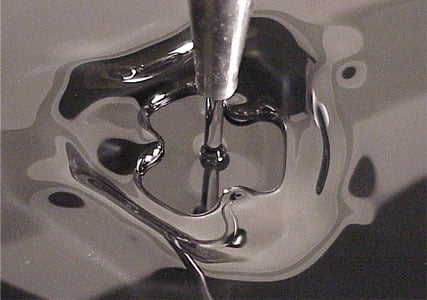
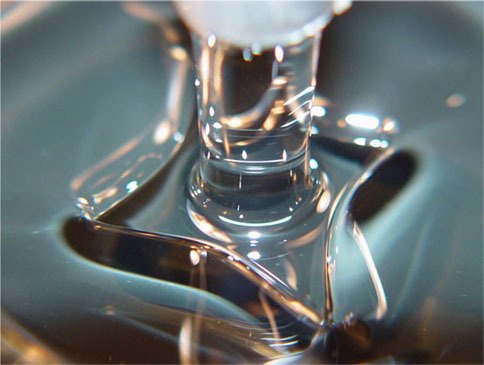
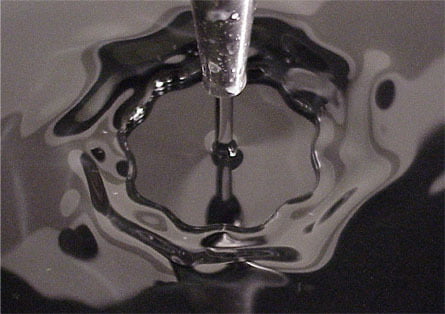
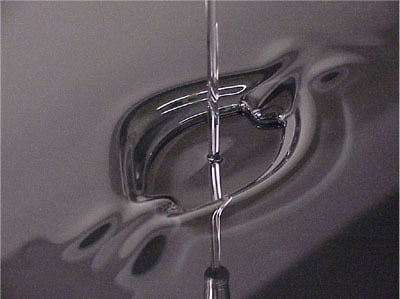
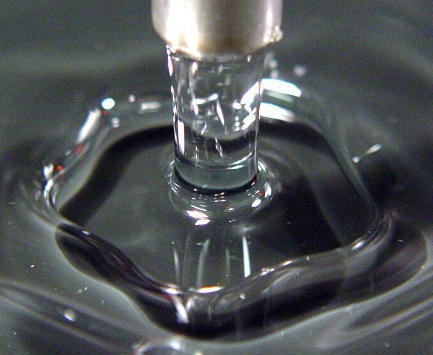
Hydraulic jumps occur when a fast-moving fluid enters a region of slow-moving fluid and transfers its kinetic energy into potential energy by increasing its elevation. For a steady falling jet, this usually causes the formation of a circular hydraulic jump–that distinctive ring you see in the bottom of your kitchen sink. But circles aren’t the only shape a hydraulic jump can take, particularly in more viscous fluids than water. In these fluids, surface tension instabilities can break the symmetry of the hydraulic jump, leading to an array of polygonal and clover-like shapes. (Photo credits: J. W. M. Bush et al.)
Spray Starch
High speed video of of spray starch from a can. Once the initial transients die down, a cone-shaped annular sheet forms. Disturbances propagate in the sheet, tearing it into filaments that break down into droplets. Beautiful complexity hidden in a simple everyday device. (Video credit: John Savage)
Dynamic Leidenfrost Impact
The Leidenfrost effect occurs when a liquid encounters a solid object much hotter than the liquid’s boiling point, like when water skitters on a hot griddle or someone plunges a hand in liquid nitrogen. A thin layer of vapor forms between the liquid and the solid, thereby (briefly) insulating the remaining liquid. The Leidenfrost effect can be static–like a droplet sitting on a pan–or dynamic, like the video above in which a droplet impacts the hot object. The video shows both a top and a side view of a droplet striking a plate that is over five times hotter than the liquid’s boiling point. On impact, the droplet spreads and flattens, and a spray of even tinier droplets is ejected before rebound. (Video credit: T. Tran and D. Lohse, from a review by D. Quere)

The Archer Fish’s Arrows

The archer fish hunts by shooting a jet of water at insects in the leaves above and knocking them into the water. How the fish achieve this feat has been a matter of contention. A study of high-speed video of the archer’s shot shows that fluid dynamics are key. The fish releases a pulsed liquid jet, imparting greater velocity to the tail of the jet than the head. As a result, the tail tends to catch up to the head and increase the jet’s mass on impact while decreasing the duration of impact. Simultaneously, the jet tends to break down into droplets via the Rayleigh-Plateau instability caused by surface tension. Surface tension’s power to hold the water in droplets combined with the inertial effects of the pulsed jet create a ball of fluid that strikes the archer’s prey with more than five times the power than vertebrate muscles alone can impart. For more on archer fish, check out this video and the original research paper by A. Vailati et a. (Photo credits: Scott Linstead and BBC; submitted by Stuart R)


