
Arctic sea ice often appears as a single extensive sheet when, in reality, it is made up of many smaller sections of ice shifting and grinding against one another under the influence of winds and ocean currents. This can cause cracks–known as leads–to open up between sections of the ice. This animation, constructed from infrared satellite images, shows the growth of several cracks, leading to extensive break-up of the ice sheet from late-January through March. The fracturing was driven by a high-pressure system that parked over the region, bringing warmer temperatures and southwesterly winds that fueled the Beaufort Gyre, a large-scale, wind-driven, clockwise circulation in the sea that helped pull the ice apart. For more, see NASA EO’s explanation. (Video credit: NASA Earth Observatory)
Tag: fluid dynamics

Penguins Can Be Colder Than Their Surroundings
Thermal imaging of emperor penguins in Antarctica shows that, in still conditions, large portions of their bodies remain colder than ambient temperatures. In the image above, the heads, beaks, eyes, and flippers of this pair of penguin are the warmest while much of their feathered surface remains several degrees colder than the temperature around them. Not only does this indicate that the penguins’ skin and feathers are extremely effective insulators–the core temperature of each penguin is roughly the same as a human’s–but it means that the penguins are losing heat via radiative cooling toward the sky, the same way your car does when frost forms. The measurements in the study are for penguins at least one body length away from any other penguins; of course penguins typically huddle together to generate additional warmth. The mathematics of this behavior are under active research. (Photo credit: D. McCafferty et al.; via Wired)

Stopping Jet Break-Up
When a stream of liquid falls, a surface tension effect called the Plateau-Rayleigh instability causes small variations in the jet’s radius to grow until the liquid breaks into droplets. For a kitchen faucet, this instability acts quickly, breaking the stream into drops within a few centimeters. But for more viscous fluids, like honey, jets can reach as many as ten meters in length before breaking up. New research shows that, while viscosity does not play a role in stretching and shaping the jet as it falls–that’s primarily gravity’s doing–it plays a key role in the way perturbations to the jet grow. Viscosity can delay or inhibit those small variations in the jet’s diameter, preventing their growth due to the Plateau-Rayleigh instability. In this respect, viscosity is a stabilizing influence on the flow. (Photo credit: Harsha K R; via Flow Visualization)

Skittering Droplets
Water splattered onto a a hot skillet will skitter and skip across the surface on a thin layer of vapor due to the Leidenfrost effect. The partial vaporization of the droplet provides a low-friction cushion for the droplet to glide on and acts as an insulating layer that delays the vaporization of the rest of the droplet. Modernist Cuisine shows us how serene this common and sometimes explosive effect looks at 3,000 frames per second. (On the topic of cooking, you can use the Leidenfrost effect to see if your skillet is hot enough when making pancakes. If a few droplets of water skitter across the pan before sizzling away, then your pan is ready for batter!) (Video credit: Modernist Cuisine; submitted by Eban B.)

Reader Question: Standing Waves
captainandry asks:
What would happen to a fish or swimmer in a standing wave?
First of all, check out the video that inspired this question, which shows a standing water wave created in a wave tank. Before we tackle the standing wave, it’s helpful to know what motion exists in a typical water wave. For deep water waves, the motion of a particle as the waves pass is circular, with a decreasing radius with increasing depth. Below a certain depth the energy of the surface wave doesn’t penetrate. Here’s an animation, where the red dots represent massless particles and the blue circles show their paths:
In shallower waters, the circular paths get compressed into ellipses. The image below shows pathlines for particles at different depths as a water wave passes. Notice how the paths are circular near the surface, where the depth is much greater than the wavelength, while close to the bottom, the pathlines are elliptical.

So what about motion for a standing water wave? Such a wave has no apparent horizontal motion, as seen in the animation below:

Similar to the way that decreasing the depth compresses the circular particle motion into an ellipsoid, creating a standing wave compresses the horizontal motion of any particle near the surface. What this means is that anything floating near the surface of the standing wave will simply bob up and down. Unless it’s located at one of the nodes (marked by red dots), in which case it won’t move at all! As with the other types of water waves, the amount of displacement will decrease with depth. People and fish, of course, are not massless particles, so their motion will be damped by inertia, but the same principles apply.
(Photo credits: P. Videtich; R. L. Wiegel and J.W. Johnson; Wikipedia)

Egg-Spinning Fun
If you have any leftover hard-boiled eggs, you can recreate this bit of fluid dynamical fun. Spin the egg through a puddle of milk, and you’ll find that the egg draws liquid up from the puddle and flights it out in a series of jets. As the egg spins, it drags the milk it touches with it. Points closer to the egg’s equator have a higher velocity because they travel a larger distance with each rotation. This variation in velocities creates a favorable pressure gradient that draws milk up the sides of the egg as it spins, creating a simple pump. To see the effect in action check out this Science Friday video or the BYU Splash Lab’s Easter-themed video. (Photo credit: BYU Splash Lab)
Gravity’s Effect on Bursting Bubbles
In a gravitational field, the pressure in a fluid increases with depth. You can consider it due to the weight of the fluid above. Outside of scuba diving or hiking at altitude, this effect is not one typically given much thought. But what effect can it have at a smaller scale? This video shows the collapse and rebound of three initially spherical cavitation bubbles inside a liquid. Each bubble is created in a different gravitational field – one in microgravity, one in normal gravity, and one at 1.8x Earth gravity. The bubble in microgravity remains axisymmetric and spherical, but the two bubbles recorded in gravitational fields develop jets during rebound. Even at a scale of only a few millimeters, gravity causes an imbalance in pressure across the bubble that creates asymmetry. (Video credit: D. Obreschkow et al.)
Saturn’s Great White Spot
We’ve touched a couple times on Saturnian storms, but this NASA video gives a great overview of the Great White Spot, a storm that appeared in late 2010. Gauging the fluid dynamics of gas giants like Saturn and Jupiter is difficult, in large part because we can see only the outermost portion of the atmosphere. Numerous theories and models have been suggested to explain features and dynamics that we observe, but much of the overall behavior remains a subject of debate among planetary scientists. (Video credit: NASA Goddard)

Lava in Action
We’ve touched on volcanoes and the fluid dynamics of lava a couple of times here at FYFD, but over at Wired volcanologist Erik Klemetti has some wonderful photos and videos he took while visiting an active lava flow in Hawaii along with great explanations of the flow shapes and processes. Above we see him using a rock hammer to remove a sample from an active flow. Klemetti describes the lava’s behavior as taffy-like – extremely viscous and stretchy but prone to break like a plastic. Be sure to check out his posts! (Photo credit: E. Klemetti; submitted by @FlexMonkey)

Colorful Spirals

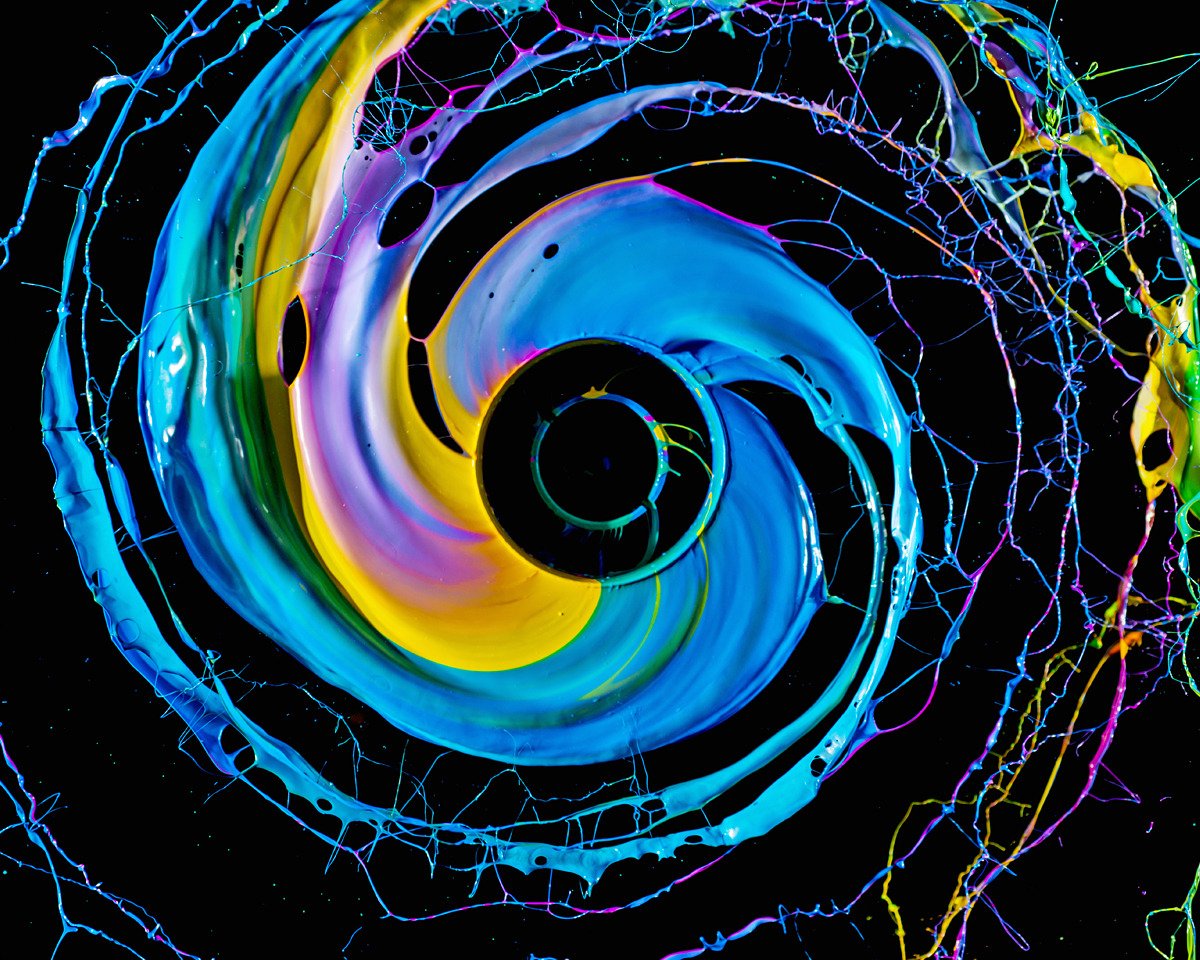
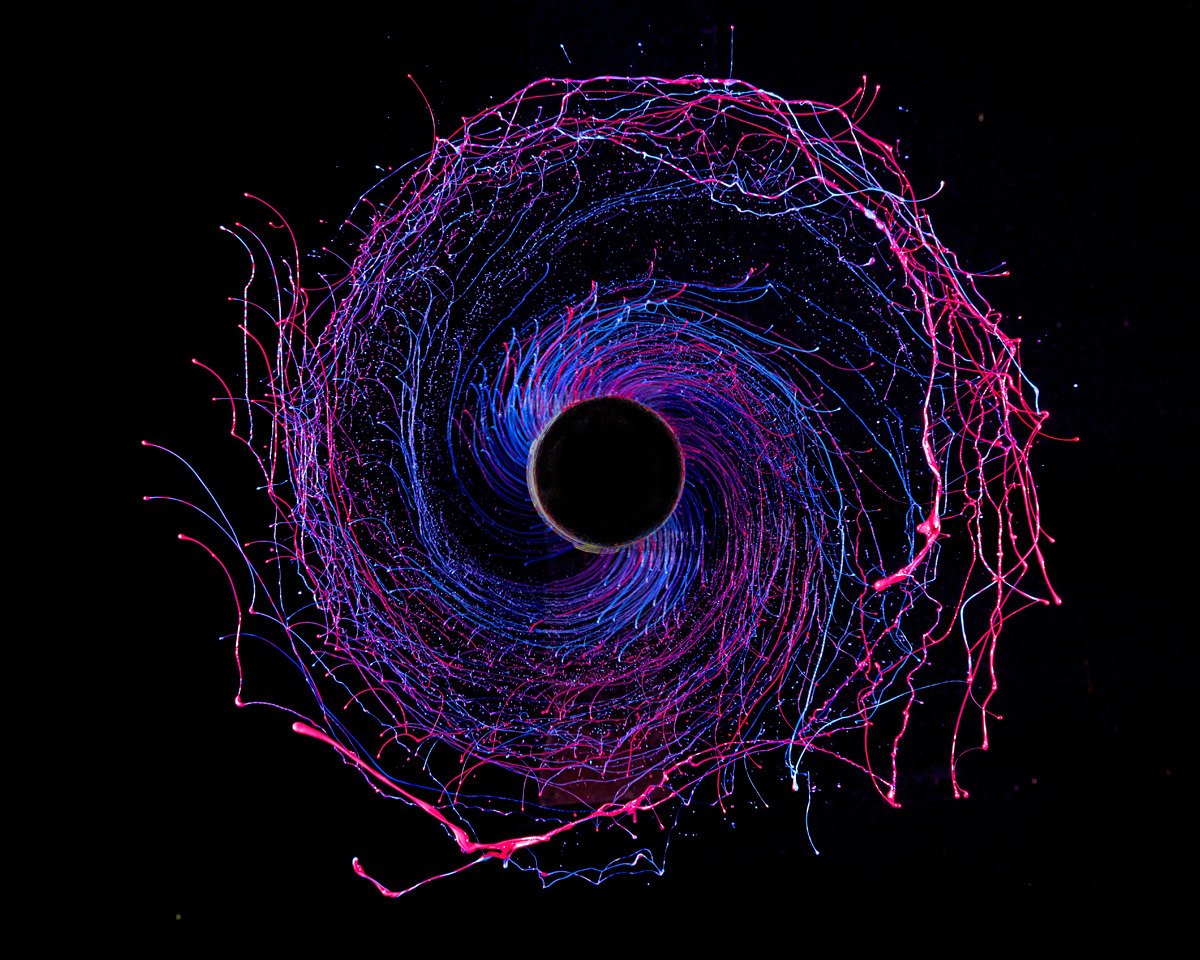
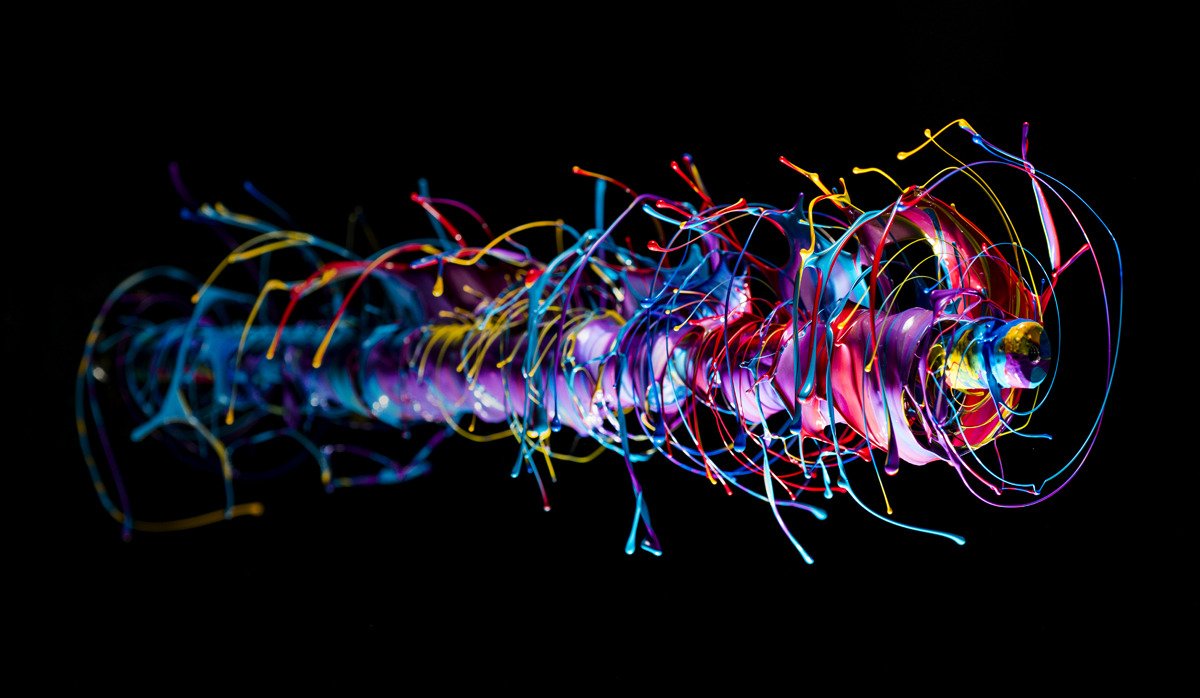
Artist Fabian Oefner captures these colorful portraits of fluid instability by dripping acrylic paints onto a metal rod, which is connected to a drill. When the drill is switched on, paint is flung away from the rod, creating these snapshots of centripetal force and surface tension. Note how droplets gather at the ends of the spiral arms like in a Plateau-Rayleigh or a rimming instability. For more, check out Oefner’s webpage, which includes a video showing how the images are made, or his previously featured work, “Millefiori”. (Photo credit: F. Oefner; submitted by Stephen D.)


