
Tag: fluid dynamics

  • Shocks on a Wing

    Shocks on a Wing

    Commercial airliners fly in what is known as the transonic regime at Mach numbers between 0.8 and 1.0. While the airplane itself never exceeds the speed of sound, that doesn’t mean that there aren’t localized regions where air flows over the airplane at speeds above Mach 1. In fact, it’s actually possible sometimes to see shock waves on the top of airliner’s wings with nothing more than your eyes. The animations above show shock waves sitting about 50-60% of the way down the wing’s chord on a Boeing 737 (top) and Airbus A-320 (bottom). The shock wave looks like an unsteady visual aberration sitting a little ways forward of the wing’s control surfaces.

    The wings themselves are shaped so that these little shock waves are relatively stationary and remain upstream of the flaps pilots use for control. Otherwise, the sharp pressure change across a shock wave sitting over a control surface could make moving that surface difficult. This was one of the challenges pilots first trying to break the sound barrier faced. (Image credits: R. Corman, source; agermannamedhans, source)

  • Vertical Axis Wind Turbines

    Vertical Axis Wind Turbines

    Most people are familiar with the propeller-like shape of conventional wind turbines. These turbines can be more than 100m tall and can generate several megawatts apiece, but placing them in arrays requires a lot of open space because flow downstream of one turbine will interfere with the efficiency of the next. Vertical axis wind turbines (VAWT), like those shown in the photo above, are smaller and produce a fraction of the power of their larger horizontal-axis counterparts, but VAWTs can be placed much closer together. In fact, putting them in closely spaced arrays can actually increase their output through flow synergies. Researchers hope that eventually VAWT arrays will be able to produce significantly more power per land area than conventional wind turbines. (Image credit: Texas A&M Corpus Christi)

  • Windy Urban Corridors (*)

    Windy Urban Corridors (*)

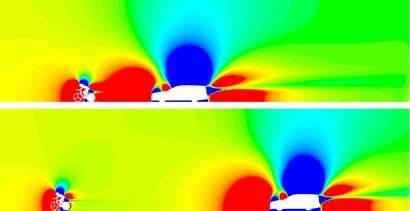
    For pedestrians, windy conditions can be uncomfortable or even downright dangerous. And while you might expect the buildings of an urban environment to protect people from the wind, that’s not always the case. The image above shows a simulation of ground-level wind conditions in Venice on a breezy day. While many areas, shown in blue and green, have lower wind speeds, there are a few areas, shown in red, where wind speeds are well above the day’s average. This enhancement often occurs in areas where buildings constrict airflow and funnel it together. The buildings create a form of the Venturi effect, where narrowing passages cause local pressure to drop, driving an increase in wind speed. Architects and urban designers are increasingly turning to numerical simulations and CFD to study these effects in urban environments and to search for ways to mitigate problems and keep pedestrians safe. (Image credits: CFD analysis – SimScale; pedestrians – Saltysalt, skolnv)

    (*) This post was sponsored by SimScale, the cloud-based simulation platform. SimScale offers a free Community plan for anyone interested in trying CFD, FEA and thermal simulations in their browser. Sign up for a free account here

    For information on FYFD’s sponsored post policy, click here.

  • Featured Video Play Icon

    Bursting Droplets

    Mixing multiple fluids can often lead to surprising and mesmerizing effects, whether it’s droplets that dance or tears along the walls of a wine glass. A recent paper highlights another such mixture-driven instability – the bursting of a water-alcohol droplet deposited on an oil bath. The Lutetium Project tackles the physics behind this colorful burst in the short video above. The behavior is driven by the quick evaporation rate of alcohol in the droplet and the way this changing chemical concentration affects surface tension in the droplet. Alcohol evaporates more quickly from the edges of the drop, creating a region of higher surface tension around the edge. This pulls fluid to the rim of the drop, where it breaks up into droplets that get pulled outward as the inner drop shrinks.

    The oil bath plays an important role in the instability, too. Without it, friction between the drop and a wall is too high for the droplet to “burst”. A thick layer of oil acts as a lubricant, allowing the escaping satellite drops to speed away. (Video and image credit: The Lutetium Project; research credit: L. Keiser et al.; submitted by G. Durey)

  • Breaking the Wave Speed Limit

    Breaking the Wave Speed Limit

    Whirligig beetles are small surface swimming insects. As they race across the water surface, they create both visible and unnoticeable waves on the water. These waves are the result of both surface tension and gravity. Typically, it’s the wavelength of the gravity waves that limit a swimmer or boat’s speed. When the wavelength of the gravity waves a swimmer creates meets the size of the swimmer, the waves generated ahead of the swimmer start to reinforce the waves forming at the back of the swimmer. This traps the swimmer (or boat) in a trough between its bow and stern waves and limits the max speed of the swimmer since overcoming this critical hull speed requires excessive amounts of power.

    The tiny whirligig beetle overcomes this natural speed limit cleverly. It is smaller than the shortest possible gravity wave in water. Thus, it can never be trapped between its bow and stern waves! This allows the tiny swimmer to zip across the water’s surface at speeds above 0.5 m/s. That’s over 30 beetle body lengths per second! (Image credit: H. L. Drake, source; research credit: V. Tucker; submitted by Marc A.)

  • Featured Video Play Icon

    How Jet Engines Work

    Jet engines are a major part of aviation today, and this great video from the new LIB LAB project breaks down how jet engines operate. It focuses especially on the subject of combustion, in which fuel-air mixtures are burned to generate power and thrust. By breaking fuels down into simpler compounds, jet engines are able to accelerate exhaust gases, which creates thrust. They even provide instructions for an effervescence-driven bubble rocket so that kids can (safely!) experiment with propulsion at home. (Video credit: LIB LAB/Corvallis-Benton County Public Library)

  • Supporting Bubbles

    Supporting Bubbles

    Surface tension holds small droplets in a partial sphere known as a spherical cap. But when droplets become larger, they flatten out into puddles due to the influence of gravity. In contrast, soap bubbles remain spherical to much larger sizes. The bubble pictured above, for example, is more than 1 meter in radius and nearly 1 meter in height.

    There is a maximum height for a soap bubble, though, and it’s set by the physical chemistry of the surfactants used in the soap. To support itself, the bubble requires a difference in surface tension between the top and bottom of the bubble. A higher surface tension is necessary at the top of the bubble to help prevent fluid from draining away. The difference in surface tension between the top and bottom of the bubble can never be greater than the difference in surface tension between pure water and the soap mixture – thus those values set a maximum height for a bubble. The researchers found their bubbles maxed out at a height of about 2 meters, consistent with their theoretical predictions. (Image credit: C. Cohen et al.; via freshphotons)

  • Featured Video Play Icon

    Spillways

    Extensive rains in California have brought an unusual sight to Lake Berryessa – an overflowing spillway. The upper photo, taken in 2010, shows the concrete structure of the spillway’s entrance, known as a bellmouth – or, in the words of locals, a glory hole. When the water level rises above the concrete, water begins to cascade down the spillway to relieve flooding.

    The flow is rather mesmerizing and beautifully laminar until it’s fallen many feet down the hole. This is intentional on the part of the designers – at least the laminar part. It means that the flow velocity at the entrance is slow, so that animals (or trespassing people) nearby are not going to get sucked down the spillway a la Charybdis. Nevertheless, the spillway does make quick work of excess water. The New York Times reported that on February 21st about two million gallons (7.5 million liters) of water a minute flowed down the spillway. (Image credits: J. Brooks; T. Van Hoosear; video credit: Lake Berryessa News; submitted by Zach B.)

  • Featured Video Play Icon

    Battery Rockets

    When I post Slow Mo Guys videos, it often comes with a warning not to try this at home. For their latest video, that deserves an extra-special mention: seriously, don’t try this. In this video, Dan and Gav explode lithium-ion batteries. In the process, they discover a safety feature – namely vents on one face of the battery. Because runaway thermal reactions (a.k.a. explosions) are a possibility with this type of battery system, consumer-grade batteries are designed to try and prevent extreme damage. One of these outwardly visible safety features are these four vents that release gas when when the battery is too hot. By venting the gas, manufacturers keep the battery from exploding and sending hot chemicals and shrapnel in all directions. Instead the venting gas turns the entire battery into a miniature rocket. (Video and image credit: The Slow Mo Guys)

  • Wrinkling Winds

    Wrinkling Winds

    If you’ve ever sat out on a lake and just watched the water’s surface, you’ve probably noticed how complex and variable it looks. There may be waves that rock your kayak but there are smaller variations, too, like little ripples or even tiny wrinkles that appear on the surface. Much of this activity comes from wind blowing across the water. When the wind exceeds a critical speed, waves form. They generally travel in lines that are aligned perpendicular to the wind (lower right). But what happens when the wind is below the critical speed?

    A recent study looked at just this question. By blowing air across the surface of different liquids and observing variations in the surface height as small as 2 micrometers, the researchers were able to measure tiny wrinkles on the water’s surface (lower left) when the wind speed was small. The size and shape of the wrinkles actually corresponds to structures in the turbulent air flow over the water! For fluids like water, there’s a smooth transition from wrinkles to waves as the wind speed increases, so both may be visible at the same time. For higher viscosity fluids, the switch from one to the other is more abrupt. (Image credits: water – M. Soveran; figure – A. Paquier et al. w/ annotations added in blue; research credit: A. Paquier et al.)