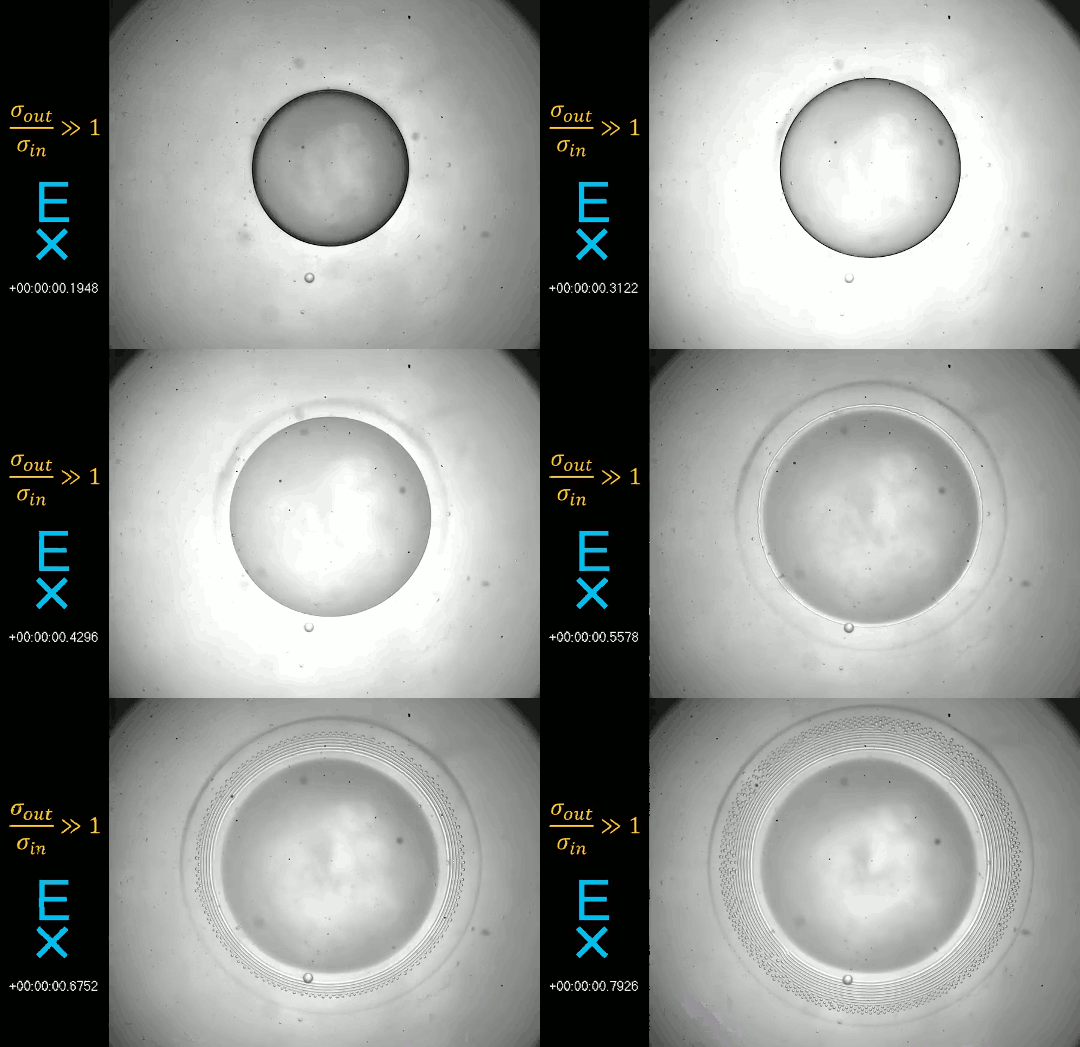
Droplets of acetone deposited on a bath of warm water can float along on a Leidenfrost-like vapor layer. The droplets are self-propelling, too, thanks to interactions between the acetone and water. Acetone can dissolve in water, and when acetone vapor beneath the drop gets absorbed into the water bath, it lowers the local surface tension. That drop in surface tension creates a pull in the direction of a higher surface tension; this is what is known as the Marangoni effect. Because of that flow in the direction of higher surface tension, the acetone drop accelerates away. (Image credit: S. Janssens et al., source)
Tag: fluid dynamics

Asperitas Clouds
This short timelapse captures an impressive display of asperitas clouds over Augusta, Georgia. Asperitas clouds, previously known as undulatus asperatus, are a new classification recommended by the Cloud Appreciation Society in 2009. Recently, the World Meteorological Organization indicated they would include the clouds in the their latest Cloud Atlas under the new name. Asperitas clouds form under conditions similar to those of mammatus clouds – in areas with stable, cool, sinking air near the outskirts of thunderstorms. Despite their ominous appearance, the clouds are not themselves an indicator of severe weather – just a spectacular display of our atmospheric dynamics. Happy World Meteorological Day! (Video credit: A. Walters; via Rebekah W/Flow Viz)

Using Jets to Find Food
Archer fish are well-known for their ability to hit aerial targets with perfectly aimed jets of water, as we’ve discussed previously. But a new study shows they use a similar technique to form underwater jets that help them uncover food. The researchers found that the fish altered the timing of their jet formation based on the type of substrate – fine sand, course sand, or mud – that the food pellet was hidden in. A great next step in this research would be using a technique like particle image velociometry (PIV) to measure the flow field directly and see to what extent the fish’s actions are altering the jet they produce. (Image and research credit: J. Dewenter et al.; GIF source: freshphotons)

Bottle Rocket Shock Diamonds
Mach diamonds or shock diamonds can often be seen in the exhaust of rocket engines. Here they’re shown in high-speed video of a bottle rocket’s launch. The rocket’s exhaust exits at a pressure that is higher than the surrounding atmosphere, which causes the exhaust to bulge outward and forms two expansion fans, seen in pink, to lower the pressure. The pressure actually drops too low, however, causing shock waves, seen in turquoise, to form in order to raise the exhaust’s pressure. This back-and-forth between shock waves and expansion fans continues, forming the diamond shapes we see. Each subsequent set gets weaker as the exhaust closes in on the right pressure, and ultimately the series of diamonds fades into turbulence. (Image credit: P. Peterson and P. Taylor, source)

Titan’s Bubbly Islands
Titan, Saturn’s largest moon, is a fascinating world with remarkable similarities to our own. It is the only other world we know of with stable bodies of liquid at its surface. Unlike Earth, frigid Titan’s lakes and seas are filled with methane and ethane. Radar data from the Cassini mission has shown oddly changing shorelines on Titan, above, with islands that seem to magically appear and disappear over time.
Researchers at NASA’s Jet Propulsion Laboratory now think these islands may, in fact, be bubbles. As Titan’s lakes cool, they’re better able to absorb nitrogen gas, but when temperatures warm up, that gas comes out of solution and floats to the surface, much like the bubbles of carbon dioxide in a soda. If this hypothesis holds up, there are some interesting implications for Titan’s atmosphere. Here on Earth, bubbles popping in the ocean are a major source of aerosol particles. It’s possible migrating rafts of bubbles could behave similarly on Titan. (Photo credit: NASA/JPL-Caltech/ASI/Cornell; submitted by jpshoer)
I’m excited to announce I will be visiting JPL later this month (March 30th), where I have the honor of giving a Women’s History Month talk. If there are any JPLers who are FYFD fans, I hope to see you there. Be sure to RSVP to the ACW luncheon by the March 24th deadline.

Hot Versus Cold
Did you know that you can hear the difference between hot and cold water when they’re poured? Go ahead and give the video above a listen to try it out. I’ll wait.
As explained in the video, the viscosity of water changes with temperature – the higher the temperature, the lower the viscosity. In fact, the viscosity of water at 10 degrees Celsius is more than 4 times higher than the viscosity at 100 degrees Celsius! That’s pretty significant, and it’s a big enough difference that we can hear it in the splash, even if we don’t see the difference when pouring.
Surface tension also decreases with temperature but not nearly as strongly. That 100 degrees Celsius water has 25% less surface tension than the 10 degrees Celsius water. But the combination of this change in viscosity and change in surface tension is why your cold water is more likely to dribble down the spout of your coffee pot when you’re filling the coffee machine than when you’re pouring coffee from the same pot. (Video credit: Steve Mould and Tom Scott; submitted by entropy-perturbation)

Surface Tension’s Pop
Surface tension in a liquid arises from molecular forces. Within a liquid like water, a molecule inside the fluid experiences equal tugs from similar molecules in every direction. A molecule at the surface, on the other hand, experiences the pull of similar molecules only on some sides. The net effect of this imbalance is a tensile force along the liquid surface that acts kind of like a sheet of elastic rubber – this is the effect we call surface tension. If you break the surface tension in a soap film like the one shown above, any tear will expand rapidly as the intact surface tension at the edges pulls the interior fluid away from the tear. (Image credit: C. Kalelkar and A. Sahni, source)

Sloshing in Space
Last month, French astronaut Thomas Pesquet posted a video of some experiments he did on the International Space Station exploring the movement of fluids in microgravity. He filmed the experiments as part of the SPHERES Slosh project. Sloshing is the technical term for how liquids respond to the motion of their container, and it’s a tough problem whether you’re carrying a full coffee mug on Earth or dealing with a partially-emptied fuel canister in orbit.
Here on Earth, gravitational forces dominate how fluids respond, but in microgravity, surface tension is a more powerful player. Pesquet’s demonstrations help scientists here on Earth better understand and model how liquids respond to movement in space. One major application for this is in spacecraft fuel tanks, which engineers must be able to design so that they empty themselves consistently with or without the added complications of spinning, maneuvering, or impulsive kicks of acceleration. (Video and image credit: ESA; submitted by gdurey)


Breaking Down Vortices
Vortex rings are ubiquitous in nature, showing up in droplet impacts, in propulsion, and even in volcanic eruptions. Understanding the interaction and breakdown of multiple vortices with one another is therefore key. The image above shows a circular disk that’s being oscillated up and down (in and out of the page). As the disk moves and changes direction, it generates vortices that interact with one another. Here some of those interactions are visualized with fluorescent dye. The overlapping vortices form complex and beautiful shapes on their way to breakdown. (Image credit: J. Deng et al., poster, paper)

Molten Copper
In this video, the Slow Mo Guys prove that pouring molten copper in slow motion is every bit as satisfying as one would imagine. Because they pour the metal from fairly high up, they get a nice break-up from a jet into a series of droplets; that’s due to the Plateau-Rayleigh instability, in which surface tension drives the fluid to break up into drops. Upon impact, the copper splashes and splatters very nicely, forming the crown-like splash many are familiar with from famous photos like Doc Edgerton’s milk drop. The key difference between the molten copper and any other liquid’s splash comes from cooling; watch closely and you’ll see some of the copper solidifying along the edges and surface of the fluid as it cools. In this respect, watching the molten copper is more like watching lava flow than seeing water splash. (Video and image credit: The Slow Mo Guys)