Tag: fluid dynamics

  • Happy 2000 Posts!

    Happy 2000 Posts!

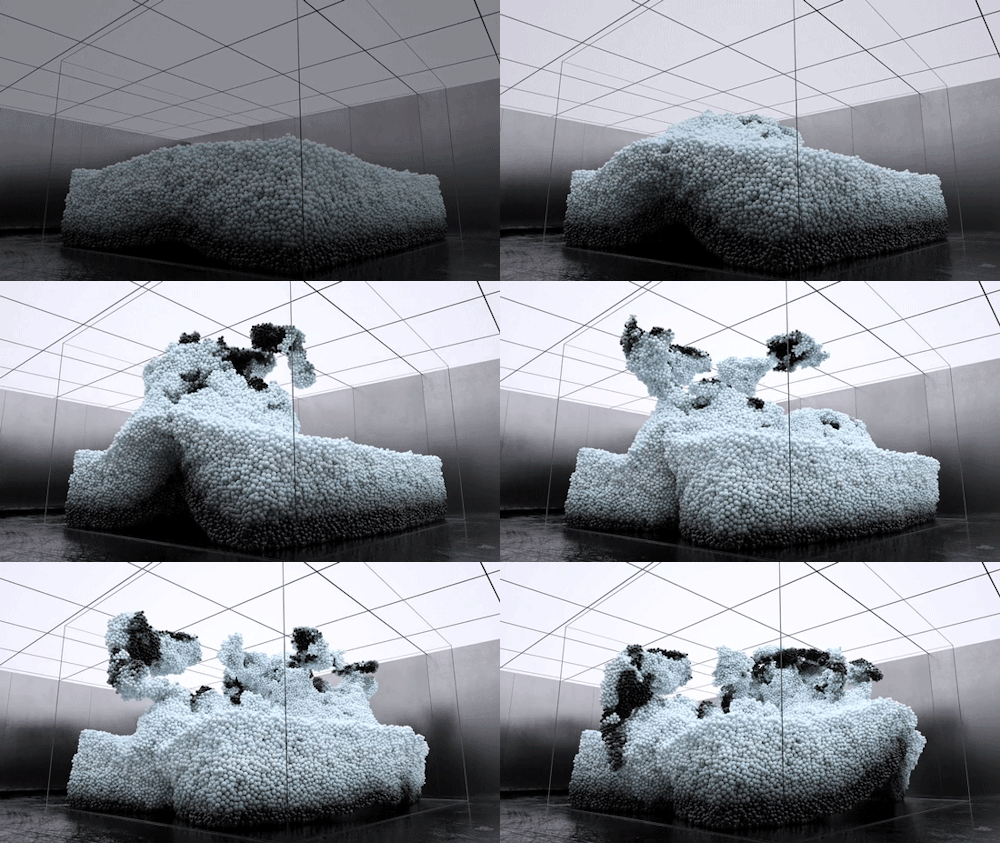
    Happy Friday and happy 2000th FYFD post! To celebrate, I played with surface tension and the Marangoni effect to make some art. For a run-down on the physics, check out this previous post on water calligraphy. Two thousand posts feels like a major milestone. Not everyone realizes this, but FYFD is a one-woman operation, so 2000 posts is a whole lot of research, image editing, and writing. For fun, I’m including here eight completely random FYFD entries, representing less than one-half of one percent of my total archives:  

    1. Why did Chinese junks put holes in their rudders?
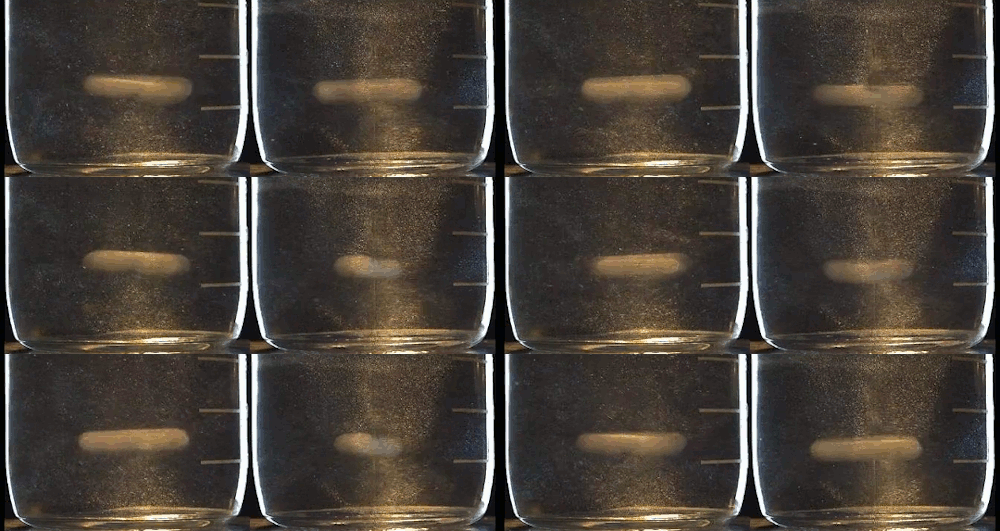
    2. Making droplets in an ultrasonic humidifier
    3. Floating on a granular raft
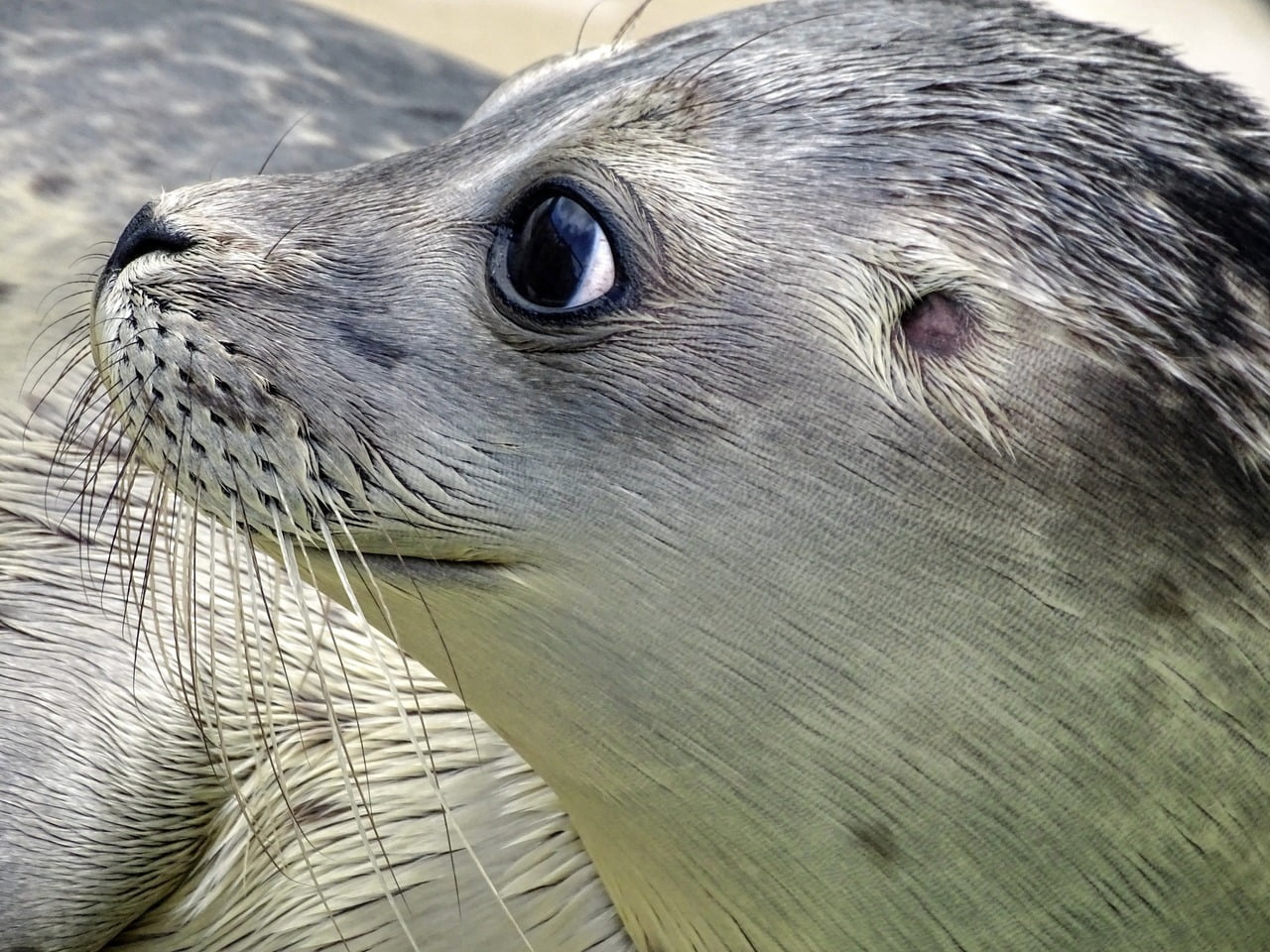
    4. Air-trapping fur keeps otters warm
    5. The physics of the knuckleball
    6. What makes badminton so fast?
    7. Playing with fluorescein
    8. How frost forms

    Want to keep up the random walk? Use https://fyfluiddynamics.com/random to find random entries, or if you prefer your browsing to be more directed, check out the visual archive or the themed series page

    As always, a special thanks to those who help support FYFD through Patreon subscriptions – I couldn’t keep writing and making videos without your help! And thank you to all of you who read and share FYFD. Whether you’ve been following along for a week or for the last eight years, your enthusiasm keeps me motivated! Thank you!

    (Image credits: 2k animation – N. Sharp; Chinese junk ship – Premier Ship Models; ultrasonic humidifier – S. J. Kim et al.; granular raft –  E. Jambon-Puillet and S. Protiere; 3D-printed “fur” – F. Frankel; knuckleball – L. Kang; shuttlecock – Science Friday; fluorescein – Shanks FX; freezing droplets – J. Boreyko et al.)

  • Riding Across Water

    Riding Across Water

    Humans may not be fast enough to run across water, but we’ve found other ways to conquer the waves. It’s even possible (though definitely not recommended) to ride across stretches of water on a dirt bike. To do so, you have to keep the bike (hydro)planing, and to understand what that means, let’s take a moment to talk about boats.

    At low speeds, boats stay afloat based on buoyancy, a force that depends on how much water they displace. But when moving at high speeds, modern speedboats lift mostly out of the water and skim the surface instead. At this point, it’s hydrodynamic lift that keeps the boat above the surface and we say that the boat is planing. Calculating that hydrodynamic lift is fairly complicated and depends on many factors – for those who are interested, check out some of David Savitsky’s papers – but, generally speaking, going faster gives you more lift.

    This brings us back to the dirt bike. There’s nothing particularly hydrodynamic about a dirt bike. It’s not shaped to provide hydrodynamic lift, but it does come with a high power-to-weight ratio. It’s this ability to create pure speed, and a rider’s keen sense for holding the bike at the right angle, that enables pros to cross open water. Needless to say, this is the kind of stunt that could end really badly, so don’t try it yourself. (Image credits: C. Alessandrelli, source; EnduroTripster, source; via Digg; submitted by 1307phaezr)

  • Martian Mantle Convection

    Martian Mantle Convection

    Over geological timescales – on the order of millions of years – even hard substances like rock can flow like a fluid. Heat from the Earth’s core drives convection inside our mantle, and that fluid motion ultimately drives the plate tectonics we experience here at the surface. But most other planetary bodies, including those with mantle convection similar to ours, don’t have a surface that shifts like our tectonic plates. Mars and Venus, for example, have solid, unmoving surfaces. The images above provide a peek at what goes on beneath. The upper image shows a simulation of mantle convection inside Mars over millions of years. The lower image is a timelapse of dye convecting through a layer of glucose syrup being heated from below. Notice how both examples show evidence of convective cells and plumes that help circulate warm fluid up and colder fluid downward. (Image credit: Mars simulation – C. Hüttig et al, source; N. Tosi et al., source; submitted by Nicola T.)

  • Wave Clouds

    Wave Clouds

    Stripe-like wave clouds can often form downstream of mountains. This satellite image shows such clouds in the South Pacific where rocky mountains jut 600 meters (2,000 ft) above the sea. This disrupts air flowing east by forcing it to move up and over the island topography. The air does not simply settle back down on the other side, though. It must come back into equilibrium with its surroundings in terms of density and temperature. While doing so it will travel up and down along a wavy path. As it reaches the crest of the wave, humid air cooling condenses and forms a cloud. At troughs, the air warms and the condensation disappears. This creates the stripey cloud pattern in the mountain’s wake, which fades out as the atmospheric gravity waves die out. (Image credit: NASA/J. Schmaltz; via NASA Earth Observatory)

  • Plasma From a Jet of Water

    Plasma From a Jet of Water

    There aren’t many naturally occurring plasmas in our daily lives; by far the most common one is lightning. So it’s something of a surprise that a stream of water hitting a material like glass is able to produce a toroid of plasma like the one above. The key here, though, is that the jet has to be fast – to the tune of 200 meters per second or faster. When a jet of deionized water strikes a surface at that speed, the water has to take a very sharp, 90-degree turn, and, thanks to the polar nature of water, this causes a (negative) charge to build up at that turn. It’s akin to rubbing a balloon to build up a static charge, and it’s known as a triboelectric effect. At rest (and without high shear rates), water and glass in contact tend to create in a positive charge in the water. The plasma is created when an arc forms through air between those two charged areas.

    Experiments in helium environments create a different color of plasma, confirming that the arc definitely travels through the gas. Similarly, if you use regular water instead of deionized water, the conductivity of the dissolved salts in the water is enough to prevent the necessary build up of charge. (Image and research credit: M. Gharib et al.; video credit: Applied Science; submitted by Kam-Yung Soh)
  • Spinning Paint

    Spinning Paint

    Several years ago Fabian Oefner started spinning paint, and it’s been a perennial favorite online ever since. Here the Slow Mo Guys revisit their own paint-spinning antics by super-sizing their set-up. In some respects, it’s a little dissatisfying; as with their first time around, they don’t moderate the drill speed at all, so after the initial spin-up, the centrifugal acceleration is so strong that it just shreds the paint instead of showing off the interplay between the acceleration and surface tension’s efforts to keep the paint together.

    In their largest experiment, though, the Slow Mo Guys get some interesting physics. Here there’s only a single slot for paint to exit, so the set-up doesn’t lose all its paint at once. The centrifugal acceleration flings the paint out in sheets that stretch into ligaments and then tear into droplets as they move further out. But there’s some more complicated phenomena, too. Notice the bubble-like shapes forming in the yellow paint on the lower right. These are known as bags, and they form because of the relative speed of the paint and the air it’s moving through. This is actually the same thing that happens to falling drops of rain! (Video and image credit: The Slow Mo Guys)

  • Breaking Ground

    Breaking Ground

    Pushing a fluid into a porous granular material can fracture it into branching, lightning-like patterns. Here, air is injected into wet grains as a laboratory analog to hydrocarbon extraction or fracturing to treat contaminated soil. The injection of air compacts grains along the branch boundaries, keeping individual branches separated from one another. The patterns that form change with grain shape and ultimately result from the interactions of pressure, surface tension, friction and viscous forces. Studies like these help optimize fluid flow, decontaminate polluted soil faster, and determine risk in gas-driven fracturing of hydrocarbon reservoirs. (Image and video credit: J. Campbell et al.; submitted by B. Sandnes)

  • Nestling Droplets

    Nestling Droplets

    Pay attention after a rainfall, and you may notice beads of water gathering in the corners of a spider’s web or along the leaves of a cypress tree (bottom right). Look closely and you’ll notice that the largest droplets don’t form along a straight fiber. Instead they nestle into the corners of a bent fiber (top image). Researchers recently characterized this corner mechanism and found that the angle at which the largest droplets form is about 36 degrees. This angle provides the optimal conditions for capillary action and surface tension to hold large drops in place. At smaller angles, a growing droplet’s weight pulls it down until the thin film holding the droplet near the top ruptures and the droplet falls. At larger angles, a heavy droplet will slowly detach from one side of its fiber and shift toward the other side until its weight is too great for the wetted length of fiber to hold. Then it detaches completely and falls. (Research and image credit: Z. Pan et al.; via T. Truscott)

  • What Makes Joints Pop?

    What Makes Joints Pop?

    Cracking one’s knuckles produces an unmistakable popping noise that satisfies some and disconcerts others. The question of what exactly causes the popping noise has persisted for more than fifty years. It’s generally agreed that separating the two sides of a joint causes low enough pressures to form a cavitation bubble in the sinovial fluid of the joint. But researchers have been divided on whether it’s the formation or the collapse of this bubble that’s responsible for the sound. Studying the phenomenon firsthand is difficult with today’s imaging technologies – none of them are fast enough to capture a behavior that takes only 300 milliseconds. As a result, scientists are turning to mathematical modeling and numerical simulation.

    A recent study tackled the problem by modeling a joint that already contains a bubble and examining the bubble’s response to changes in pressure inside the joint. The pressure changes alter the bubble’s size and cause it to generate sound. When compared to experiments of people cracking their knuckles, the simulated sounds are remarkably similar in both amplitude and frequency. It’s not even necessary for the bubble to collapse completely to make the noise. Just a partial collapse is enough to sound just like that old, familiar pop. (Image credit: G. Kawchuk et al.; research credit: V. Chandran Suja and A. Barakat; via Gizmodo)

  • Jupiter’s Belts and Zones

    Jupiter’s Belts and Zones

    Jupiter’s distinctive bands of colored clouds, known as belts and zones, have been an iconic part of the planet since they were first observed by Galileo. (The scientist, not the space mission!) They are considered part of Jupiter’s weather layer, the region of its atmosphere where storms reign. Thanks to gravitational measurements by the Juno spacecraft, we now know how deep these bands persist; they stretch about 3,000 kilometers into Jupiter! That means that Jupiter’s weather layer accounts for about one percent of the planet’s total mass. By comparison, Earth’s entire atmosphere makes up less than one millionth of its mass. What lies beneath Jupiter’s colorful clouds is also intriguing. The same gravitational measurements that indicate the weather layer’s depth also suggest that, beneath these storms, the rest of Jupiter rotates like a solid body. (Image credit: NASA, source; research credit: Y. Kaspi et al., submitted by Kam-Yung Soh)