Tag: fluid dynamics

  • Wild Extrusions

    Wild Extrusions

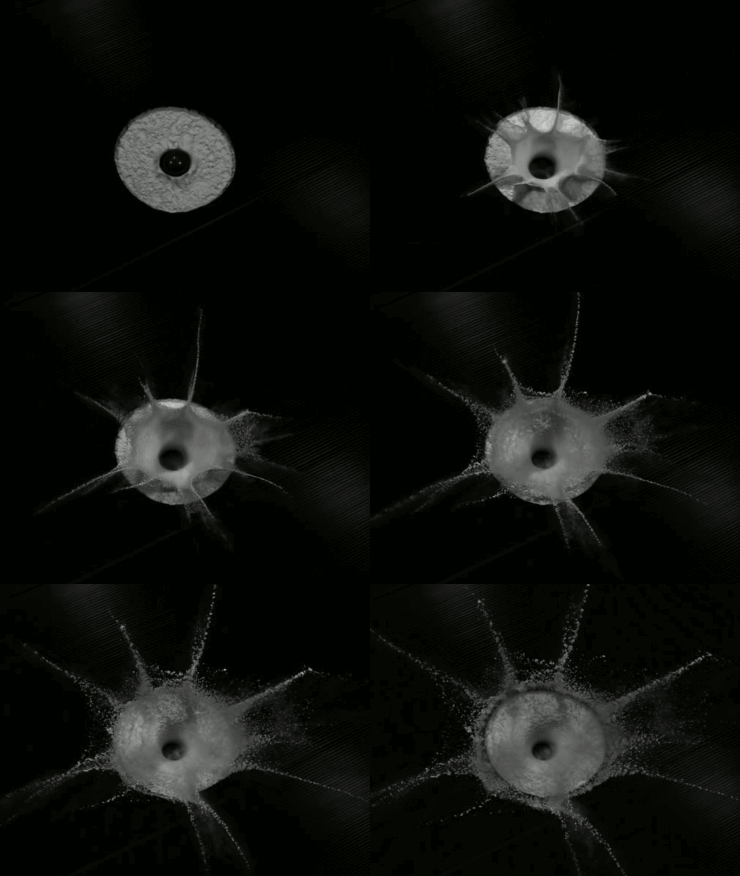
    In their continuing quest to squish all the things, the Hydraulic Press channel recently debuted a tool with a series of small holes they can extrude various substances through. The video features several great extrusions, including oobleck, temperature-sensitive putty, cheese, and crayons (above). Most of these substances are non-Newtonian fluids of some kind, and the extreme forces the hydraulic press causes makes for some wild effects.

    Many of the substances, including the crayons above, display signs of the sharkskin instability in their rough edges. When non-Newtonian fluids (like the paraffin wax in crayons) get extruded quickly, the material at the edges experiences a lot of friction and shear when trying to flow along the wall of the hole. When the fluid finally breaks free, the region along the outside accelerates to match the speed of fluid at the center of the extrusion. Parts of the mixture may resist that acceleration, resulting in the uneven edges seen above. (Video credit: Hydraulic Press Channel; GIF via Colossal)

  • The Catherine Wheel

    The Catherine Wheel

    When particles of different sizes fall in an avalanche, they separate out by size. Smaller particles form one layer with another layer of larger particles over the top. This happens because the smaller particles tend to fall in between the larger ones, similar to the percolation theory in the Brazil nut effect. In a slowly rotating drum, this size segregation during an avalanche forms a distinctive pattern (above) called a Catherine wheel pattern. Here, the gray layers form from smaller iron particles, while the white layers are large particles of sugar. Notice that the pattern starts to form during each avalanche, but it freezes in place after grains pile up against the drum wall and cause a shock wave to run back up the avalanche. (Image credit: J. Gray and V. Chugunov, reprinted in J. Gray, source)

  • Hydrofoils and Stability

    Hydrofoils and Stability

    Today’s fastest boats use hydrofoils to lift most of a boat’s hull out of the water. This greatly reduces the drag a boat experiences, but it can also make the boat difficult to handle. One style of hydrofoil boat, called a single-track hydrofoil, uses two hydrofoils in line with one another to support and steer the boat. The pilot can steer the lead hydrofoil into the direction of a fall to correct it. Stability-wise, this is the same way that you keep a bicycle upright. On a boat, the situation is a bit tougher to manage, and, like riding a bike, it takes practice. A group of students published a full mathematical model for the dynamics of this kind of boat, which allows designers to test a prototype’s stability early in the design process and enables student teams to use computer simulators to train their pilots to drive a boat before putting them out on the water, similar to the way that airplane pilots train. (Image credit: TU Delft Solar Boat Team, source; research credit: G. van Marrewijk et al., pdf; via TU Delft News; submitted by Marc A.)

  • Colorful Erosion

    Colorful Erosion

    Wind, water, and gravity are great sculptors of our world. This false-color satellite image shows the Ga’ara Depression in Iraq, which formed some 300 million years ago beneath a shallow sea. The steep cliffs along the southern edge of the depression continue moving southward as they’re eroded by wind and run-off. When infrequent but intense rains pour down the channels of the southern cliffs, it carves away sediment which the water carries onward. In the flatter basin, these sometimes-rivers slow and spread out, eventually dropping the sediment they carry into sandbars. The build-up of sandbars causes the slower-moving water to shift its course back-and-forth over time, creating the alluvial fans seen along the southern and western borders. (Image credit: J. Stevens, via NASA Earth Observatory)

  • Can Zooplankton Mix Oceans?

    Can Zooplankton Mix Oceans?

    Krill and other tiny marine zooplankton make daily migrations to and from the ocean surface. Previously, models of ocean mixing ignored these migrations; these animals are tiny, researchers argued, so any effects they could have would be too small to matter. But zooplankton make these migrations in huge swarms, and studies of a laboratory analog of their migrations (using brine shrimp rather than krill) reveal that, when moving en masse, these tiny swimmers create turbulent jets and eddies far larger than an individual. Their collective motion is enough to mix salty water layers 1000 times faster than molecular diffusion alone! Learn more in the latest FYFD video, embedded below. (Image and video credit: N. Sharp; research credit: I. Houghton et al.; h/t to Kam-Yung Soh)

  • Featured Video Play Icon

    “Flowers and Colors”

    Many children have done the simple experiment of placing a cut flower in dyed water and watching as it changed color. The latest video from Beauty of Science relies on some related physics. Since the color of flowers typically depends on acidity, immersing a flower in dilute acid will change its color from pinks and purples to yellows and greens. Watching this transformation, we can learn about how fluids get transported through flowers.

    Like the leaves on a tree, flowers are covered in tiny cells called stomata that can open and close. In the daytime, stomata are typically open to allow carbon dioxide to diffuse into the plant. (At the same time, water pulled up from the roots is evaporating out the stomata, as seen previously.) Once immersed in acid, the open stomata are no longer bringing in carbon dioxide; instead, the acid is diffusing in and slowly spreading through the petals. In the timelapse video, some areas of the petal change faster than others. This could indicate more open stomata in the regions that change first or even that some areas inside the petal transport water (and acid) better than others. (Video and image credit: Beauty of Science; see also Making Of)

  • Bubble Trains in a Microchannel

    Bubble Trains in a Microchannel

    Trains of bubbles flowing through a microchannel get distorted by periodic expansions and constrictions. In these images, flow is from left to right, and the narrow point of the channel is about 250 microns across. In narrow regions, the front of the bubble tends to move faster, while in wider areas, the back of the bubble speeds up. This causes the distinctive shape changes we see. Microfluidic channels with these exaggerated shifts in geometry allow researchers to study the physics behind liquids and gases seeping through the interstitial gaps of a porous media, like when water and gases move through rock and soil. (Image and research credit: M. Sauzade and T. Cubaud)

  • The Disintegrating Splash

    The Disintegrating Splash

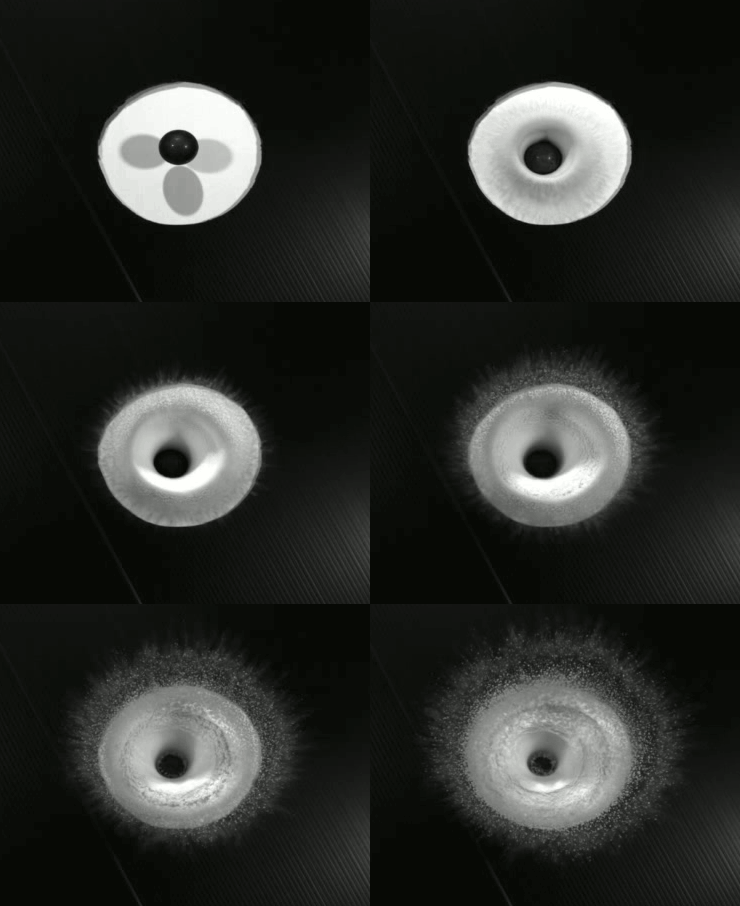
    A drop of blue-dyed glycerine impacts a thin film of isopropanol, creating a spectacular splash and breakup. The drop’s impact flings a layer of the isopropanol into the air, where air currents make the thin sheet buckle inward and break into a spray of droplets. Meanwhile, the liquid from the drop forms a thick, blue crown that rises and expands outward. When tiny droplets of the isopropanol hit the splash crown, their lower surface tension causes the blue glycerine to pull away, due to the Marangoni effect. This opens up holes in the crown, which grow quickly, until the entire sheet breaks apart. (Image and research credit: A. Aljedaani et al., source)

  • Snowmelt

    Snowmelt

    Much of the rain that falls on Earth began as snow high in the atmosphere. As it falls through warmer layers of air, the snowflakes melt and form water droplets. The details of this melting process have been difficult to capture experimentally, but a new computational model may provide insight. The basic process has a couple stages. As snow begins to melt, surface tension draws the water into concave areas nearby. When those regions fill up, the water flows out and merges with neighboring liquid, forming water droplets around a melting ice core.

    Although this same sequence was observed for many types of snow, scientists also observed some important differences between rimed and unrimed snowflakes. Rime forms when supercooled water droplets freeze onto the surface of a snowflake. Lightly rimed snow still looks light and fluffy, like the animation above, but heavily rimed snow forms denser and more spherical chunks. Because there are lots of porous gaps in heavily rimed snow, water tends to gather there during initial melting. Rimed snow was also more likely to form one large water droplet rather than breaking into multiple droplets like snow with less rime. For more, check out NASA’s video and the Bad Astronomy write-up. (Image credit: NASA, source; research credit: J. Leinonen and A. von Lerber; via Bad Astronomy; submitted by Kam Yung-Soh)

  • Skyglow

    Skyglow

    Timelapse can be a beautiful way to highlight slow-moving flows like those in the sky. But it can also be valuable in showing differences in speed, as in the latest SKYGLOW Project video, “Colorado Serenade”, which shows the Colorado River and the skies overhead simultaneously. Timelapse highlights the difference in time scales between the fast-moving river and slower-moving clouds.

    This mirrors an important phenomenon in fluid dynamics known as “separation of scales”. In a flow, there are often multiple effects at play and they may occur on different time (or length) scales. Which matters most in a given situation will depend on those scales. Consider a rocket engine. Combustion inside the engine ignites fuel and oxidizer, releasing heat. At the same time, the flow in the engine is key to mixing that fuel and oxidizer together so that all of the fuel and oxidizer ignites before it is sent downstream into the rocket nozzle. There are two important time scales here: the time it takes for the flow to mix fuel and oxidizer together and the time it takes for the combustive chemical reaction to take place. In an ideal world, engineers can balance those two time scales to maximize efficiency. But in the (admittedly less ideal) real world, this is not always possible. (Video and image credit: H. Mehmedinovic/SKYGLOW)