June and July brings blooming phytoplankton to the Baltic Sea, seen here in late July 2025. On-the-water measurements show that much of this bloom was cyanobacteria, an ancient type of organism among the first to process carbon dioxide into oxygen. These organisms thrive in nutrient- and nitrogen-rich waters. Here, they mark out the tides and currents that mix the Baltic. Zoom in on the full image, and you’ll see dark, nearly-straight lines across the swirls; these are the wakes of boats. (Image credit: M. Garrison; via NASA Earth Observatory)
Tag: fluid dynamics

Salty Swirls
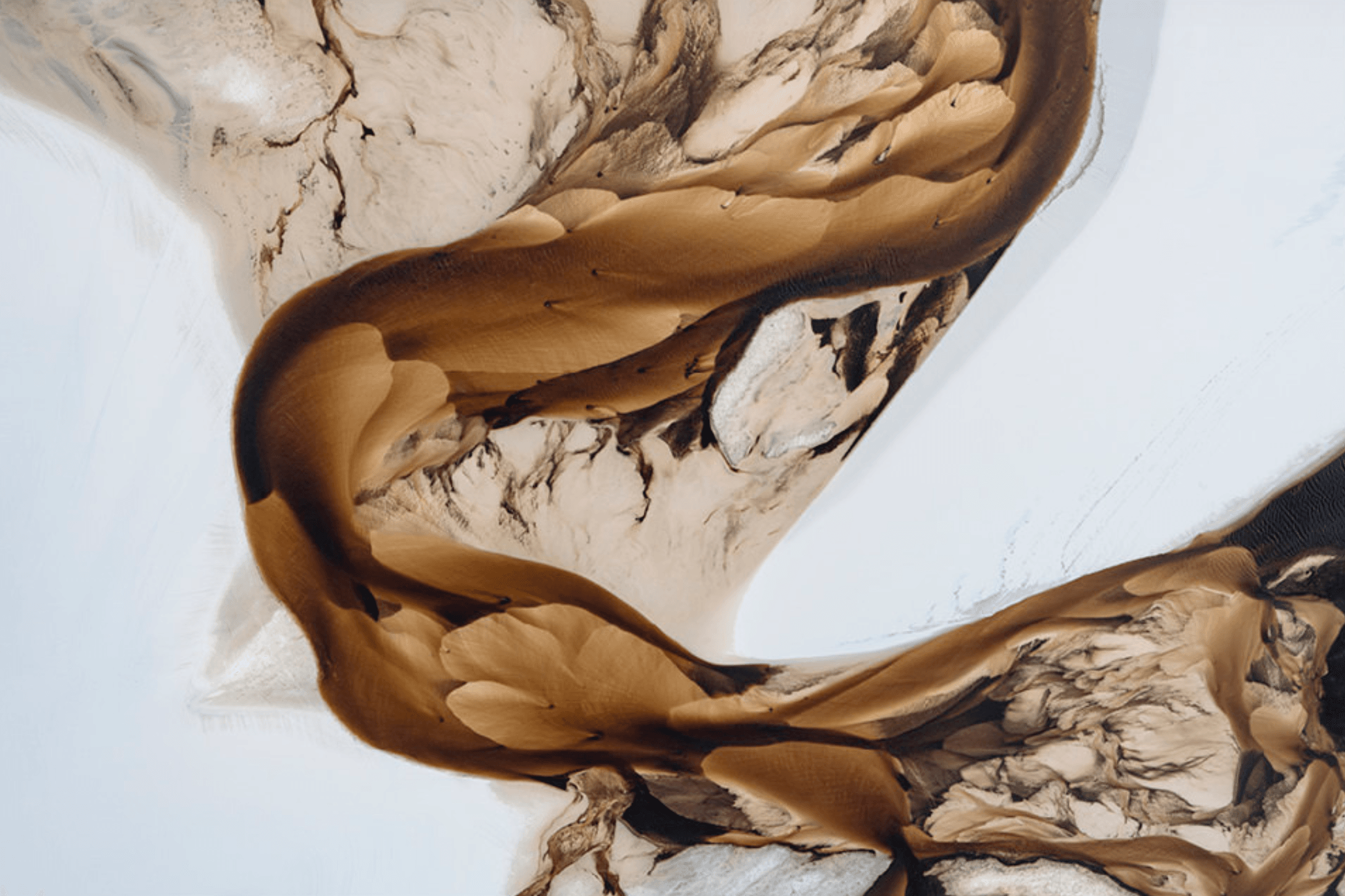
Flamingos soar over swirls of salt and algae in a lake in Kenya’s Rift Valley. Shaped by winds, currents, physics, and chemistry these eddies reflect the motion of the water, evaporation patterns, and more. Without more information, it’s hard to say exactly what shapes the pattern, but it does appear reminiscent of a Kelvin-Helmholtz instability in places. (Image credit: B. Hayden/IAPOTY; via Colossal)

Studying Hydroelastic Turbulence
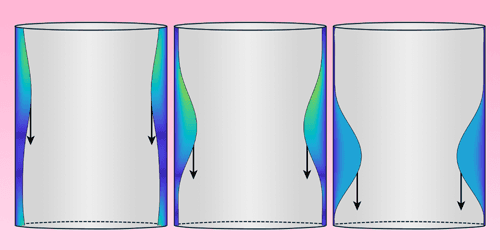
Can energy at the small-scales of a turbulent flow work its way up to larger scales? That’s a question at the heart of today’s study. Here, researchers are studying hydroelastic waves — created by stretching a thin elastic membrane over a water tank. The membrane gets vibrated up and down in just one location with an amplitude of about 1 millimeter. The resulting waves depend both on the movement of the water and the elasticity of the membrane, mimicking situations like ice-covered seas.
Rather than simply dying away, the local fluctuations introduced at the membrane spread, coalescing into larger-scale hydroelastic waves. How energy flows between these scales could have implications for weather forecasting, climate modeling, and other turbulent systems. (Image and research credit: M. Vernet and E. Falcon; via APS)

The Puquios System of Nazca
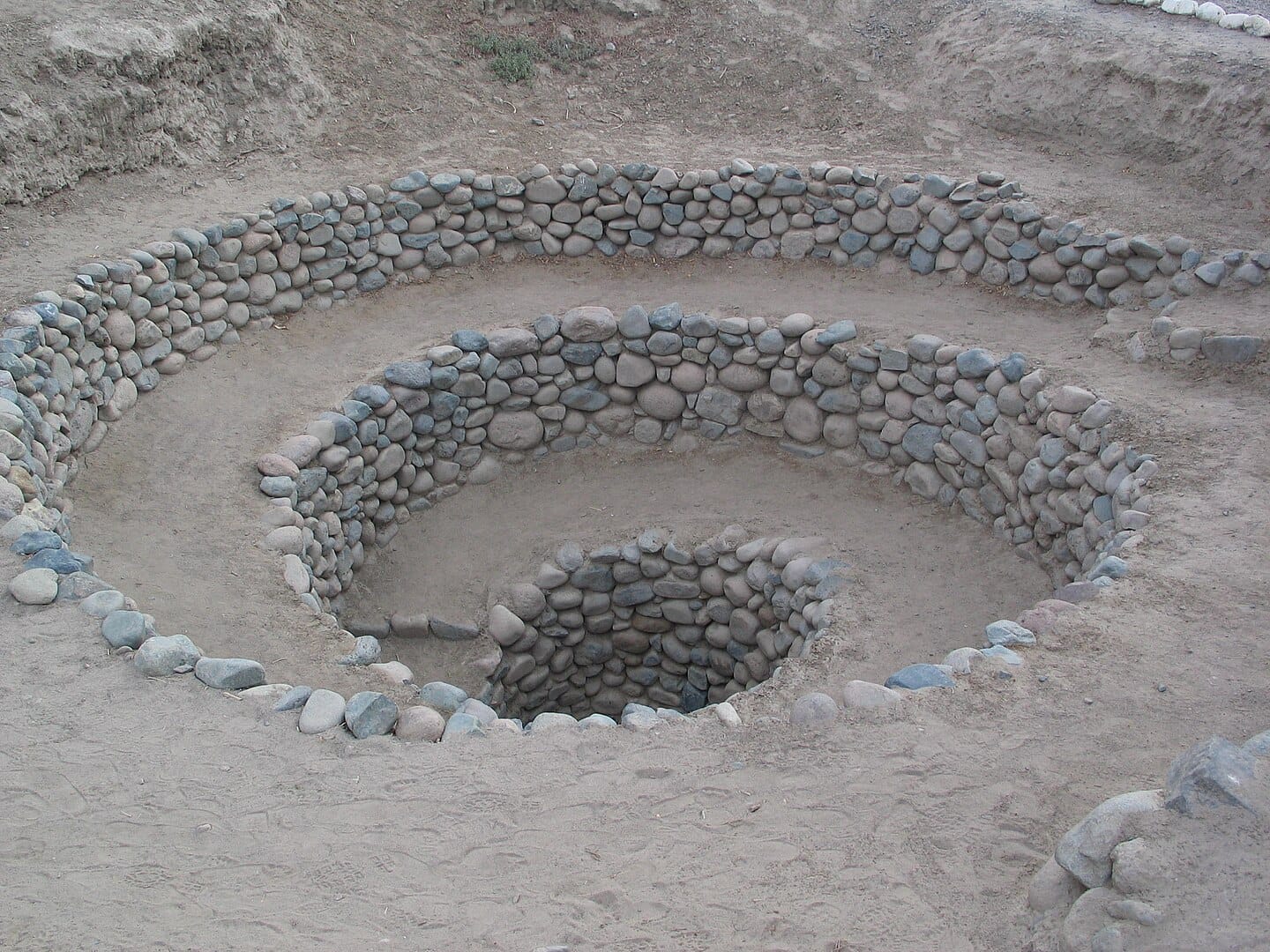
The arid Nazca region of Peru is dotted with spiral-shaped indentations, part of an irrigation system that helped indigenous civilizations thrive here before European contact. Although the region’s rainfall varies year-to-year, it never amounts to much. So pre-Columbian Nazcans turned instead to underground aquifers to gather and transport water.

An aerial view of several puquois chimneys near Nazca, Peru. Aquifers in the region slope downward, following the local geology. Puquios builders began by digging a preliminary well in the highlands, tunneling down until they reached the aquifer. Then they built a horizontal tunnel underground, sloping gently downward, toward the location where water was needed. Along that roughly horizontal tunnel, they built additional chimneys, the spiraling mouths of which are seen above. These chimneys are thought to serve multiple purposes. They provide maintenance access to the aqueduct tunnel, and their shape may help funnel wind underground to oxygenate the water and help keep it flowing. Eventually, the underground tunnel would exit into an open trench and a reservoir, providing year-round water for irrigation and personal use.

Although the puquios cannot themselves be dated through usual archaeological means, the current consensus is that they originate from around 500 C.E., with subsequent modifications by both indigenous and colonial inhabitants. Impressively, several dozen puquios are still providing water today. (Image credits: Ab5602/Wikimedia, PsamatheM/Wikimedia, and R. Lasaponara et al.; research credit: R. Lasaponara et al.; via Eleanor K.)

Recycling Water
As regions are stressed by severe drought, communities considering how to stretch their water supply increasingly turn to the option of reclaiming wastewater. As Grady explains in this video, that idea faces both technological and psychological challenges. But neither, it turns out, is insurmountable. (Video and image credit: Practical Engineering)

“Sensations”
Beautiful colors, subtle flows, and sudden fractals animate Thomas Blanchard’s “Sensations,” which, like his other short films, is entirely CGI-free. It’s a lovely exploration of droplets, liquid lenses, Marangoni effects, and fingering instabilities. (Video and image credit: T. Blanchard)

Uranus Emits More Than Thought
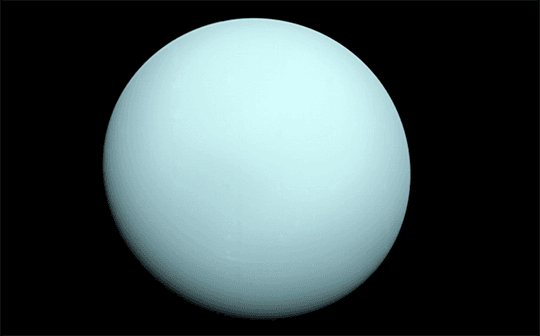
Since Voyager 2 visited Uranus in 1986, scientists have debated the odd ice giant’s heat balance. The other giant planets of our solar system — Jupiter, Saturn, and Neptune — all emit much more heat than they absorb from the sun, indicating that they have strong internal heat sources. Voyager 2’s measurements from Uranus indicated only weak heat emissions.
But a new study indicates that Uranus does, in fact, have an internal heat source contributing to its heat flux. The study combined observations with a global model of Uranus across the planet’s full 84-year orbit and concluded that Uranus emits 12.5% more internal heat than it absorbs from the sun. That suggests that Uranus may not be so different from its fellow giants, but the planet’s large seasonal variations and differences across hemispheres raise plenty of questions about the planet’s interior structure. (Image credit: NASA; research credit: X. Wang et al.; via Gizmodo)
Veil Nebula
These glowing wisps are the visible remains of a star that went supernova about 7,000 years ago. Today the supernova remnant is known as the Veil Nebula and is visible only through telescopes. In the image, red marks hydrogen gas and blue marks oxygen. First carried by shock waves, these remains of a former star now serve as seed material for other stars and planetary systems to form. (Image credit: A. Alharbi; via APOD)

What Makes a Dune?
Wind and water can form sandy ripples in a matter of minutes. Most will be erased, but some can grow to meter-scale and beyond. What distinguishes these two fates? Researchers used a laser scanner to measure early dune growth in the Namib Desert to see. They found that the underlying surface played a big role in whether sand gathered or disappeared from a given spot. Surfaces like gravel, rock, or moistened sand were better for starting a dune than loose sand was. Each of these surface types affected how much sand the wind could carry off, as well as whether grains bounced or stuck where they landed. Every trapped sand grain made the surface a little rougher, increasing the chances of trapping the next sand grain. Over time, the gathering sand forms a bump that affects the wind flow nearby, further shaping the proto-dune. As long as the wind isn’t strong enough to scour the surface clean, it will keep gathering sand as the process continues. (Image credit: M. Gheidarlou; research credit: C. Rambert et al.; via Eos)