Tag: fluid dynamics

  • Chaos in the Lagoon Nebula

    Chaos in the Lagoon Nebula

    Even on the scale of light-years, fluid dynamics plays a role in our universe. This photograph shows the Lagoon Nebula, where stars, gas, and dust are battling for supremacy. Jets from young stars push the dust left from supernova remnants into a chaotic patterns, and the high-energy particles streaming from the youthful stars illuminate interstellar gases, creating the nebula’s distinctive glow. This section of the nebula is about 50 light-years across, so every picture we capture is only the tiniest snapshot of the true scale of its turbulence. (Image credit: Z. Wu; via APOD)

  • Flying Through Waterfalls

    Flying Through Waterfalls

    Swifts and starlings often make their nests behind waterfalls. To explore how these birds traverse their watery curtain, researchers observed hummingbirds, a smaller sister species, flying through an artificial waterfall. They found that the birds tended to part the water with one wing while continuing to use the other to produce thrust. This behavior helped them cross the barrier smoothly and easily.

    In contrast, smaller and slower flyers, like the insect species the researchers tested, were typically unable to cross the waterfall. Instead, they got carried away by the flow or managed to pass through only to crash. The scientists suggest that protection from insects may be one reason birds choose to nest behind waterfalls. (Image and research credit: V. Ortega-Jimenez et al.; via Science; submitted by Kam-Yung Soh)

  • Featured Video Play Icon

    “Colors”

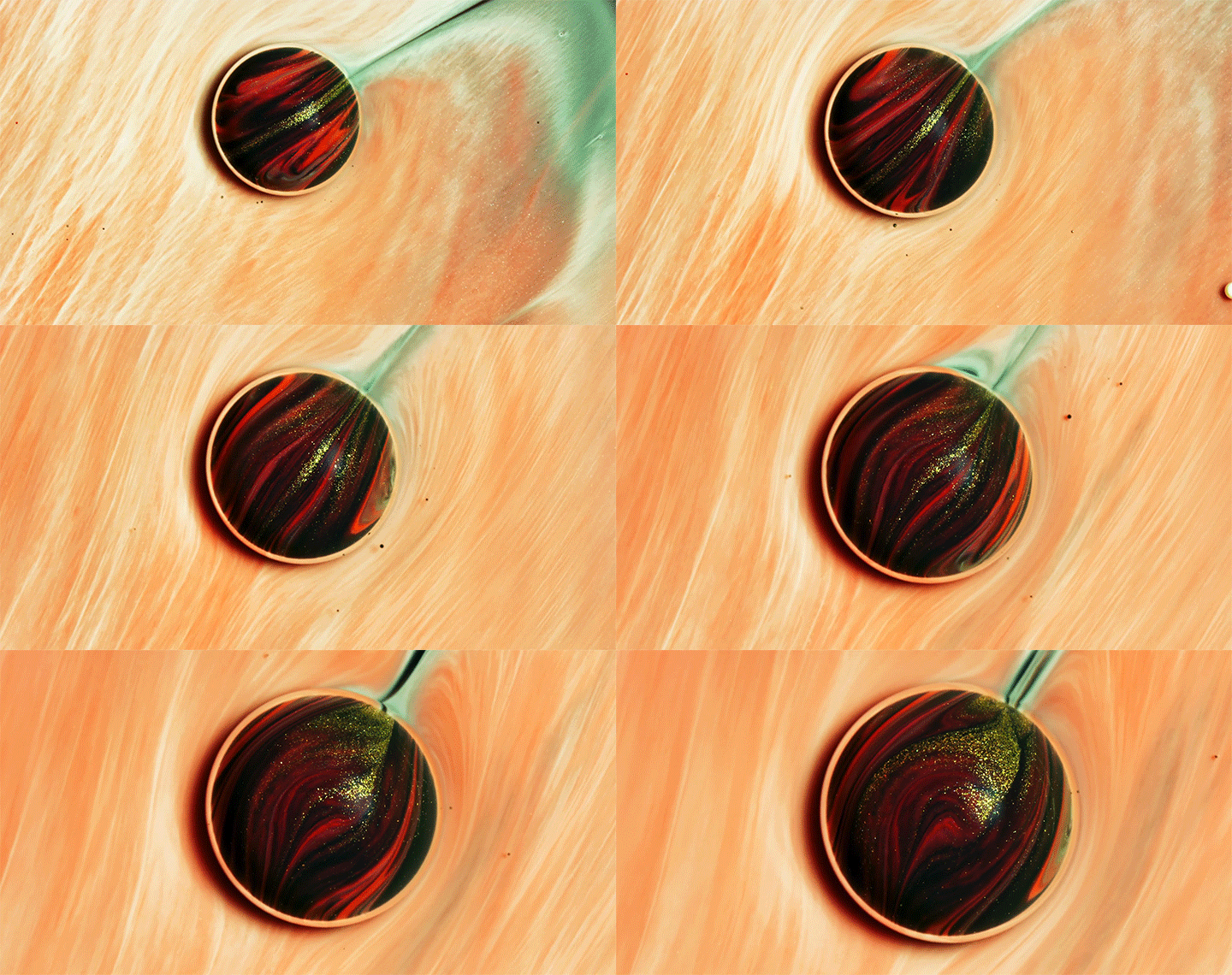
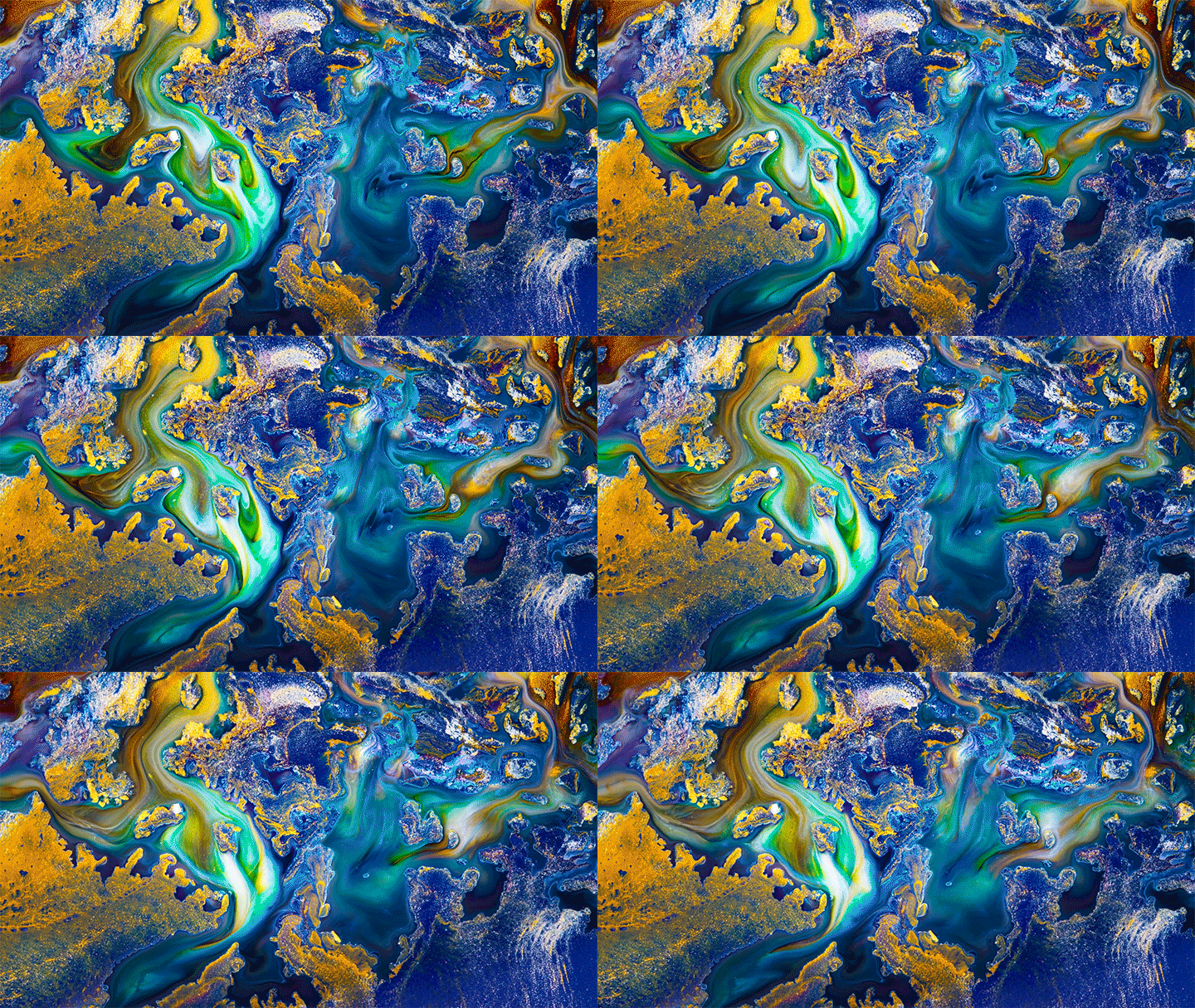
    Paint, soap, bleach, oil, and oat milk combine to create the gorgeous colorscapes of Thomas Blanchard’s short film “Colors”. Watch as droplets burst and waves of color flow past. It’s a lovely break from whatever you’re dealing with at the moment, and at less than 3 minutes long, you can spare the time! (Image and video credit: T. Blanchard)

  • Rings of Ice

    Rings of Ice

    Heavy rains followed by a sudden freeze can produce icy puddles like this one. Because the pool was shallow to begin with, it likely froze rapidly. As the temperature continued dropping, the newly-formed ice contracted; the ring pattern of the cracks tells us the stress in the ice was primarily radial. Once formed, the cracks provided a path for any unfrozen water still in the puddle to get squeezed up onto the surface through capillary action and any further expansion or contraction of the ice. (Image credit: D. Stith; via EPOD; submitted by Kam-Yung Soh)

  • Droplets on Inclined Walls

    Droplets on Inclined Walls

    When a droplet impacts an inclined surface, it spreads asymmetrically. The splash shape is largely elliptical, as researchers found when modeling such impacts over a range of inclination angles. Understanding such splash patterns is important not only for industrial applications like printing but in areas like forensic science. (Image and research credit: P. García-Geijo et al.)

  • Featured Video Play Icon

    A Primer on Blood Pressure

    Some of the most important fluid dynamics goes on every moment inside our bodies. After only a few weeks of gestation, the human heart begins its lifelong task of pumping blood throughout tens of thousands of kilometers’ worth of blood vessels. One of our simplest methods for tracking the health of this critical system is a person’s blood pressure, which measures the forces exerted on our blood vessels as our hearts pump. This video gives a brief primer on blood pressure as well as some of the problems that arise when extended bouts of high blood pressure damage our blood vessels. (Image and video credit: TED-Ed)

  • Freezing Splats

    Freezing Splats

    When a drop hits a surface colder than its freezing point, there’s a competition between retraction and solidification that determines the final shape of the splat. For many materials, like wax or soldering metals, the contact angle between their liquid and solid phase is zero, so there’s no major shape change once solidification begins. But water — as is so often the case — is an exception.

    Water and ice have a non-zero contact angle, which means that retraction can continue even after the drop begins freezing. As a result, the final shape of the splat varies depending on how cold the surface is. For a surface only a little colder than the freezing point, the final splat forms a spherical cap (Image 1). But once the surface is colder, freezing happens before the water can fully retract and the final splat forms a ring (Image 2). (Image and research credit: V. Thiévenaz et al.)

  • Coffee, Magnified

    Coffee, Magnified

    Sometimes it’s nice to see a new perspective on something familiar. These images show oils from coffee beans suspended in hot water, as seen under 40x magnification. The crystals you see are caffeine and the variety of shapes in the oil blobs is due to being sandwiched between two layers of glass. You can check out an image of the set-up these students used here. (Image credits: M. Armstrong and B. Pullutasig)

    Coffee oils suspended in hot water.
  • A Colorful Portrait of Flow

    A Colorful Portrait of Flow

    This gorgeous, natural-color image shows Lake Balkhash in southeastern Kazakhstan. In early March, the ice on the lake was beginning to break up, revealing glimpses of swirling sediment below the water’s surface. In contrast, the smaller lakes and ponds of the surrounding area remained frozen amidst the wintery browns of the nearby desert and wetlands. (Image credit: J. Stevens/USGS; via NASA Earth Observatory)

  • Vortex Rings on V-Shaped Walls

    Vortex Rings on V-Shaped Walls

    Vortex ring impacts are eternally fascinating. Here, researchers explore what happens when a vortex ring encounters a V-shaped wall. Because the outer portions of the vortex ring hit the wall sooner than the inner ones, distortions begin there first.

    The vortex’s approach creates a pressure gradient that causes flow near the wall to separate, generating that first little hook in each arm of the vortex. Next, secondary vortices develop on either side and quickly get pulled into the original vortex. The whole process repeats a second time to generate tertiary vortices that continue the inward spiral. The impact appears even more complicated when viewed from the side of the valley (Image 2). Check out Image 3 for a point-by-point breakdown of the impact process. (Image and research credit: T. New et al.)