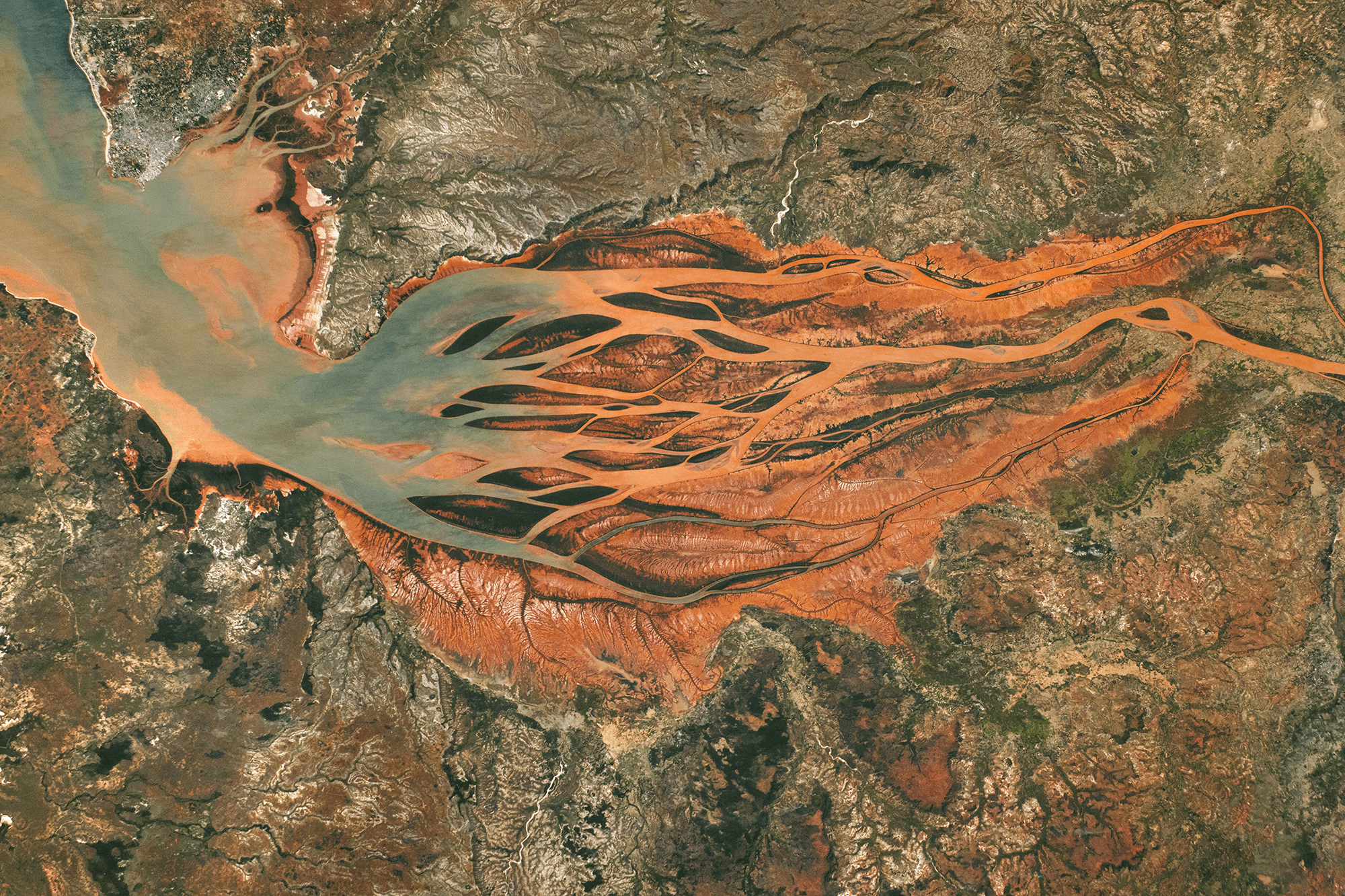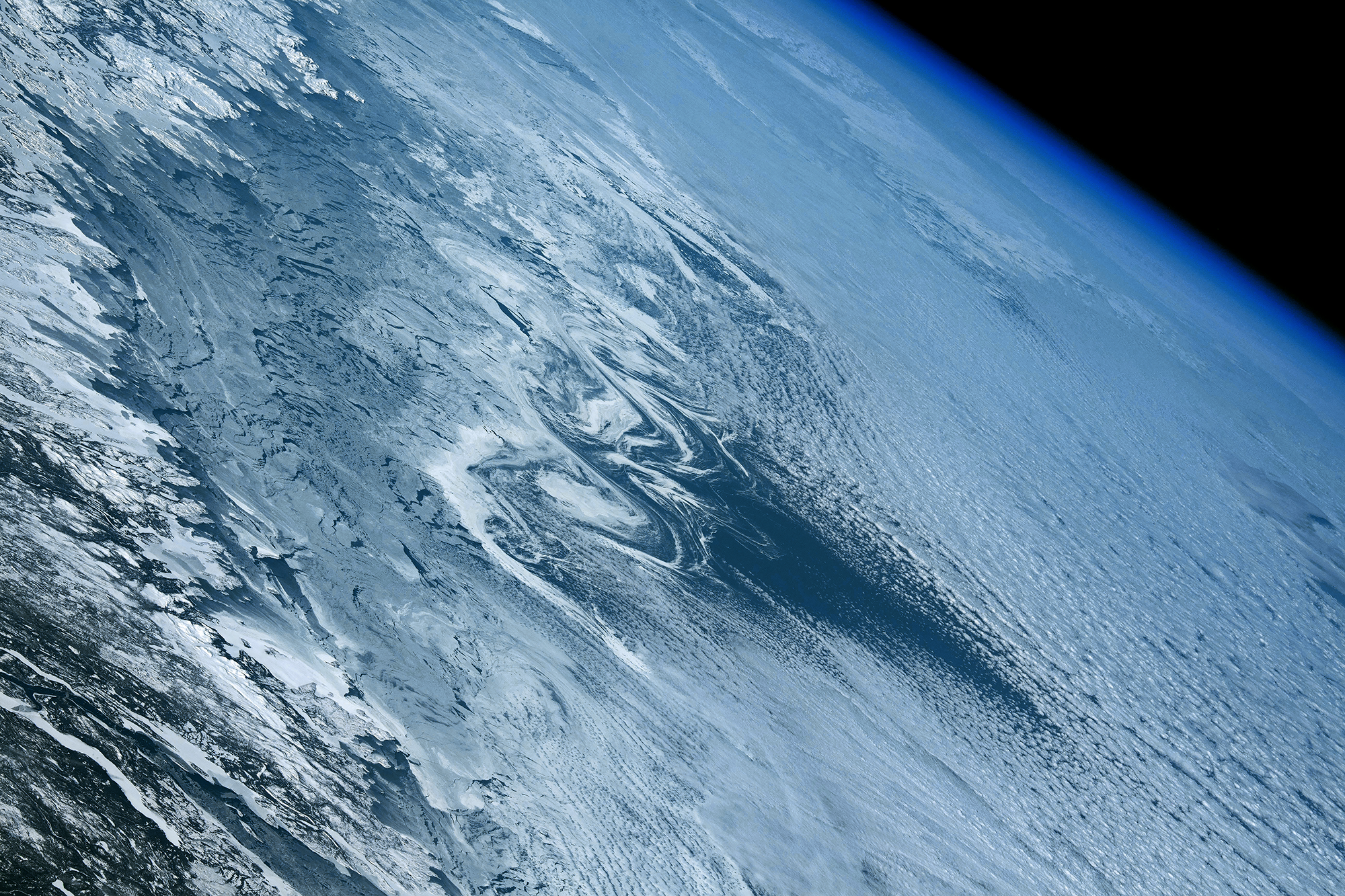
Turbulent flows feature swirling eddies over a range of sizes — the larger the size range, the higher the Reynolds number. In this satellite image, sediment highlights these eddies in shades of turquoise, showing off the complexity of the flows created where rivers, ocean, and tides meet. The eddies we see here stretch from kilometers in width down to a handful of meters, but the flow’s turbulence persists down to millimeter-scales before viscosity damps it out. (Image credit: L. Dauphin; via NASA Earth Observatory)
Tag: flow visualization

Playing With Water in 2D Containers
Once again Steve Mould is putting his prototyping skills to use to work out what goes on inside tricky containers. Here he looks at a “magic” wizard’s cup where — like the assassin’s teapot — cleverly placed holes in the side of the cup can block or allow air’s escape. In the wizard’s cup this lets the wizard refill the cup at will.
He also takes a look at how draining works, using tracer particles and a video editing effect that “echoes” previous frames in a video. For the tracer particles, this algorithm effectively visualizes pathlines in the flow. Areas with faster-moving fluid have longer pathlines that are closer together, whereas slow-moving regions have short pathlines. (Video credit: S. Mould)

“Emitter”
For this latest experimental film, artist Roman De Giuli provides a glimpse of the unique fluid art machine he’s built over the last 3.5 years. With 10 channels driven by peristasltic tube pumps and stepper motors, his “printer” drips up to 10 colors on a paint-covered, tilted canvas to create these beautiful images. As he says in his description of the invention, the set-up produces paint layering that’s almost impossible to create by hand. Fluid dynamically speaking, we’re seeing gravity currents like a lava flow or avalanche that are mixing together viscously. There’s also some added effects from density differences between different layered paint colors. Artistically, this machine offers an infinite palette of visual opportunities; financially, though, De Giuli admits its an absolute beast at consuming paint! (Image and video credit: R. De Giuli)

Viscous Fireworks
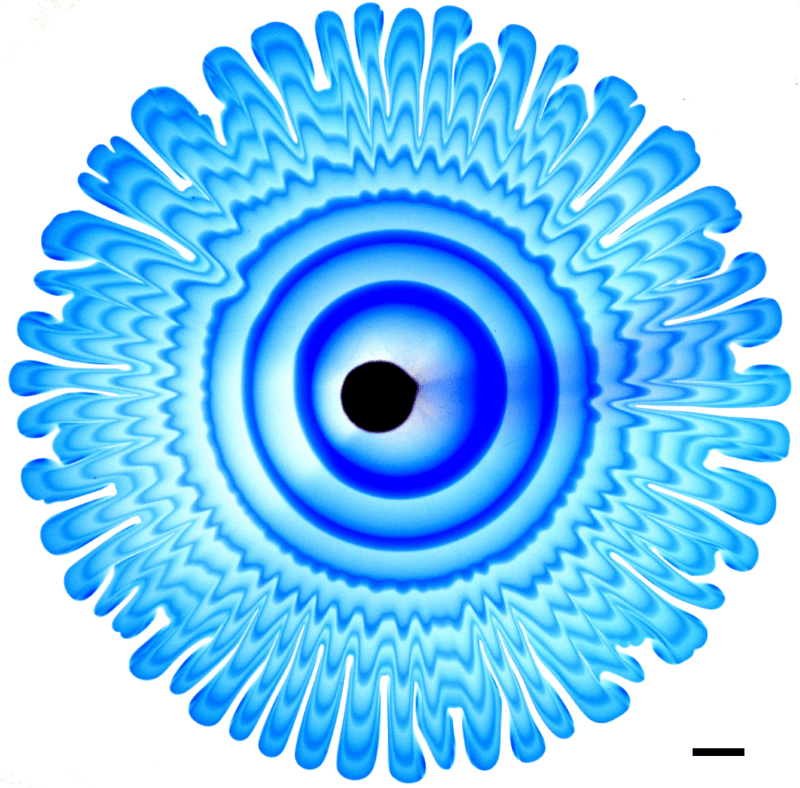
Inject a less viscous fluid into a gap filled with a more viscous fluid, and you’ll get finger-like patterns spreading radially. Here, researchers put a twist on this viscous fingering by taking turns injecting different liquids. Each injection cycle disrupts what came before, layering fingering patterns on fingering patterns. The results resemble fireworks. Happy 4th of July! (Image credit: C. Chou et al.)

Star-Birthing Shock Waves
Although the space between stars is empty by terrestrial standards, it’s not devoid of matter. There’s a scattering of cold gas and dust, pocked by areas known as prestellar cores with densities of a few thousand particles per cubic centimeter. This is just enough matter to help gravity eventually win its tug of war with the forces that would drive molecules apart.
When shock waves pass through these regions — whether thrown off a dying star or a newly birthed one — they compress the material, kickstarting the process of stellar formation. Passing shock waves can also shake loose molecules stuck to the dust, providing key tracer elements that astronomers can use to visualize shock waves and the areas they affect. To learn more, see this article over at Physics Today. (Image credit: NASA/ESA/CSA/STSCI/K. Pontoppidan/A. Pagan; see also Physics Today)

Dripping Viscoelastics
An ultrasoft viscoelastic fluid drips in this research poster from the Gallery of Soft Matter. Complex materials like this one have stretchy, elastic behaviors typical of a solid along with the flowing, viscous properties of a fluid. Here, gravity overcomes the material’s elasticity, leaving it to sag and flow. As that happens, the fluid must slide past air, and the density difference between the two fluids creates the small distortions seen on the liquid sheet. This is an example of a Rayleigh-Taylor instability. (Image credit: J. Hwang et al.)

Melting Permafrost Stains Alaskan Rivers Orange
The swiftly melting permafrost of the Arctic is releasing toxic metals like zinc, cadmium, and iron into Alaskan waterways. The contaminant levels are so high that it’s staining many rivers orange — a feature that can be seen from space. A new study identified at least 75 affected rivers in the Brooks mountain range.
In addition to staining the rivers, these metals make the water acidic, with some waterways reaching a pH as low as 2.3, similar to the acidity of vinegar. The combination is deadly to aquatic life in the rivers, and the acidity, unfortunately, will accelerate the dissolution of rocks that can release even more metals into the water. (Image credit: K. Hill/National Park Service; research credit: J. O’Donnell et al.; via LiveScience; submitted by Emily R.)

A contaminated portion of the Kutuk River runs orange alongside an uncontaminated portion of the same waterway. 
A Comet’s Tail
A comet‘s tail changes from day-to-day depending on how much material the comet is losing and how strong the solar wind it’s facing is. This image sequence shows Comet 12P/Pons-Brooks over nine days in 2024 from March 6th (top) through March 14th (bottom). The variations in the comet’s appearance are striking; some days show nearly no tail while others have long plumes with swirls of turbulence. It’s a reminder that, even if they appear unchanging in the moment you see one, a comet is in constant flux. (Image credit: Shengyu Li & Shaining; via APOD)

Exciting a Flame in a Trough
A viewer sent Steve Mould his accidental discovery of this odd flame behavior. In these 3D-printed troughs, a flame lit in lighter fluid will rocket around the track repeatedly as it burns the local supply of gaseous lighter fluid. As Steve shows in his video, this system is an excitable medium and the trick works for a whole array of 3D-printed shapes. Check out the full video above. (Video and image credit: S. Mould)

Wind Sculptures
Vibrantly colored fabrics move in the breeze in artist Thomas Jackson’s outdoor installations. During the golden hours, he captures that movement in photographs like these. Jackson uses tulle, silk, and other everyday objects in his projects, and when finished, he takes a “leave no trace” approach, removing all materials and recycling them into new projects. Find more work on his website and Instagram. (Image credit: T. Jackson; via Colossal)