Tag: pattern formation

  • Whiskey Webs

    Whiskey Webs

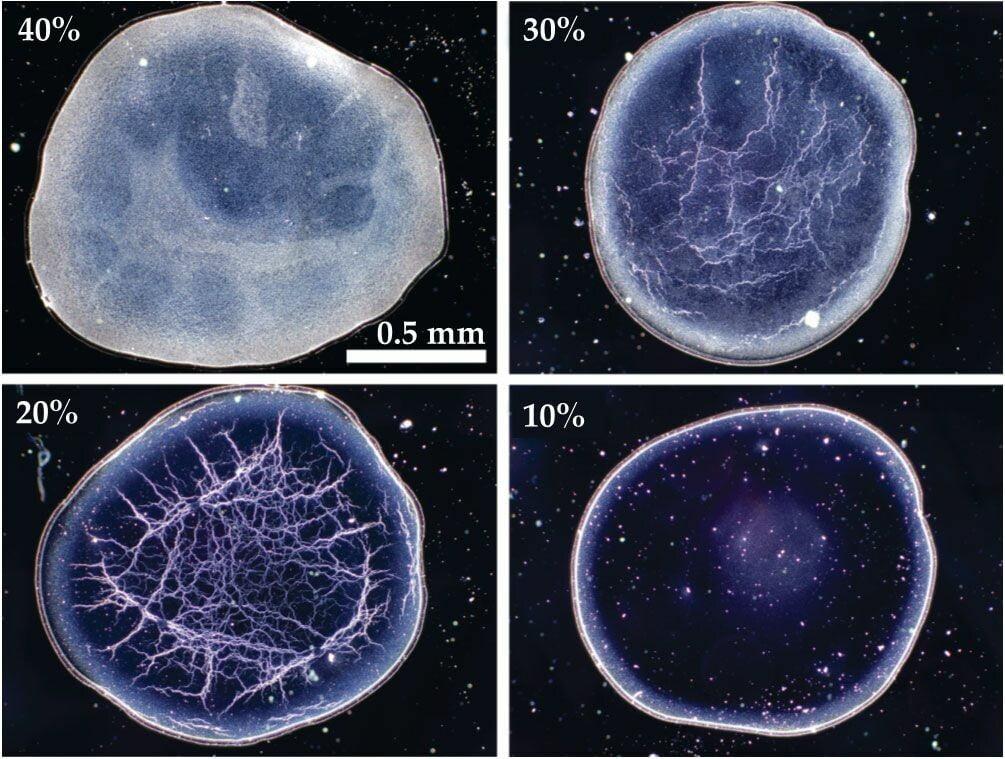
    Unlike scotch whisky, when American bourbon whiskeys are diluted, they form unique web-like evaporation patterns. These differences arise in part from the way the liquors are aged: scotch is aged in re-used barrels, whereas bourbons require aging in a new, charred American white oak barrel*.

    During aging, the whiskey picks up water-insoluble chemicals from the barrel. When water is added to the bourbon, it helps transport those insoluble components to the surface of a droplet, where they form a monolayer of fatty acid chains (Image 2; in green). As evaporation continues and the droplet gets smaller, the molecules at the shrinking surface collapse inward, forming the rigid web structure we see left behind. The patterns that form act as a kind of fingerprint for the bourbon. Check out some of the brand-to-brand variations over at the researchers’ Whiskey Webs site. (Image and research credit: S. Williams et al.; via Physics Today)

    * In case you were wondering, this is actually a legal requirement in order to be considered bourbon. Bourbons must also be made from a grain mixture that is >50% corn.

  • Featured Video Play Icon

    “Dendrite Fractals”

    In this short film from the Chemical Bouillon team, dark ink drops spread in dendritic fractal patterns after being deposited on an unknown transparent liquid. Although the patterns look similar to those of the Saffman-Taylor instability, I suspect what we see here is actually driven by surface tension and not viscosity.

    The authors describe the ink they used as a “special old” “tree ink,” which — putting on my fountain pen aficionado hat — probably means some variety of iron gall ink. These inks draw on chemicals extracted from trees and other plants to create a permanent, waterproof ink. They tend to be highly acidic, which could play a role in the pattern formation seen here. (Video and image credit: Chemical Bouillon)

  • Drying Out

    Drying Out

    Look closely at old paintings, and you’ll notice arrays of tiny, straight cracks that form as the paint dried. This sort of pattern formation during drying is not unusual. Here we see the patterns formed when a thin layer of hydrogel sandwiched between two glass plates dries. As the water evaporates, stress builds at the interface between the air and gel, causing bubbles to form. The bubble size and shape depend on the size on the gap between the plates and the characteristics of the gel. The resulting patterns can be entirely disordered, or they can form worm-like designs that curl throughout the domain. (Image and research credit: R. Pic et al.)

  • Ice Labyrinths

    Ice Labyrinths

    Pattern formation is extremely common in nature, from the dendritic growth of trees and snowflakes to the stripes of a tiger. A new paper describes how a thin layer of ice in a liquid can form labyrinthine patterns when illuminated with near-infrared light. Both the liquid and ice are maintained at a constant temperature below the melting point, but the ice absorbs the near-infrared light more effectively than the water. This means that parts of the ice that are far from the liquid warm and melt faster, creating holes that can then allow a pocket of liquid to seep in and reduce the absorption rate. The ice crystals themselves thin and expand across the surface at the expense of more holes, which eventually create larger channels that pock the ice. (Image and research credit: S. Preis et al.; via Nature; submitted by Kam-Yung Soh)