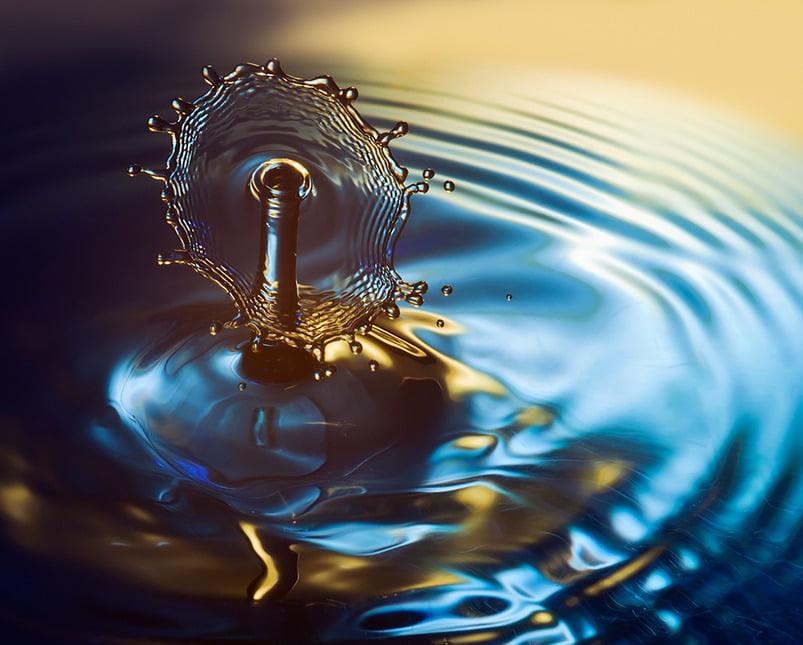
When a water drop strikes a pool, it can form a cavity in the free surface that will rebound into a jet. If a well-timed second drop hits that jet at the height of its rebound, the impact creates an umbrella-like sheet like the one seen here. The thin liquid sheet expands outward from the point of impact, its rim thickening and ejecting tiny filaments and droplets as surface tension causes a Plateau-Rayleigh-type instability. Tiny capillary waves–ripples–gather near the rim, an echo of the impact between the jet and the second drop. All of this occurs in less than the blink of an eye, but with high-speed video and perfectly-timed photography, we can capture the beauty of these everyday phenomena. (Photo credit: H. Westum)
Tag: droplet impact

The Vortex Under a Falling Drop
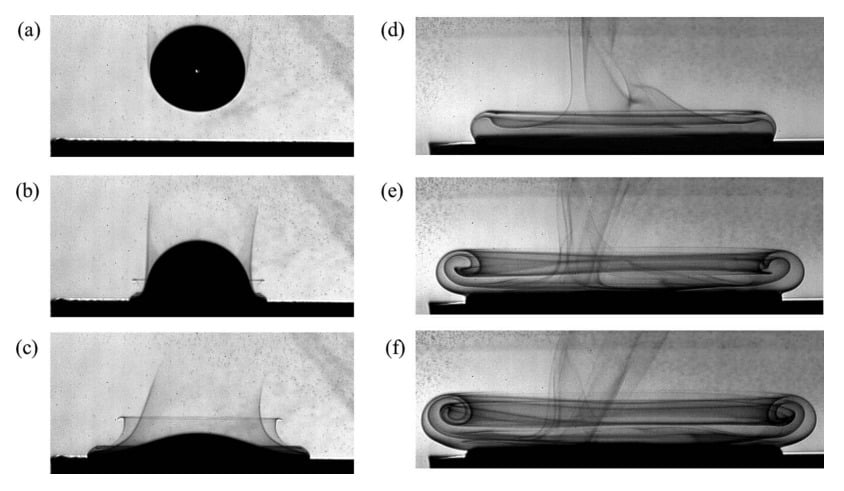
We take for granted that drops which impact a solid surface will splash, but, in fact, drops only splash when the surrounding air pressure is high enough. When the air pressure is low enough, drops simply impact and spread, regardless of the fluid, drop height, or surface roughness. Why this is and what role the surrounding air plays remains unclear. Here researchers visualize the air flow around a droplet impact. In (a) we see the approaching drop and the air it pulls with it. Upon impact in (b) and © the drop spreads and flattens while a crown of air rises in its wake. The drop’s spread initiates a vortex ring that is pinned to the drop’s edge. In later times (d)-(f) the vortex ring detaches from the drop and rolls up. (Photo credit: I. Bischofberger et al.)

Bouncing Atop a Pool
When slowed down, everyday occurrences, like a drop of water falling into a pool, can look absolutely extraordinary. When a falling drop has low momentum, it doesn’t simply disappear into the puddle. It sits on the surface, separated from the main pool by a very thin layer of air. Given time, the air drains away and the droplet cascades its way into the pool via smaller and smaller droplets. By vibrating the surface, the droplet bounces, with each bounce refreshing the layer of air that separates it from the main pool. Minute Lab’s video does a great job of explaining the process from beginning to end, accompanied with wonderful video of each step in action. For even more mind-boggling, check out how these bouncing droplets can demonstrate quantum mechanical behaviors. (Video credit: Minute Laboratory; submitted by Pascal)
Rebounding Off Dry Ice
Droplet rebound is frequently associated with superhydrophobic surfaces but can also be generated by very large temperature differences. For very hot substrates, a thin layer of the drop vaporizes on contact via the Leidenfrost effect and helps a drop rebound by preventing it from wetting the surface. This video shows almost the opposite: a water droplet hitting solid carbon dioxide (-79 degrees C). Upon contact, the solid carbon dioxide sublimates, creating a thin layer of gas that separates the droplet from the surface. You can also see the vortex ring that accompanies the drop’s impact. Water vapor near the carbon dioxide surface has condensed into tiny airborne droplets that act as tracer particles that reveal the vortex’s formation and the rebounding droplet’s wake. (Video credit: C. Antonini et al.; Research paper)
Reader Question: Non-Coalescing Droplets
Reader ancientavian asks:
I’ve often noticed that, when water splashes (especially as with raindrops or other forms of spray), often it appears that small droplets of water skitter off on top of the larger surface before rejoining the main body. Is this an actual phenomenon, or an optical illusion? What causes it?
That’s a great observation, and it’s a real-world example of some of the physics we’ve talked about before. When a drop hits a pool, it rebounds in a little pillar called a Worthington jet and often ejects a smaller droplet. This droplet, thanks to its lower inertia, can bounce off the surface. If we slow things way down and look closely at that drop, we’ll see that it can even sit briefly on the surface before all the air beneath it drains away and it coalesces with the pool below. But that kind of coalescence cascade typically happens in microseconds, far too fast for the human eye.
But it is possible outside the lab to find instances where this effect lasts long enough for the eye to catch. Take a look at this video. Here Destin of Smarter Every Day captures some great footage of water droplets skittering across a pool. They last long enough to be visible to the naked eye. What’s happening here is the same as the situation we described before, except that the water surface is essentially vibrating! The impacts of all the multitude of droplets create ripples that undulate the water’s surface continuously. As a result, air gets injected beneath the droplets and they skate along above the surface for longer than they would if the water were still. (Video credit: SuperSloMoVideos)
Droplet Bounce
This high-speed video shows the remarkable resilience of a water droplet upon impact against as a solid surface. The droplet deforms into a pancake-shape, with its center depressing almost flat before rebounding upward. The rest of the drop follows, splitting into several droplets as capillary waves dance across its surface. When one satellite drop almost escapes, the main droplet just barely comes in contact with it, the coalescence enough to tip surface tension into pulling them together instead of breaking them apart. (Video credit: K. Suh/ChemistryWorldUK)

Droplet Impact Visualized
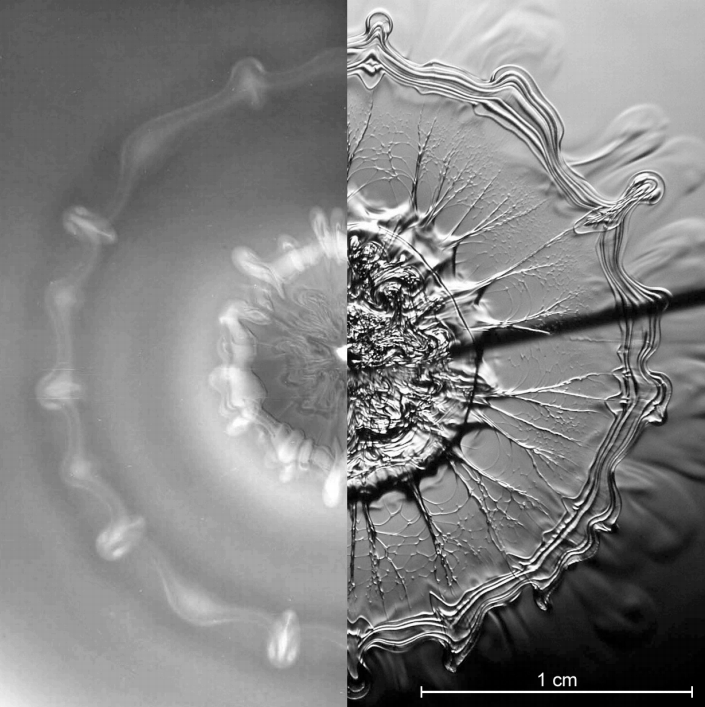
When a drop falls from a moderate height into a shallow pool, its impact creates a complicated pattern. The photo above is a composite image showing a top-down view 100 ms after such an impact. On the left side, the flow is visualized using dye whereas the right shows a schlieren photograph, in which contrast indicates variations in density. Both methods show the same general structure – an inner vortex ring generated at the edge of the impact crater and formed mostly of drop fluid and an outer vortex ring, consisting primarily of pool fluid, formed by the spreading wave. Both regions show signs of instability and breakdown. (Photo credit: A. Wilkens et al.)

Liquid Sculptures


Water droplet art celebrates the infinite forms created from the impact of drops with a pool and rebounding jets. It’s a still life captured from split second interactions between inertia, momentum, and surface tension. These examples from photographer Markus Reugels are among some of the most complex shapes I’ve seen captured. Be sure to check out his website for more beautiful examples of liquids frozen in time. (Photo credits: Markus Reugels; via Photigy)

The Red Crown
A drop of red dye falls into a thin layer of milk, forming a crown splash. Notice the pale edges of the droplets at the rim of the crown; this is milk that has been entrained by the original drop. The rim and satellite droplets surrounding the splash are formed due to surface tension effects, chiefly the Plateau-Rayleigh instability–the same effect responsible for breaking a falling column of liquid into droplets like in a leaking faucet. The instability will have a most unstable wavelength that determines the number of satellite droplets formed. (Photo credit: W. van Hoeve et al., University of Twente)

Bouncing and Break-Up
In the collage above, successive frames showing the bouncing and break-up of liquid droplets impacting a solid inclined surface coated with a thin layer of high-viscosity fluid have been superposed. This allows one to see the trajectory and deformation of the original droplet as well as its daughter droplets. The impacts vary by Weber number, a dimensionless parameter used to compare the effects of a droplet’s inertia to its surface tension. A larger Weber number indicates inertial dominance, and the Weber number increases from 1.7 in (a) to 15.3 in (d). In the case of (a), the impact of the droplet is such that the droplet does not merge with the layer of fluid on the surface, so the complete droplet rebounds. In cases (b)-(d), there is partial merger between the initial droplet and the fluid layer. The impact flattens the original droplet into a pancake-like layer, which rebounds in a Worthington jet before ejecting several smaller droplets. For more, see Gilet and Bush 2012. (Photo credit: T. Gilet and J. W. M. Bush)