Tag: computational fluid dynamics

  • Better Inhalers Through CFD

    Better Inhalers Through CFD

    As levels of air pollution rise, so does the incidence of pulmonary diseases like asthma. Treatments for these diseases largely rely on inhalers containing drug particles that need to be carried into the small bronchi of the lungs. To better understand how the process works, researchers used computational fluid dynamics to simulate how air and particles travel through the human respiratory tract.

    The team found that larger particles tended to get stuck in the mouth instead of making it down into the lungs. This problem was made worse at high inhalation rates because the particles’ inertia was too large for them to make the sharp turn down into the trachea. In contrast, smaller particles could travel down into the lungs and into the smaller branches there before settling. The authors concluded that inhalers should use fine drug particles to maximize delivery into the lungs. They also note that adjusting inhalers to deliver more medication to the lungs may also lower the overall price because less of the dosage gets wasted in the patient’s mouth.

    Of course, the study’s results also serve as a warning about the dangers of air pollution from fine particulates. Here in Colorado, our summers are punctuated with wildfire smoke, much of it in the form of tiny particles about the same size as the drug particles in this study. If fine drug particles are effective at making it into the smaller branches of our lungs, so are those pollutants. That’s a good reason to stay inside in smoky conditions or use a high-quality N-95 mask while out and about. (Image credit: coltsfan; research credit: A. Tiwari et al.; via Physics World; submitted by Kam-Yung Soh)

  • Stingray Eyes

    Stingray Eyes

    With their flexible, flattened shape, rays are some of the most efficient swimmers in the ocean. But, at first glance, it seems as if their protruding eyes and mouth would interfere with that streamlining. A new study uses computational fluid dynamics to tackle the effects of these protrusions on stingray hydrodynamics.

    With their digital stingrays, the team found that the animal’s eyes and mouth created vortices that accelerated flow over the front of the ray and increased the pressure difference across its top and bottom surfaces. The result was better thrust and the ability to cruise at higher speeds. Overall, the ray’s eyes and mouth increased its hydrodynamic efficiency by more than 20.5% and 10.6%, respectively. The lesson here: looks can be deceiving when it comes to hydrodynamics! (Image credit: D. Clode; research credit: Q. Mao et al.)

  • Featured Video Play Icon

    Keeping Cool in the Cretaceous

    I love that fluid dynamics can bring new insights to other subjects, like this study on how heavily-armored ankylosaurs avoided heat stroke. Scans of ankylosaur skulls show a complicated, twisty nasal cavity that researchers likened to a child’s crazy straw. Using numerical simulations, they showed that the airflow through these passages acts like a heat exchanger. As air gets drawn into its body, it warms up from exposure to blood vessels lining the nasal cavity; that means that, simultaneously, the hot blood is getting cooled. Those blood vessels lead up to the animal’s brain, indicating that these twisted cavities essentially serve as air-conditioning for the sauropod’s brain! (Image and video credit: Scientific American; research credit: J. Bourke et al.; via J. Ouellette)

  • Sea Sponge Hydrodynamics

    Sea Sponge Hydrodynamics

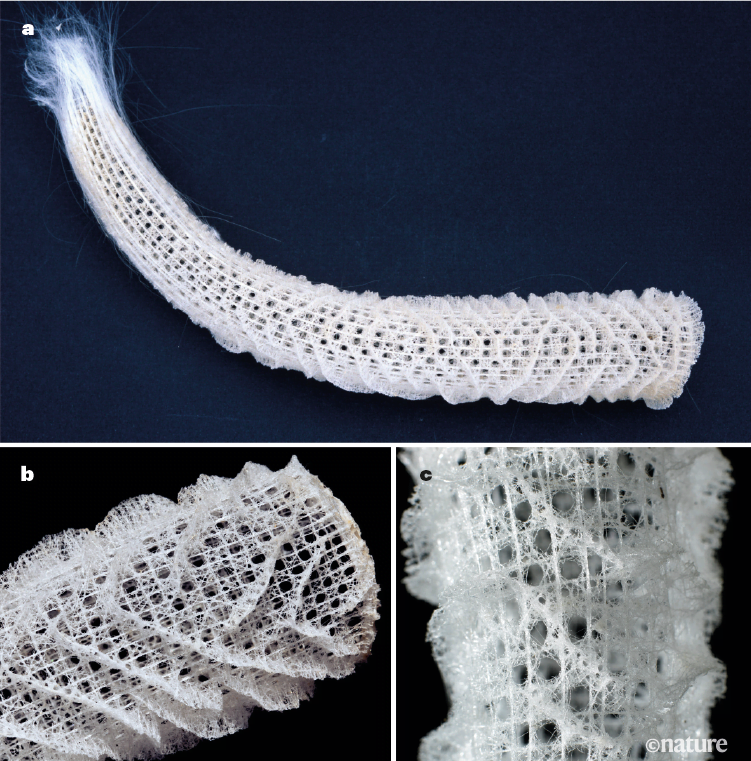
    The Venus’s flower basket is a sea sponge that lives at depths of 100-1000 meters. Its intricate latticework skeleton has long fascinated engineers for its structural mechanics, but a new study shows that the sponge’s shape benefits it hydrodynamically as well.

    The sea sponge’s skeleton is predominantly cylindrical, with tiny gaps that allow water to flow through it and helical ridges alongside its outer surface to strengthen it against the deep-sea currents surrounding it. Through detailed numerical simulations, researchers found that both of these features — the holes and the ridges — serve fluid mechanical purposes for the sponge. The porous holes of the sea sponge drastically reduce flow in the sponge’s wake (third image), which provides major drag reduction for the sea sponge. That drag reduction makes it easier for the sponge to stay rooted to the ocean floor.

    The helical ridges, on the other hand, create low-speed vortices within the sea-sponge’s body cavity (second image). Such vortices increase the time water spends inside the sponge, likely helping it to filter-feed more efficiently. The additional vorticity comes at the cost of slightly increased drag but not enough to outweigh the savings from its porosity. (Image and research credit: G. Falcucci et al.; via Nature; submitted by Kam-Yung Soh)

  • Controlling Aerosols Onstage

    Controlling Aerosols Onstage

    Few industries saw more disruption from the pandemic than the performing arts. To help orchestras return to the concert hall in a way that keeps performers and audience members safe, researchers have simulated air flow and aerosols around musicians onstage. Some instruments — like the trumpet — are super-spreaders when it comes to aerosol production, and, in the conventional organization of orchestras, those aerosols have to travel through other sections of the orchestra before reaching air vents, putting more musicians at risk.

    (Upper left) Aerosol concentration for an orchestra performing in their original arrangement, with doors to the hall closed; (Upper right) Aerosol concentration in the modified musician arrangement, with doors open; (Bottom row) Time-averaged aerosol concentration in the breathing zone of performers for (left) the original arrangement and (right) with modified seating.
    (Upper row) Aerosol concentration for the orchestra’s original seating arrangement (left) and in the modified arrangement (right). (Bottom row) Time-averaged concentration of aerosol particles in the breathing zone of each musician in the original (left) and modified arrangements (right).

    Using Large Eddy Simulation, researchers looked at alternate seating arrangements for the Utah Symphony that could mitigate these risks. By rearranging the musicians so that instruments that produce lots of aerosols are closer to the air vents and open doors, the team reduced the average concentration of aerosols around musicians by a factor of 100, giving the performers a chance to return to the stage far more safely. (Image credit: top – M. Nägeli, simulation – H. Hedworth et al.; research credit: H. Hedworth et al.; via NYTimes; submitted by Kam-Yung Soh)

  • Airborne Aerosol Transmission of COVID-19

    Airborne Aerosol Transmission of COVID-19

    Early in the COVID-19 pandemic health officials resisted the idea that the novel coronavirus was transmissible through tiny aerosol droplets rather than larger, non-buoyant droplets. One case that made headlines and helped shift opinion was that of an outbreak among patrons of a Guangzhou restaurant traced to a single, pre-symptomatic patient zero. The pattern of who became sick at the carrier’s table and those nearby made little sense unless the restaurant’s air flow played a role in spreading the virus.

    https://www.youtube.com/watch?v=WaZiCqQmO4g

    This paper studies the incident in detail, using an in-house computational fluid dynamics (CFD) code to simulate both airflow in the restaurant and the paths aerosol droplets would follow in that environment. It takes into account flow from the air conditioner and the warm air rising from customers. The study’s predictions of which areas would have the highest concentrations of virus-laden aerosols matches well with the actual pattern of the outbreak. The authors hope that tools like theirs can help prevent future outbreaks by indicating the most dangerous paths for transmission and measures that can block those. (Image credit: Center for Disease Control; video, research, and submission credit: H. Liu et al.)

  • Spiderwebs and Stratocumulus Clouds

    Spiderwebs and Stratocumulus Clouds

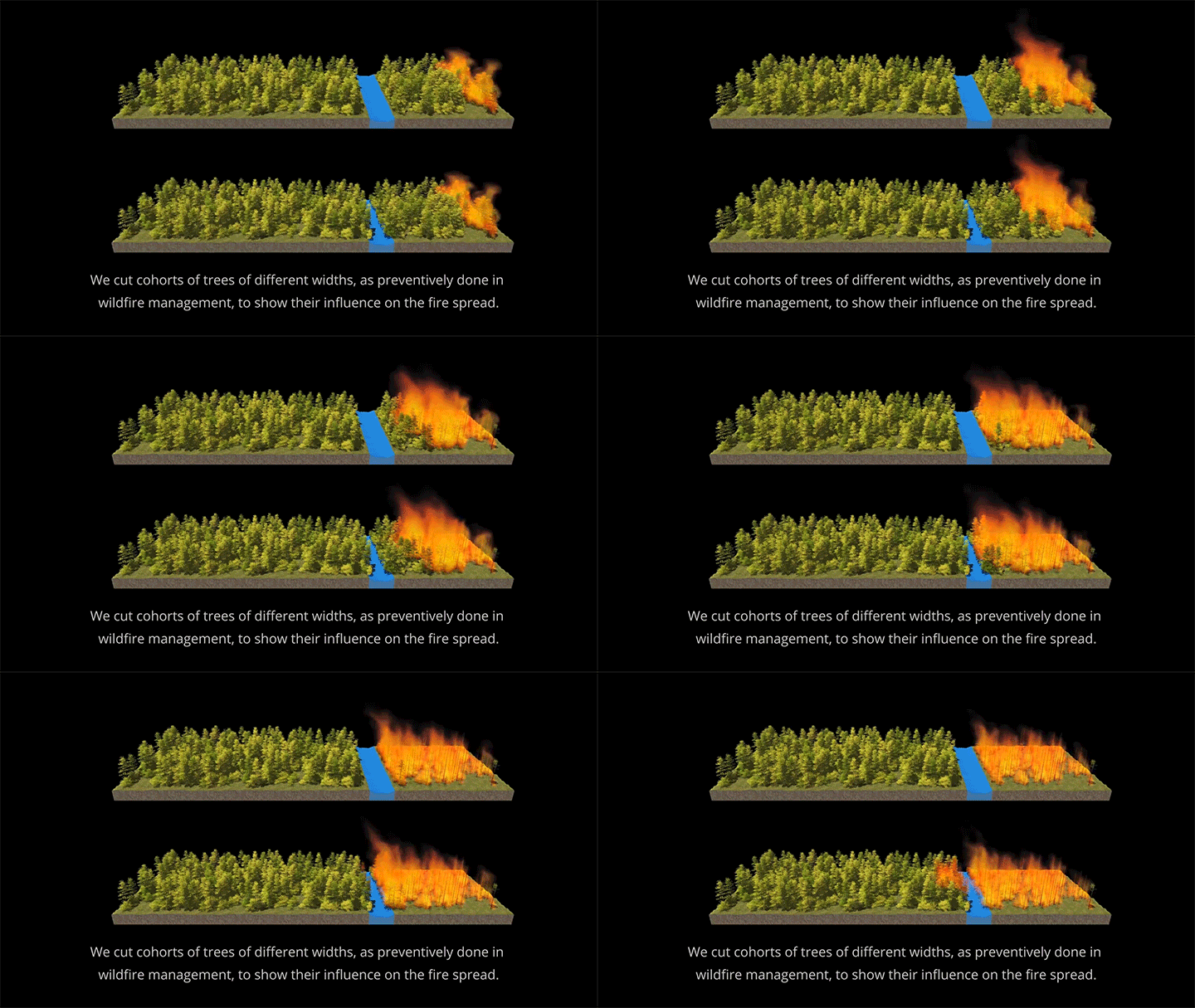
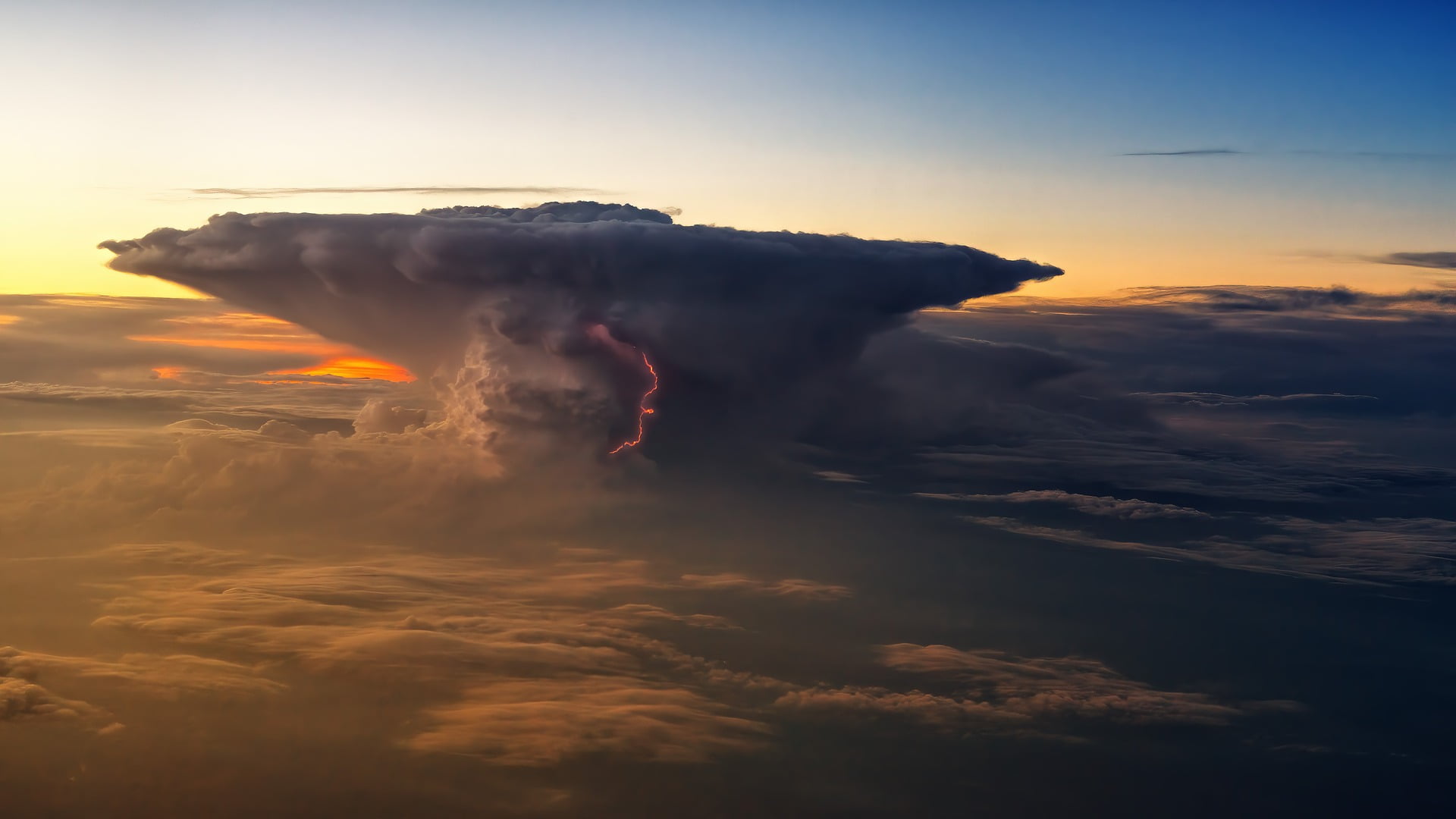
    Stratocumulus clouds cover about 20% of Earth’s surface at any given time, and they form distinctive patterns of lumpy cells separated by thin slits. Because of their interconnectedness, researchers nicknamed these narrow regions spiderwebs. New simulations show that evaporative cooling along the cloud tops drives the formation of these spiderwebs (Image 2). Without it (Image 3), the cloud pattern looks very different. (Image credits: featured image – L. Dauphin/MODIS, others – UConn ME 3250; research credit: G. Matheou et al.)

  • Cutting Coronavirus Risk in Cars

    Cutting Coronavirus Risk in Cars

    Even in a pandemic, it’s sometimes necessary to share a car with someone outside one’s bubble. When that’s the case, it’s important to know how to limit risks of coronavirus exposure. For this study, researchers used computational fluid dynamics to simulate flow around and inside a Prius-like four-door sedan with a driver and a single passenger located in the rear passenger-side seat. Assuming the air conditioner was on and the car was moving at 50 miles per hour, the researchers found that the baseline flow of air inside the car moves from the back of the cabin toward the front. With the windows closed, the simulation suggested that 8-10% of the aerosol particles exhaled by one passenger could reach the other.

    Opening the car’s windows increases the ventilation and reduces exposure risk. The best configuration the researchers found opened two windows: the front passenger-side window and the rear driver-side window. By opening the window opposite each person, the airflow in the car creates a sort of curtain between the two that reduces aerosol exposure to only 0.2-2% of what’s exhaled by the other occupant. (Image credit: rideshare – V. Xok, CFD – V. Mathai et al.; research credit: V. Mathai et al.; via NYTimes; submitted by Kam-Yung Soh)

    Computed streamlines for flow through a sedan with a driver and one rear passenger, with each opposite window opened.
  • Rocking From The Waves

    Rocking From The Waves

    Not all seismic activity stems from earthquakes. In fact, much of Earth’s measured seismic waves come from interactions of the ocean and atmosphere with solid ground. Some of the strongest vibrations come from interactions of ocean waves, which transmit pressure waves that don’t attenuate with depth before passing into the solid Earth.

    How those waves propagate and scatter inside the Earth has been a matter of contention for decades, but recent simulations are beginning to uncover the mechanisms that lead to the waves seismologists measure. (Image credit: I. Mingazova; via Physics Today)

  • Hammerhead Hydrodynamics

    Hammerhead Hydrodynamics

    Hammerhead sharks have some of the most distinctive craniums in the ocean, which begs the question: how do they swim with that head? New computational fluid dynamics studies suggest that their long foil-shaped heads help the sharks maneuver swiftly, but they come at the cost of substantially higher drag. The researchers found that drag on the hammerhead’s cranium required energy expenditures more than 10 times higher than other sharks, but since the study looked at heads only, it’s possible that the rest of the shark’s positioning helps mitigate that cost. (Image credit: shark – J. Allert, CFD – M. Gaylord et al.; research credit: M. Gaylord et al.; via NYTimes; submitted by Kam-Yung Soh)

    Pressure contours and streamlines around a hammerhead shark head.