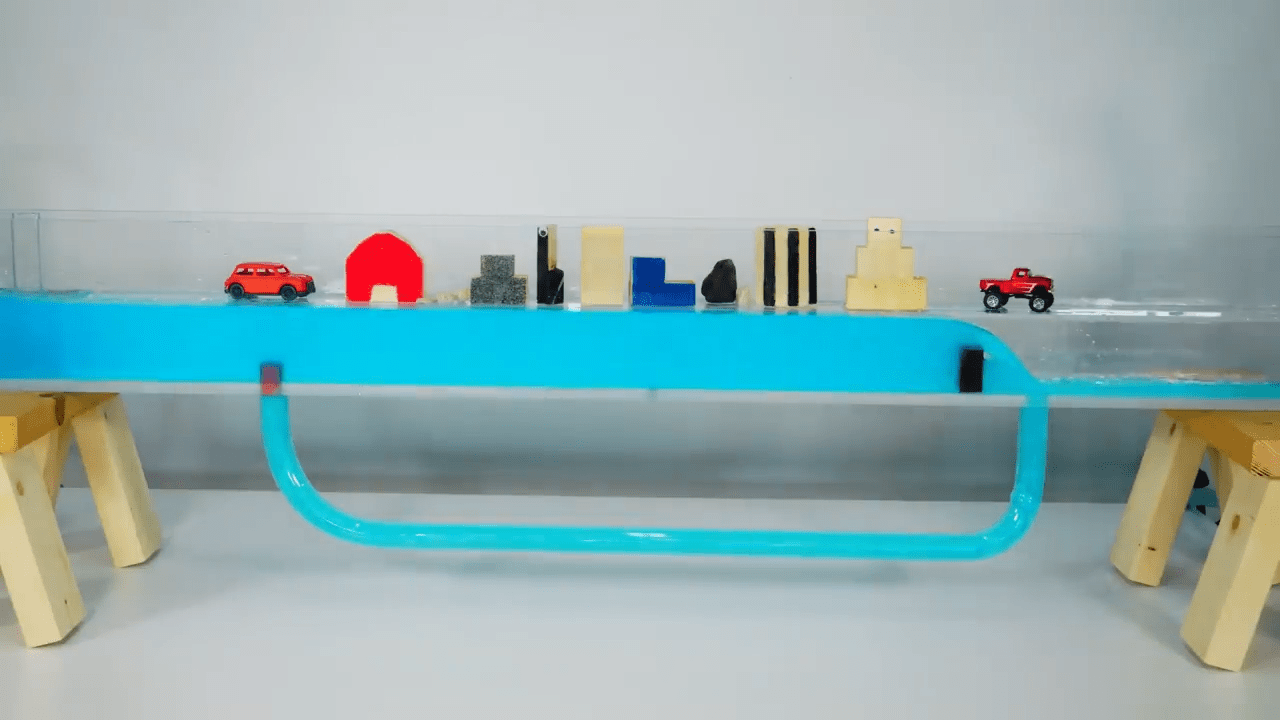
When rain falls, some of that water turns into run-off in storm systems but much of it seeps into the ground. What happens to that water? In most places, it joins the local aquifer, infusing the spaces between soil particles underground. In this video, Grady takes us through some of the interactions between surface water, aquifers, and the wells we use to access water underground. He’s even built some great demonstrations to show how aquifers and surface water like rivers pass water back and forth. (Image and video credit: Practical Engineering)
Tag: civil engineering

Pumping Waste
Sewage systems rely on gravity to remove waste from our homes and carry it toward treatment plants. But that constant downward slope can’t always be maintained. Sometimes we have to bring the sewage back up to the surface to process it. For that, modern systems rely on pumps and other equipment to move the challenging slurry of liquid and solid materials. In this video, Grady from Practical Engineering breaks down the physics and engineering of sewage pumping. (Image and video credit: Practical Engineering)
The Best of FYFD 2021
A year ago I observed what a strange year 2020 had been, and in many ways, I could say the same of 2021. Before the pandemic, I spent quite a lot of time traveling. In 2021, the only nights I slept outside my own bed came on a long weekend up to the mountains with my family. But 2021 also saw a bit of a return to normalcy – I was giving keynote addresses and workshops again, albeit virtually. What will 2022 hold? Who knows?!
As per tradition, here are the top FYFD posts of 2021:
- A superior mirage leaves a ship floating in mid-air
- Drone videos of sheep herding are mesmerizing
- Permeable pavement allows water to drain
- The slow and dreamy fluid landscape of “Le Temps et l’Espace”
- What do you do when you’re an insect researcher with a high-speed camera?
- Satellite images… or paint?
- The intricate lacework of the Venus’s flower basket sea sponge
- Building a Bluetooth speaker with ferrofluid music visualization
- Finding the acoustics of Stonehenge
- Making butter by traditional French methods
It’s an eclectic mix of topics this year: bizarre phenomena, stunning art, archaeological exploration, and a touch of biophysics!
If you enjoy FYFD, please remember that it’s primarily reader-supported. You can help support the site by becoming a patron, making a one-time donation, buying some merch, or simply by sharing on social media. And if you find yourself struggling to remember to check the website, remember you can get FYFD in your inbox every two weeks with our newsletter. Happy New Year!
(Image credits: mirage – D. Morris, sheep – L. Patel, pavement – Practical Engineering, Le Temps – T. Blanchard, insects – Ant Lab, Satellike – R. De Giuli, sea sponge – G. Falcucci et al., speaker – DAKD Jung, Stonehenge – T. Cox et al., butter – Art Insider)

Dune Invasion
Migrating sand dunes can encounter obstacles both natural and manmade as they move. Dunes — both above ground and under water — have been known to bury roads, pipelines, and even buildings. A recent experimental study looks at which obstacles a dune will cross and which will trap it in place. Their set-up consists of a narrow channel built in a ring, essentially a racetrack for dunes. Flow is driven by a series of paddles that rotate opposite the tank’s rotation.
The team studied obstacles of different shapes and sizes relative to their dunes, and they found that dunes were generally able to cross obstacles that were smaller than the dune. Obstacles larger than the dune would trap it in place, and, for obstacles close to the same size as the dune, round obstacles were easier to cross whereas sharp-angled ones tended to trap the dune.
The idealized nature of their experiment means that their results aren’t immediately applicable to the complex dunes of the outside world, but the study will be an important touchstone for those predicting dune behavior through numerical simulation. Studies like those require experimental cases to validate their baseline simulations. (Image credit: top – J. Bezanger, figure – K. Bacik et al.; research credit: K. Bacik et al.; via APS Physics)


Pressure At The Dam
Hydrostatic pressure in a fluid is based on the fluid’s depth. You’ll rarely see a more dramatic example of that power than with a water release from a dam. Here we see the outlet of the Verbund Hydro Power dam in Austria. With 190 meters of water behind the dam, the outlet jet is massive. It moves 20,000 liters of water per second at a speed of 50 meters per second. Imagine what it would be like to stand next to that! (Image and video credit: Discovery UK; submitted by Olwyn B.)

Zuiderzee Works
Few countries have to contend with water the way the Netherlands does. With 26% of its area and 21% of its population living below sea level, water control is critical. This satellite image shows some of the natural and manmade features that help protect the landscape. The West Frisian Islands, the long spine-like archipelago seen here, form the first barrier. Behind them lies the mudflats of the Wadden Sea, home to countless wetland species. The Wadden Sea is separated from the freshwater Lake Ijssel by the Afsluitdijk, constructed in 1932 to protect the country from rising seas. With the dam in place, the Dutch used wind power to drain the shallow lands behind the dam, reclaiming the polders labeled here. With the islands, mudflats, and lake between urban settlements and the sea, engineers have more options for diverting water and protecting people from disastrous flooding. (Image credit: A. Holmes/NASA’s Ocean Color Web; via NASA Earth Observatory)

How Sinkholes Form
Growing up in the Ozarks, I explored my fair share of caves and sinkholes. These geological features form when flowing groundwater erodes soil, sand, and even rock underground. The Ozark Plateau consists largely of limestone, which is water soluble, making it very prone to this internal erosion. As bedrock dissolves away, it is eventually unable to hold up the weight of ground above it, causing a catastrophic collapse into a sinkhole. Although my childhood sinkholes were naturally occurring, they can also form in spots where leaking pipes and infrastructure help wash underlying soil away. Unfortunately for engineers, this internal erosion can take place for years without any visible sign above ground. (Image and video credit: Practical Engineering)

How Sewers Work
One of the most important and underappreciated pieces of urban infrastructure is the sewage system. We rely on them to make our waste vanish, as if by magic. In reality, these systems are carefully engineered and built to be largely self-cleaning and future-proof. Gravity is the primary driver of the system, and engineers design the slope of sewage lines so that flow inside the pipes is fast enough to keep solid waste suspended. There are, of course, plenty of challenges involved; check out the full video for an overview. (Image and video credit: Practical Engineering)

Tokyo 2020: Kasai Canoe Slalom Course
The Kasai Canoe Slalom Course is Japan’s first man-made whitewater venue. To test the design and its multiple configurations, engineers at CTU in Prague built this large-scale hydraulic model. Check out the video below to see it under construction and in action.
The course is adaptable so that it can be used for high-level competitions like the Olympics, then reconfigured for recreational use. You can even see what it’s like to run part of the course in a multi-person raft, thanks to a miniature, GoPro-equipped boat! (Image credit: top – M. Trizuliak, others – CTU Prague; video credit: CTU Prague)
Missed our previous Olympics coverage? Check out how sailboats outrace the wind, the future of swim tech, and how surface roughness affects volleyball aerodynamics.

Pump Problems
Pumps are a critical piece of infrastructure, but to keep them operating, engineers have to account for several potential pitfalls. In this Practical Engineering video, Grady discusses some of the common fluid dynamical effects that can destroy a pump and its performance. As you’ll see in the video, a lot of the challenges boil down to keeping air out of the pump. Since air and water are vastly different in their density and compressibility, most pumps cannot handle both of them at the same time. Pumps need to be primed to displace any air inside them and allow them to develop the suction needed to pump water. On the other hand, too much suction can create cavitation, which damages pump parts. And, finally, the intake systems for pumps have to be designed to keep air from getting sucked in. If nothing else, having too much air in the lines reduces the pump’s efficiency. (Image and video credit: Practical Engineering)