We create a lot of waste and, at least for now, much of that waste goes into landfills. Properly managing garbage requires much more than digging a hole in the ground, as Grady from Practical Engineering shows in this video. Maintaining a landfill requires careful management of water, soil, landfill strata, and even gas buildup. And these challenges don’t end once the trucks stop arriving. Landfills require decades of care even after their closure. Check out the video to learn more about how these artificial structures are built, managed, and maintained. (Video and image credit: Practical Engineering)
Tag: civil engineering

Building Underwater Foundations
For bridges, deep-sea platforms, and marine wind turbines, engineers have to build secure foundations able to withstand extremely heavy loads. Just how do they do this? One technique — driven piles — is as simple as driving poles into the ground. This is the method medieval engineers used to establish the city of Venice, but the origins of the technique are lost to history. Driving piles compacts the ground around and beneath the foundation, enabling it to withstand far greater loads.
In some applications, hammering piles just isn’t practical. Drilling piles is another common technique. In this method, the drilled hole is reinforced with an outer casing, then concrete is pumped in to harden. Drilled piles will work even underwater, as long as the concrete gets pumped in from the bottom. Then it can push water up and out of the casing without absorbing enough water to change its properties. (Video and image credit: Practical Engineering)

The Art of French Drains
Civil engineers face a constant challenge trying to protect their structures from water — both above and below the ground. Subsurface water can build up enough pressure to lift and damage structures, so engineers use subsurface infrastructure — like French drains — to control the water underground. Despite the name (and my title pun), French drains have nothing to do with France. Instead, they are named for Henry French, an author who described their construction and use in the 19th century. These drains use a combination of rocks, mechanical filters, and perforated pipeline to guide subsurface water and drain it away from foundations. (Video and image credit: Practical Engineering)

Engineering the City of Venice
In 452, Roman refugees established what became the city of Venice across a series of low-lying marshy islands in a lagoon. With no solid ground available, Venice has needed clever engineering for its infrastructure, as discussed in this Primal Space video. That started with building the first piles — which still survive to this day — by driving long timbers down into harder clay levels. Because these wooden poles sit entirely below the water and are capped with stone foundations, they are preserved against rotting.
As Venice grew over the next thousand years, its citizens had other infrastructure problems to solve. When fresh water needs outstripped what could be delivered by boat from the mainland, Venetians redesigned the substructure of each square to capture, filter, and store rainwater. And to wash away waste, they designed tunnels that use gravity and the daily tides to flush out sewage. (Video and image credit: Primal Space)

Mardi Gras Pass
The mighty Mississippi River has long been bound by humanity’s efforts. To keep the river in place and control its flooding, engineers have built levees, canals, and other structures. But those efforts have come with costs. Where the wild Mississippi used to deposit sediment and build new land, the bound river sends its sediment out to sea, contributing to wetland erosion. But sometimes the river still exerts its own control.
In 2012, around the time of Mardi Gras, the river broke through its eastern bank (near an existing canal) and created a new channel to the Gulf of Mexico. Known as Mardi Gras Pass, this distributary waterway now contributes fresh sediment, nutrients, and water to the Louisiana wetlands. Despite its small size, observations indicate that the Mardi Gras Pass is, indeed, helping to build new land in the area. (Image credit: J. Stevens; via NASA Earth Observatory)

Fish Ladders Keep Species Swimming
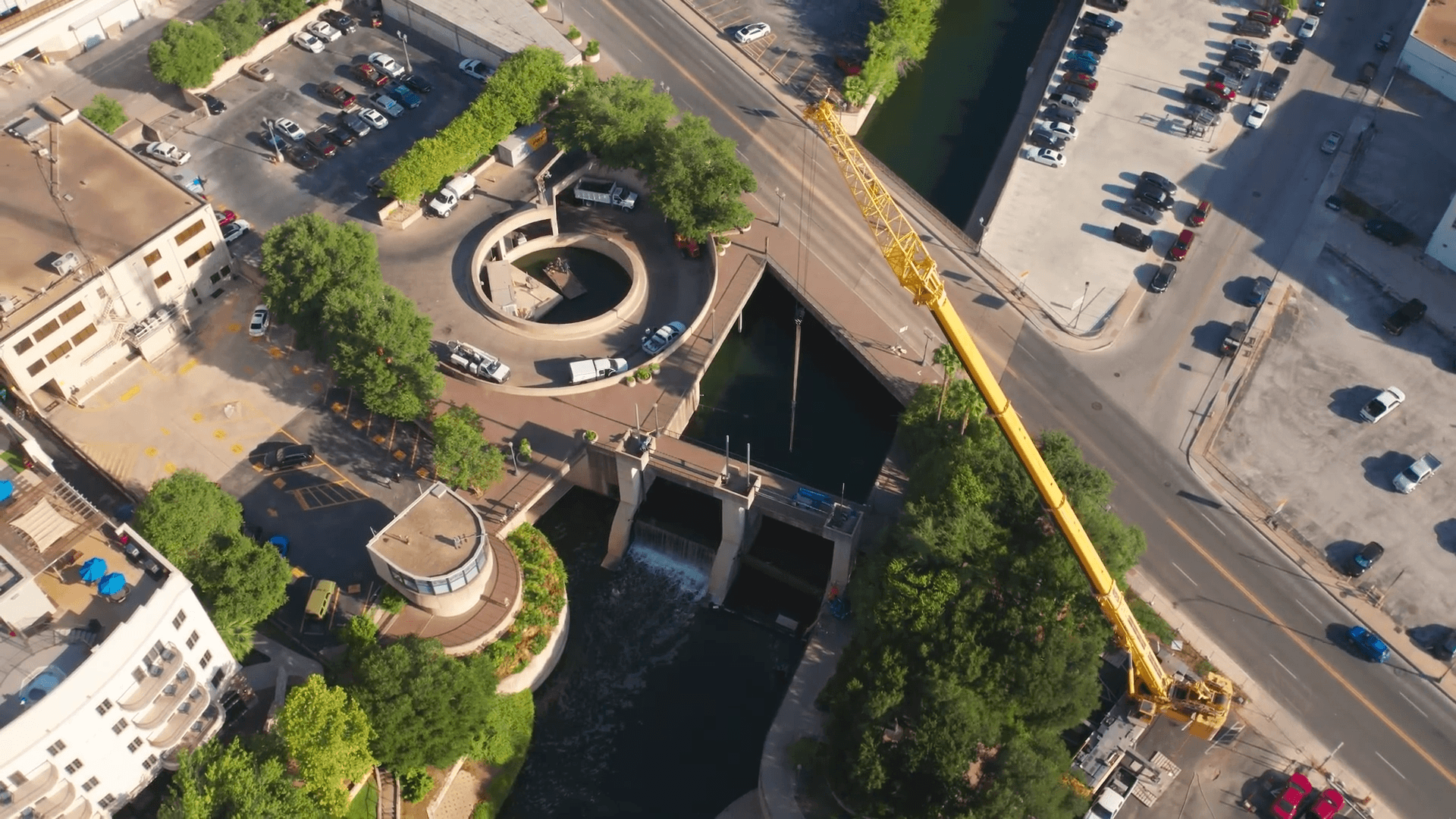
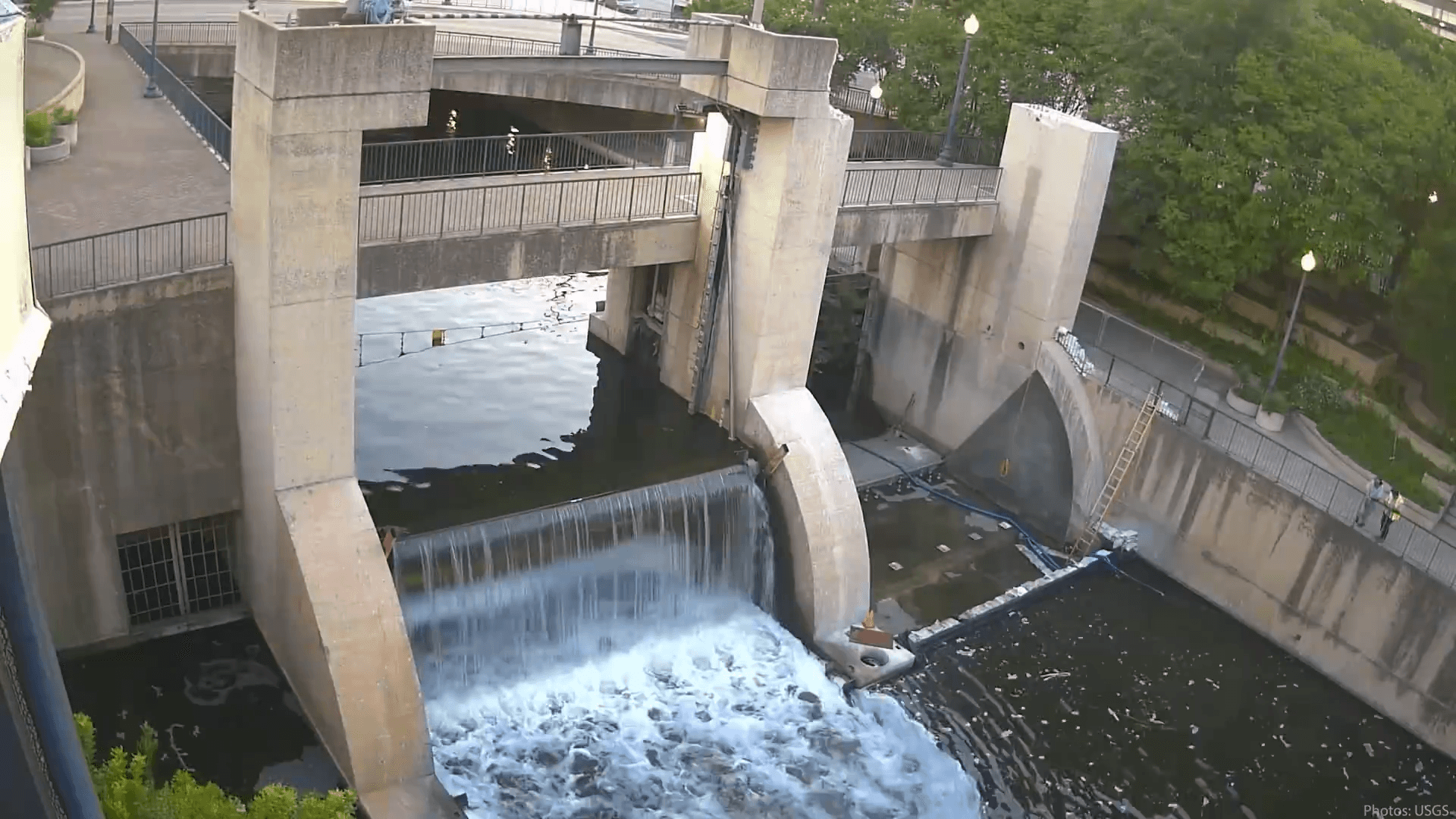
Dams often use fish ladders to help migratory species make their way upstream without interruption. In this video, Grady from Practical Engineering discusses some of the considerations that go into this special infrastructure and what kinds of designs work for different species. The first challenge for any dam is attracting fish to the ladder, which is often done by regulating the water flow at the entrance to create the velocity and turbulence that fish look for when going upstream.
Once fish are in the ladder, they travel up a series of jumps that break the dam’s elevation into manageable steps. Different dams use various baffle designs to create jumps suited to their local species and the way they like to swim. Calmer spots in each section give fish a spot to rest before they carry on. In well-designed systems, the vast majority (97%!) of fish that enter a ladder make it through to the other side. (Video and image credit: Practical Engineering)

Ancient River Branch Discovered Near Giza Pyramids
Today the pyramid complex at Giza sits kilometers from the Nile River, raising longstanding questions about how ancient builders moved the enormous stones that make up each structure. A new study using radar satellite imagery, geophysical data, and deep soil coring identified a previously unknown ancient branch of the Nile that ran alongside the Giza Pyramids as well as pyramids at sites to the south. The team’s data indicate that, during the era of the pyramids’ construction, the river would have flowed for over 60 kilometers with a maximum width of nearly 700 meters. Having such a substantial waterway right next to the pyramid sites would have drastically simplified the logistics of moving stones and workers during construction. (Image credit: A. Bichler; research credit: E. Ghoneim et al.; via My Modern Met)

Helping Fish Bypass Hydro Power Dams
Many dams in the U.S. were built at a time when their ecological impact was not a major concern. But, thanks to ongoing efforts to study affected species and upgrade infrastructure, many dams now balance human energy needs with the needs of non-humans, like migratory fish populations. In this video, Grady from Practical Engineering takes us behind-the-scenes at McNary Dam in the Pacific Northwest, where special plans and equipment help adult fish swim upstream and juvenile fish pass downstream with as little impact as possible. It’s impressive just how widespread and thorough their infrastructure for letting fish and lampreys through is! There are even facilities to help naturalists track and study the populations passing through. (Video and image credit: Practical Engineering)

The Channel Tunnel
To celebrate the 30th anniversary of the Channel Tunnel, Practical Engineering takes a look back at the construction and operation of this incredible piece of infrastructure. This 30-mile-long underwater tunnel began construction in the 1980s, using giant Tunnel Boring Machines to drill out three tunnels, starting from either side and, incredibly, meeting in the middle. All that construction underground (and underwater) is no simple feat, as Grady discusses. He also takes a look at some of the operational challenges of the design, including managing heat and air pressure build-up. (Image and video credit: Practical Engineering)

Remembering Rivers Past
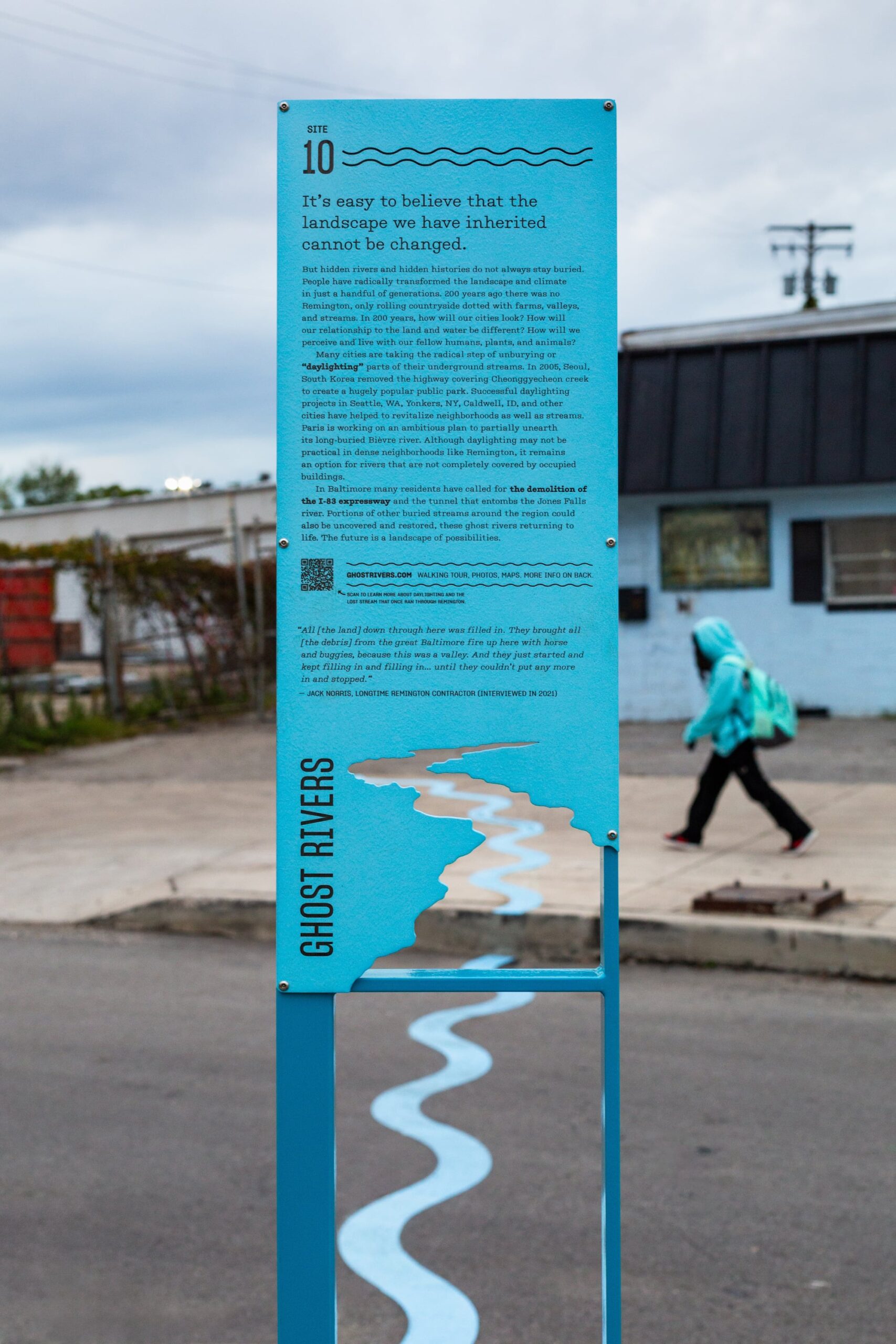
Our landscapes have changed dramatically over the last 200 years of urban development, but traces of the land’s past still remain. Many streams and rivers that once ran on the surface persist in underground culverts. Bruce Willen’s “Ghost Rivers” installation highlights the path of one such waterway, Sumwalt Run, which flows across what is now the Remington and Charles Village neighborhoods of Baltimore. The project includes ten installations that describe the hidden water and its history as well as a wavy, blue line that marks its path. (Image credits: Public Mechanics and F. Hamilton, see alt text; installation: B. Willen; via Colossal)