Tag: cavity

  • Featured Video Play Icon

    Reader Question: Inside a Vortex

    Reader embersofkymillo asks:

    Hey FYFD, could you do some analysis/explanations behind the physics of this vortex stuff? I love when you do spots on Slow Mo Guys vids and figured I’d share a recent one w you 

    I enjoy doing that, too! So let’s talk a little about vortices. What Dan’s tea stirrer is doing is creating a low-pressure core for a vortex. We can see just how strong that low pressure region is by the way it sucks the air-water interface down toward the spinning arms. Eventually the interface and stirrer meet, and what was once a single, smooth(ish) surface gets torn into a myriad of bubbles. (As an aside, those bubbles get loud.) 

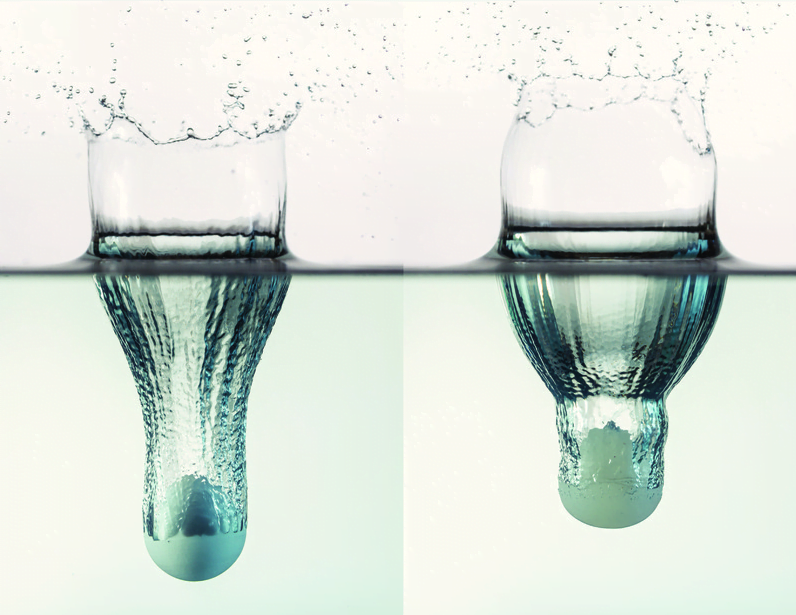
    I also like the sequence of sugar cube drops because they make for some very cool splashes. Notice how the orientation of the cube’s edges as it hits determines the shape of the inital splash curtain. The asymmetry borne out of that impact actually follows through all the way through the seal of the cavity behind the cube. It reminds me of this oldie-but-goodie video on drops hitting different shapes. (Video and image credit: The Slow Mo Guys; submitted by embersofkymillo)

  • Water Impacts

    Water Impacts

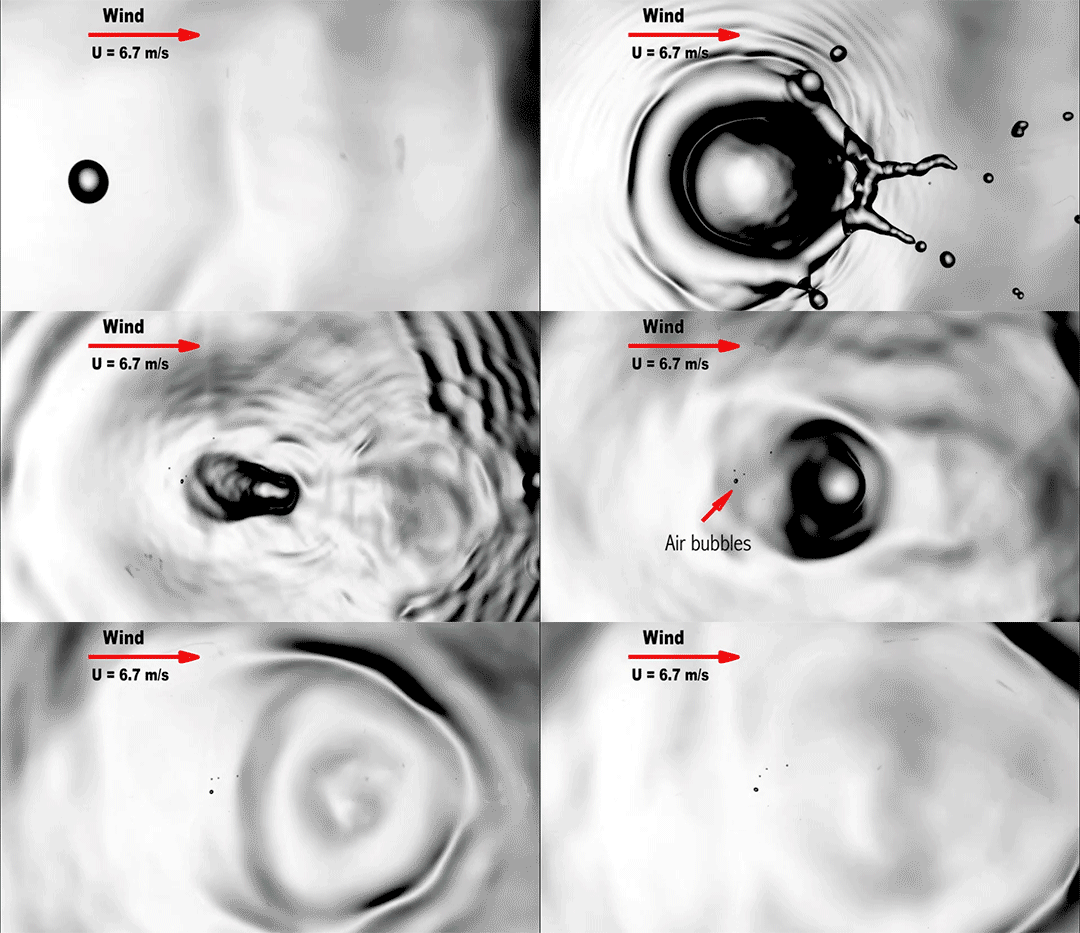
    In the clean and simplified world of the laboratory, a droplet’s impact on water is symmetric. From a central point of impact, it sends out a ring of ripples, or even a crown splash, if it has enough momentum. But the real world is rarely so simple.

    Here we see how droplets impact when the wind is blowing against them. The drops fall at an angle, creating an oblique cavity. Rings of ripples spread from the impact, but the ligaments of a splash crown form only on the leeward side. As the wind speed increases, so does the violence of the impact, eventually beginning to trap tiny pockets of air beneath the surface. Those miniature bubbles can spray droplets and aerosols into the air when they finally pop. (Image and video credit: A. Wang et al.)

  • Entrained

    Entrained

    When an object hits water whether it draws air in with it depends on its shape, impact speed, and surface characteristics. In this experiment, though, there’s a bit of a twist. Here the sphere is passing through an interface with surfactants added. On the left, the sphere passes through smoothly without entraining air or creating a cavity. On the right, the same sphere impacts at the same speed but this time the interface is covered in a layer of bubbles. As a result, the sphere pulls a large air cavity into the water with it. Why the big difference?

    As the sphere passes through the bubbles, they burst, spraying the sphere with droplets. On impact, those droplets disrupt the layer of water traveling up the sides of the sphere, causing it to pull away from the surface and form a splash. Instead of smoothly coating the sphere in water, air can now stick to the sphere and get pulled in with it. (Image and research credit: N. Speirs et al., source)

  • Using Paper to Avoid Splashback

    Using Paper to Avoid Splashback

    Daily life and countless pool parties have taught us all that objects falling into water create a splash. Sometimes that splash is undesirable, and while there are many ways to tune a splash – by adding surfactants or changing the fluid’s viscosity – there’s a relatively common one that’s escaped scientific study until now. Researchers looked at how splashes change when you add a thin, penetrable fabric – commonly known as toilet paper – to the water surface. 

    Now, the common assumption is that adding a sheet of toilet paper can prevent splashback, but the story is not quite that simple. On the left, you see a splash generated without toilet paper. Because the ball is hydrophilic (water-loving), it does not pull any air into a cavity as it passes. There’s a nice axisymmetric Worthington jet formed, and it doesn’t splash very high, although some of the satellite droplets go quite a bit higher.

    On the right, we see a splash with a single sheet of toilet paper. In this case, the impact of the sphere penetrates the paper, and the way the paper deforms causes air to get sucked down into a cavity behind the ball. That creates a wider, amorphous jet that rebounds higher than the jet in clean water, though it does not shed satellite drops. 

    The researchers found that single and even double sheets of toilet paper can actually increase the height of the splash jet if the object penetrates them. The hole the object makes actually helps focus the jet. Adding a couple more layers, though, can eliminate splashing completely. (Image and research credit: D. Watson et al.)

  • Sandy Splashes

    Sandy Splashes

    Sand and other granular materials can be strikingly fluid-like. Here the impact of a solid sphere on sand generates a splash remarkably similar to what’s seen with water. When the ball hits, it creates a crater in the surface and sends up a bowl-like spray of sand. As the ball continues falling through the sand, the grains try to fill the empty space left behind. The walls of sand collapsing around the void meet somewhere between the surface and the depth of the ball. This generates the tall jet we observe, as well as a second one under the surface that we can’t see. We know that collapse traps an air bubble under the surface because of the eruption that occurs as the jet falls. That’s the air bubble reaching the surface. (Image credit: T. Nguyen et al., source; see also R. Mikkelsen et al.)

  • Galapagos Week: Diving Birds

    Galapagos Week: Diving Birds

    One of my favorite things to do while we were sailing along the Galapagos was watching the blue-footed boobies hunt. Like the gannets shown above, boobies are plunge divers. They circle overhead until they spot their prey, then they fold their wings and dive headfirst into the water, impacting at speeds of more than 20 m/s (~45 mph). It’s absolutely incredible to watch. The physics involved are impressive, too, especially considering how badly a human would be injured diving at their speeds! 

    Fluid dynamically speaking, there are three important phases to the birds’ entry. The first is the impact phase, which lasts from initial contact until the bird’s head is underwater. In the second phase, an air cavity forms behind the head and around the neck as it enters the water. Finally, when the chest – the widest point of the bird – hits the water, the bird reaches the submerged phase. 

    Mechanically, the most interesting part is the air cavity phase. During this time, the bird’s head is slowing down due to high hydrodynamic drag from the water, but the rest of the bird is still moving fast. That means the bird’s slender neck experiences strong compressive forces, which would tend to make it buckle. Researchers at Virginia Tech examined this very problem and found that the birds’ sizing – its head shape, neck length, and so forth – combined with their typical diving speeds kept these birds well away from the conditions that would cause their necks to buckle. With the added stabilization from the birds’ neck muscles, they estimated that gannets and other plunge divers might be able to safely dive at speeds twice what would kill a human! Check out the BBC video below to see high-speed footage of gannets diving. (Image credits: G. Lecoeur; B. Chang et al.; research credits: B. Chang et al., pdf; video credit: BBC)

    Tomorrow will be the final day of Galapagos Week. Catch up on previous posts here

  • Squishy Impacts

    Squishy Impacts

    How spheres impact water has been studied for more than a century. The typical impact for a rigid sphere creates a cavity like the one on the upper left – relatively narrow and prone to pinching off at its skinny waist. If the sphere is elastic –squishy – instead, the cavity ends up looking much different. This is shown in the upper right image, taken with an elastic ball and otherwise identical conditions to the upper left image. The elastic ball deforms; it flattens as it hits the surface, creating a wider cavity. If you watch the animations in the bottom row, you can see the sphere oscillating after impact. Those changes in shape form a second cavity inside the first one. It’s this smaller second cavity that pinches off and sends a liquid jet back up to the collapsing splash curtain

    From the top image, we can also see that the elastic sphere slows down more quickly after impact. This makes sense because part of its kinetic energy at impact has gone into the sphere’s shape changes and their interaction with the surrounding water. 

    If you’d like to see more splashy stuff, be sure to check out my webcast with a couple of this paper’s authors. (Image credits: top row – C. Mabey; bottom row – R. Hurd et al., source; research credit: R. Hurd et al.)

  • Cavity Collapse

    Cavity Collapse

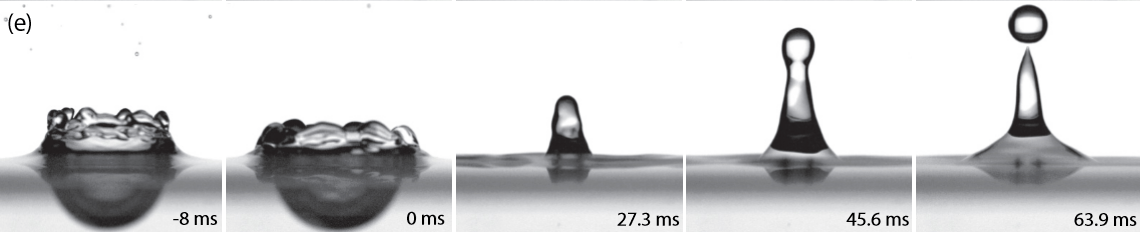
    One of the most iconic images in fluid dynamics is that of a drop impacting a liquid. When a drop hits a pool, it creates a crater, or cavity. That cavity expands and then collapses to form a jet that rebounds above the pool’s surface. If the jet is fast enough, it will eject one or more droplets before it falls back into the pool. Faster droplets, like the one that formed the cavity and jet shown above, actually create slower and fatter jets. In this regime, the complicated interplay of surface tension and gravity effects results in a jet velocity that is independent of impact speed and the liquid’s viscosity. Understanding this jet and splash dynamics is important for many industrial applications, including ink-jet printing. (Image credit: G. Michon et al.)

  • Rio 2016: Diving

    Rio 2016: Diving

    Diving is a popular event for spectators, but it can also be rather confusing. We know that divers are rewarded for minimizing their splash, but what exactly does that mean and how do they do it?

    The ideal water entry, called a rip entry by divers, requires a diver to hit the water in a vertical orientation with their arms braced and palms held flat over their head. Striking the water tears open a cavity for the athlete’s body to enter. To minimize splash, the diver wants to fall into this expanding cavity without striking the sides, which would throw up an additional splash. This is the reason for vertical entry. Hand position is also important. If the athlete were to point their fingers, they would create a narrower cavity and larger splash.

    After the athlete enters the water, the cavity closes off under the surface and the water rebounds in a splashy Worthington jet. For the speed and size of human divers, this later splash is essentially unavoidable. What the commentators don’t really tell you, though, is that diving judges are only supposed to judge a diver’s entry up to the point that their feet go under the surface. They’re instructed to ignore everything that happens underwater and after entry. So that big rebound splash we all see isn’t meant to count! (Image credits: A. Pretty/GettyImages; kaorigoto, source)

    Previously: Minimizing splash by being hydrophilic; the physics of skipping rocks and avoiding splashback at the urinal

    Join us throughout the Rio Olympics for more fluid dynamics in sports. If you love FYFD, please help support the site!

  • Crown Splash Sealing

    Crown Splash Sealing

    A sphere falling into water generates a spectacular crown
    splash at the surface. The object’s impact ejects a thin sheet of fluid
    that rises vertically. The air pulled down into the cavity by the
    sphere’s passage makes the air pressure inside the sheet lower than the
    ambient air pressure on the exterior of the sheet. This pressure
    difference is part of what draws the crown inward to seal the cavity. As
    the splash collapses inward and seals, the liquid sheet starts to
    buckle and wrinkle, leaving periodic stripes around the closing neck.
    This so-called buckling instability occurs when the radius of the neck
    collapses faster than the vertical speed of the splash. For more, see
    the research paper or this award-winning video. (Image credit: J. Marston et al., source)