Tag: cavity

  • Molten Salt in Water

    Molten Salt in Water

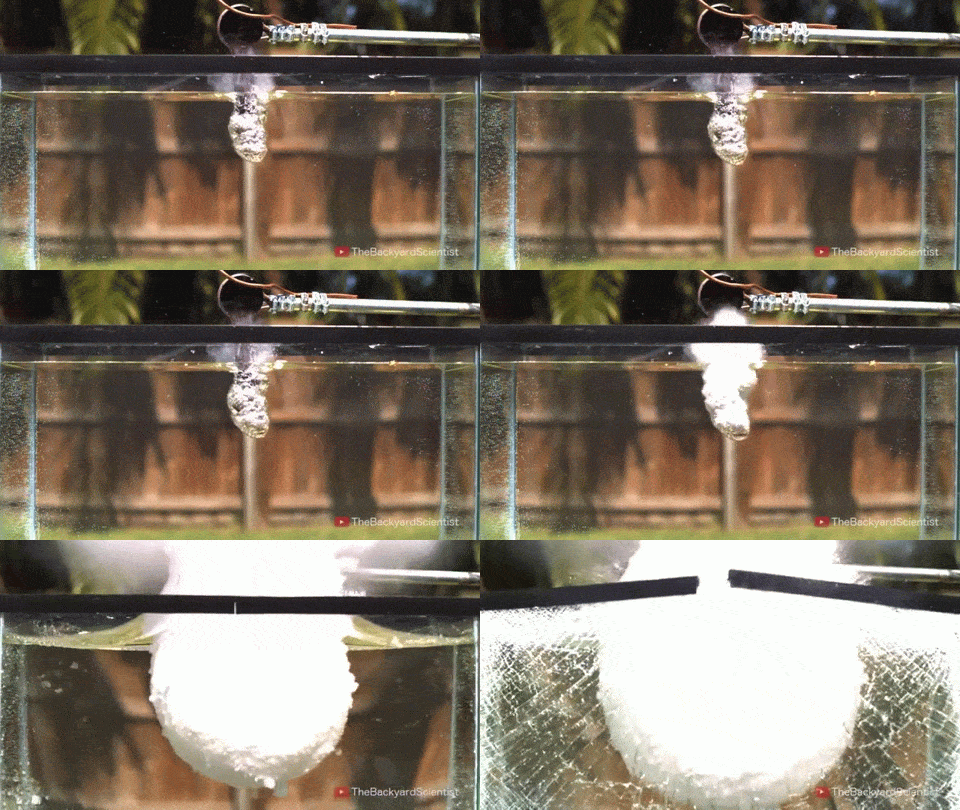
    In his latest video, The Backyard Scientist explores what happens when molten salt (sodium chloride) gets poured into water. As you can see, the results are quite dramatic! He demonstrates pretty convincingly that the effect is physical – not chemical. The extreme difference in temperature between the liquid water (< 100 degrees Celsius) and the molten salt (> 800 degrees Celsius) causes the water to instantly vaporize due to the Leidenfrost effect. This vapor layer protects the liquid water from the molten salt – until it doesn’t. When some driving force causes a drop of water to touch the salt without that protective vapor layer, the extreme temperature difference superheats the water, causing it to expand violently, which drives more water into salt and feeds the explosion.

    But why don’t the other molten salts he tests explode? Sodium carbonate, the third salt he tests, has a melting point of 851 degrees Celsius, 50 degrees hotter than sodium chloride. Yet for that test, the Leidenfrost effect prevents any contact between the two liquids. The key in this case, I hypothesize, is not simply the temperature difference between the water and salt, but the difference in fluid properties between sodium chloride and sodium carbonate. The breakdown of the vapor layer and subsequent contact between the water and the molten salt depends in part on instabilities in the fluids. A cavity where instabilities can grow more easily is one where the Leidenfrost effect is less likely to protect and separate the two fluids. And, in fact, it turns out that the surface tension of molten sodium chloride is significantly lower than that of molten sodium carbonate! A lower surface tension value means that the molten sodium chloride breaks into droplets more easily and its vapor cavity will respond more strongly to fluid instabilities, making it more likely to come in contact with liquid water and, thus, cause explosions. (Image/video credit: The Backyard Scientist; submitted by Simon H)
  • Skipping Squishy Spheres

    Skipping Squishy Spheres

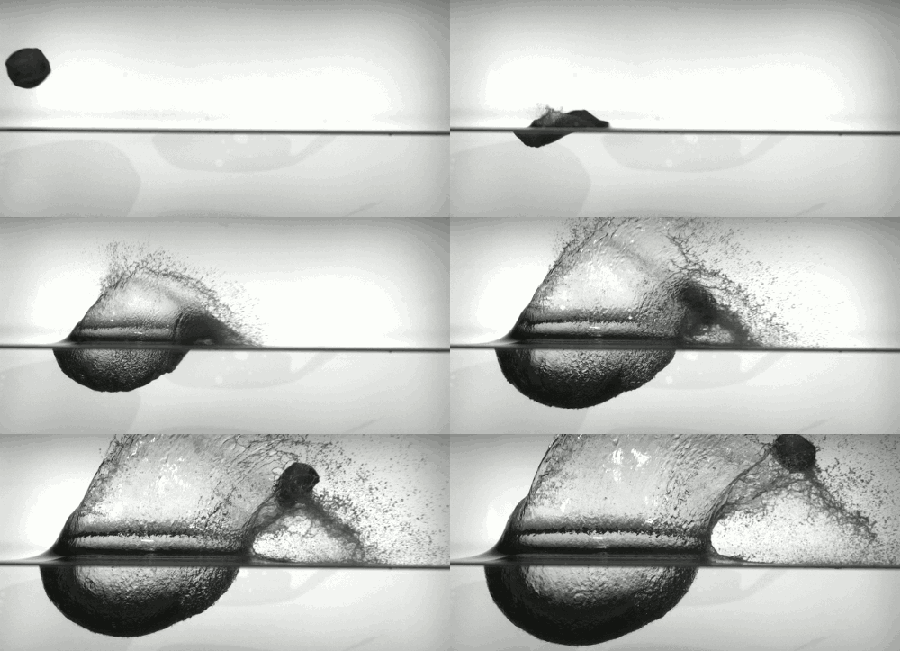
    Skipping a stone on water requires a flat, disk-like stone thrown at a shallow angle, but elastic spheres are remarkable skippers, too, even at higher impact angles. Researchers at the Splash Lab have just published their work on why these balls skip so well. As seen in the top animation, the elastic spheres deform on impact, flattening to a more disk-like shape that rides at an angle of attack relative to the air-water interface. Both features are important to the spheres’ enhanced skipping. By flattening, the sphere comes into greater contact with the water and by orienting at a larger angle of attack, the sphere increases the vertical component of force the water generates on the sphere. It’s this vertical force that lifts the sphere up and lets it keep bouncing.

    Because the ball is soft, it keeps deforming after its impact and bounce (see top animation). For some skips, the timescale of the sphere’s elastic waves is smaller than the length of time the sphere is in contact with the water. When this is the case, the sphere’s elastic waves will affect the impact cavity in the water, forming what the researchers call a

    matryoshka cavity, after the Russian nesting dolls. An example is shown in the second animation. For more, check out the USU press releasethe original paper, or the award-winning video they made a few years ago.  (Image credits: J. Belden et al./The Splash Lab)

    If you enjoy FYFD and want to help support it, please consider becoming a patron!

  • Why Joints Pop

    Why Joints Pop

    Joints like our knuckles are lubricated with liquid called the synovial fluid. When manipulated, these joints can pop or crack audibly. For half a century, researchers have thought the cracking sound joints under tension make was the result of bubbles in the synovial fluid collapsing. But a new cine magnetic resonance imaging (MRI) study shows that the sound is generated during bubble inception and that the cavity persists after the sound. When the bones of the joint are pulled, viscous forces resist their separation. With enough force, the joints separate suddenly, causing a pressure drop in the synovial fluid that forms a vapor-filled cavity in the joint. According to the real-time MRI observations, this is when the sound is generated. The cavity does eventually dissipate, they found, but only well after the pop. The whole joint-cracking process is consistent with the tribonucleation mechanism seen in machinery.  (Image credit: G. Kawchuk et al.; GIF via skunkbear, source video)

  • Pineapple Cavity

    Pineapple Cavity

    Objects falling into a quiescent fluid leave an air-filled cavity in their wake. The cavity collapses quickly due to the pressure of the surrounding fluid; but while it lasts, the cavity carries a signature of the object that made it. The collage above shows a series of snapshots of the formation and collapse of a cavity created by a 20-petal disk. Although the disk is essentially circular with only a small variation along its circumference, the effects of those perturbations appear soon after formation in the sidewalls of the cavity and persist until after its pinch-off and collapse. For more cavity dynamics, see here. (Image credit: O. Enriquez et al.)

  • Featured Video Play Icon

    Granular Jets

    Object impacts in water and other fluids often create cavities that generate jets when they collapse. But impacts on granular materials can produce similar results, forming a cavity, a splash corona, and, under the right circumstances, a jet. This Sixty Symbols video explores the effect of grain size (and thus weight) on the formation of such a rebound jet. Ultimately, the jet behavior is driven by air. When the granular material is poured, air gets trapped between the grains. The impact compresses the grains, forcing the previously trapped air up and out through the cavity created by the impact. Interestingly, once the air pressure is low enough, jet creation is suppressed, not unlike splash suppression in liquids. (Video credit: Sixty Symbols/Univ. of Nottingham)

  • Featured Video Play Icon

    Shooting a Bullet Through a Water Balloon

    This high-speed video of a bullet fired into a water balloon shows how dramatically drag forces can affect an object. In general, drag is proportional to fluid density times an object’s velocity squared. This means that changes in velocity cause even larger changes in drag force. In this case, though, it’s not the bullet’s velocity that is its undoing. When the bullet penetrates the balloon, it transitions from moving through air to moving through water, which is 1000 times more dense. In an instant, the bullet’s drag increases by three orders of magnitude. The response is immediate: the bullet slows down so quickly that it lacks the energy to pierce the far side of the balloon. This is not the only neat fluid dynamics in the video, though. When the bullet enters the balloon, it drags air in its wake, creating an air-filled cavity in the balloon. The cavity seals near the entry point and quickly breaks up into smaller bubbles. Meanwhile, a unstable jet of water streams out of the balloon through the bullet hole, driven by hydrodynamic pressure and the constriction of the balloon. (Video credit: Keyence)

  • Impacting a Viscous Pool

    Impacting a Viscous Pool

    Whenever a hollow cavity forms at the surface of a liquid, the cavity’s collapse generates a jet–a rising, high-speed column of liquid. The composite images above show snapshots of the process, from the moment of the cavity’s greatest depth to the peak of the jet. The top row of images shows water, and the bottom row contains a fluid 800 times more viscous than water. The added viscosity both smooths the geometry of the process and slows the jet down, yet strong similarities clearly remain. Focusing on similarities in fluid flows across a range of variables, like viscosity, is key to building mathematical models of fluid behavior. Once developed, these models can help predict behaviors for a wide range of flows without requiring extensive calculation or experimentation. (Image credit: E. Ghabache et al.)

  • Featured Video Play Icon

    Vibrating Paint

    Paint is probably the Internet’s second favorite non-Newtonian fluid to vibrate on a speaker–after oobleck, of course. And the Slow Mo Guys’ take on it does not disappoint: it’s bursting (literally?) with great fluid dynamics. It all starts at 1:53 when the less dense green paint starts dimpling due to the Faraday instability. Notice how the dimples and jets of fluid are all roughly equally spaced. When the vibration surpasses the green paint’s critical amplitude, jets sprout all over, ejecting droplets as they bounce. At 3:15, watch as a tiny yellow jet collapses into a cavity before the cavity’s collapse and the vibration combine to propel a jet much further outward. The macro shots are brilliant as well; watch for ligaments of paint breaking into droplets due to the surface-tension-driven Plateau-Rayleigh instability. (Video credit: The Slow Mo Guys)

  • Featured Video Play Icon

    Entering a Viscous Liquid

    When a solid object impacts on a liquid a cavity typically forms, entraining air into the pool. But this behavior varies widely according to the surface of the solid as well as the fluid’s properties. This video shows a sphere impacting a highly viscous liquid. The sphere stops shortly after impact while the cavity continues expanding in its wake. With a fluid like water, a long and thin cavity will typically pinch off before the object is decelerated, causing bubbles to form. No such behavior here. Instead the wide cavity pinches off at the surface of the motionless sphere and begins its rebound upwards. It even appears to pull the sphere partially back towards the surface! (Video credit: A. Le Goff et al.)

  • Featured Video Play Icon

    Rock Skipping Tips

    Almost everyone has tried skipping rocks across the surface of a pond or lake. Here Professor Tadd Truscott gives a primer on the physics of rock skipping, including some high-speed video of the impact and rebound. In a conventional side-arm-launched skip, the rock’s impact creates a cavity, whose edge the rock rides. This pitches the rock upward, creating a lifting force that launches the rock back up for another skip. Alternatively, you can launch a rock overhand with a strong backspin. The rock will go under the surface, but if there’s enough spin on it, there will be sufficient circulation to create lift that brings the rock back up. This is the same Magnus effect used in many sports to control the behavior of a ball–whether it’s a corner or free kick in soccer or a spike in volleyball or tennis. (Video credit: BYU Splash Lab/Brigham Young University)