Gravity is such an omnipresent force in our lives that we frequently forget how strongly it affects our daily experiences and how differently nature behaves without it. A wonderful example of this is the simple flame of a candle. On Earth, a candle flame is tear-drop-shaped and elongated, burning hotter near the bottom and glowing yellow from soot at the top. But, as Dianna demonstrates with her free-fall experiment, this shape is due entirely to the effects of gravity. Buoyant forces make the hot air near the candle rise, pulling in cooler air and fresh oxygen at the base while stretching out the flame. In microgravity – or free-fall – flames are instead spherical, their shape driven by molecular and chemical diffusion. Check out the full video to see more effects of acceleration on flames. (Video credit: Physics Girl)
Tag: buoyancy

Soaring Pelicans


Earlier this summer, I looked up on a bright, sunny day and saw a quartet of black and white figures soaring overhead. Initially, I thought it might be a formation of kites or unmanned aerial vehicles (UAVs) because I saw no flapping as the group wheeled about. With the help of the Cornell Lab of Ornithology’s awesome Merlin app, I was able to identify the soarers as American white pelicans – not a species I’d expected to find flying along the Front Range of the Rocky Mountains! (Turns out, they breed on lakes around here.)
The reason I saw so little flapping is that the birds were riding thermals. As the sun heats the ground, air near the surface warms up and begins to rise due to its buoyancy. Pelicans interested in flying between breeding and foraging grounds will start testing the thermals early in the day, as soon as they begin to form. As the heating continues, the intensity of thermals strengthens and they extend higher into the atmosphere. This is where the birds can really excel at using atmospheric energy for their flight. Pelicans will circle within a thermal until they reach roughly the middle of its height. Then they will glide, gradually losing altitude until they reach another thermal where they can climb without expending their own energy. With a 2.7 meter wingspan and a relatively low drag coefficient, the pelicans can glide and soar remarkably well. Researchers have even suggested using them as a sort of biological UAV for studying atmospheric dynamics! (Image credits: D. Henise, M. Stratmoen; research credit: H. Shannon et al., pdfs – 1, 2)

Tightrope Walkair
A bubble rising through water can get caught on an aerophilic (air-attracting) fiber. The bubble will then adhere to the fiber and be guided to the surface by it. In the poster above, the image is a composite photo of such a bubble every 40 milliseconds. Once captured by the fiber, the bubble first accelerates and then reaches a terminal velocity, indicated by the equal spacing of the bubble photos toward the right end of the picture. The terminal velocity strikes a balance between buoyancy, which pulls the bubble upward, and skin friction between the bubble and the water, which acts like drag on the bubble. At the terminal velocity, these forces are equal; neither is able to speed up or slow down the bubble. (Image credit: H. de Maleprade et al.)

Eroding Candy


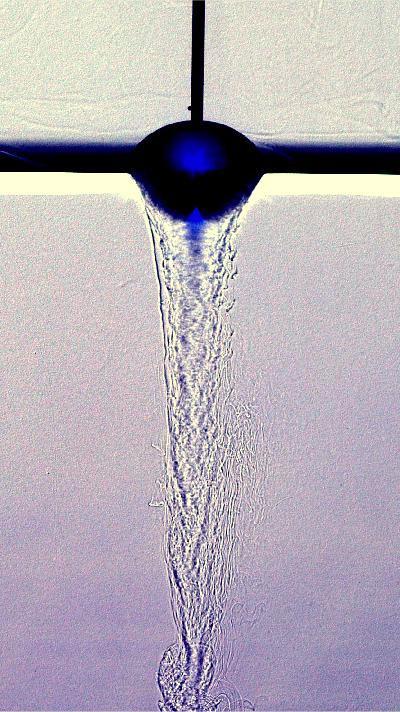
When you pop a hard candy in your mouth, you probably don’t give much thought to the fluid dynamics involved in dissolving it. The series above shows a hard candy suspended in water being slowly eaten away. As sugars in the candy dissolve into the water, the fluid becomes denser and falls away. This creates the downward flow visible in the center of the image. As sugar-laden water sinks, fresher water is pulled in alongside the walls of the candy. That flow helps erode the candy, creating a rougher surface. Since rough surfaces have a greater surface area exposed (than a smooth surface), they prompt further and faster dissolution. That strengthens the downward flow, pulls in more ambient water, and keeps the whole process going. (Image credit: M. Wykes)

“Ink in Motion”
In this short film, the Macro Room team plays with the diffusion of ink in water and its interaction with various shapes. Injecting ink with a syringe results in a beautiful, billowing turbulent plume. By fiddling with the playback time, the video really highlights some of the neat instabilities the ink goes through before it mixes. Note how the yellow ink at 1:12 breaks into jellyfish-like shapes with tentacles that sprout more ink; that’s a classic form of the Rayleigh-Taylor instability, driven by the higher density ink sinking through the lower density water. Ink’s higher density is what drives the ink-falls flowing down the flowers in the final segment, too. Definitely take a couple minutes to watch the full video. (Image and video credit: Macro Room; via James H./Flow Vis)


Fanning the Flame
A fan’s blade passes through the hot air rising above a flame in this iconic image by high-speed photography pioneer Harold Edgerton. This photo uses an optical technique known as schlieren photography that makes density differences in transparent media like air visible. Because of its lower density, the hot plume of air above the flame rises. When the fan blade swings past, it sheds a vortex off its tip and the rising air from the flame gets pulled into the vortex to make it visible. To the left, a ghostly counter-rotating vortex sits on the opposite side of the fan blade. (Photo credit: H. Edgerton and K. Vandiver)

Spreading Bubbles Help Nature’s Scuba Divers
How liquid droplets spread on solid surfaces is pretty well understood, but researchers have looked less at the related problem of how a gas spreads. In a recent paper, scientists have examined the spreading dynamics of bubbles impacting an immersed solid. As the bubble contacts the surface, it quickly squeezes out water trapped between the bubble and the gas layer trapped at the solid surface. The bubble squishes as surface tension tries to flatten the liquid-gas interface. Buoyancy also helps flatten the bubble. The spreading is remarkably fast, taking only about 10 milliseconds. That’s good news for the many insects who use trapped air bubbles like these to breathe underwater. Check out the video below to learn about some of these natural scuba divers. (Image credit: H. de Maleprade et al., source; video credit: Deep Look)

Acrylic and Oil

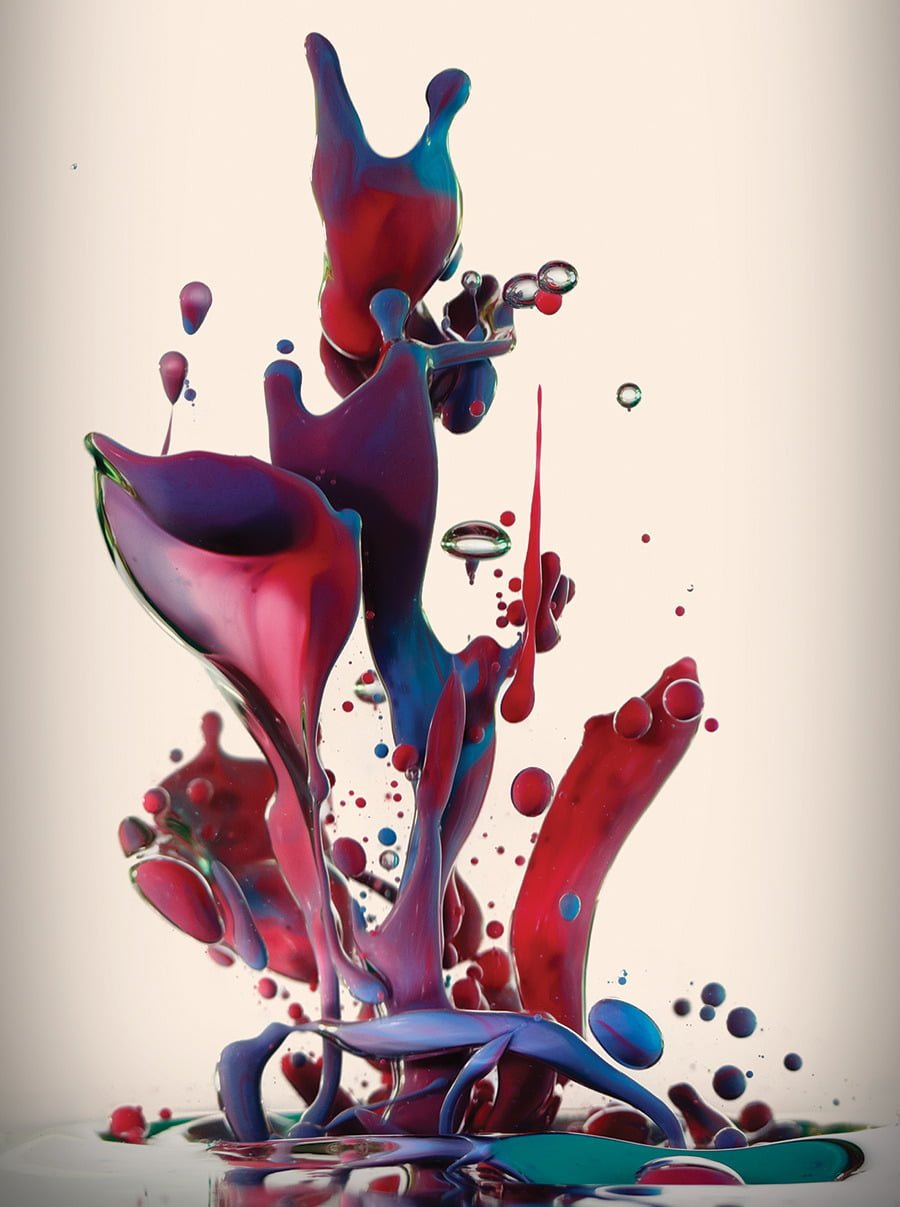
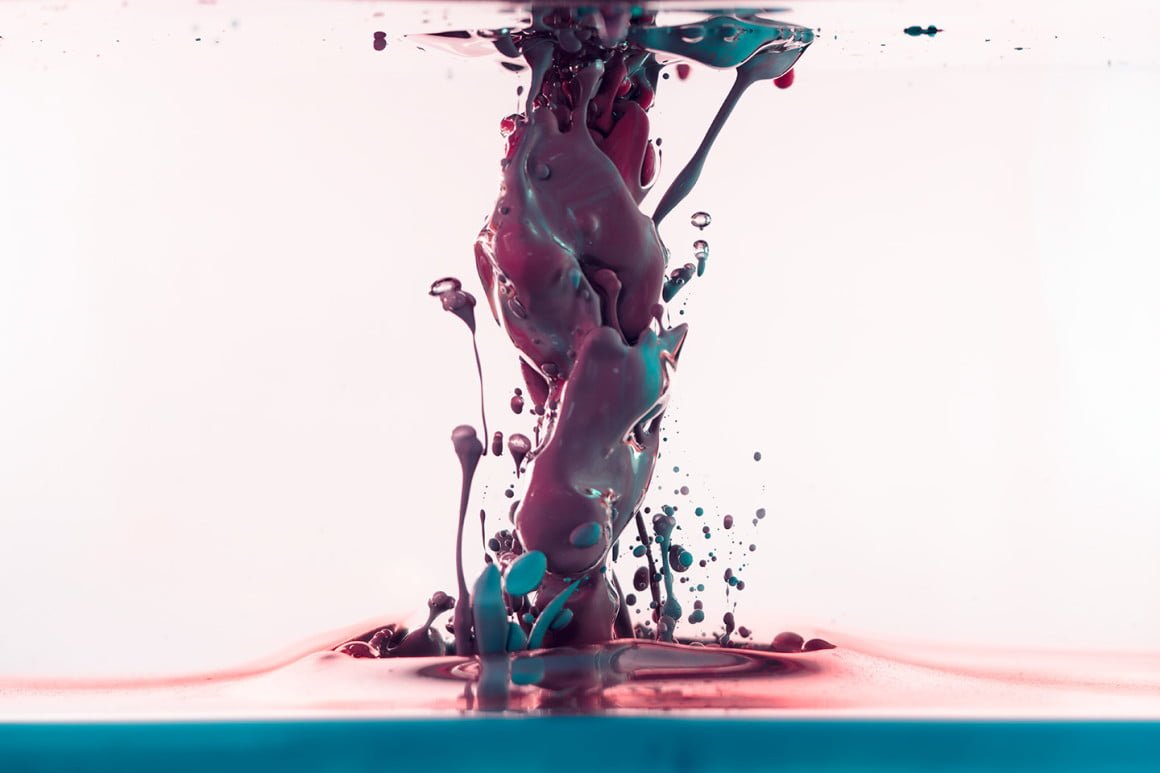
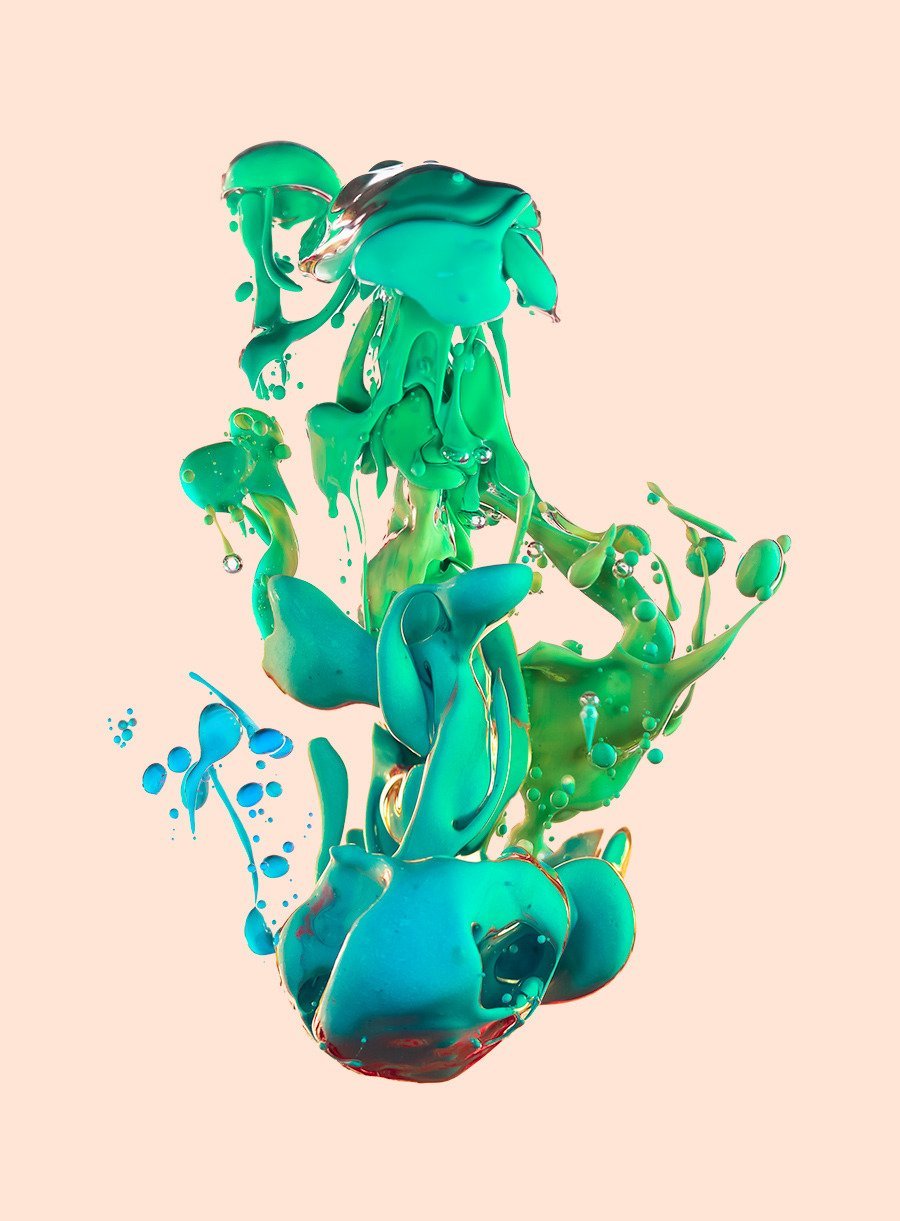
Photographer Alberto Seveso is well-known for ink in water art, some of which FYFD has featured previously (1, 2, 3). More recently, he’s been experimenting with alternative methods, dropping fluids like acrylic paint into sunflower oil. The effect is quite different but no less beautiful. Because the paint and oil are immiscible, the boundaries between the two fluids are much more clearly defined and highlighted in an iridescent sheen. Instead of appearing like billowing waves of silk, the paint forms abstract and alien shapes driven by gravity, inertia, and density differences. For many more great examples, check out Seveso’s website. (Photo credit: A. Seveso)

Dissolving
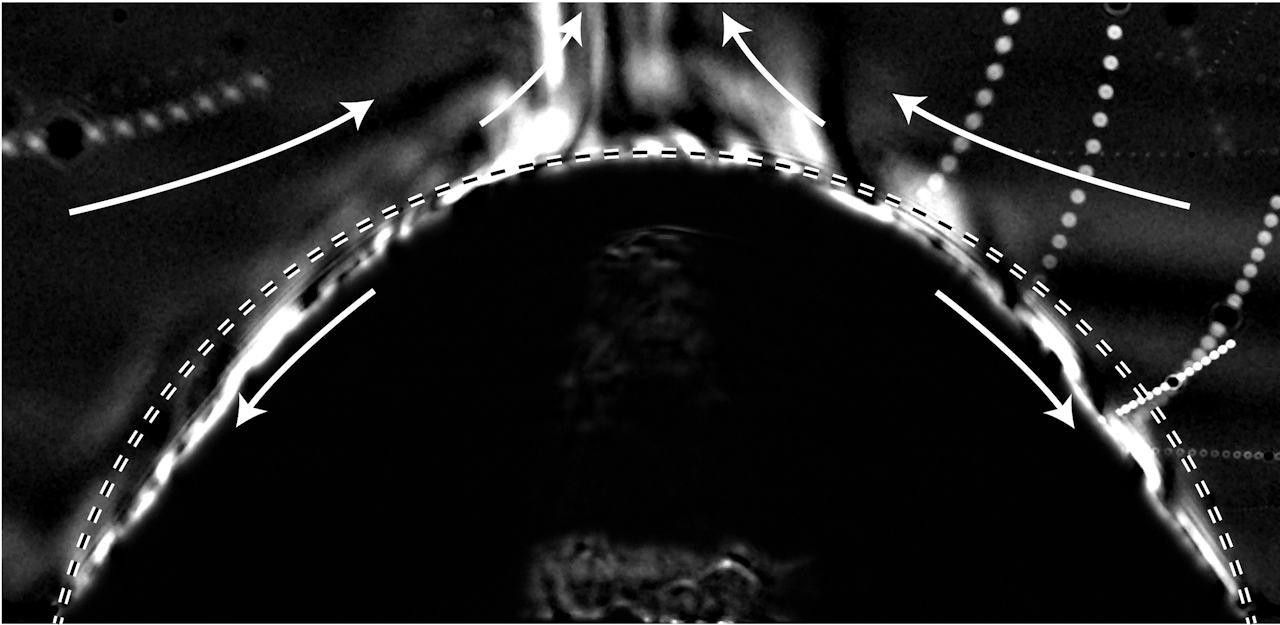
It looks like the fiery edge of a star’s corona, but this photo actually shows a dissolving droplet. The droplet, shown as the lower dark region in this shadowgraph image, is a mixture of pentanol and decanol sitting in a bath of water. Pentanol is a type of alcohol that is fully miscible with decanol and is water soluble, so that it will dissolve into the surrounding water over time. Decanol, on the other hand, is immiscible with water, so that part of the droplet won’t mix with the surrounding water.
The bright swirls along the droplet’s edge show areas with more pentanol. As the alcohol dissolves into the water, it forms a buoyant plume at the top of the droplet that rises due to pentanol’s lower density. That rising plume draws fresh water in from the sides, shown by the upper white arrows. Inside the droplet, flow moves in the opposite direction, from the top toward the outer edges. This is a result of uneven surface tension within the droplet. Scientists are interested in understanding the dynamics of these multiple component drops for applications like printing, where it’s desirable for pigments in an ink drop to be distributed evenly as the drop dries. (Image credit: E. Dietrich et al.)

“Oil Spill”


In “Oil Spill” artist Fabian Oefner explores the shapes and colors of oil floating atop water. An old adage tells us that oil and water don’t mix, but this is not perfectly true. Especially in low concentrations, oil can mix slightly with water, which is why the edges of Oefner’s creations become fuzzy and break down. For the most part, though, the thin layer of oil spreads across the water’s surface, its slight variations in thickness casting the different iridescent colors we observe – just the same as a soap bubble’s iridescence. The colorful patterns are a snapshot of motion in the oil; in some places it radiates outward, pulled by the stronger surface tension of water. In other places it forms plumes and swirls that may be the result of temperature variations or other disquiet motion in the surrounding water or air. (Image credits: F. Oefner)