Hold a buoyant sphere like a ping pong ball underwater and let it go, and you’ll find that the ball pops up out of the water. Intuitively, you would think that letting the ball go from a lower depth would make it pop up higher – after all, it has a greater distance to accelerate over, right? But it turns out that the highest jumps comes from balls that rise the shortest distance. When released at greater depths, the buoyant sphere follows a path that swerves from side to side. This oscillating path is the result of vortices being shed off the ball, first on one side and then the other. (Image and research credit: T. Truscott et al.)
Tag: buoyancy

Living Fluid Dynamics
This short film for the 2016 Gallery of Fluid Motion features Montana State University students experiencing fluid dynamics in the classroom and in their daily lives. As in her previous film (which we deconstructed), Shanon Reckinger aims to illustrate some of our everyday interactions with fluids. This time identifying individual phenomena is left as an exercise for the viewer, but there are hints hidden in the classroom scenes. How many can you catch? I’ve labeled some of the ones I noticed in the tags. (Video credit: S. Reckinger et al.)

Rio 2016: Synchro Swimming and Water Polo


Both synchronized swimming and water polo require competitors to hold themselves stable above the water’s surface without touching the pool’s bottom. One of the basic techniques for doing so in both sports is known as the eggbeater kick, shown above. The eggbeater kick is very similar to the motion for the breaststroke’s kick, but it’s performed upright and with alternating leg motions, sweeping a clockwise circle with the left leg and a counterclockwise one with the right.
A swimmer typically stays afloat due to a buoyant force equal to the weight of the volume of water the swimmer displaces. Rising further out the water means reducing the buoyant force, so the swimmer must generate other forces to counter their weight. The eggbeater kick does this two ways. First, as the swimmer sweeps their foot around, it acts like a hydrofoil, generating lift that holds the swimmer up. Second, other parts of the kick cycle force water downward, which, by Newton’s third law, pushes the swimmer up.
Keeping a wide stance and sweeping the legs alternately allows the athlete to balance the horizontal forces their motions create while keeping the upward forces generated relatively constant. This gives them a stable, arms-free platform that’s a foundation for everything else their sport requires. (Image credits: GettyImages; The Studio WLV, source)
Previously: How buoyancy helps swimmers
Join us throughout the Rio Olympics for more fluid dynamics in sports. If you love FYFD, please help support the site!

Dust Devils
Dust devils, like fire tornadoes and waterspouts, form from warm, rising air. As the sun heats the ground to temperatures hotter than the surrounding atmosphere, hot air will begin to rise. When it rises, that air leaves behind a region of lower pressure that draws in nearby air. Any vorticity in that air gets intensified as it gets pulled toward the low pressure area. It will start to spin faster, exactly like a spinning ice skater who pulls in his arms. The result is a spinning vortex of air driven by buoyant convection. On Earth, dust devils are typically no more than a few meters in size and can only pick up light objects like leaves or hay. On Mars, dust devils can be hundreds of meters tall, and, though they’re too weak to do much damage, they have helpfully cleaned off the solar panels of some of our rovers! (Image credit: T. Bargman, source; via Gizmodo)

Daily Fluids, Part 1
Just getting cleaned up and ready for the day involves a lot of fluid physics. Here are a few of the phenomena you may see daily without realizing:
Plateau-Rayleigh Instability
This behavior is responsible for the dripping of your faucet. More specifically, it’s the reason that a falling jet breaks up into droplets. It works on rain, too!Forced Convection
Everyone is familiar with a winter wind making them colder or hot air from a dryer getting the moisture off their hands. These are examples of forced convection – heat transfer by driving a fluid past a solid. Another common example? The fans in your computer!Liquid Atomization
This is the process of breaking a liquid into lots of tiny droplets. Aside from any aerosol can ever, this phenomenon is also key to your daily shower and internal combustion in your car.Archimedes Principle
This might be one of my favorite bits of the whole video because it hearkens back to some of my own earliest fluid dynamics exposure. Archimedes Principle says that buoyancy is equal to the weight of the fluid a body displaces. My mom (a science teacher) taught me about this one in the bathtub! It’s key to everything that ever floated, including us!Tune in all week for more examples of fluid dynamics in daily life. (Image credit: S. Reckinger et al., source)
Paper Marbling
Fluid dynamics and art have gone hand-in-hand for centuries. In this video, artist Garip Ay demonstrates one of the coolest fluids-based art techniques: paper marbling. In this technique, artists float ink or paints on a liquid surface, manipulate the colors as desired–in this case to recreate Van Gogh’s “Starry Night”–and then float a piece of paper atop the surface to transfer the image. Multiple cultures around the world developed marbling techniques, dating all the way back to the Middle Ages. Ay is an expert in ebru, a Turkish form of the art. For more of Ay’s art, check out his website and YouTube channel. (Video credit: G. Ay; via Gizmodo)

Mushrooms Make Their Own Breeze
Plants and other non-motile organisms have developed some clever methods to disperse their seeds and spores for reproduction. Some plants use vortex rings for dispersal; others make their seeds aerodynamic. Low ground-dwellers like mushrooms must contend with a lack of wind to lift their spores and carry them away. Instead, they use evaporative cooling to generate their own air currents.
Mushroom caps contain a lot of water and, as that water evaporates, it cools air near the mushroom, just as sweat evaporating off your skin cools you. That cooler, denser air tends to spread, carrying the spores outward. At the same time, the freshly evaporated water vapor is less dense than the surrounding air, so it rises. This combination of rising and spreading is capable of carrying spores tens of centimeters into the air, where the wind is stronger and able to carry spores further. (Image credit: New Atlantis, source; research credit: E. Dressaire et al.)

Icebergs and Caramel
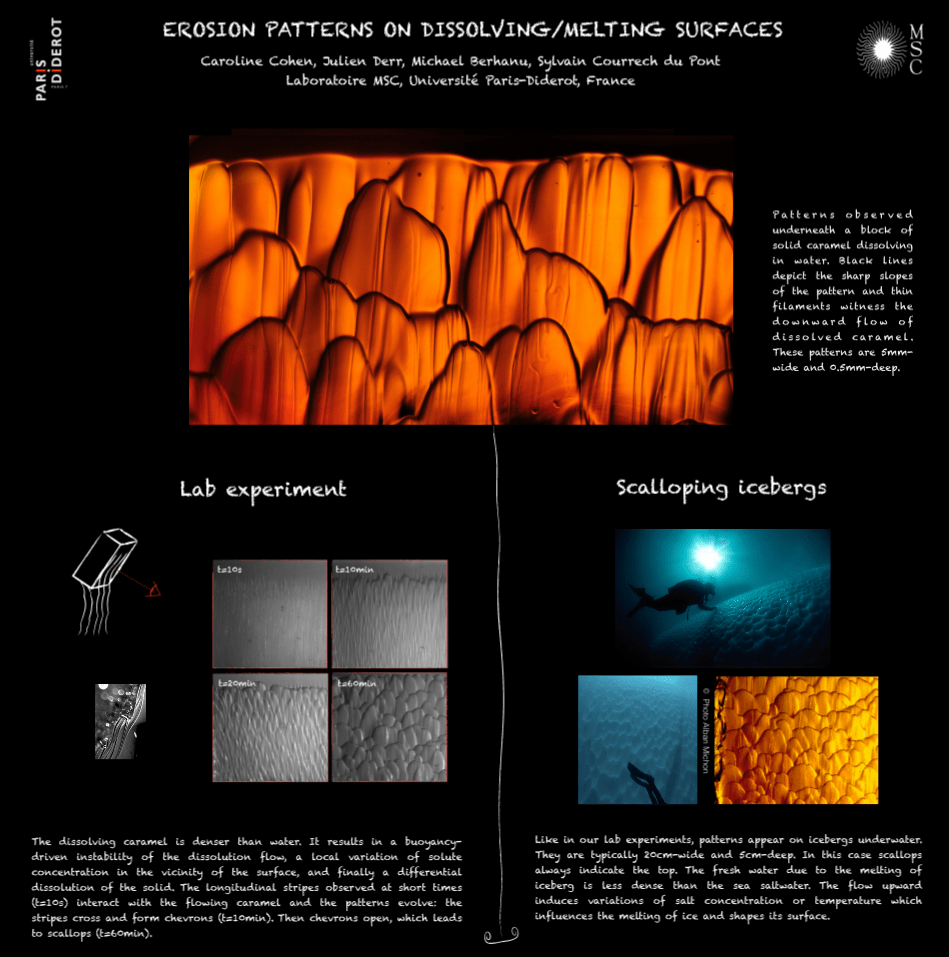
What do icebergs and caramel have in common? Both have similar scalloped erosion patterns as they dissolve. When caramel dissolves in water, the denser caramel sinks in the buoyant water. An initially smooth surface will first form lines, then the flowing caramel and the uneven surface interact, forming chevrons, followed by larger scallops. A similar process happens with melting icebergs. The meltwater from an iceberg is less dense than the surrounding seawater, so it will rise as it melts. This causes variations in the salt concentration and temperature near the iceberg, which cause it to melt differently in different spots, ultimately leading to the same scallop shapes observed in the caramel. Check out the full-size PDF of the poster here. (Image credit: C. Cohen et al.)
Sandscapes
Many of us have played with sand art–the rotating frames filled with water, sand, and air. In this video, Shanks FX demonstrates some of the realistic and surrealistic landscapes you can create using this toy. It also makes for a neat fluid dynamics demonstration. The buoyancy of the trapped air bubbles lets the sand sift slowly down instead of falling immediately. And the sand descends in a variety of ways–sometimes laminar columns and other times wilder turbulent plumes. (Video credit and submission: Shanks FX/PBS Digital Studios)