Tag: buoyancy

  • Featured Video Play Icon

    Inside the Blockage of the Suez Canal

    In March 2021, the world watched as the Ever Given container ship got stuck in the Suez Canal, disrupting global shipping for more than a week. In this Practical Engineering video, Grady delves into some of the phenomena that may have played a role in the incident of the ship that launched a thousand memes.

    Heavy container ships displace a lot of water, and in a narrow, shallow canal, there isn’t much space left for that water to go. To squeeze by, the water must speed up, which (per Bernoulli’s law) creates a pressure drop and suction force on the ship. For a ship too close to a canal bank, that suction will pull the ship further to the side, increasing its chances of lodging in the bank. (Video and image credit: Practical Engineering)

  • Oil-Coated Bubbles

    Oil-Coated Bubbles

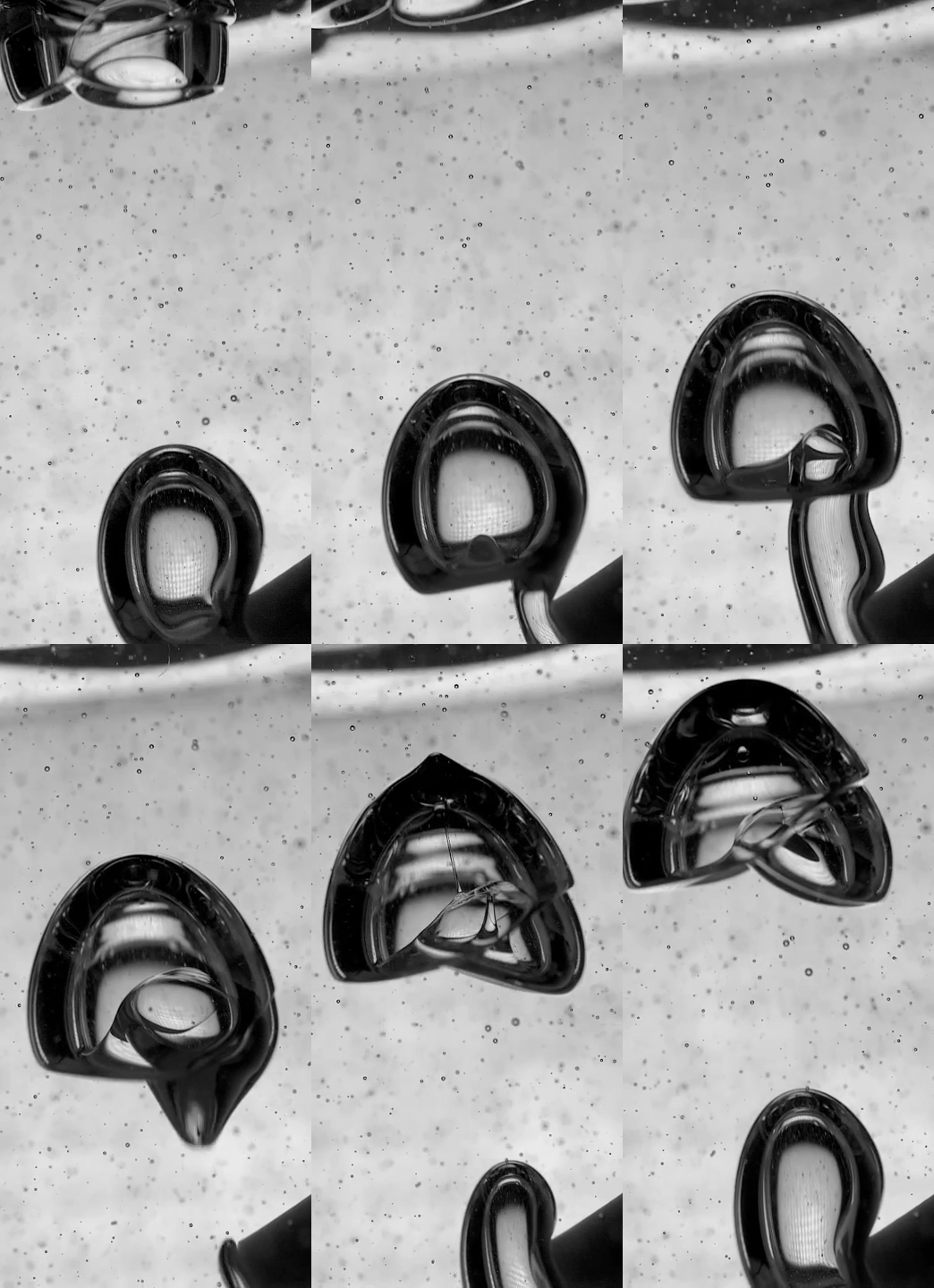
    Bubbles in industrial applications are often more complicated than a simple pocket of air surrounded by water. Here researchers investigate the formation of an air bubble coated in oil before it rises through water. The photo above shows a series of snapshots as the bubble forms. Initially, a droplet of oil sits pinned on the surface. As air gets injected, the oil stretches around the growing bubble. Eventually, buoyancy pulls the bubble off the injector, creating a rising air bubble coated in oil. The team found that oil-coated bubbles could grow much larger than those in water alone. (Image and research credit: B. Ji et al.)

  • Hedgehogs Atop Waves

    Hedgehogs Atop Waves

    Since Michael Faraday, scientists have watched the curious patterns that form in a vibrating liquid. By adding floating particles to such a system, researchers have discovered spiky, hedgehog-like shapes that form near the surface. At low amplitudes, the surface patterns resemble the typical smooth rounded lobes one would expect, but as the wave amplitude increases, spikes form in the tracers, driven by the motion of the waves. (Image and research credit: H. Alarcón et al.; via APS Physics)

  • Oil in Water

    Oil in Water

    In the decade since the Deepwater Horizons oil spill, scientists have been working hard to understand the intricacies of how liquid and gaseous hydrocarbons behave underwater. The high pressures, low temperatures, and varying density of the surrounding ocean water all complicate the situation.

    Released hydrocarbons form a plume made up of oil drops and gas bubbles of many sizes. Large drops and bubbles rise relatively quickly due to their buoyancy, so they remain confined to a relatively small area around the leak. Smaller drops are slower to rise and can instead get picked up by ocean currents, allowing them to spread. The smallest micro-droplets of oil hardly rise at all; instead they remained trapped in the water column, where currents can move them tens to hundreds of kilometers from their point of release. (Image and research credit: M. Boufadel et al.; via AGU Eos; submitted by Kam-Yung Soh)

  • Floating in Levitating Liquids

    Floating in Levitating Liquids

    When it comes to stability, nature can be amazingly counter-intuitive, as in this case of flotation on the underside of a levitating liquid. First things first: how is this liquid layer levitating? To answer that, consider a simpler system: a pendulum. There are two equilibrium positions for a pendulum: hanging straight down or pointing straight up. We don’t typically observe the latter position because it’s unstable; the slightest disturbance from that perfectly vertical situation will make it fall. But it’s possible to stabilize an inverted pendulum simply by shaking it up and down. The vibration creates a dynamic stability.

    The same physics, it turns out, holds for a layer of viscous fluid. With the right vibration, the denser fluid can levitate stably over a layer of air. Inside this vibrating layer, the rules of buoyancy are a little different because the vibration modifies the effects of gravity. As a result, bubbles deep in the liquid layer sink (Image 1). The researchers used this behavior to create their levitating layer (Image 2). The shaking also serves to stabilize objects floating on the underside of the liquid layer, allowing the boat in Image 3 to float upside down! (Image and research credit: B. Apffel et al.; via NYTimes; submitted by multiple sources)

  • Featured Video Play Icon

    The Magic* Cork

    *Spoiler alert: it’s not magic. It’s science!

    Just what makes this dropped cork float beneath the surface? Just like a normal cork, it’s buoyancy! But this seemingly straightforward video is hiding a few key elements. Firstly, the cork has been modified; it has a metal sphere inside it so that its effective density is higher than that of water.

    Secondly, that liquid is not pure water; notice the hazy swirls near the bottom of the flask when the cork drops in? This is tap water that’s had a layer of salt dissolving in the bottom of it for the last day. That creates a density gradient with denser, salty water at the bottom and lighter, fresh water at the top. In fluid dynamics, we’d say the fluid is stably stratified; “stratified” meaning that there are distinct layers (strata) of different density and “stably” because the heavier ones are at the bottom.

    When the cork is dropped in, it settles at the fluid layer that matches its density. Because the surrounding fluid is stably stratified, poking the cork makes it bounce slightly but return to its initial height. Our atmosphere behaves just like this when it’s stably stratified. If you displace a parcel of air, it will oscillate up and down before settling back to equilibrium. In fact, the cork and the air even bounce at the same frequency! (Video and submission credit: F. Croccolo)

  • Featured Video Play Icon

    Hot Ice, Buoyancy Tricks, and More DIY Fun

    Here’s a smorgasbord of DIY experiments from Dianna at Physics Girl. Some are fluidsy, some aren’t, but all of them give you a chance to stretch your science muscles at home. Personally, I think she saved the best for last with her laser-acoustics demo! (Video credit: Physics Girl)

  • Featured Video Play Icon

    Ventilation and Respiratory Disease

    In 1977, one passenger with the flu infected 38 people onboard a flight with malfunctioning ventilation. In this video, Dianna digs into the physics of respiratory disease transmission and just why ventilation is so key to preventing it.

    There are three primary modes of transmission for respiratory diseases like influence or SARS-CoV-2: 1) touching an infected surface and then oneself, i.e., self-inoculation; 2) inhaling virus-filled droplets larger than 5 nm; and 3) inhaling virus-filled droplets smaller than 5 nm. That size cut-off may seem a little arbitrary, but it’s how scientists distinguish between droplets that fall quickly to the ground and ones that can persist on buoyant air currents.

    That airborne persistence is one of the reasons ventilation — in other words, replacing the air — is so important. So many people on that 1977 flight got sick because there was no system removing the infected air and bringing in fresh air. For more on the fluid dynamics disease transmission, check out these posts. Curious about those bacterial bubble bursts? I’ve covered that, too. (Video and image credit: Physics Girl)

  • Speeding Sedimentation

    Speeding Sedimentation

    Did you know that particles settle faster in an inclined container instead of a vertical one? This sedimentation phenomenon is known as the Boycott effect, after the researcher who first described it. Boycott noticed that red blood cells settled out of samples faster when the test tubes were inclined.

    The inclined walls give particles a much larger area to settle on. As the particles gather on the wall, it creates a buoyant, particle-free layer of fluid above. That fluid quickly rises to the top of the container, helping to push the sediment further toward the bottom. As you can see in the video below, the Boycott effect drastically reduces settling time. (Video and image credit: C. Kalelkar)

  • Featured Video Play Icon

    Popping an Oil Balloon

    Oil and water don’t mix — or at least they won’t without a lot of effort! In this video, we get to admire just how immiscible these fluids are as oil-filled balloons get burst underwater.

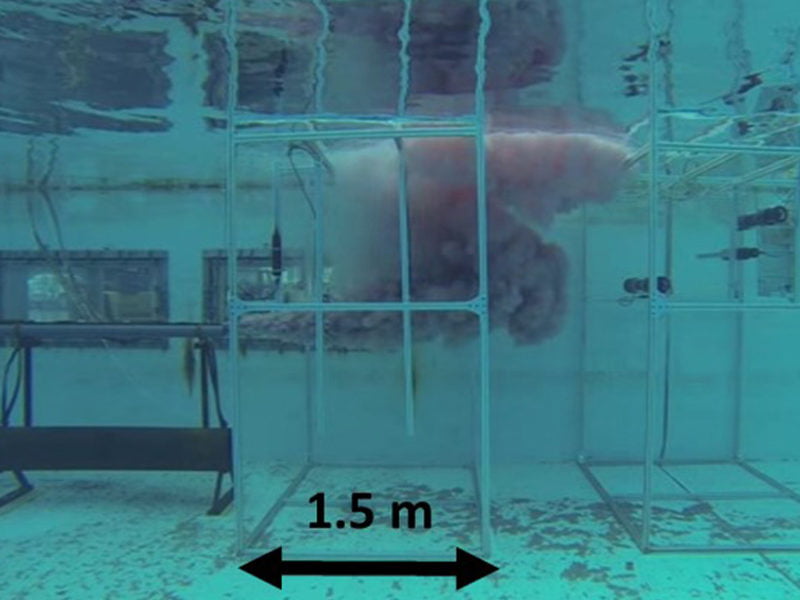
    Visually, the two bursts are quite spectacular. In the first image, the initial balloon has a sizeable air bubble at the top, which rises even more rapidly than the buoyant oil, creating a miniature, jelly-fish-like plume that reaches the surface first. The large oil plume follows, behaving similarly to the balloon burst without an added air bubble.

    The last of the oil in both cases comes from a cloud of smaller droplets formed near the bottom of the balloon. Being smaller and less buoyant, these drops take a lot longer to rise to the surface and remain much closer to spherical as they do. I suspect these smaller droplets form due to the forces created by the fast-moving elastic as it tears away. (Video and image credit: Warped Perception)