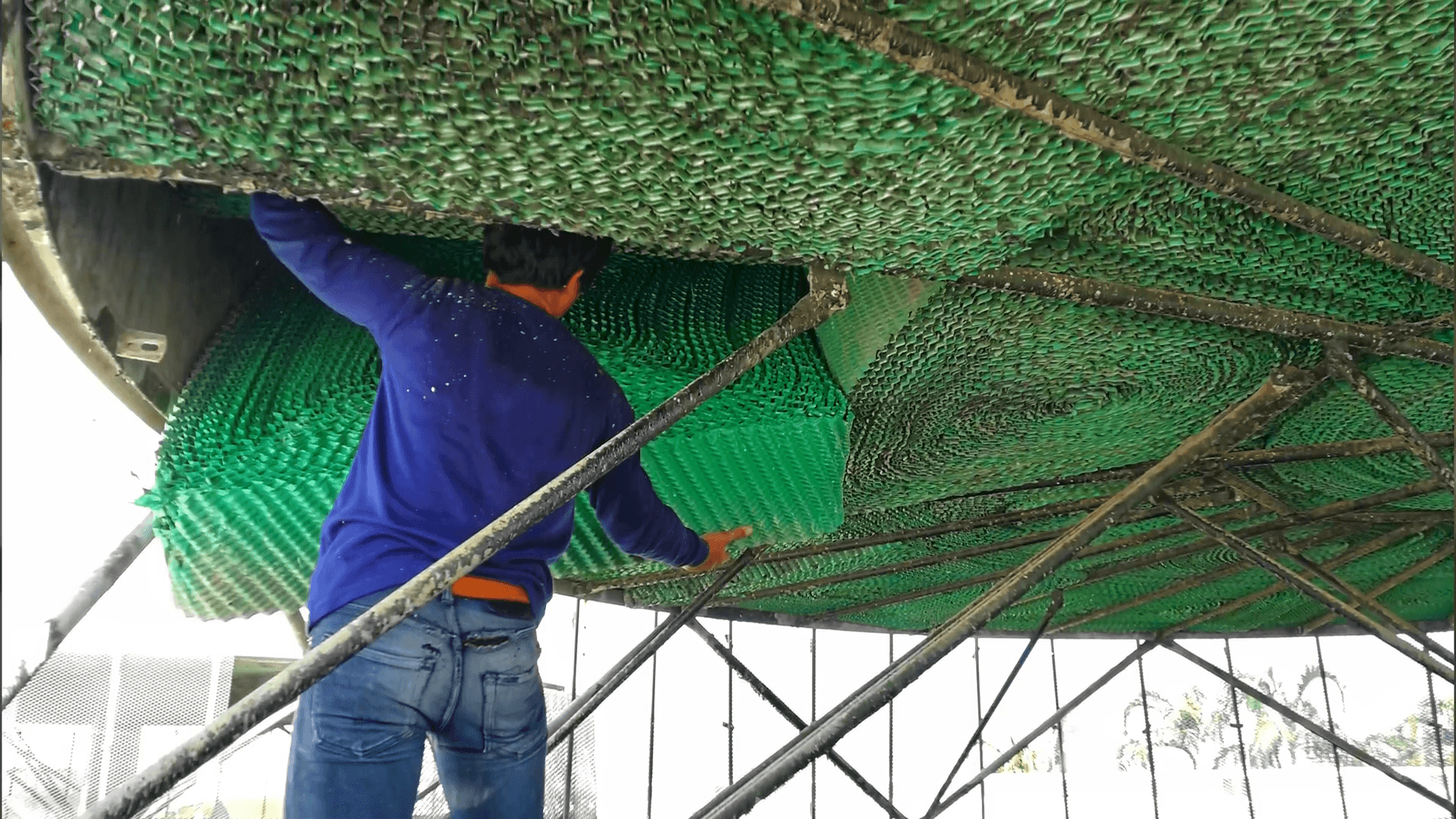
Power plants (and other industrial settings) often need to cool water to control plant temperatures. This usually requires cooling towers like the iconic curved towers seen at nuclear power plants. Towers like these use little to no moving parts — instead relying cleverly on heat transfer, buoyancy, and thermodynamics — to move and cool massive amounts of water. Grady breaks them down in terms of operation, structural engineering, and fluid/thermal dynamics in this Practical Engineering video. Grady’s videos are always great, but I especially love how this one tackles a highly visible piece of infrastructure from multiple engineering perspectives. (Video and image credit: Practical Engineering)
Tag: buoyancy

Billowing Ouzo
Pour the Greek liquor ouzo into water, and your glass will billow with a milky, white cloud, formed from tiny oil droplets. The drink’s unusual dynamics come from the interactions of three ingredients: water, oil, and ethanol. Ethanol is able to dissolve in both water and oil, but water and oil themselves do not mix.
In this video, researchers explore the turbulent effects of pouring ouzo into water. In particular, pouring from the top creates a fountain-like effect, due to a tug-of-war between the ouzo’s momentum and its buoyancy. Momentum wants the ouzo to push down into the water, and buoyancy tries to lift it back up. For an extra neat effect, they also show what happens when the ouzo is confined to a 2D plane and what happens when momentum and buoyancy act together instead of oppositely. (Image and video credit: Y. Lee et al.)

Toying With Density and Miscibility
Steve Mould opens this video with a classic physics toy that uses materials of different densities as a brainteaser. Two transparent, immiscible liquids fill the container, along with beads of a couple different densities. When you shake the toy, the liquids emulsify, creating a layer with an intermediate density. As the two liquids separate, the emulsified middle layer disappears, causing the beads (which have densities between that of the two original liquids) to come together.
The rest of the video describes the challenges of expanding this set-up into three immiscible liquids and four sets of beads. Along the way, Steve had to contend with issues of miscibility, refractive index, and even chemical solvents. It’s amazing, sometimes, what it takes to make a seemingly simple idea into reality. (Video and image credit: S. Mould)

Convection in Action
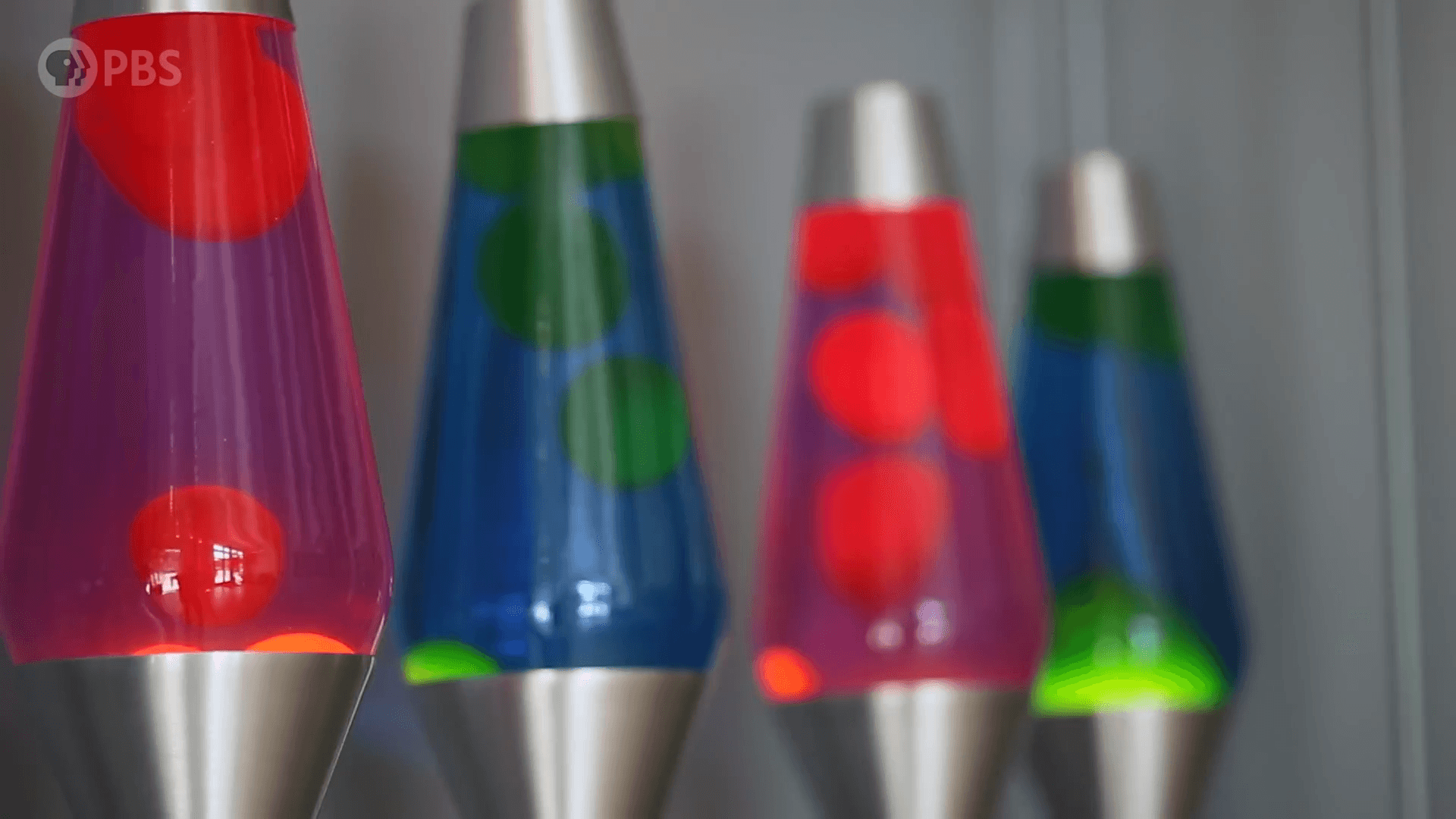
We’re surrounded daily by convection — a buoyancy-driven flow — but most of the time it’s invisible to us. In this video, Steve Mould shows off what convection really looks like with some of his excellent tabletop demos. The first half of the video gives profile views of turbulent convection, with chaotic and unsteady patterns. When he switches to oil instead of water, the higher viscosity (and lower Reynolds number) offer a more structured, laminar look. And finally, he shows a little non-temperature-dependent convection with a mixture of Tia Maria and cream, which convects due to evaporation changing the density. (Image and video credit: S. Mould; submitted by Eric W.)

Dancing Peanuts
Bartenders in Argentina sometimes entertain patrons by tossing a few peanuts into their beer. Initially, the peanuts sink, but after a few seconds they rise, wreathed in bubbles. Once on the surface, they roll, causing the bubbles to pop, and the peanut sinks once again. The cycle repeats, sometimes for as long as a couple hours.
There are a couple physical processes governing this dance. The first is bubble nucleation. Most beers are carbonated; they contain dissolved carbon dioxide gas that remains in solution while the beer is under pressure. Once poured, that storage pressure is gone and bubbles start to form in the liquid. The shape of the peanut means that bubbles form more easily on it than on the glass walls or in the liquid. And once the peanut is covered in bubbles, buoyancy comes into play. The bubbles attached to the peanut reduce its density relative to the surrounding fluid, enabling the peanut to rise up and float.
This same process is seen with other objects in carbonated fluids, too, such as blueberries in beer and lemon seeds in carbonated water. But it’s also reflected elsewhere in nature. For example, magnetite crystals are thought to float in magma due to a similar nucleation of dissolved gases on their surface. (Image and research credit: L. Pereira et al.; via APS Physics)

Bubble Cleaning
Removing dirt and bacteria from fruits and vegetables is a delicate job; too much force can bruise the produce and hasten spoiling. That’s why fluid mechanicians want to give the job to bubbles. Placing objects in a stream of air bubbles inside a bath is a surprisingly effective method for gently cleaning surfaces. A recent study finds that 22.5 degrees is the optimal angle for sliding bubbles to scrape a surface clean.
As the bubbles slide past the surface, they exert a shear force that scrapes away debris, just as you might use a loofah in the shower. The angle the bubble makes with the surface determines how long it’s in contact and how much force the bubble exerts. Increasing the angle makes the bubble slide faster, increasing its shear force. But above 22.5 degrees, the bubble’s buoyancy means that it spends less time pressed against the surface, which decreases its cleaning ability.
The team hopes to use their results to build a “fruit Jacuzzi” device that will direct bubble streams to gently and effectively clean fruits and vegetables in a matter of minutes. (Image and research credit: A. Hooshanginejad et al.; via APS Physics)

“Iridescent”
Soft colors and sudden coalescence combine in this short film from Susi Sie’s team. The visuals rely on liquid lenses (likely oil) floating atop a water bath. You can see how the fluids get manipulated in their behind-the-scenes video, which also provides a peek at how the sound effects get made. (Video credit: S. Sie et al.)

Airflow in the Opera
Like so many other performers, the singers and musicians of New York’s Metropolitan Opera House were left without a way to safely perform when the SARS-CoV-2 pandemic began in early 2020. In search of safe ways to perform and rehearse, the Met turned to researchers at nearby Princeton University, who worked directly with the performers to explore aerosol production and airflow in the context of professional opera.
Through visualization and other experiments, the team found that the highly-controlled breathing of opera singers actually posed a lower risk for spreading pathogens than typical speaking and breathing. Most of a singer’s voiced sounds are sustained vowels, which produce a slow, buoyant jet that remains close to a singer. The exception are consonants, which created rapid, forward-projected jets.
In the orchestra, the researchers found that placing a mask over the bell of wind instruments like the trombone reduced the speed and spread of air. One of the highest risk instruments they found was the oboe. Playing the oboe requires a long, slow release of air, but between musical phrases, oboists rapidly exhale any remaining air from their lungs and take a fresh breath. That rapid exhale creates a fast, forceful jet of air that necessitates placing the oboist further from others. (Image credit: top – P. Chiabrando, others – P. Bourrianne et al.; research credit: P. Bourrianne et al.; via APS Physics; submitted by Kam-Yung Soh)

“Bubbles Experience”
Acrylic paint, oil, water, and air combine to create ephemeral sculptures in Alberto Seveso’s “Bubbles Experience” series. I love the mixture of shapes he achieves, from large, seemingly-laminar columns to a mist of bubbles, each trailing a painted tail. They’re like tiny, liquid comets. See more from this series here and find more examples of his work in his online portfolio. (Image credit: A. Seveso)

Backswimmers
Backswimmers rule the surface of ponds, streams, and other bodies of water. These insects spend much of their time clinging just beneath the air-water interface, where they hunt larvae and other insects. They use oversized, oar-shaped back legs to row, and they breathe using an air bubble that clings to their abdomen like a personal scuba tank. Oxygen from the water diffuses into the bubble, keeping the insect’s air supply fresh. When the time comes to move to greener pastures, they flip to the other side of the water’s surface, unfurl their wings, and take off. (Image and video credit: Deep Look)