Human eyesight is not always the best for observing how nature behaves around us. Fortunately, we’ve developed cameras and sensors that allow us to effectively see in wavelengths beyond those of visible light. What’s shown here is a frying pan with a thin layer of cooking oil. To the human eye, this would be nothing special, but in the infrared, we can see Rayeigh-Benard convection cells as they form. This instability is a function of the temperature gradient across the oil layer, gravity, and surface tension. As the oil near the bottom of the pan heats up, its density decreases and buoyancy causes it to rise to the surface while cooler oil sinks to replace it. Here the center of the cells is the hot rising oil and the edges are the cooler sinking fluid. The convection cells are reasonably stable when the pan is moved, but, even if they are obscured, they will reform very quickly. (Video credit: C. Xie)
Tag: buoyancy

Sneezes Vs. Coughs
Sneezing and coughing are major contributors to the spread of many pathogens. Both are multiphase flows, consisting of both liquid droplets and gaseous vapors that interact. The image on the left shows a sneeze cloud as a turbulent plume. The kink in the cloud shows that plume is buoyant, which helps it remain aloft. The right image shows trajectories for some of the larger droplets ejected in a sneeze. Like the sneeze cloud, these droplets persist for significant distances. The buoyancy of the cloud also helps keep aloft some of the smaller pathogen-bearing droplets. Researchers are building models for these multiphase flows and their interactions to better predict and counter the spread of such airborne pathogens. For similar examples of fluid dynamics in public health, see what coughing looks like, how hospital toilets may spread pathogens, and how adjusting viscoelastic properties may counter these effects. For more about this work, see the Bourouiba research group’s website. (Image credit: L. Bourouiba et al.)

Convective Impressionism


Buoyant convection, driven by temperature-dependent changes in density, is a major force here on Earth. It’s responsible for mixing in the oceans, governs the shape of flames, and drives weather patterns. The images above show flow patterns caused by buoyant convection. The colors come from liquid crystal beads immersed in the fluid; red indicates cooler fluid and blue indicates warmer fluid. You can see plumes of warmer fluid rising in some of the photos. At the same time, though, the images are beautiful simply as art and are strongly reminiscent of works by Vincent van Gogh. (Image credit: J. Zhang et al.)

Fluids Round-up – 11 January 2014
It’s a big fluids round-up today, so let’s get right to it.
- Over at txchnologist, there’s a great article on controlling combustion instabilities in rocket engines with sound.
- Quanta Magazine asks if knot theory can help unravel turbulence. (submitted by iamaponyrocket)
- SciAm takes a look at how FIFA finally got their aerodynamics right so that their video game football (soccer) balls fly correctly.
- The Smithsonian considers an important question: can you fry foods in space?
- The Navy unveiled a fantastic new facility for simulating ocean waves (via J. Ouellette)
- At SciAm, there’s a nice explanation of the polar vortex and its effects on recent freezing weather. For additional background, check out this excerpt from a presentation by meteorology professor Jennifer Francis. (via Nicholas Travers)
- Cold weather also brings a host of new viral videos; NatGeo explains some of the science behind instant snow, ice fog, and frozen bubbles. See also: our own explanation of the instant snow phenomenon.
- io9 looks at the physics of knuckleballs.
- Over at Wired, Rhett Allain questions whether dwarves should stand in floating barrels. Also on the subject of The Hobbit, here’s an analysis of fire-breathing in dragons.
- At SciAm, Kyle Hill explains how inertia lets one pour a drink toward the sky.
- SciAm reports on a manufacturing process for superhydrophobic paper.
- I don’t know what banking has to do with a pool of non-Newtonian fluids, but this Malaysian ad sure makes it look fun. (via physicsphysics and jmlinhart)
- Wired has a great write-up on the mantis shrimp, which kills its prey with cavitation.
- io9 tackles explaining one of the most vexing brain teasers in fluid dynamics, the Feynman sprinkler.
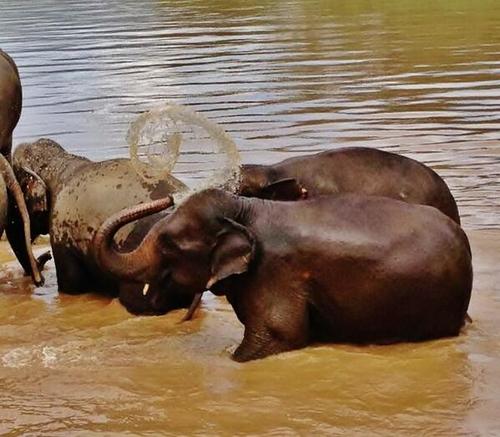
- Finally, today’s lead image comes from our friends at Think Elephants, who study elephant intelligence over in Thailand and occasionally capture the animals’ mastery of fluid dynamics. Be sure to check them out and follow them on Twitter and Facebook.
(Photo credit: Think Elephants International/R. Shoer)

Holiday Fluids: Cocoa Convection
If you make a proper cup of hot chocolate this holiday, watch carefully and you just may catch some Rayleigh-Benard convection like the video above. (Note, video playback is 3x.) The canonical Rayleigh-Benard problem is one in which fluid is heated from below and cooled from above. For the cup of hot chocolate, the cooling comes from the colder, ambient air at the cocoa’s surface. Because cooler fluid is denser than warmer fluid, the cocoa near the surface will tend to sink down, allowing warmer cocoa to rise. As that warm cocoa reaches the surface, it too will cool and sink back down, continuing the cycle. The effect relies on buoyancy and, by extension, gravity; on the International Space Station, for example, astronauts would not observe such convection. The distinctive shape of the cells depends on the boundaries of the cup. This post is part of our weeklong holiday-themed fluid dynamics series. (Video credit: Armuotas)
Holiday Fluids: German Pyramids
I broke out some of my family’s Christmas decorations for today’s video. Enjoy and be sure to come back tomorrow when our week of holiday-themed fluid dynamics continues! (Video credit: N. Sharp)
Mushrooms Make Their Own Breeze
Mushrooms don’t rely on a stray breeze to spread their spores; they generate their own air currents instead. The key is evaporation. The mushroom cap contains large amounts of water, and, as this water evaporates, it cools the mushroom and the air next to it. This cool air is denser than the surrounding air, and so tends to spread out and convect. At the same time, though, the water vapor that evaporated from the mushroom is less dense than nearby air, which helps it rise. This combination of spreading and rising air carries spores away from the mushroom cap and, as seen in the video above, can combine to form beautiful and complex currents that spread the spores. (Video credit: E. Dressaire et al.)
The Challenges of Trapping Carbon Dioxide
One way to reduce carbon dioxide in the atmosphere is to pump the CO2 into saline aquifers deep below the surface. Such aquifers are thin but stretch over large areas and are sometimes gently sloping. Since carbon dioxide is relatively buoyant, it may migrate up-slope after injection and potentially leak elsewhere. Dissolving the carbon dioxide into the groundwater helps prevent this undesirable migration. The video above shows a laboratory analog of the fluid instability at the heart of this trap. Imagine the video tilted by a few degrees so it slopes upward toward the right. The initially buoyant carbon dioxide, represented by the dark fluid, rises on the left and moves rightward, up-slope. As the CO2 dissolves into the ambient groundwater, the water becomes denser and fingers of the CO2-rich water drift downward, effectively halting the carbon dioxide’s escape. This is known as convective dissolution. (Video credit: C. MacMinn and R. Juanes)

Fire in Microgravity
In the movie “Gravity” Sandra Bullock’s character battles a fire aboard the International Space Station. Combustion is a huge concern in space habitats. Microgravity fires are challenging to detect and fight because they behave very differently in the absence of buoyancy. On Earth, buoyancy makes hot air rise from a flame while cooler air is pulled in near the base. This feeds fresh oxygen to the teardrop-shaped flame. In space, there is no buoyancy and flames are spherical. They also burn at lower temperatures and lower oxygen concentrations–so low, in fact, that the oxygen depletion necessary to extinguish a fire is lower than what humans require to survive.
No buoyancy makes it harder for fires to spread, but it also makes them harder to detect since smoke doesn’t rise toward a detector on the ceiling. Instead, fire detectors aboard the Space Station are housed in the ventilation system that moves air through the modules constantly. In the event of a fire, astronauts use a three-step fire suppression system. First, they shut off the ventilation system to delay the fire’s spread. Then they shut off power to the affected unit, and, finally, they use fire extinguishers on the flames. The Russian module is equipped with a foam extinguisher and the others use CO2 units. (Image credit: Warner Brothers)
Overflowing Foam
Hitting a glass bottle full of a non-carbonated drink can shatter the bottle due to cavitation, but doing the same with a carbonated beverage can make the bottle overflow with foam. The video above breaks down the physics of this bar prank. It all begins with nucleation and the tiny bubbles of carbon dioxide that form in the liquid. Striking the top of the bottle generates a compression wave that travels through the liquid, shrinking bubbles as it passes. When it hits the bottom of the bottle, it gets reflected as an expansion wave that expands the bubbles. This reflection happens several times between the free surface of the liquid and the bottom of the bottle. The rapid collapse-and-expansion of the bubbles makes them implode into a cloud of tinier bubbles that expands until the local supply of carbon dioxide is used up. At this point, the buoyancy of the bubbles carries them upward in plumes, creating more bubbles with the dissolved carbon dioxide nearby. And, all of a sudden, you’ve got foam everywhere. Like all of this week’s videos, this video is an entry in the 2013 Gallery of Fluid Motion. (Video credit: J. Rodriguez-Rodriguez et al.)