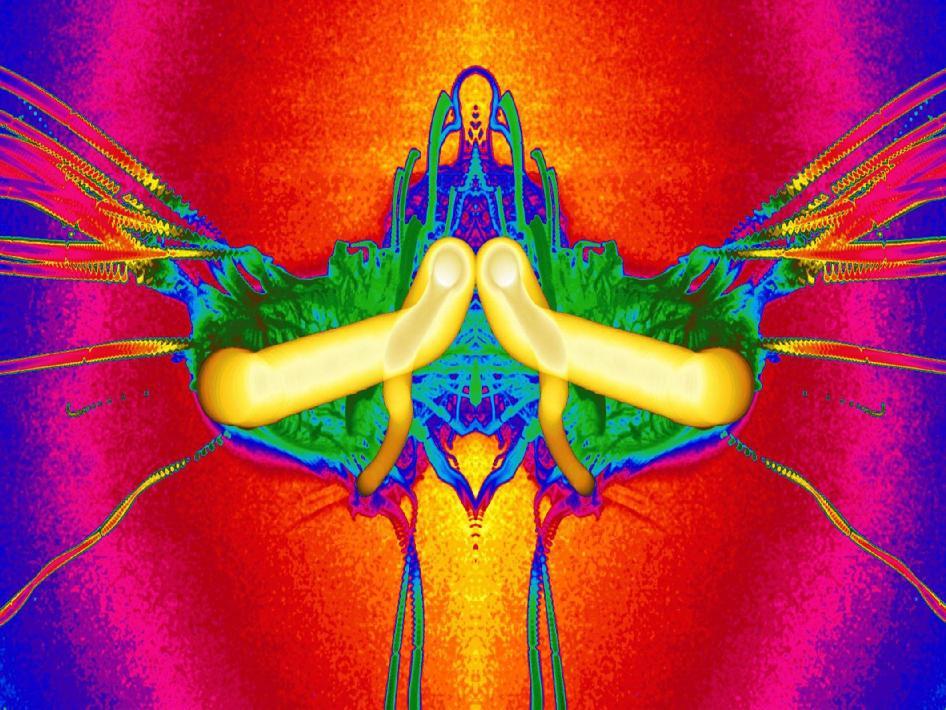
This timelapse video shows the formation and steady-state behavior of a buoyancy-driven plume created by a chemical reaction. As the plume accelerates upward, it develops a head, which in some cases detaches from the plume in the form of a vortex ring. A new head then develops before also detaching and accelerating upwards. (Video credit: M. Rogers)
Tag: buoyancy

Brinicles
In the frozen reaches of our planet, the atmosphere and ocean can interact in bizarre ways. Under calm ocean conditions when the air at sea level is much colder than the water temperature brinicles–the underwater equivalent to an icicle–can form. The cold air above rapidly freezes ocean water at the surface, concentrating water’s salt content into a very cold brine which sinks rapidly. As this brine descends, it freezes the water around it into an ice sheath. As the brinicle grows and eventually reaches the sea floor, its cold temperatures can wreak havoc on the creatures living there.
Testing Flames in Space
In microgravity, flames behave very differently than on earth due to a lack of buoyant forces. On earth, a flame can continue burning because, as the warm air around it rises, cooler air gets entrained, drawing fresh oxygen to the flame. In microgravity, both the heat from the flame and the oxygen it needs to burn move only by molecular diffusion, the random motion of molecules, or the background environmental flow (air circulation on the ISS, for example). This video shows a test of the Flame Extinguishment Experiment (FLEX) currently flying onboard the ISS. A fuel droplet is ignited, burns in a symmetric sphere and then eventually extinguishes either due to a lack of fuel or a lack of oxygen. Check out this NASA press release for more, including great quotes like this:
“As a Princeton undergrad, I saw in a graduate course the conservation equations of combustion and realized that those equations were complex enough to occupy me for the rest of my life; they contained so much interesting physics.” – Forman Williams

High-Altitude Balloon Flight


Tangentially fluids-related, but SpaceWeather has a fun video of a high-altitude helium balloon bursting. Although this balloon carried a space-related payload, it’s the same type of set-up used for weather balloons. With only a few basic assumptions, it’s possible to do some neat calculations on the buoyancy, loading capacity, and behavior of such balloons.
Bill Nye Demos
[original media no longer available]
Have a little science enthusiasm from Bill Nye to brighten your Tuesday! This video includes demonstrations on thermodynamics (sucking the balloon into the flask), the Marangoni effect (driving the powder off the water surface and powering the glue boat by creating gradients in surface tension), and buoyancy (floating cans of cola).
Vortex Shedding from a Hot Cylinder
This numerical simulation shows vortex shedding behind a hot cylinder. The behavior is very similar to what one sees behind an unheated cylinder, until the coefficient of thermal expansion increases and the von Karman vortex street is completely distorted. Describing the particulars of the computation, jessecaps writes (links added):
I wrote an incompressible flow solver to simulate flow past a heated cylinder. The Navier-Stokes equations are discretized on a Cartesian grid and solved explicitly in time. The pressure-Poisson equation is solved implicitly using a bi-conjugate gradient method. The Boussinesq approximation was used (density is constant everywhere except for the gravity term) to account for buoyancy. Reynolds number = 250, Froude number = 1 (gravity is pointing down). The two simulations show the effect of the coefficient of thermal expansion. Each video shows a plot of velocity and temperature.
(submitted by jessecaps)

Microgravity Combustion
Combustion in microgravity is markedly different than that on earth, due to a lack of buoyant convection. The combustion of a droplet of heptane is shown here as a composite image. The bright yellow structure shows the path of the droplet, which gets smaller as it burns. The green structures show the initial development of soot, which eventually streams outward as long streaks. # (submitted by jshoer)

Upside-Down Umbrellas
When a heavier fluid is suspended over a lighter fluid (as with ink or food coloring in water), the interface between fluids is subject to the Rayleigh-Taylor instability. As the heavier fluid starts to sink, it forms “fingers”, which develop into mushroom-cap shapes as the fluid continues falling. Sometimes the shear stress between the heavier fluid and lighter fluid causes secondary Kelvin-Helmholtz instabilities as well. (Photo by Leonardo Aguiar)

Boiling in Microgravity
This week’s edition of the ISS research blog focuses on the Boiling Experiment Facility (BXF) and the goals of unlocking the secrets of boiling in microgravity. Without gravity to provide buoyant convection, boiling in space tends to produce one giant bubble instead of the hundreds of tiny ones we’re accustomed to seeing on our stoves. According to Dr. Tara Ruttley:
TheBoiling Experiment Facility or BXF, which launched on STS-133 in February 2010, will enable scientists to perform in-depth studies of the complexities involved in bubble formation as a result of heat transfer. For instance, what roles do surface tension and evaporation play during nucleate boiling when buoyancy and convection are not in the equation? What about the variations in the properties of the heating surface? By controlling for gravity while on the International Space Station, scientists can investigate the various elements of boiling, thus potentially driving improved cooling system designs. Improved efficiency in cooling technology can lead to positive impacts on the global economy and environment; two hot topics that have much to gain from boiling in space.
Rafting for Rocks
Another look at the science behind the roaming rocks of Death Valley.