AG Carinae is a bright, unstable luminous blue variable star. This rare type of star lives fast and dies young (by stellar standards) over only a few million years. During that time, it will occasionally blow off its outer layers in a violent eruption as a result of the ongoing tug of war between its radiation pressure and gravity. That’s the source for the nebula we see surrounding the star in this image. The red areas of the image are a mixture of hydrogen and nitrogen gas; the blue clumps are cooler pockets of dust shaped by the hotter, faster-moving stellar wind. Zoom in on the image and you can see amazing structural detail in the nebula, evidence of turbulence on a scale of light-years. (Image credit: NASA/ESA/STScI; via Gizmodo)
Tag: astrophysics

Brown Dwarfs and Their Stripes
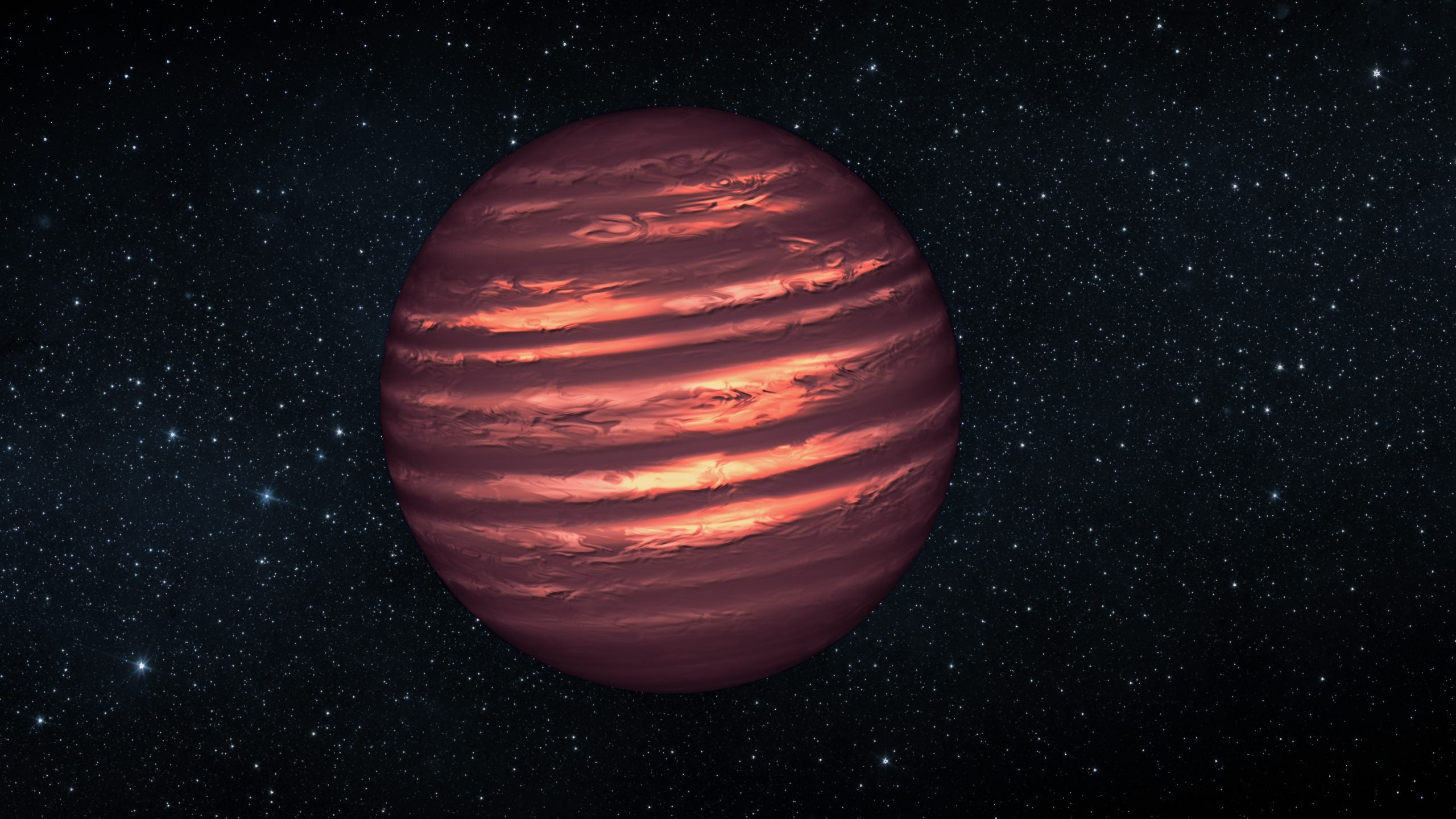
Brown dwarfs are neither stars nor gas giants but something in between. Our two nearest brown dwarf neighbors are roughly equivalent to Jupiter in size but about 30 times more massive. Since these objects are so dim, little is known about their structure. Do they resemble stars in their atmospheric patterns or gas giants like Jupiter?
To find out, a team of researchers studied two nearby brown dwarfs with the Transiting Exoplanet Survey Satellite. They were able to map the objects’ varying lightcurves and model an upper atmosphere consistent with those observations. They found that both dwarfs have high-speed winds running parallel to their equators, meaning that they likely have stripes like Jupiter. The similarities even extended to the brown dwarfs’ poles, where — like on Jupiter — the atmosphere became dominated by local vortices. (Image credit: NASA/JPL; video credit: Steward Observatory; research credit: D. Apai et al.; via Gizmodo)

Eyes on the Sun
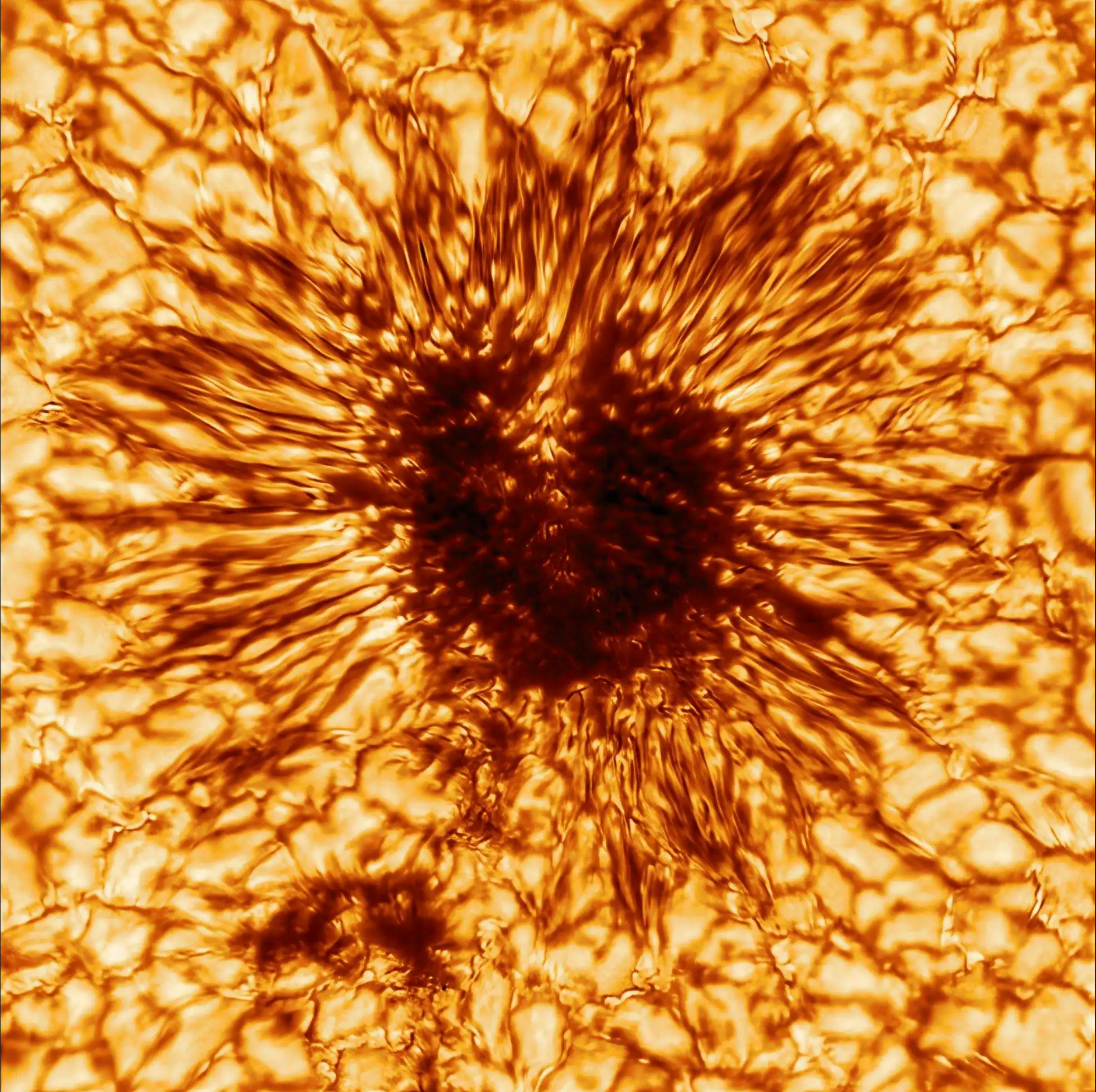
Though it may look like the Eye of Sauron, this image is actually one of our best-ever glimpses of a sunspot. Captured by the Daniel K. Inouye Solar Telescope, this sunspot is larger than our entire planet, yet we can see details as small as 20km across. The dark central region of the image is the sunspot’s umbra, surrounded by the lighter, streakier penumbra. Along the edges of the image, you see a more typical pattern of bright convection cells. Compared to the rest of the sun’s surface, sunspots are cool — about 1,000 K cooler — due to their intense magnetic field flux inhibiting convection. (Image credit: NSO/AURA/NSF; via Bad Astronomer; submitted by Kam-Yung Soh)

Chaos in the Lagoon Nebula
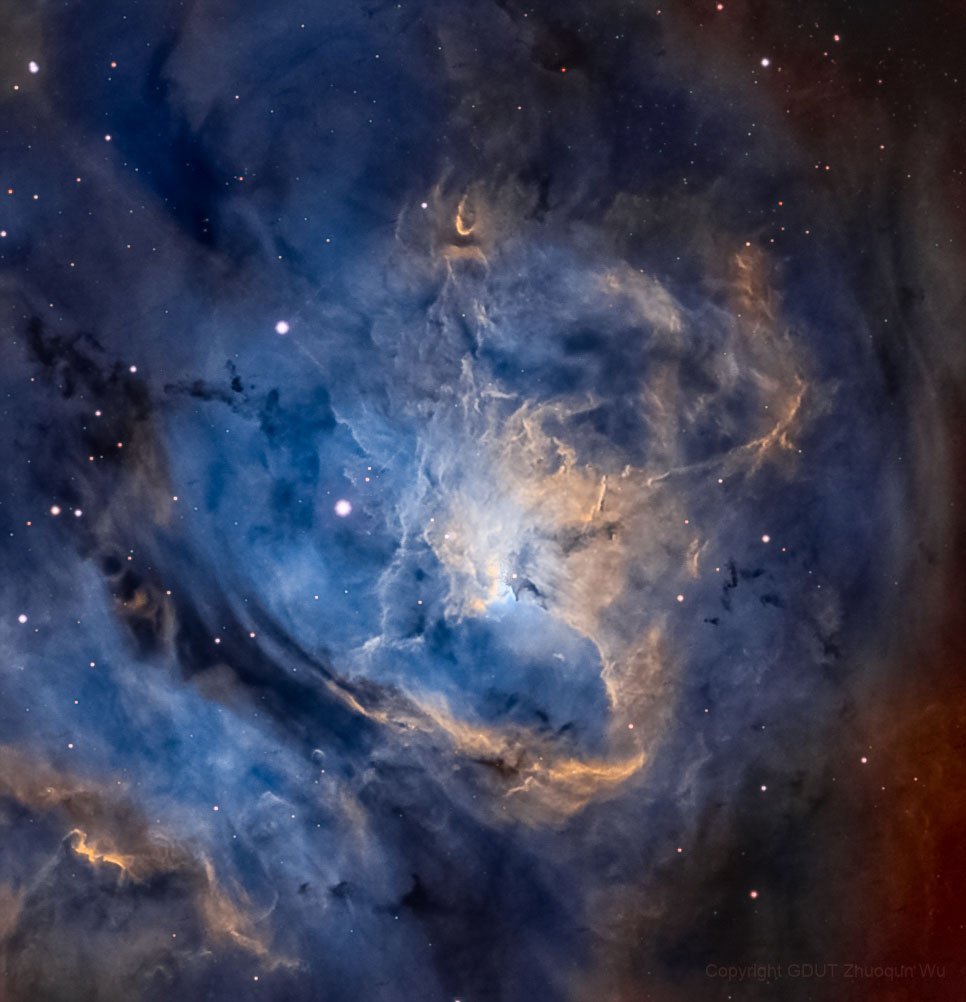
Even on the scale of light-years, fluid dynamics plays a role in our universe. This photograph shows the Lagoon Nebula, where stars, gas, and dust are battling for supremacy. Jets from young stars push the dust left from supernova remnants into a chaotic patterns, and the high-energy particles streaming from the youthful stars illuminate interstellar gases, creating the nebula’s distinctive glow. This section of the nebula is about 50 light-years across, so every picture we capture is only the tiniest snapshot of the true scale of its turbulence. (Image credit: Z. Wu; via APOD)

Mimicking Supernovas


The Hubble archives are full of incredible swirls of cosmic gas and dust, many of which were born in supernovas. Predicting the forms these massive explosions will generate is extremely difficult, thanks in large part to the complicated fluid dynamics generated by their blast waves. But new lab-scale experiments may help shed light on those underlying processes.
Researchers mimic supernovas in the lab by launching blast waves through an interface between a dense gas (shown in white) and a lighter one (which appears black). As the blast wave passes, it drives the dense fluid into the lighter one, triggering a series of instabilities. Notice how any initial perturbations in the interface quickly grow into mushroom-like spikes that rapidly become turbulent. This behavior is exactly what’s seen in supernovas (and in inertial confinement fusion)! (Video credit: Georgia Tech; research credit: B. Musci et al.; submitted by D. Ranjan)
Shock Waves Drive Nova Brightening


New observations of nova V906 Carinae have provided some of the first direct evidence that the observed brightening of these stellar objects is driven by shock waves. Novae form when hydrogen from a companion star settles onto a white dwarf. Once enough material accumulates, the white dwarf blows out the excess hydrogen in a donut-shaped shell moving about the speed of a typical solar wind.
Next, another outflow — likely triggered by residual nuclear reactions on the dwarf’s surface — slams into the denser shell at about twice the speed. This collision triggers shock waves that emit light in the gamma and visible wavelengths. Weeks later, a third, even faster outflow expanded into the cloud, generating more shock waves and measurable flares. (Video credit: NASA Goddard; research credit: E. Aydi et al.)
Sunlight Is Older Than You Think


Joe Hanson over at “It’s Okay to Be Smart” has a great video on the random walk photons have to make to escape the core of the sun and other stars. Because the high-energy photons born in the star’s core have to bounce their way out rather than flying in a straight line, those photons can spend thousands of years escaping the sun. After that, the eight-and-a-half minute trip to Earth is nothing.
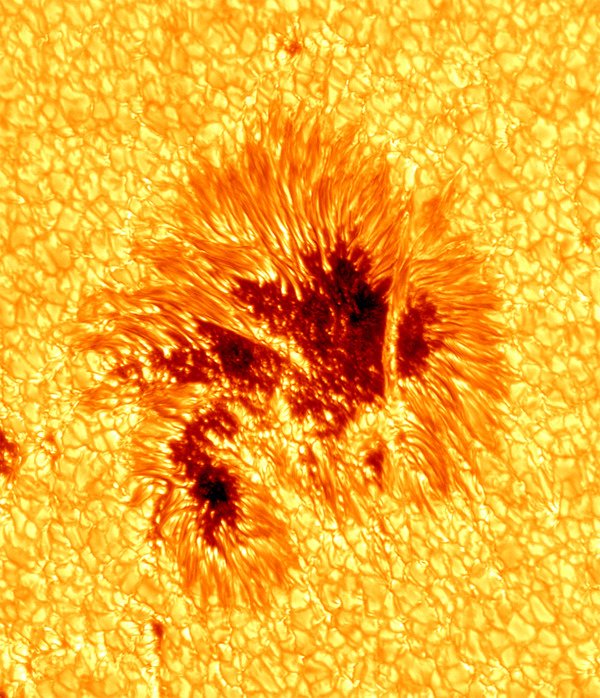
But there’s a key element missing in this explanation: convection! That radiative random walk photons do doesn’t last all the way from the core of the sun to its surface. From a depth of about 200,000 km onward, the dominant mode of transport in the sun is convection, actual fluid motion that carries heat and light much faster than simple molecular diffusion, or Brownian motion, does. That’s why the surface of the sun shines with convection cells similar to the ones you’ll see in your skillet when heating a layer of oil.
Fluid motion beyond molecular diffusion is also a big part of the other flows Joe describes in the video. If you had to wait on Brownian motion in order to smell your morning coffee, it would be cold long before you knew it was there! (Video and image credit: It’s Okay to Be Smart; sun surface image credit: Big Bear Solar Observatory/NJIT)


Magnetic Storms
Periodically, our sun releases plasma in a coronal mass ejection. Afterwards, the local magnetic field lines shift and reorganize. We can see that process in action here because charged particles spin along the magnetic lines, outlining them as bright loops in this imagery. This sequence – one of the best examples of this phenomenon to date – was captured by NASA’s Solar Dynamics Observatory in early 2017. To understand behaviors like these, scientists use magnetohydrodynamics, a marriage of the equations of fluid mechanics with Maxwell’s equations for electromagnetism. (Image credit: NASA SDO, source)

Astrophysical Turbulence
Subsonic turbulence – like the random and chaotic motions of air and water in our everyday lives – is something we have only a limited understanding of. Our knowledge of supersonic turbulence, where shock waves and compressibility rule, is even more tenuous. In part this is because, although we can observe snapshots of supersonic turbulence in astronomical settings like the Orion Nebula shown above, we cannot watch it evolve. On these scales, features simply don’t change appreciably on human timescales.
This has limited scientists to mostly numerical and theoretical studies of supersonic turbulence, but that is starting to change. Researchers are now building experimental set-ups that collide laser-driven plasma jets to generate boundary-free turbulence at Mach 6. Thus far, the observations are consistent with what’s been seen in nature: at low speeds, the turbulence is consistent with Kolmogorov’s theories, with energy cascading from large scales to smaller ones predictably. But as the Mach number increases, the nature of the turbulence shifts, moving toward the large density fluctuations seen in nebulae and other astrophysical realms. (Image credit: F. Battistella; research credit: T. White et al.; see also Nature Astronomy; submitted by Kam-Yung Soh)

Forming Asteroids


Amidst the swirling gas and dust surrounding young stars, asteroids and planets form. Just how these bodies come together – especially before they are massive enough to exert any significant gravitational potential – is an open question. Researchers are trying to better understand the physics involved by studying how clusters of granular material behave when impacted.
Above you see footage from two experiments. Both take place in a drop tower under vacuum conditions. That means the effects of air drag and gravity are removed, just like in space. On the left, the cluster is made up of soft clumps of dust; on the right, the cluster contains hard glass beads. Surprisingly, the researchers found that the two different materials behave the same way. They were able to describe both sets of impacts with exactly the same model. This suggests there may be an underlying universal behavior behind all of these granular materials, though the researchers note more experiments are needed. (Image and research credit: H. Karsuragi and J. Blum; via APS Physics)