Tag: astrophysics

  • Black Hole Signature

    Black Hole Signature

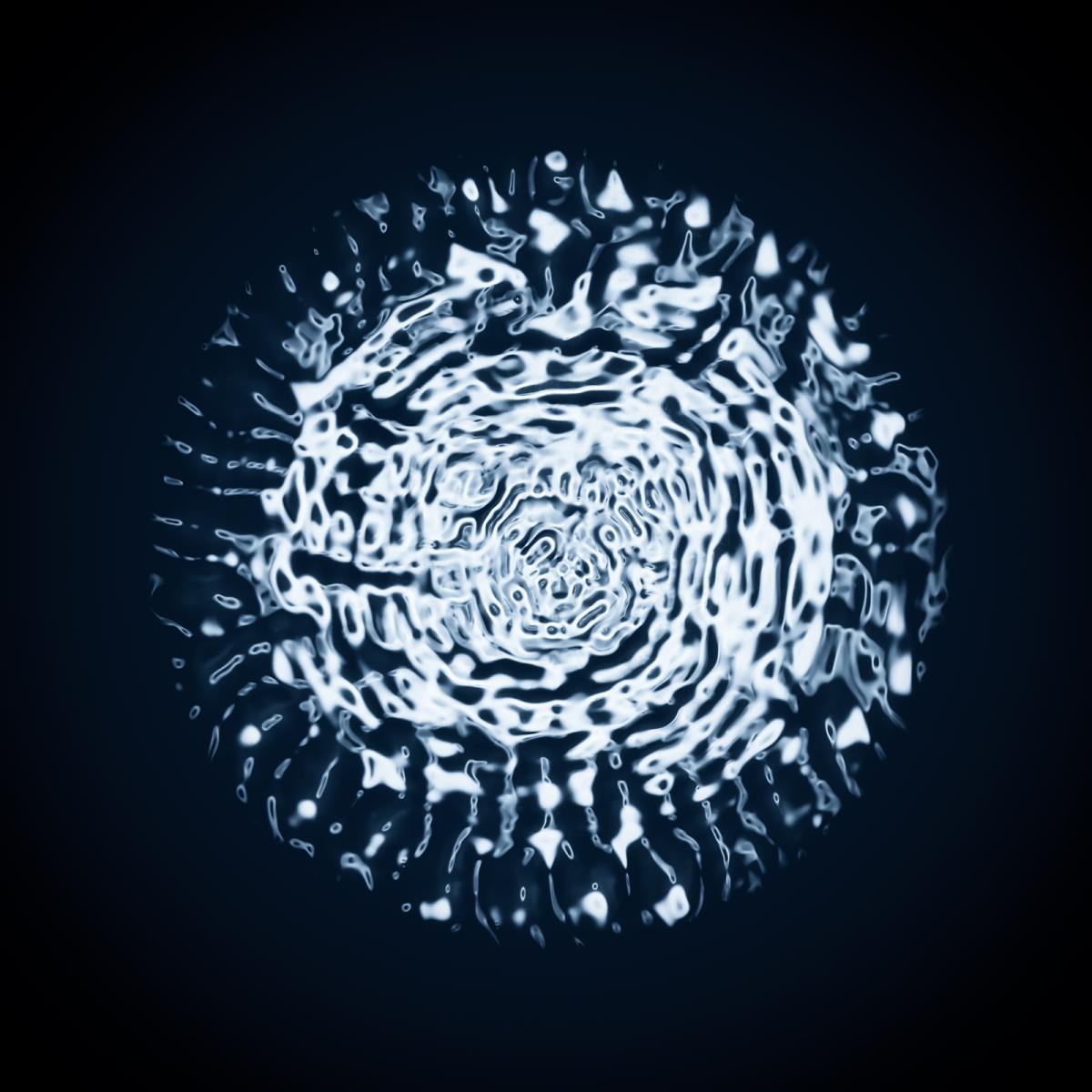
    240 million years ago, pressure waves emanated from a black hole inside the Perseus Galaxy Cluster. Much later, NASA’s Chandra X-Ray Observatory intercepted those waves. Scientists raised the frequency of the signal until it fell within the range of human hearing. And then photographer John White played that sound through a petri dish of water sitting on a speaker. The result is above: a watery glimpse of a long ago black hole’s signature. Within these Faraday waves is the echo of a stellar phenomenon that took place when the very first dinosaurs walked our planet. (Image credit: J. White; via the 2023 Astronomy POTY)

  • Solar Coronal Heating

    Solar Coronal Heating

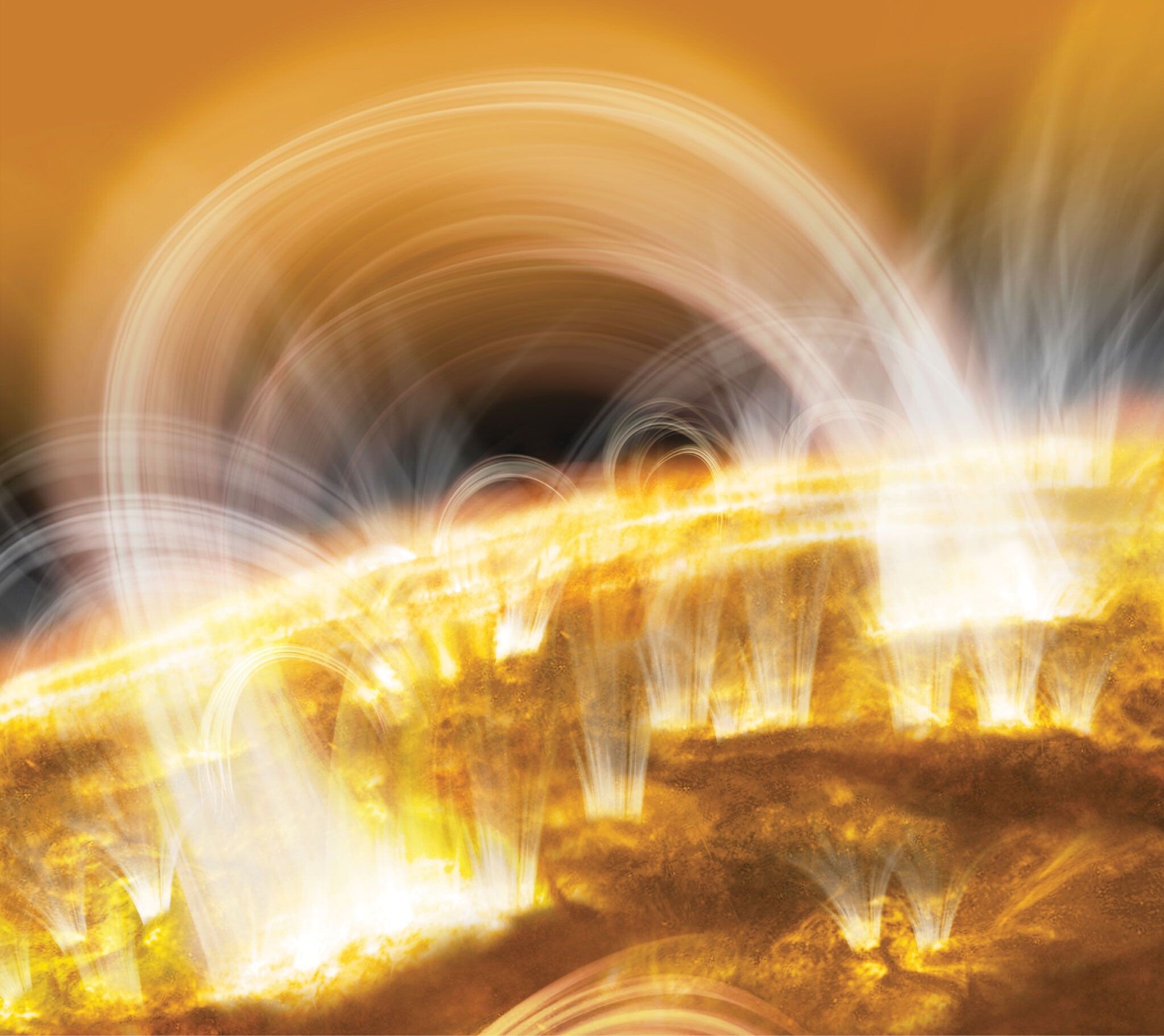
    Our Sun‘s visible surface, the photosphere, is about 5800 Kelvin, but the temperature of the wispy corona is far hotter, reaching a million Kelvin in some places. Why the corona is so hot remains something of a mystery. Scientists have theorized multiple culprits for the extreme temperatures found in the corona, but the full details of the phenomenon are still unclear.

    Recent solar missions and observations are increasingly identifying small but widespread solar activities, like the nanoflares shown above. Unlike the monstrous coronal loops researchers focused on previously, these flares are tiny and occur in regions without discernible solar flare activity. The nanoflares are brief but they can reach temperatures above a million Kelvin. Since nano- and even picoflares have been observed across the full Sun, they likely play a significant role in the overall picture of coronal heating. (Image credit: ISAS/JAXA; see also L. Sigalotti and F. Cruz)

  • A Starry Nursery

    A Starry Nursery

    This mountain of interstellar gas and dust lies in the picturesque Eagle Nebula. Though it appears solid in this near-infrared image from JWST, the density of the structure is actually quite low. Jets and solar winds from the glowing, young stars inside the region sculpt the pillar’s shape. Over the next 100,000 years, the stars’ energetic jets, solar winds, and destructive supernovas will destroy the dusty nursery. (Image credit: NASA/ESA/CSA/STScI/M. Özsaraç)

  • Black Holes in a Bathtub

    Black Holes in a Bathtub

    Physicist Silke Weinfurtner studies fluids, not for themselves, but for what they can teach us about black holes, cosmic inflation, and quantum gravity. Black holes are notoriously difficult to study directly, but, mathematically speaking, it’s possible to set up a fluid system that behaves in the same way a black hole does. The result is a bathtub-like arrangement with a central vortex, seen above. And within this “bathtub,” Weinfurtner and her colleagues can directly measure sound waves equivalent to Hawking radiation, the theoretical means by which black holes emit heat. Learn more about these analogue gravity experiments in her interview over at Quanta Magazine. (Image credit: P. Ammon; via Quanta Magazine; submitted by clogwog)

  • Searching for Stability

    Searching for Stability

    At present, there is no theory of relativistic fluid dynamics, which is problematic for those studying black holes, neutron star mergers, and heavy-ion collisions, where fluids may wind up moving at near-light speeds. Many current models for these systems allow energy to dissipate using equations that permit faster-than-light speeds. A new study shows that these assumptions lead to problematic results.

    The paper shows that, if the mathematical equations allow for faster-than-light speeds — thereby breaking causality — then the fluid system will behave stably to one observer and unstably to an observer in a different reference frame. In other words, there will always be a frame of reference where disturbances grow exponentially and destroy the system. That’s clearly not ideal.

    Fortunately, the paper also offers an important solution: if causality holds, the stability (or instability) of a system is the same regardless of reference frame. That’s incredibly powerful for researchers because it means that they only have to show the stability of the system in one reference frame to know that the result applies to all reference frames, so long as they’re not breaking causality. (Image credit: A. Pal; research credit: L. Gavassino; via APS Physics; submitted by Kam-Yung Soh)

  • Escaping the Sun

    Escaping the Sun

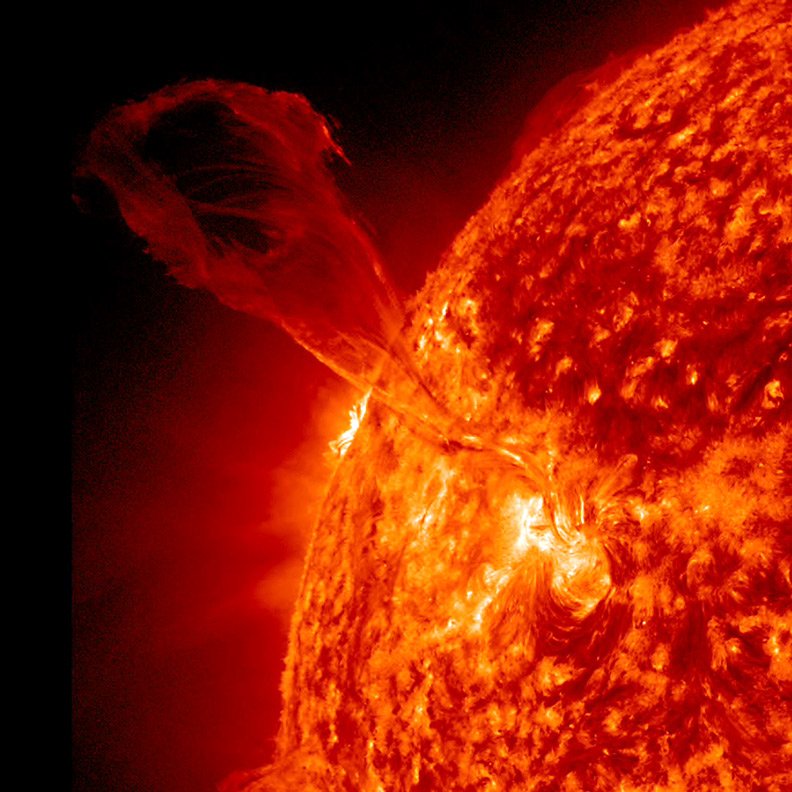
    One enduring mystery of the solar wind — a stream of high-energy particles expelled from the sun — is how the particles get accelerated in the first place. The sun frequently belches out spurts of plasma, but without further momentum, that material simply falls back to the sun’s surface under the star’s gravity. Mechanisms like shock waves can further accelerate particles that are already moving quickly, but they cannot explain how the particles get going in the first place.

    A recent study used supercomputers to tackle this challenging problem in turbulent plasma physics. Each simulation tracked nearly 200 billion particles, requiring tens of thousands of processors. The results showed that turbulence itself provides the necessary initial acceleration and serves as the first step to getting particles moving fast enough to escape the sun. (Image credit: NASA SDO; research credit: L. Comisso and L. Sironi; via Physics World)

  • Turbulence in Accretion Disks

    Turbulence in Accretion Disks

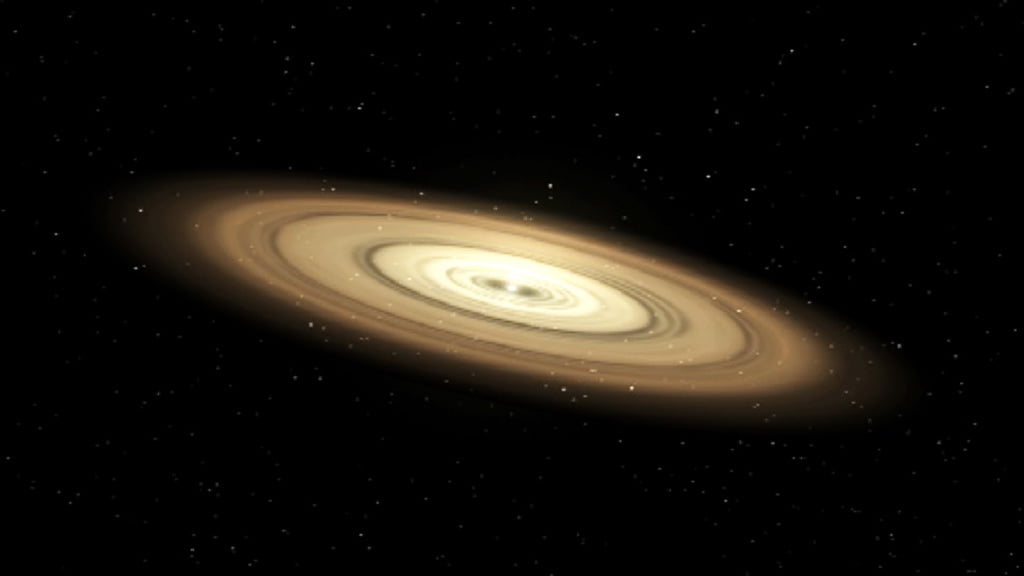
    Accretion disks form everywhere, from around young, planet-building stars to massive black holes. As matter circles in the disk, it slowly loses angular momentum and falls inward toward the central gravitational body. But the details of this process have long vexed astronomers. The low-viscosity environment of gas and dust in accretion disks simply is not sufficient to account for the level of angular momentum lost. Turbulence is expected to provide a boost to the effect, but neither astronomical observations or Taylor-Couette experiments have shown how.

    A new study uses a liquid metal, confined in a disk using radial and vertical electrical fields. Unlike prior experiments, this set-up creates a more gravity-like force to rotate the liquid. With it, researchers can tune both the rotation speed and the level of turbulence. They found that turbulence is, indeed, responsible for the loss of angular momentum that transports mass inward — even at the limit of zero intrinsic viscosity.

    Unfortunately, the apparatus isn’t a perfect analog for astrophysical disks; in the experiment, the turbulence originates from secondary flows that aren’t present in real systems. So while the team demonstrated that turbulence can drive the accretion disk’s behavior, it can’t pinpoint where that turbulence originates in real accretion disks. (Image credit: NASA; research credit: M. Vernet et al.; via Physics World)

  • Witch’s Broom

    Witch’s Broom

    Known by many names — including the Witch’s Broom Nebula — NGC 6960 is part of a supernova remnant visible in the constellation Cygnus. The wisp-like filaments of the nebula are shock waves moving through the cloud of dust and ionized gas. Based on observations using the Hubble Space Telescope, the nebula is expanding at around 1.5 million kilometers per hour. When the original supernova exploded thousands of years ago, astrophysicists estimate it would have been bright enough to see during daytime! (Image credit: K. Crawford)

  • Betelgeuse’s Flickering

    Betelgeuse’s Flickering

    Between November 2019 and March 2020 Betelgeuse, the red supergiant star in the constellation Orion’s left shoulder, experienced what’s being called the Great Dimming. Usually, the star is one of the ten brightest stars in the sky, often visible even in the suburban sprawl. But as of February 2020, it had dimmed by a factor of 2.5.

    Observers speculated all sorts of causes, including the idea that this was a precursor to a supernova explosion. Instead, it’s a relatively normal occurrence for a star like Betelgeuse. The image above is from a numerical simulation of the star, and it shows approximately what it would look like to the human eye over a 7.5 year time span. As you can see, its brightness varies noticeably, and its surface seems almost to boil. This has to do with convection in the star. Compared to a star like our sun, Betelgeuse has fewer — and much larger — convection cells.

    With a little more time and data, astronomers pinned down the exact source of Betelgeuse’s flickering during the Great Dimming. The year before the star belched an enormous bubble of gas into space. Then, when part of the star cooled in the aftermath, that gas condensed and formed a dust cloud which partially obscured the star. You can see an artist’s conception of the situation in the video below. (Image and research credit: B. Freytag; research credit: M. Montargès et al.; video credit: ESO/L. Calçada)

  • Eye of the Stellar Storm

    Eye of the Stellar Storm

    AG Carinae is a bright, unstable luminous blue variable star. This rare type of star lives fast and dies young (by stellar standards) over only a few million years. During that time, it will occasionally blow off its outer layers in a violent eruption as a result of the ongoing tug of war between its radiation pressure and gravity. That’s the source for the nebula we see surrounding the star in this image. The red areas of the image are a mixture of hydrogen and nitrogen gas; the blue clumps are cooler pockets of dust shaped by the hotter, faster-moving stellar wind. Zoom in on the image and you can see amazing structural detail in the nebula, evidence of turbulence on a scale of light-years. (Image credit: NASA/ESA/STScI; via Gizmodo)