Tag: astronomy

  • Martian Lava Coils

    Martian Lava Coils

    NASA’s HiRISE spacecraft has sent back images of lava coils left on the surface of Mars. These features form when lava flows of different speeds move past one another; they’re essentially Kelvin-Helmholtz waves–like the ones often seen in clouds–in the lava flow that have solidified into solid rock! On Earth these coils appear about a foot wide; the Martian versions are 100 feet across. (Photo credit: NASA/JPL/University of Arizona; via Wired; submitted by Brian L)

  • Portrait of Gas Giants

    [original media no longer available]

    Here raw footage from NASA’s Cassini and Voyager missions has been combined in a stunning portrait of Saturn and Jupiter. Watch as tiny moons create gravity waves in the rings of Saturn and observe the complicated relative motion between the cloud bands on Jupiter and the swirls and vortices that result. Fluid dynamics are truly everywhere. (Video credit: Sander van den Berg; submitted by Daniel B)

  • Barchan Dunes

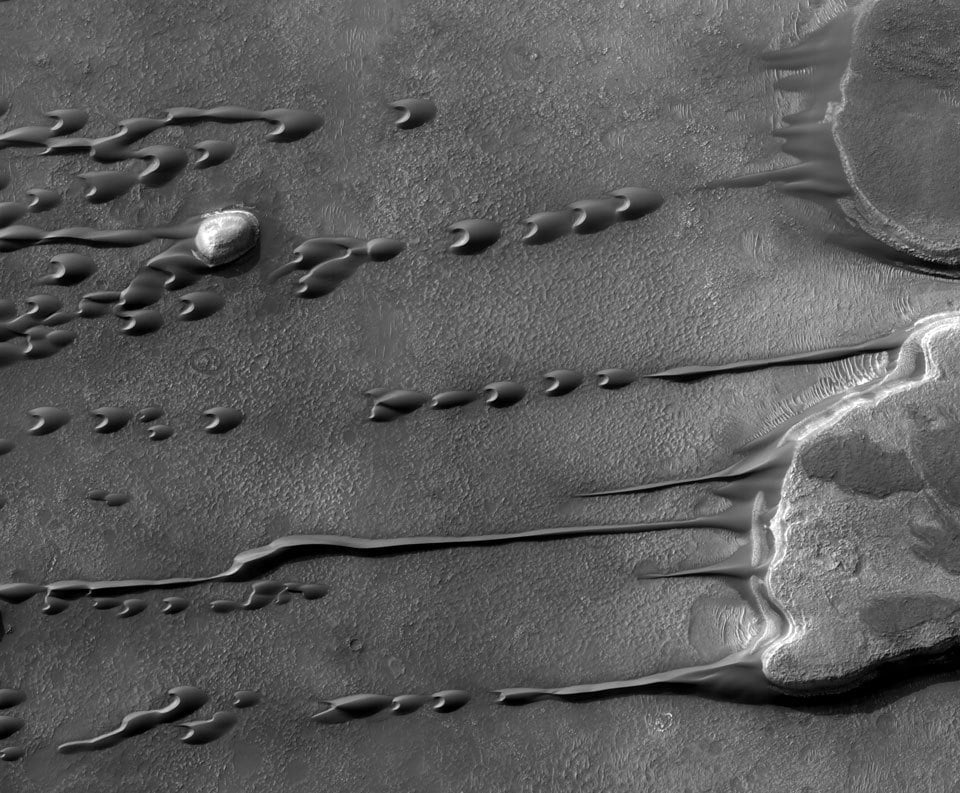
    Barchan Dunes

    The winds of Mars create sand dunes that seem to flow like a liquid across the planet’s surface. Here the wind blows from right to left around the flat top mesas on the right side of the image. The dark, arc-shaped dunes formed in the wake of the mesas are called barchans and can move downstream remarkably intact, even able to cross paths with other dunes. (Photo credit: MRO, NASA; via APOD)

  • Featured Video Play Icon

    Dancing Plasma

    Two dark areas of plasma, cooler than the surrounding fluid, dance and intertwine above the sun’s surface. Plasma, a rarefied gas made up of ions, is an electrically conductive fluid, shaped here by the magnetic field of the sun. Note how the strands pass material back and forth along the magnetic field lines. This timelapse video, captured by NASA’s Solar Dynamics Observatory, takes place over the course of a day and is captured in the extreme ultraviolet range.

  • Featured Video Play Icon

    Solar Tornadoes

    NASA’s Solar Dynamics Observatory captured this video of swirls of darker, cooler plasma caught between competing magnetic forces over the course of 30 hours. The plasma strands rotate like tornadoes caught on magnetic field lines. It sometimes feels incredible to observe such familiar-looking fluid behavior in such unfamiliar places, but it’s just a reminder that physics works no matter where you are.

  • Featured Video Play Icon

    Supersonic Stellar Jets

    Astronomers studying stellar jets–massive outflows of gases and particles pouring from the poles of newborn stars–are finding reasons to turn to fluid dynamicists to understand the timelapse videos they’ve stitched together from multiple exposures from the Hubble telescope. Usually astronomical events unfold on such a slow timescale that our only view of them is as a snapshot frozen in time.  Stellar jets can move relatively quickly, though, with portions of the jet flowing at supersonic speeds. Over the course of Hubble’s lifetime, these jets have been imaged multiple times, allowing astronomers to create movies that reveal swirling eddies and shock wave motion previously unseen. (submitted by sakalgirl)

  • Jovian Storms

    Jovian Storms

    Home to storms capable of lasting for a hundred years or more, Jupiter’s atmosphere is a highly turbulent place. Currently, no comprehensive theory exists to explain the symmetry of Jupiter’s bands of clouds and the persistence of vortices such as the Great Red Spot, however, the mixing and stratification visible on the planet remains a beautiful reminder of the power of fluid dynamics. (Photo credits:Cassini – 1, 2,  Voyager 1, New Horizons – 1, 2)

  • Neutron Superfluids in Stars?

    Neutron Superfluids in Stars?

    This image shows a composite X-ray (red, green, and blue) and optical (gold) view of the supernova remnant Cassiopeia A, located about 11,000 light years away. At the heart of this supernova remnant is a neutron star. After ten years of observations, astronomers have found a 4% decline in the temperature of this neutron star, which cannot be accounted for in current theory. Two research teams have independently found that this cooling could be due to the star converting the neutrons in its core into a superfluid. As the neutron superfluid is formed, neutrinos are emitted; this decreases the energy in the star and causes more rapid cooling. See Wired for more. #

  • Calcium Plasma on the Sun

    Calcium Plasma on the Sun

    This high-resolution photo of our sun shows the structure of calcium plasma on the surface of the sun. Plasmas are governed by the same physics as our familiar earthbound fluids but are also extremely sensitive to magnetic fields. Their branch of fluid dynamics is often referred to as magnetohydrodynamics (MHD), where the Navier-Stokes equations have to be solved in conjunction with Maxwell’s equations. (via Bad Astronomy)