Tag: aerodynamics

  • PyeongChang 2018: Cross-Country Skiing

    PyeongChang 2018: Cross-Country Skiing

    Cross-country skiing, also known as Nordic skiing, is a part of many longstanding disciplines in the Winter Games. Unlike downhill skiing, cross-country events typically involve mass starts, which allow athletes to interact, using one another for pacing and tactics. Drafting can be a valuable method to save energy and reduce drag. A following skier sees a 25% drag reduction while drafting; the lead skier gets about a 3% reduction in drag compared to skiing solo. Competitors usually wear tight-fitting suits to minimize drag, but unlike speedskating, for example, cross-country skiers don’t get much benefit from roughened surfaces and impermeable fabrics. Typical race speeds are 4 – 9 m/s, and most of these high-tech fabrics don’t provide tangible benefits until higher speeds. (Image credit: Reuters/S. Karpukhin, US Biathlon, GettyImages/Q. Rooney)

  • PyeongChang 2018: Bobsleigh

    PyeongChang 2018: Bobsleigh

    In bobsleigh, two- and four-person teams compete across four runs down an ice track. The shortest cumulative time wins, and since typical runs are separated by hundredths of a second, teams look for any advantage that helps them shave time. The size, weight, and components of a sled are restricted by federation rules; for example, teams cannot use vortex generators to improve their aerodynamics. Instead bobsledders work with companies like BMW, McLaren, and Ferrari to engineer their sleds. Both computational fluid dynamics and wind tunnel tests with the actual team in the sled are used to make each sled as aerodynamic as possible. (Image credit: IOC, Gillette World Sports, source)

  • PyeongChang 2018: Ski Jumping

    PyeongChang 2018: Ski Jumping

    No winter sport is more aerodynamically demanding than ski jumping. A jump consists of four parts: the in-run, take-off, flight, and landing. The in-run is where an athlete gains her speed, and to keep drag from slowing her down, she descends in a streamlined tuck that minimizes frontal area. The biggest aerodynamic challenge comes during flight, when the jumper wants to maximize lift while minimizing drag. The athlete spreads her skis in a V-shape and flattens her body, using her hands to adjust her flight. Flying the farthest requires careful management of forces while in the air. Wind plays a major role as well, with headwinds helping athletes fly farther. To compensate, scoring includes a wind factor calculated based on conditions for each jump. (Image credit: B. Pieper, Reuters/K. Pfaffenbach, PyeongChang 2018)

  • Withstanding Windstorms

    Withstanding Windstorms

    Saguaro cacti can grow 15 meters tall, and despite their shallow root systems can withstand storm winds up to 38 meters per second without being blown over. Grooves in the cacti’s surface may contribute to its resilience, by adding structural support and/or through reducing aerodynamic loads. The latter theory mirrors the concept of dimples on a golf ball; namely, grooves create turbulence in the flow near the cactus, which allows air flow to track further around the cactus before separating. The result is less drag for a given wind speed than a smooth cactus would experience.

    Indeed, recent experiments on a grooved cylinder with a pneumatically-controlled shape showed exactly that; the morphable cylinder’s drag was consistently significantly lower than fixed samples. Cacti do change their shapes somewhat as their water content changes, but they don’t have the ability for up-to-the-minute alterations. Nevertheless, their adaptations can inspire engineered creations that morph to reduce wind impact. (Image credit: A. Levine; research credit: M. Guttag and P. Reis)

  • Reader Question: Drafting in Time Trials

    Reader Question: Drafting in Time Trials

    In a comment on this recent post regarding drafting advantages to a leader, reader fey-ruz asks:

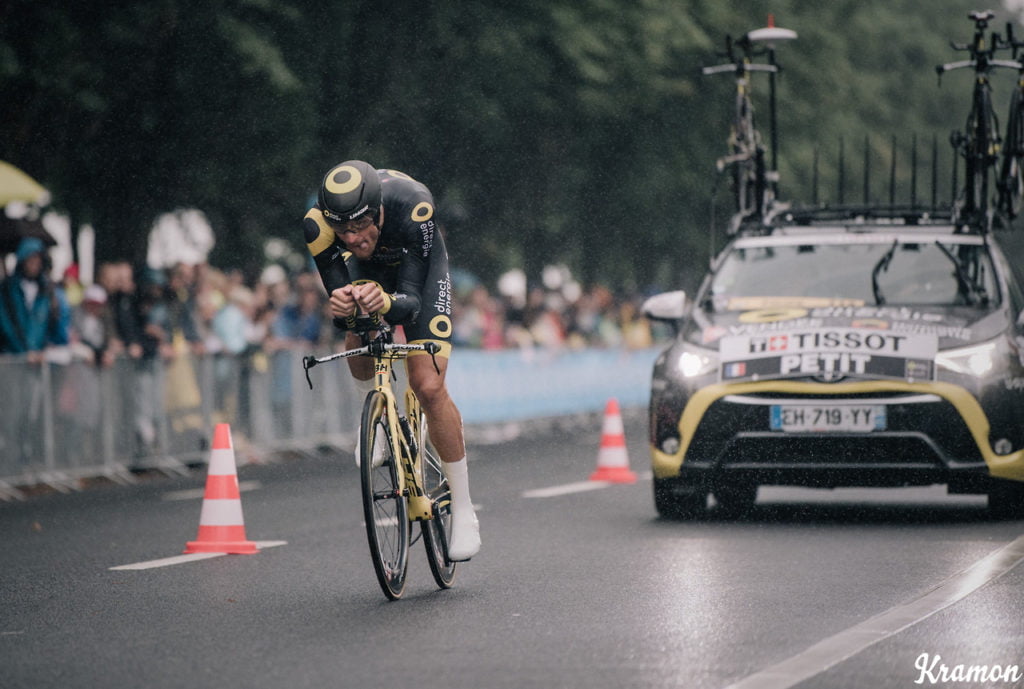
    in cycling, team follow cars are required to maintain a minimum distance from their riders during time trials for this very reason (although i imagine the effects in that context are much smaller and dependent on the conditions, esp the wind speed, direction, and strength). FYFD, is there a simple way to understand where this upstream influence comes from? or a specific term in the navier-stokes equations that it results from?

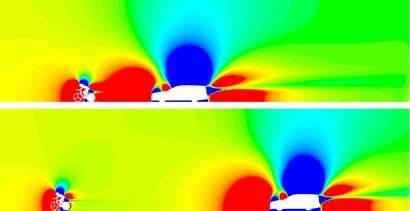
    Cars following riders during a time trial can actually make a huge difference! One study from a couple of years ago estimated that a car following a rider in a short (13.8 km) time trial could take 6 seconds off the rider’s time. The images up top show a simulation from that study with a car following at 5 meters versus 10 meters. The colors indicate the pressure field around the car and rider. Red is high pressure, blue is low pressure. Both the car and the rider have high pressure in front of them; you can think of this as a result of them pushing the air in front of them.

    A large part of the rider’s drag comes from the difference in pressure ahead and behind them. (For a look at flow around a cyclist that focuses on velocity instead, check out my video on cycling aerodynamics.) When a car drives close behind a cyclist, it’s essentially pushing air ahead of it and into the cyclist’s wake. This actually reduces the difference in pressure between the cyclist’s front and back sides, thereby reducing his drag. Because cars are large, they have an oversized effect in this regard, but having a motorbike or another rider nearby also helps the lead cyclist aerodynamically.

    As for the Navier-Stokes equation – this effect isn’t one that you can really pin down to a single term since it’s a consequence of the flow overall. (Image credits: TU Eindhoven; K. Ramon)

  • Cycling Skinsuits and Vortex Generators

    Cycling Skinsuits and Vortex Generators

    It didn’t take long for an aerodynamic controversy to crop up in this year’s Tour de France. At the 14km individual time trial, riders from Team Sky wore custom Castelli skinsuits with integrated dot-like patterns on their upper arms (shown above). By the next day, a sports scientist with a competing team cried foul play, claiming that these fabrics could have given Team Sky as much as 25 seconds’ advantage over other riders. The Sky team finished with 4 out of the top 10 places on the time trial, and their leader, three-time Tour winner Chris Froome, finished some 35 seconds ahead of his expected competitors for the yellow jersey.

    Vortex generators explained

    So how could a few dots make a measurable difference? These protrusions are vortex generators meant to modify flow around a cyclist. Humans are not aerodynamic and what typically happens when air flows over a cyclist’s arms is shown in the flow visualization above: the air follows the curve of the arm part way, then it separates from the body, leaving a region of recirculation that increases drag. Vortex generators can help prevent or delay that drag-inducing flow separation by adding extra energy and turbulence to the air near the arm’s surface. Because turbulent boundary layers can follow a curve longer before separating, this helps reduce the drag by reducing the recirculation zone.

    About that time savings

    Aerodynamically speaking, those vortex generators can make a difference, but the question is, how much? In his complaint, Grappe cites a 2016 paper by L. Brownlie et al. that wind-tunnel tested different vortex generator patterns for use in running apparel. The speeds tested included those relevant to cycling. The specific numbers Grappe quotes aren’t directly relevant, however:

    As noted above, race garments that contain VG provide reductions in Fd of between 3.7 and 6.8% compared to equivalent
    advanced race apparel developed for the 2012 London Olympics which in turn provided substantially lower drag than
    conventional race apparel.

    the effectiveness of 5, 10 and 15 cm wide strips of VG applied to each flank of a sleeveless singlet revealed that the 5 cm wide
    strips provided between 3.1 and 7.1% less Fd than the 10 cm wide strips and between 1.9 and 4.3% less Fd than the 15 cm wide
    strips.  

    Here Brownlie et al. are specifically describing the savings for running apparel, which uses vortex generators in very different places than you would on a cyclist. Note the second quote even refers to a sleeveless singlet, so the vortex generators measured are definitely not in the same place as these skinsuits!

    The bottom line

    I fully expect that vortex generators give a marginal aerodynamic edge, which is why Sky and other teams have already been using them in competition. But I hesitate to declare that the savings is as high as 5-7%, and I have no way to verify Grappe’s subsequent claims that this translates to 18-25 seconds in the time trial. Those are numbers he gives without citing what model is being used to translate drag gains into time.

    In the end, what is needed is clarification of the rules. As they stand, one rule seems to allow the skinsuits because the vortex generators are integrated into the fabric, whereas another states clothing is forbidden “to influence the performances of a rider such as reducing air resistance”. Those two stances seems contradictory, and, for now, the race officials’ verdict to allow the suits stands.

    If you want to learn more about aerodynamics and cycling, be sure to check out my latest FYFD video. (Image credits: B. Tessier/Reuters; Getty Images; L. Brownlie et al. 2009; h/t to W. Küper)

  • How Cycling Position Affects Aerodynamics

    How Cycling Position Affects Aerodynamics

    New FYFD video! How much does a rider’s position on the bike affect the drag they experience? To find out I teamed up with folks from the University of Colorado at Boulder and at SimScale to explore this topic using high-speed video, flow visualization, and computational fluid dynamics. 

    Check out the full video below, and if you need some more cycling science before the Tour de France gets rolling, you can find some of my previous cycling-related posts here. (Image and video credit: N. Sharp; CFD simulation – A. Arafat)

    ETA: Please note that the video contained in this post was sponsored by SimScale.

  • Aerodynamic Leidenfrost Effect

    Aerodynamic Leidenfrost Effect

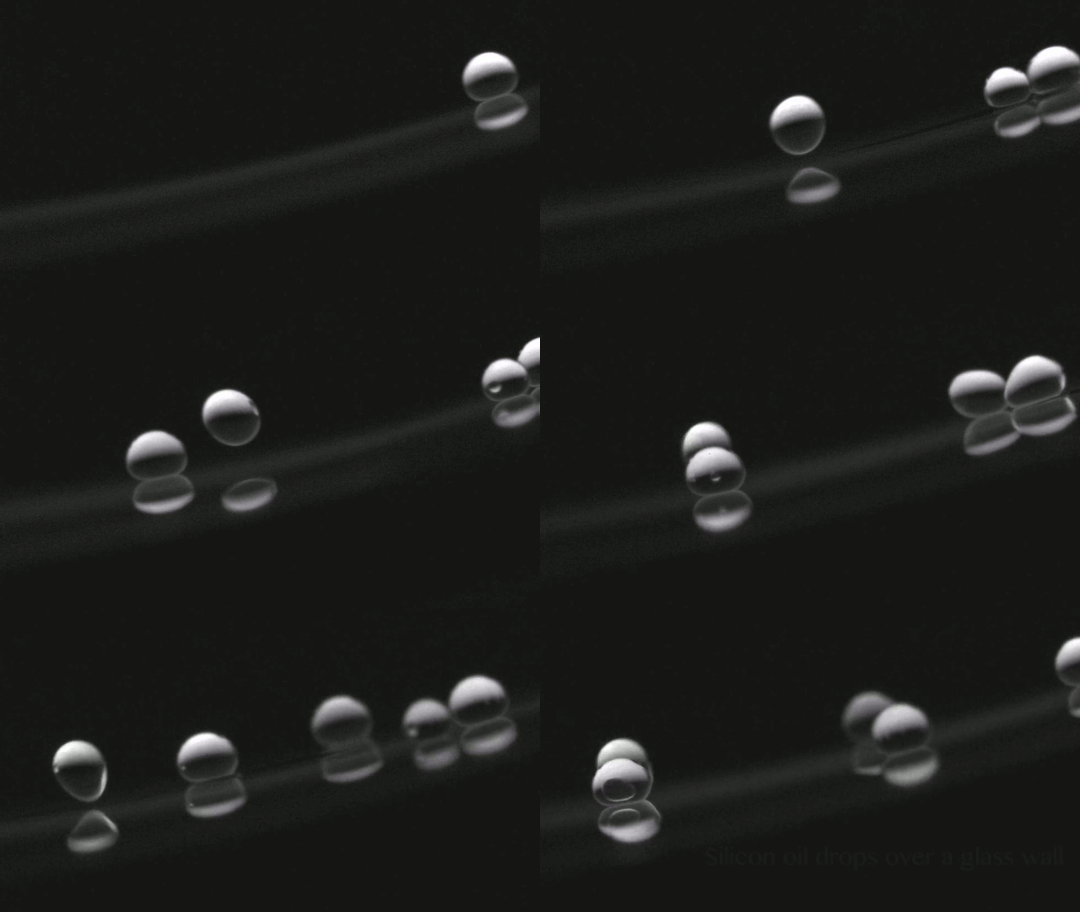
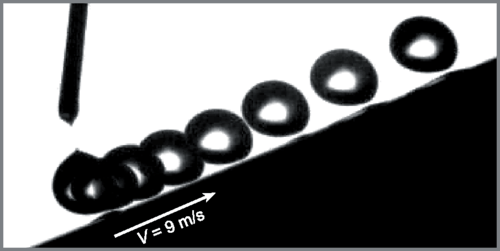
    If you place a droplet on a surface much hotter than its boiling point, that droplet will skitter and float almost frictionlessly across the surface on a thin layer of its own vapor. This is what is known as the Leidenfrost effect. But you don’t have to heat a surface to get this behavior. There’s also an aerodynamic Leidenfrost effect, shown above, when the surface is moving. As the surface moves, it drags a layer of air along with it, and that layer of air is capable of keeping droplets aloft indefinitely. The thickness of the air layer depends on speed; the faster the plate moves, the thicker the air layer underneath droplets. The aerodynamic forces generated are large enough to drive a droplet up an incline against the force of gravity (bottom image). (Image credit: animation – M. Saito et al., source; chronophotograph – A. Gautheir et al., pdf)

  • Resonating with the Windows Down

    Resonating with the Windows Down

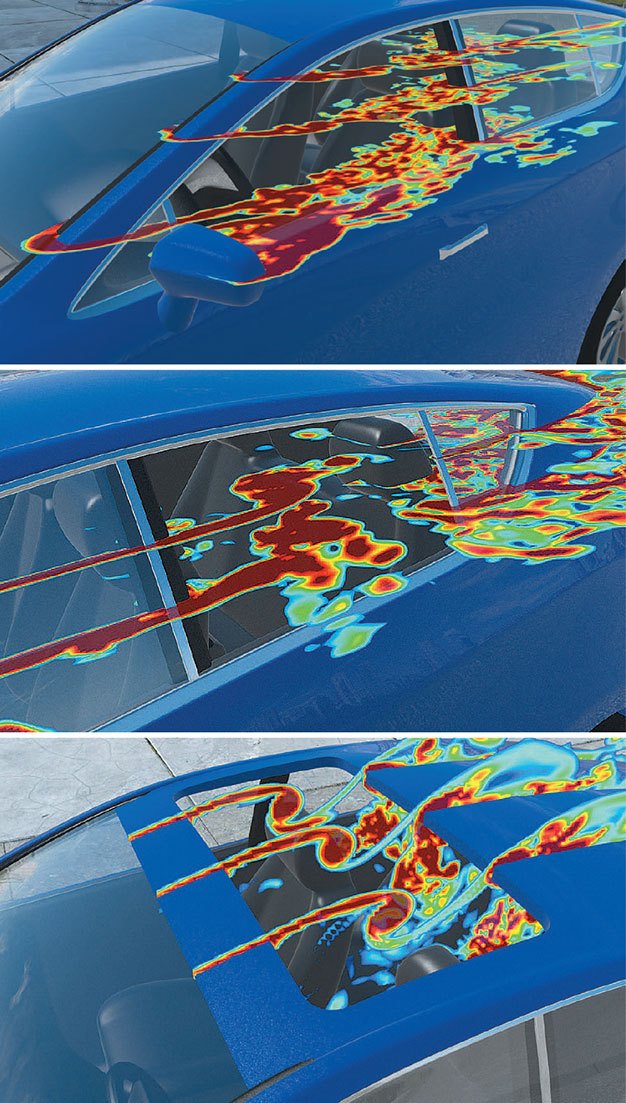
    Ever roll down your window a bit while driving and immediately hear a terrible, rhythmic noise? That awful whum-whum-whum is–oddly enough–an example of the same physics that allows you to make an open bottle whistle by blowing over it. Fluid dynamicists call it Helmholtz resonance. Air flowing over the bottle neck or around the car makes the air inside the container vibrate with a frequency that depends on the bottle or car’s characteristics. That vibration generates noise that we hear as a hum or whistle for a bottle or a lower frequency whum-whum for a car window.

    The images above show flow past different open windows on a car. Air flow remains relatively steady past the side-view mirror and front window of a modern car, so the noise from opening the front window is not usually too bad. But flow separation and reconnection near the rear window of a car creates very unsteady airflow there which exacerbates this resonance issue. This is why lowering the rear window usually causes more noise. Fortunately, the solution is relatively simple: open more than one window and it disrupts the resonance! (Image credit: Car and Driver; submitted by Simon H.)

  • Featured Video Play Icon

    Living Fluid Dynamics

    This short film for the 2016 Gallery of Fluid Motion features Montana State University students experiencing fluid dynamics in the classroom and in their daily lives. As in her previous film (which we deconstructed), Shanon Reckinger aims to illustrate some of our everyday interactions with fluids. This time identifying individual phenomena is left as an exercise for the viewer, but there are hints hidden in the classroom scenes. How many can you catch? I’ve labeled some of the ones I noticed in the tags. (Video credit: S. Reckinger et al.)