Tag: aerodynamics

  • Bats in Ground Effect

    Bats in Ground Effect

    As pilots can tell you, flying near the ground (or an open expanse of water) gives one an aerodynamic boost. Essentially, the surface acts like a mirror, reflecting and dissipating the wingtip vortices that create downwash. That reduces the power necessary to fly, as long as you’re flying within about a wingspan of the surface.

    Theoretically, flapping fliers like bats and birds should also benefit from this ground effect, but measurements have been hard to come by. A new study using bats trained to fly in a wind tunnel provides some of the first detailed measurements of ground effect for flapping animals. The researchers found a 29% reduction in the power necessary for flight when in ground effect compared to being out of it! That’s twice the savings predicted by modeling, meaning we still have a ways to go to accurately capture the physics of flapping flight under these circumstances.

    Such a substantial savings also strengthens arguments for flight developing from the ground up. Using ground effect, surface-dwelling animals could have evolved flight gradually, taking advantage of the energy savings offered by sticking close to the surface. (Image and research credit: L. Johansson et al.; submitted by Marc A.)
  • Inside a Wind Tunnel

    Inside a Wind Tunnel

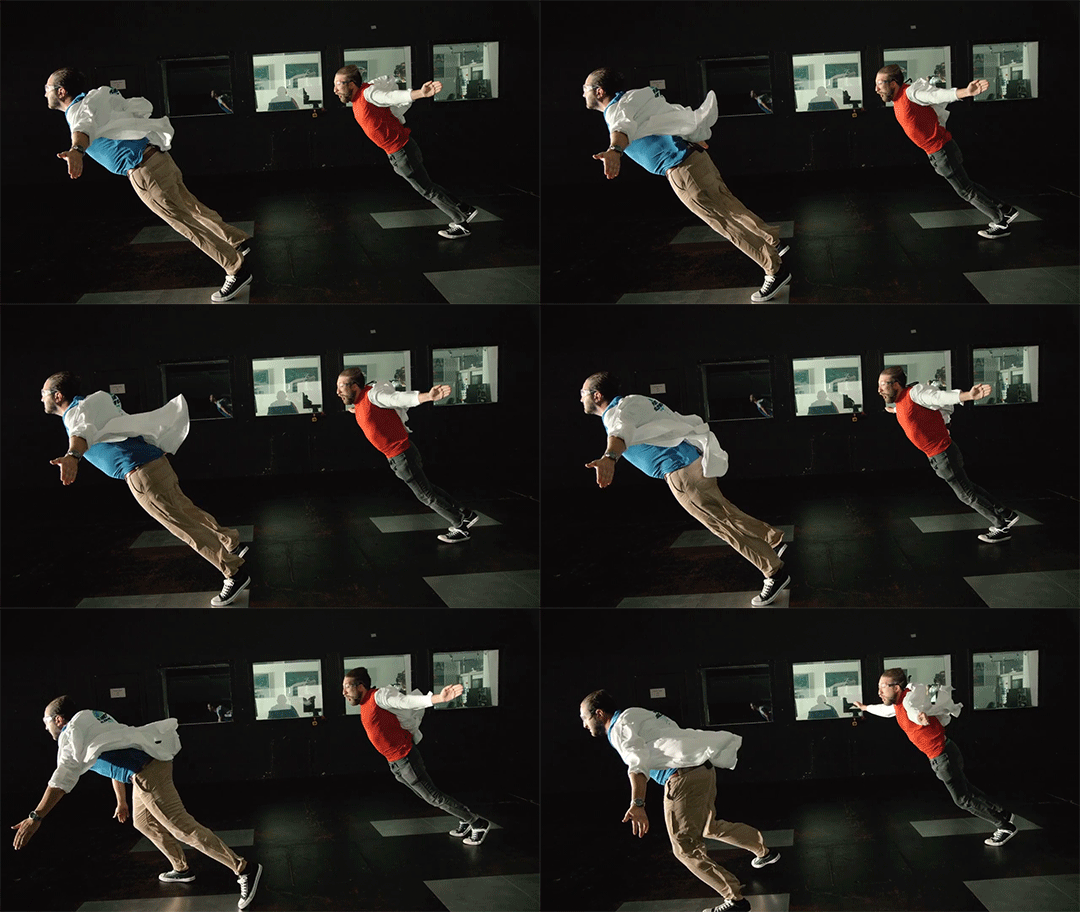
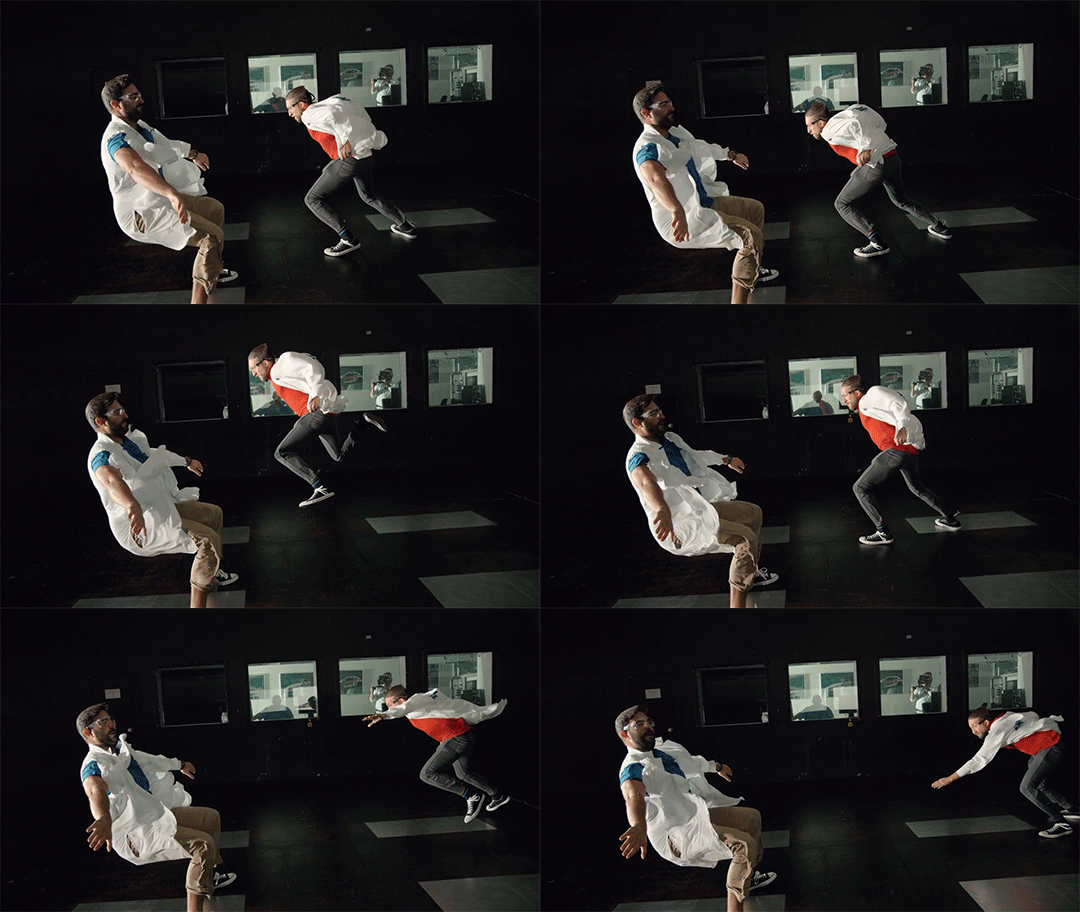
    When I was in graduate school, I worked in a facility known as the High-Speed Wind Tunnel Lab. We were located next door to the Low-Speed Wind Tunnel, and every few months we’d receive a phone call asking whether we could film someone in the high-speed wind tunnel. This was impossible for several reasons – the size of human beings and the necessity of drawing the hypersonic tunnels down to vacuum-like pressures before initiating flow being only two of them – but what it really did was highlight the difference in definitions. 

    What these (usually) weather forecasters wanted was to simulate hurricane force winds on a human being. And to an aerodynamicist, that hundred mile-an-hour flow is still low-speed. Because we’re comparing it to the speed of sound, not the normal range of wind speeds a human experiences. That said, watching humans struggle inside a wind tunnel is always entertaining. 

    As you can see from the Slow Mo Guys here, counteracting the lift and drag forces from these wind speeds is tough. On the bottom left, Dan has managed to balance his weight and the drag forces to hold himself in a virtual chair. Meanwhile, Gav’s attempt to jump forward against the wind just pushes him backward as his lab coat parachutes behind him. (Image and video credit: The Slow Mo Guys)

  • Vortices and Ground Effect

    Vortices and Ground Effect

    Though typically unseen, the vortices that swirl from the tips of aircraft wings are powerful. Here you see a Hawker Sea Fury equipped with a smoke system used to visualize the vortices that form at the wingtip as high-pressure air from the bottom of the wing and low-pressure air from the top swirl together. As you can see, the vortices persist in the wake long after the plane passes. The size and strength of the vortices depend on the size and speed of the aircraft; this is why air traffic control requires smaller planes to wait longer to take off or land if there was just a larger aircraft on the runway.

    The other cool thing to note here is how the wingtip vortices move apart from one another in the animation above. In flight, wingtip vortices usually stay roughly parallel to one another, but they drift downward in the aircraft’s wake. Near the ground, though, the vortices cannot move down, so instead ground effect forces them apart from one another, as seen here. (Image and video credit: E. Seguin; via Kelsey C.)

  • Featured Video Play Icon

    The Tacoma Narrows Bridge

    One of the most dramatic and famous engineering failures of the twentieth century is also one of the most complicated: the collapse of the Tacoma Narrows Bridge. This early suspension bridge earned the name “Galloping Gurtie” from construction workers while it was still being built because its flexibility made it prone to moving up and down under even relatively light winds. That vertical motion was due to vortex-induced vibration. As the wind blew, it shed vortices off the downstream side of the bridge. These vortices alternated, coming off the top and then bottom of the bridge deck. The resulting forces made the bridge shift up and down.

    That wasn’t the bridge’s ultimate downfall, though. Shortly before it collapsed, the bridge stopped flexing up and down and instead twisted back and forth. This was a clear sign that the bridge had moved into aeroelastic flutter. In this situation, you get a feedback loop between the bridge’s aerodynamics and its structural dynamics. When the wind twists the bridge deck to a positive angle of attack, it will try to continue forcing the bridge to twist that direction. The internal forces of the bridge will try to twist it back, but when that happens, it can overshoot and end up at a negative angle of attack. At that point, the wind tries to push it further that direction and internal forces twist it back, overshooting the other way. This back-and-forth can create a dangerous feedback loop where the twisting of the bridge keeps getting worse and worse. In fact, that’s exactly what happened – right up until the bridge collapsed rather than twisting any more. (Video and image credit: Practical Engineering)

  • Featured Video Play Icon

    Flying on Flexible Wings

    Bats are incredible and rather unique among today’s fliers. Like birds, they flap to produce their lift and thrust, but where birds have relatively stiff wings, a bat’s wings are flexible. The thin webbing of skin stretched between the bat’s finger joints has muscles inside it that fire as the mammal flaps. This means that the bat may actively control just how stiff its wing is as it flies.

    Compared to other natural and manmade fliers, the bat is incredibly agile and stable, able to recover from wind gusts in less than a full wingbeat cycle. They also have some incredible acrobatic capabilities. When preparing to perch, a bat loses almost all of its aerodynamic lift but still manages to maneuver itself so it flips over and grabs hold. Check out the full video above to learn more about these fascinating animals. (Video and image credit: Science Friday; research credit: S. Swartz and K. Breuer)

    Editor’s Note: I’ll be travelling through the end of the month with limited email access. The blog should continue posting uninterrupted, but if you contact me, just know it may be awhile before I can get back to you. Thanks! – Nicole

  • Featured Video Play Icon

    The Actual Shape of Raindrops

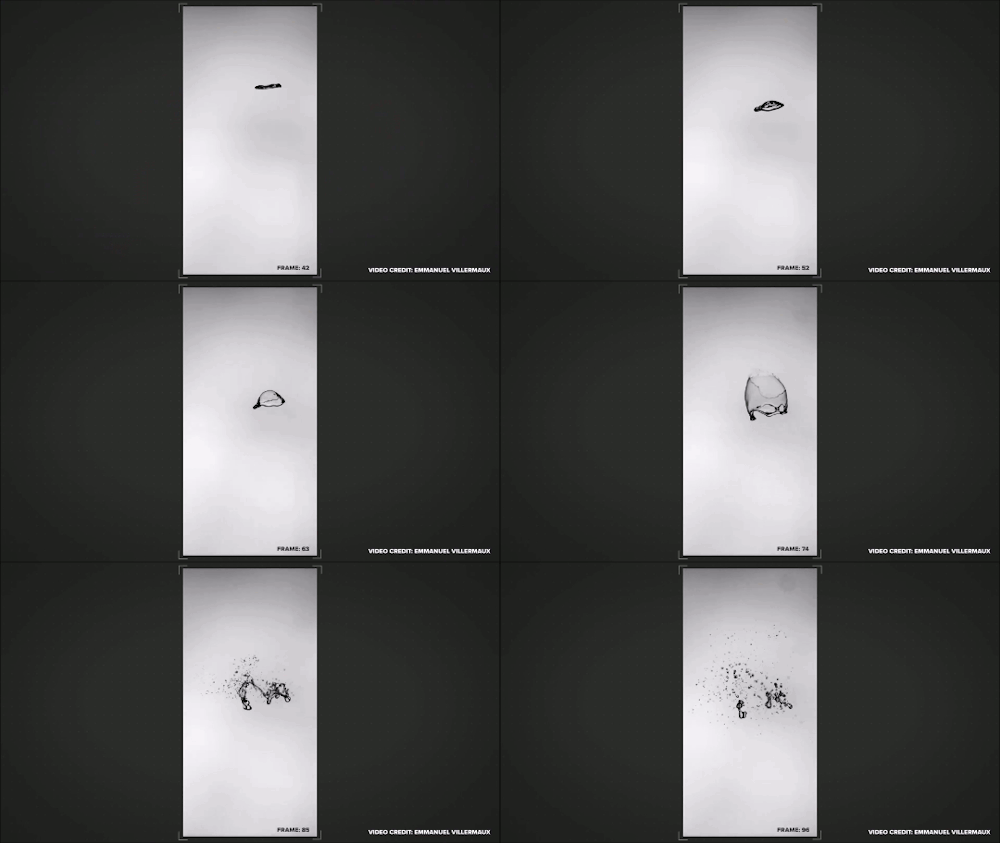
    If you imagine the shape of a raindrop, you probably think of a tear drop shape, but the reality of rain is much more complicated. It’s Okay to Be Smart has a great primer on the subject that takes a look at the forces on a raindrop and shows you the actual shape they take, which depends largely on their size.

    Small raindrops tend to coalesce together over time and get larger and progressively flatter. When the drop’s volume gets too large (below), it balloons up like a parachute. Researchers call this a bag. Stretched into a film, the drop’s surface tension is no longer able to win its fight against aerodynamic forces, and the drop shreds into smaller droplets. (Video and image credit: It’s Okay to Be Smart)

  • The Protection of the Peloton

    The Protection of the Peloton

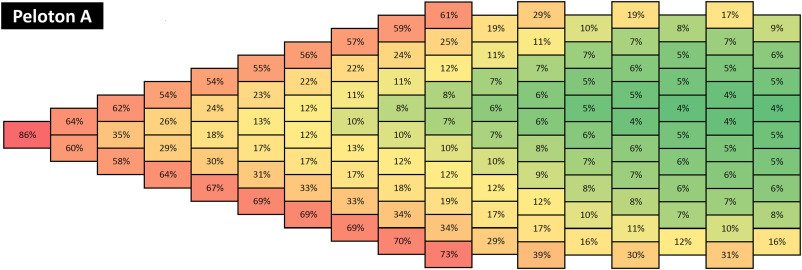
    It’s well-known by professional cyclists that sitting in the middle of the peloton requires little effort to overcome aerodynamic drag, but now, for the first time, there’s a scientific study to back that up. Researchers built their own quarter-scale peloton of 121 riders to investigate the aerodynamic effect of cycling in such a large group versus riding solo. Through wind tunnel studies and numerical simulation, they found that riders deep in the peloton can experience as little as 5-10% of the aerodynamic drag of a solo cyclist. 

    Tactically, this means teams should aim to position their protected leader or sprinter mid-way in the pack, where they’ll receive lots of shelter without risking one of the crashes common near the back of the peloton. It also suggests that teams wanting to isolate another team’s leader should try to push them toward the outer edges of the peloton rather than letting them sit in the middle. It will be interesting to see whether pro teams shift their race strategies at all with these numbers in hand.

    Of course, this study considers only a pure headwind. But other groups are looking at the effects of side winds on cyclists. (Image credit: J. Miranda; image and research credit: B. Blocken et al.; submitted by 1307phaezr)

  • The Telstar 18

    The Telstar 18

    Every four years, Adidas creates a newly designed ball for the World Cup. This year’s version is the Telstar 18, which features six glued panels (no stitching!) with a slightly raised texture. That subtle roughness is an important feature for the ball’s aerodynamics. It helps ensure that flow around the ball will become turbulent at relatively low speeds. Some previous designs, notably the 2010 Jabulani, were so smooth that flow near the ball would not become turbulent until much higher speeds. In fact, one side of the ball might have laminar flow while the other was turbulent, causing the ball to wobble and misbehave. To learn more about World Cup aerodynamics and the importance of a little surface roughness to the ball’s behavior, check out the Physics Girl video below.    (Image credit: Adidas; via APS News; video credit: Physics Girl)

  • Star Wars Aerodynamics

    Star Wars Aerodynamics

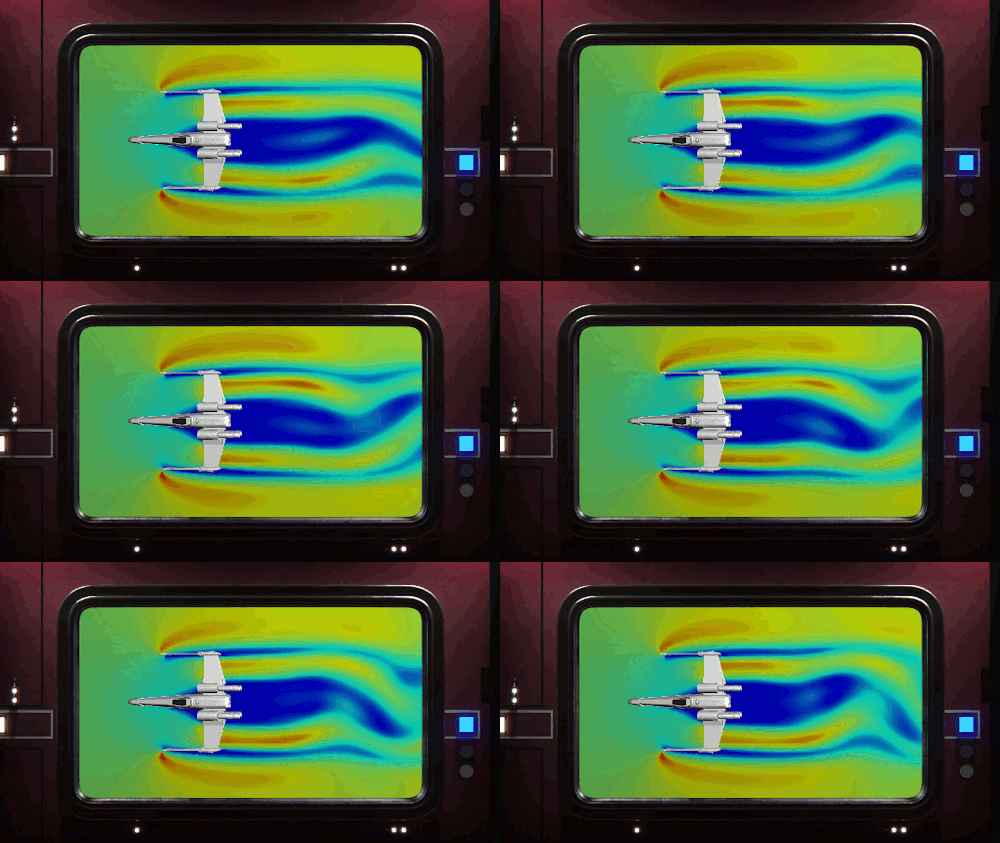
    Science fiction is not always known for hewing to scientific fact, so it will probably come as little surprise that Star Wars’ ships have terrible aerodynamics. But it’s nevertheless fun to see EC Henry’s analysis of drag coefficients of various Rebel and Imperial ships and just how poorly they fare against our own designs.

    Drag coefficients really only give a tiny piece of the story, though. We don’t know what speed Henry is testing the ships at, and we get no information about properties like lift or lift-to-drag ratio, which can be even more important than just the drag when it comes to evaluating an aircraft.

    There are some intriguing hints about other aerodynamic properties in the clips of flow around an X-wing and TIE fighter, though. Notice that the wake of both ships meanders back and forth. This is an indication of vortex shedding, and it means that both spacecraft would tend to be buffeted from side-to-side when flying in an atmosphere. Either the ships would need some kind of active control to counter those forces, or pilots would need iron constitutions to operate under those conditions! (Video and image credit: EC Henry)

    [original video no longer available]

  • Collecting Fog

    Collecting Fog

    In some parts of the world, fog is a major source of freshwater, but collecting it is a challenge. Most systems use a wire mesh to capture and collect droplets, but the process is highly inefficient, pulling only 1-3% of droplets from the fog. Researchers found that this is due largely to aerodynamic effects. The presence of the wire deflects droplets around it (bottom left). To solve this, engineers introduced an electric charge into the fog. The subsequent electric field actually pulls droplets to the wires (bottom right). When applied to a mesh (top), the efficiency of fog capture improves dramatically. 

    The technique can also be used to capture water vapor that would otherwise escape from the cooling towers of power plants. The MIT researchers who developed the technique will conduct a full-scale test at the university’s power plant this fall. They hope the technique will recapture millions of gallons of water that would otherwise drift away from the plant. (Image credits: MIT News, source; image and research credits: M. Damak and K. Varanasi, source)