Tag: aerodynamics

  • Mimicking Insect Flight

    Mimicking Insect Flight

    There’s an oft-repeated tale that science cannot explain how a bumblebee flies. And while that may have been true 80 years ago, when engineers assumed they could apply their knowledge of fixed-wing aircraft to insects, it’s very far from the truth now.

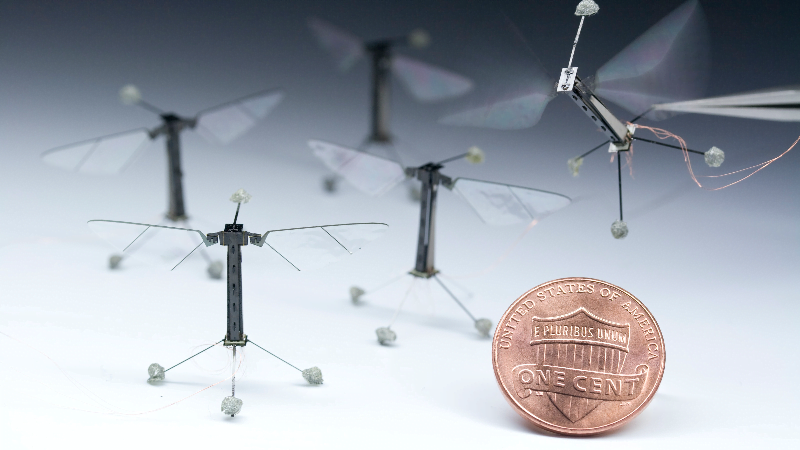
    Being small, insects use aerodynamic tricks that are very different from the physics used by aircraft or even birds. Insects like fruit flies use a forward-and-backward sweeping motion at a very high angle of attack as they flap. This motion creates a vortex at the leading edge of the wing that provides the lift keeping the insect aloft. It still requires fast reflexes — most insects flap their wings hundreds of times a second — but the mechanism is robust enough to keep insects aloft and maneuverable. (Image credits: Robobee – K. Ma and P. Chirarattananon, simulation – F. T. Muijres et al., illustration – G. Lauder; via APS Physics)

  • Crocodilian-Inspired Aerodynamics

    Crocodilian-Inspired Aerodynamics

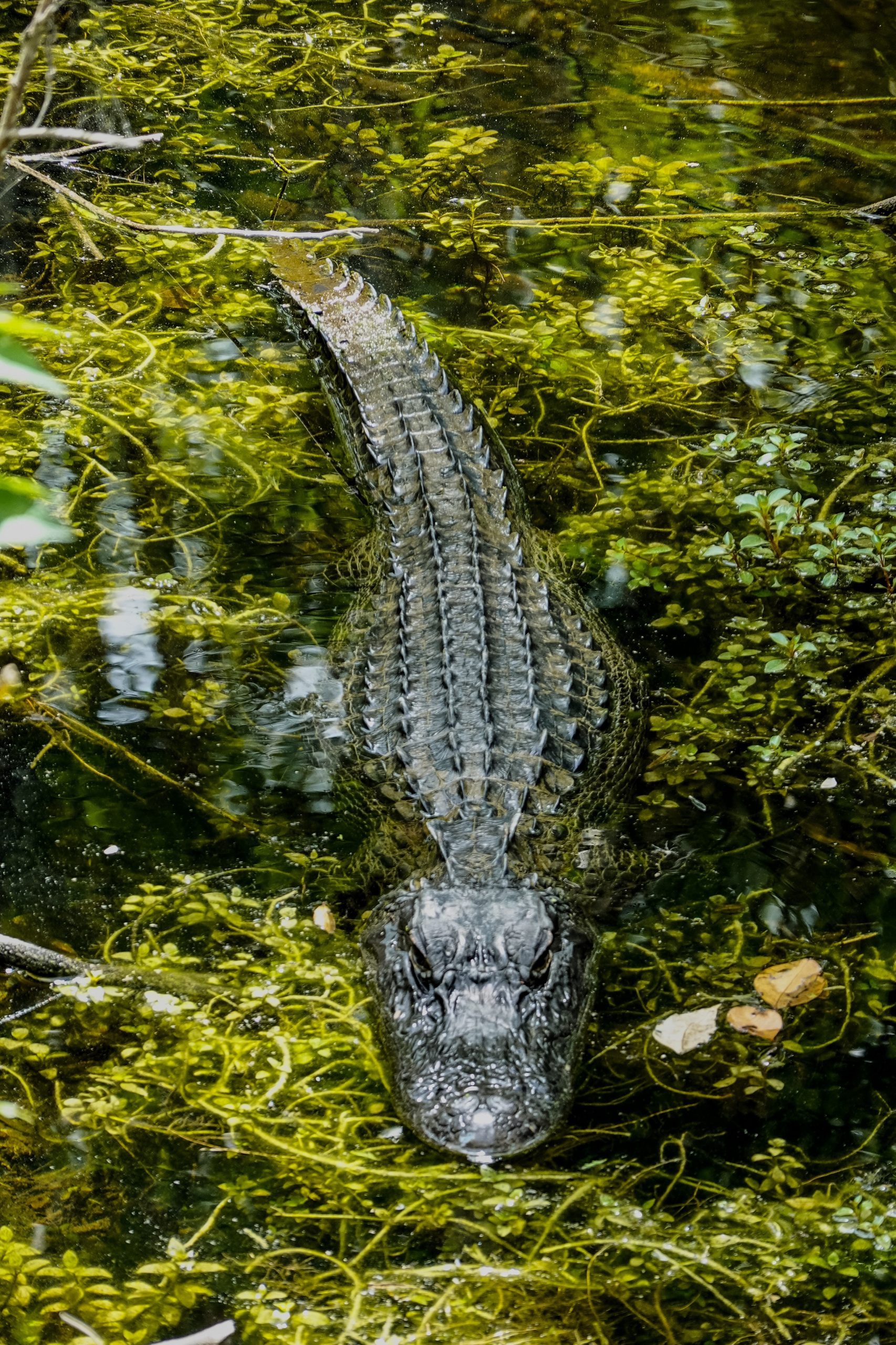
    Inspired by crocodilians, young scientist Angela Rofail designed attachments to reduce wind loads on high-rise buildings. When crocodilians swim, the ridges on their back help hide their motion from observation above the surface. Rofail wondered whether similar ridges would reduce the wind-induced swaying of high-rise buildings. Using a scale-model and crocodile-inspired knobs, the Year 10 student (read “high-school freshman” for U.S. readers) conducted wind tunnel tests that showed her modifications reduced drag on the model and kept it from moving in windy conditions. (Image credit: H. Roettger; video credit: CSIRO; via CSIRO; submitted by Kam-Yung Soh)

  • Aerodynamic Flight Testing

    Aerodynamic Flight Testing

    Flight testing models has a long history in aerodynamics. Above you see a Curtiss JN-4 biplane in flight with a model wing suspended below the fuselage. This test was conducted circa 1921 by NASA’s predecessor, NACA. At the time, of course, computational simulations were non-existent, and, although wind tunnels existed, presumably they could not recreate the exact circumstances needed for the test. Available wind tunnels might have lacked the power to reach the speeds engineers wanted, or they could have been too small for the model or had too many disturbances compared to the pristine flight environment. Any or all of these concerns can drive decisions to use flight testing instead of ground tests.

    Flight testing in aerodynamics is still used today, albeit sparingly. The second image shows a crew of Texas A&M graduate students (including yours truly) with a swept wing model we were about to test with a Cessna O-2 aircraft. By this point (roughly 10 years ago), we had wind tunnels capable of overlapping the conditions we could achieve in flight, but flight testing still gave us a larger range of conditions than working solely in the wind tunnel. (Image credits: JN-4 – NASA, O-2 – M. Woodruff; via Rainmaker1973; submitted by Marc A.)

  • COVID-19 and Outdoor Exercise

    COVID-19 and Outdoor Exercise

    By now you’ve probably come across some blog posts and news articles about a new pre-print study looking at the aerodynamics of running and the potential exposure to exhaled droplets. And you may also have seen articles questioning the accuracy and validity of such simulations. I’ve had several readers submit questions about this, so I dug into both the research and the criticisms, and here are my thoughts:

    Is this study scientifically valid?

    I’ve seen a number of complaints that since this paper hasn’t been peer-reviewed, we shouldn’t trust anything about it. That seems like an unreasonable overreaction to me considering how many studies receive press attention prior to their actual peer-reviewed publication. This is not a random CFD simulation produced by someone who just downloaded a copy of ANSYS Fluent. This work comes from a well-established group of engineers specializing in sports aerodynamics, and long-time readers will no doubt recognize some of their previous publications. Over the past decade, Blocken and his colleagues have become well-known for detailed experimental and simulation work that indicates larger aerodynamic effects in slipstreams than what we generally recognize.

    In this paper, they lay out previous (biological) studies related to SARS and droplet exhalation; they use those papers and several wind tunnel studies to validate computational models of droplet evaporation and runner aerodynamics; and then they use those inputs to simulate how a cloud of exhaled droplets from one runner affects someone running alongside, behind, or in a staggered position relative to the first runner.

    In other words, their work includes all the components one would expect of a scientific study, and it makes scientifically justifiable assumptions with regard to its methods. (That’s not, mind you, to say that no one can disagree with some of those choices, but that’s true of plenty of peer-reviewed work as well.) All in all, yes, this is a scientifically valid study, even if it has not yet undergone formal peer-review*.

    Can simulations actually tell us anything about virus transmission?

    One complaint I’ve seen from both biologists and engineers is that simulations like these don’t actually capture the full physics and biology involved in virus transmission. While I agree with that general sentiment, I would point out two important facts:

    1) Blocken et al. acknowledge that this is not a virology study and confine their scientific results to looking at what happens physically to droplets when two people are moving relative to one another. Whether those droplets can transmit disease or not is a question left to biological researchers.

    2) Most medical and biological research also does not account for the physics of droplet transmission and transport. For the past century, this research has focused almost exclusively on droplet sizes, with the assumption that large droplets fall quickly and small droplets persist a little longer. To my knowledge, some of the only work done on the actual physics of the turbulent cloud produced by coughing or sneezing comes from Lydia Bourouiba’s lab at MIT. And, to me, one of the fundamental conclusions from her work is that droplets (especially small ones) can persist a lot longer and farther than previously assumed. Can those droplets facilitate transmission of COVID-19? The general consensus I’ve seen expressed by medical experts is no, but, to my knowledge, that is based on opinion and assumption, not on an actual scientific study.

    The bottom line

    In my opinion, there’s a big disconnect right now between the medical/biological community and the engineering community. To truly capture the physics and biology of COVID-19 transmission requires the expertise and cooperation of both. Right now both sides are making potentially dangerous assertions.

    Honestly, based on what I know about aerodynamics, I am personally skeptical as to whether 6 ft of physical separation is truly enough; whether it is or not seems to depend on how transmissible the novel coronavirus is through small droplets, which, again, to my knowledge, is unestablished.

    Should we leave more distance than 6ft between us when exercising outdoors? Absolutely. Aerodynamically, it makes perfect sense that following in someone’s slipstream would put you inside their droplet cloud, which needs time and space to disperse. Personally, I’ve sidestepped the question entirely by doing all my cycling indoors while quarantined.

    tl;dr: There are a lot of open questions right now about COVID-19 transmission and what qualifies as safe distancing, but it’s smarter to err on the side of more distancing. Don’t hang close to others when running or cycling outdoors.

    (Image and research credit: B. Blocken et al.; submitted by Corky W. and Wendy H.)

    *I will add that, with my training, I have and do occasionally peer-review studies such as this one, and I read the full paper with the same sort of critical eye I would turn to a paper I was asked to review.
  • Featured Video Play Icon

    Why Do Backwards Wings Exist?

    Over the years, there have been many odd airplane designs, but one you probably haven’t seen much is the forward-swept wing. While most early aircraft featured straight wings, rear-swept wings are fairly common today, especially among commercial airliners. A rear-swept wing has its forward-most point at the root of the ring, where it attaches to the fuselage. The sweep breaks up the incoming flow into a chordwise component that flows from the leading edge to the trailing edge of the wing and a spanwise component that flows along the wing. Compared to straight wings, a swept wing provides better stability and control when flying at transonic speeds where shock waves can form on the wing (even though the plane itself is not supersonic).

    The trouble with rear-swept wings is that when they stall, they do so from the wingtips inward. Since the ailerons that control the plane’s orientation are out near the wingtips, that’s a problem. Forward-swept wings were supposed to solve this issue because they would stall from the root outward. But they came with a whole new set of problems, which included the need for robust onboard computers controlling them constantly to keep them in stable flight. In the end, the disadvantages outweighed any gains and so, for the most part, the forward-swept wing design has seen little flight time. (Image and video credit: Real Engineering)

  • Dandelion Flight, Continued

    Dandelion Flight, Continued

    Not long ago, we learned for the first time that dandelion seeds fly thanks to a stable separated vortex ring that sits behind their bristly pappus. Building on that work, researchers have now published a mathematical analysis of flow around a simplified dandelion pappus. Despite their simplifications, the model captures the flow observed in the previous experiments (bottom image: experiments on left; model on right). 

    The model also allowed researchers to test various features – like the number of filaments in the pappus – and see how they affected the flow. Interestingly, they found that dandelion flight was most stable with about 100 filaments, which is right around the number of a typical pappus! (Image credits: dandelion – Pixabay, figure – P. Ledda et al.; research credit: P. Ledda et al.; via APS Physics; submitted by Kam-Yung Soh and Marc A.)

  • Titan’s Dragonfly

    Titan’s Dragonfly

    Last week, NASA announced its next New Frontiers mission: a nuclear-powered drone named Dragonfly heading to Titan. This astrobiology mission is set to search our solar system’s second largest moon for signs of life. It’s exciting aerodynamically, as well, since Titan’s thick atmosphere makes it uniquely suited for heavier-than-air flight. Therefore, rather than using wheeled rovers like we have on Mars, Dragonfly is a rotorcraft. It will be capable of traveling up to 8km per flight, which will quickly surpass the fewer than 21km the Curiosity Rover has managed on Mars! 

    Like Earth, Titan has rainfall and open liquid bodies on its surface. I, for one, can’t wait to see the alien vistas Dragonfly sends back as it cruises over methane lakes. (Image and video credit: NASA)

  • Featured Video Play Icon

    Plant Week: Dandelions in Flight

    To kick off Plant Week here on FYFD, we’re taking a closer look at that ubiquitous flower: the dandelion. Love ‘em or hate ‘em, these little guys manage to get just about everywhere, thanks in part to their amazing ability to stay windborne for up to 150 km! To do that, the dandelion uses a bristly umbrella of tiny filaments, known as a pappus, that can generate more than four times the drag per area of a solid disk. Its porosity – all that empty space between the filaments – is also key to its stability; it helps create and stabilize a separated vortex ring that the seed uses to stay aloft. Check out the full video below! (Image and video credit: N. Sharp)

  • Bats in Ground Effect

    Bats in Ground Effect

    As pilots can tell you, flying near the ground (or an open expanse of water) gives one an aerodynamic boost. Essentially, the surface acts like a mirror, reflecting and dissipating the wingtip vortices that create downwash. That reduces the power necessary to fly, as long as you’re flying within about a wingspan of the surface.

    Theoretically, flapping fliers like bats and birds should also benefit from this ground effect, but measurements have been hard to come by. A new study using bats trained to fly in a wind tunnel provides some of the first detailed measurements of ground effect for flapping animals. The researchers found a 29% reduction in the power necessary for flight when in ground effect compared to being out of it! That’s twice the savings predicted by modeling, meaning we still have a ways to go to accurately capture the physics of flapping flight under these circumstances.

    Such a substantial savings also strengthens arguments for flight developing from the ground up. Using ground effect, surface-dwelling animals could have evolved flight gradually, taking advantage of the energy savings offered by sticking close to the surface. (Image and research credit: L. Johansson et al.; submitted by Marc A.)

  • Inside a Wind Tunnel

    Inside a Wind Tunnel

    When I was in graduate school, I worked in a facility known as the High-Speed Wind Tunnel Lab. We were located next door to the Low-Speed Wind Tunnel, and every few months we’d receive a phone call asking whether we could film someone in the high-speed wind tunnel. This was impossible for several reasons – the size of human beings and the necessity of drawing the hypersonic tunnels down to vacuum-like pressures before initiating flow being only two of them – but what it really did was highlight the difference in definitions. 

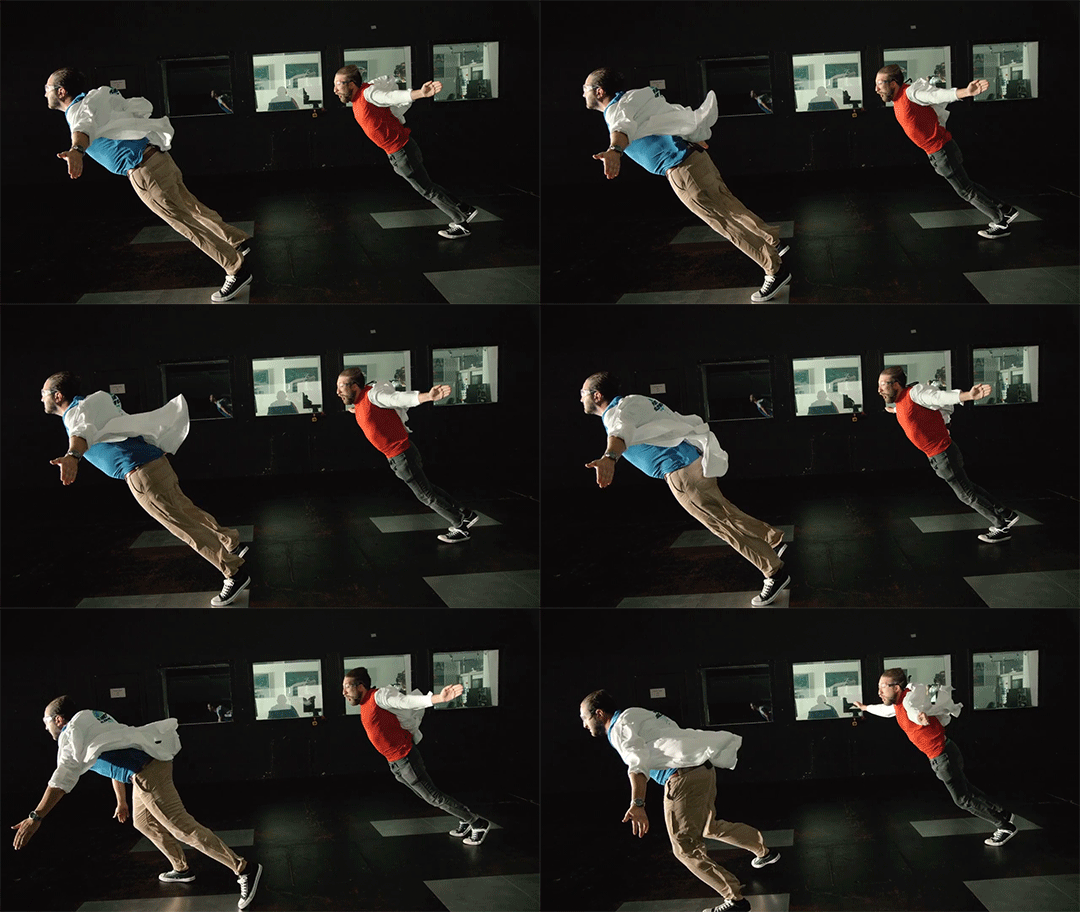
    What these (usually) weather forecasters wanted was to simulate hurricane force winds on a human being. And to an aerodynamicist, that hundred mile-an-hour flow is still low-speed. Because we’re comparing it to the speed of sound, not the normal range of wind speeds a human experiences. That said, watching humans struggle inside a wind tunnel is always entertaining. 

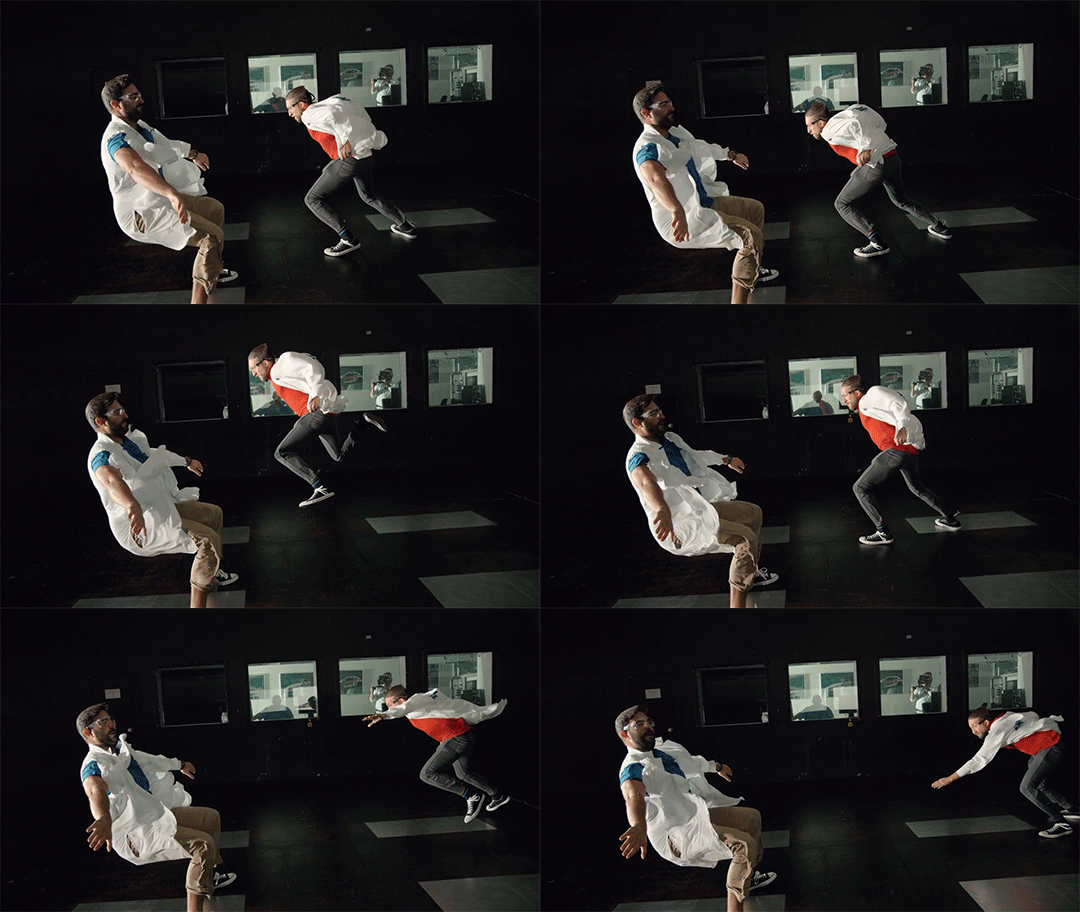
    As you can see from the Slow Mo Guys here, counteracting the lift and drag forces from these wind speeds is tough. On the bottom left, Dan has managed to balance his weight and the drag forces to hold himself in a virtual chair. Meanwhile, Gav’s attempt to jump forward against the wind just pushes him backward as his lab coat parachutes behind him. (Image and video credit: The Slow Mo Guys)