Tag: marangoni effect

  • Freezing Bubbles

    Freezing Bubbles

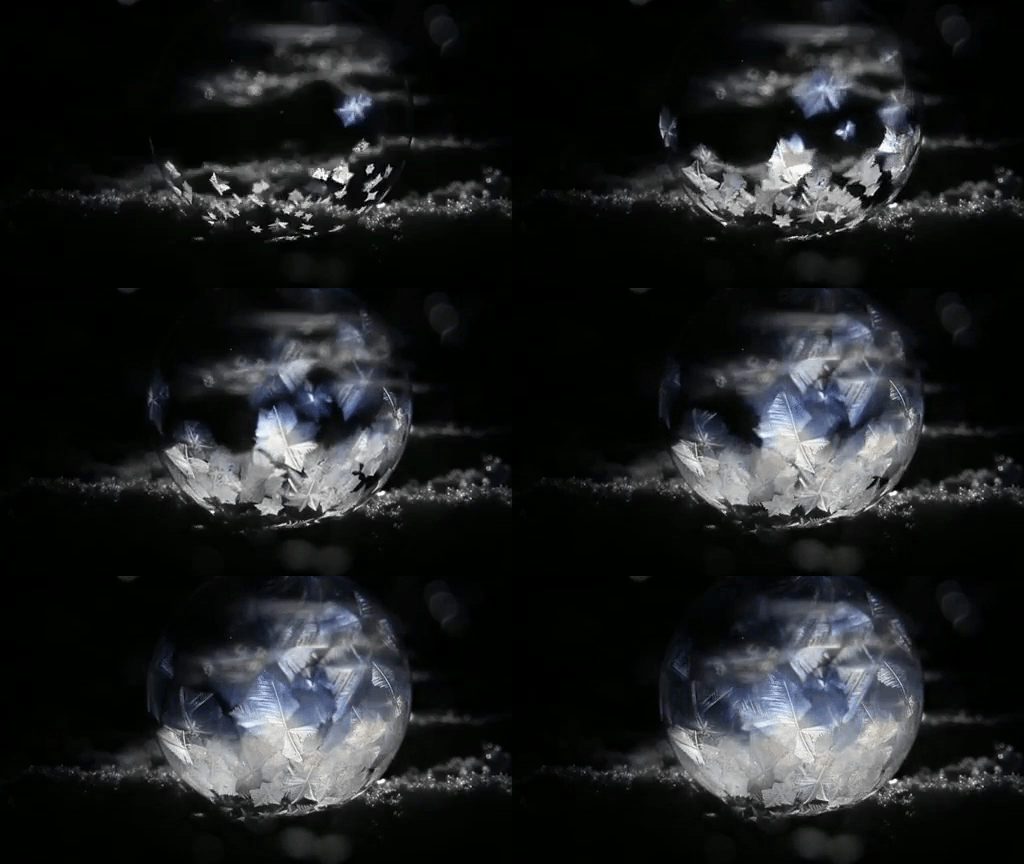
    Scientists have observed distinctive differences in the way soap bubbles freeze depending on their environment. If a bubble is surrounded by room temperature air but placed on a cold surface (top), it freezes from the bottom up, with a clear freeze front that slowly creeps upward.

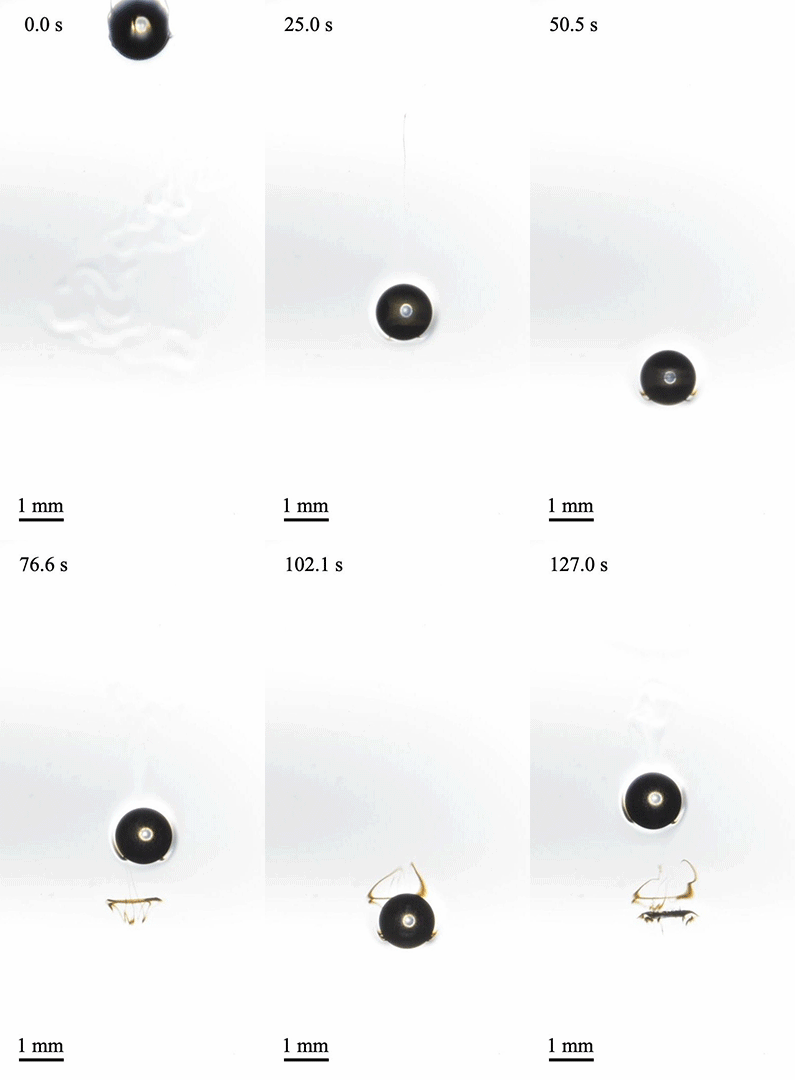
    In contrast, bubbles in an isothermal environment – one where it’s equally cold everywhere – freeze with a snow-globe-like effect of ice crystals (bottom). This freezing mode is actually triggered by a Marangoni flow. As the thin bottom layer of the soap bubble begins to freeze, it releases latent heat. That local heating changes the surface tension enough to generate an upward flow. You can see the plumes form right as the bubble touches the surface. Those plumes lift up tiny ice crystals, which continue to grow, ultimately forming the snowy crystals we see take over the surface. (Image and research credit: S. Ahmadi et al.; submitted by Kam-Yung Soh)

  • Featured Video Play Icon

    “Aurora”

    In “Aurora”, artist Rus Khasanov uses fluids to create a short film full of psychedelic color and cosmic visuals. As in a soap bubble, the bright colors – as well as the pure black holes – come from the interference of light rays. The colors directly relate to the thickness of fluid, and they allow us to see all the subtle flows caused by variations in surface tension. (Video and image credit: R. Khasanov)

  • Featured Video Play Icon

    Ink Explosion

    Sometimes beautiful flows come from simple combinations. Here the artists of Chemical Bouillon combine ink and hydrocarbons to create lovely explosions of color. Eschewing quick cuts between views, they allow us to linger and explore the flow ourselves as it changes. Differences in surface tension drive streaming flows along the surface, but there seem to be some chemical reactions contributing as well. Watch along the edges and you may even see convection pulling ink down and back. The whole video is only 2 minutes long and worth a full watch. (Image and video credit: Chemical Bouillon)

  • The Bouncing Drop

    The Bouncing Drop

    For a droplet to bounce, we expect it to hit a wall or a sharp interface of some kind. But in a new study, researchers demonstrate a droplet that bounces with neither. Shown above is an oil droplet sinking through a stratified mixture of ethanol (toward the top) and water (toward the bottom). Because the oil is heavier than ethanol, it initially sinks, dragging some of the ethanol with it as it falls. Over time, some of that ethanol rises again, forming what’s known as a buoyant jet.

    Simultaneously, the gradient of ethanol to water between the top and bottom of the drop creates an imbalance in surface tension. The ethanol near the top of the drop has a lower surface tension than the water at the bottom. This creates a downward Marangoni flow along the drop interface.

    The bounce itself happens quickly after a long, slow sinking period. As the drop’s sinking slows, the buoyant jet weakens until it disappears completely. At the same time, the downward Marangoni flow pulls fresh ethanol-rich fluid toward the top of the drop. That increases the surface tension difference and strengthens the Marangoni flow, creating a positive feedback loop. In less than a second, the Marangoni flow increases by two orders of magnitude, pulling so hard that the drop shoots upward.

    That resets the cycle by weakening the Marangoni flow and strengthening the buoyant jet. The droplet can continue bouncing for about 30 minutes until the concentration gradient is so well-mixed that the cycle can’t continue. (Image and research credit: Y. Li et al.; via APS Physics; submitted by Kam-Yung Soh)

  • Featured Video Play Icon

    The Art of Paper Marbling

    Known as ebru in Turkey and suminagashi in Japan, the art of paper marbling has flourished in cultures around the world since medieval times. The details of methods vary, but in general, the technique uses a base of oily water to float various dyes and pigments. Artists then use brushes, wires, and other tools to manipulate the dyes into the desired pattern. Paper is spread over the top to soak up the color pattern before being hung to dry. Every print made in this manner is a unique result of buoyancy, surface tension variation, and viscous manipulation. Check out the video above to watch a timelapse video showing the technique in action. (Video and image credit: Royal Hali)

  • Featured Video Play Icon

    “The Empire of C”

    Filmmaker Thomas Blanchard has once again released a beautiful, fluid-filled short to captivate us. Built from paint, oil, and liquid soap, “The Empire of C” feels like it gives viewers a birds-eye perspective over a fantastical land. I was particularly drawn to two fluid dynamical aspects of the film. The first were the dendritic sequences in the opening, which feel a bit like watching river deltas form in real time. Despite their resemblance to the Saffman-Taylor instability, I think these fingers are interfacially driven – meaning that they result from differences in surface tension between the different liquids Blanchard is using. 

    The second thing that caught my eye and made me rewind the video over and over were the glittery droplets. The glitter acts like tracer particles, allowing you to see the flow inside the droplets. Check out that counter-circulation compared to the paint flowing by outside! It’s a reminder that even inside a seemingly still droplet, there’s lots going on. (Video and image credit: T. Blanchard)

  • Featured Video Play Icon

    “Winter’s Magic”

    Don Komarechka’s beautiful short film, “Winter’s Magic,” captures the beauty of soap bubbles as they freeze. It’s a delicate process and one difficult to capture in video. The bubble freezes first at the bottom, where it touches the cold surface – in this case, snow. That freezing releases latent heat and creates a temperature gradient along the thin liquid film. With that temperature gradient comes a variation in surface tension, and it’s this that creates the flow that lifts the ice crystals from the surface and turns the bubble into a snow globe. Eventually, as the frozen crystals continue growing, flow in the bubble walls comes to halt as the film solidifies.

    For more on the physics of freezing bubbles, check out this interview with the researchers, or, to learn more on how to film freezing bubbles, check out Komarechka’s description. (Video and image credit: D. Komarechka; via Laughing Squid; h/t to Jennifer O.)

  • What Drives Droplets

    What Drives Droplets

    There’s been a lot of interest recently in what goes on inside droplets made up of more than one fluid as they evaporate. This can be entertaining with liquids like whiskey or ouzo, but it has practical applications in ink-jet printing and manufacturing as well. And a new experiment suggests that we’ve been fundamentally wrong about what drives the flow inside these drops.

    As these drops evaporate, a donut-shaped recirculating vortex forms inside them, as seem in the cutaway views above. Conventional wisdom says that vortex is driven by surface tension. Evaporation of components like alcohol is more efficient at the edges of the drop, and as the alcohol evaporates, it creates a higher surface tension at the drop’s edge than at its peak. Marangoni forces then pull fluid down toward the edges, creating the vortex. That explanation is  consistent with observations of a sessile drop sitting on top of a surface (left side of images).

    But those observations are also consistent with another explanation: evaporating ethanol makes the local density higher, so alcohol-rich parts of the drop rise toward the peak while alcohol-poor regions sink. This difference in density would also create a flow pattern consistent with observations. So which is the real driver, surface tension or gravity?

    To find out, researchers flipped the drop upside-down (right side of images). When hanging, the preferred flow direction due to surface tension doesn’t change; flow should still go from the deepest point on the drop toward the edge. But gravity is swapped; alcohol-rich areas should be found near the edge and attachment points of the drop because buoyancy drives them there. And that is exactly what’s observed. The flow direction inside the hanging droplet is consistent with the direction prescribed by buoyancy-driven flow, thereby upending conventional wisdom. It turns out that gravity, not surface tension, is the major driver of internal flow in these multi-component droplets! (Image and research credit: A. Edwards et al.; via APS Physics; submitted by Kam-Yung Soh)

  • Featured Video Play Icon

    “If I Say”

    The new Mumford & Sons single “If I Say” features a fluid-dynamical music video. It’s full of dendritic fingers and flowing colors – likely from combinations of inks, paints, and other fluids. Although the fingers are reminiscent of the viscosity-dependent Saffman-Taylor instability, these appear to be driven by variations in surface tension between the different fluids. That’s a major feature throughout the video; although some of the flow is caused by the syringes depositing fluids, much of it seems to be a Marangoni effect, where flow moves away from areas of low surface tension to ones with higher surface tension. (Video credit: Mumford & Sons; filmed by P. Hofstede; via Katie M.)

  • Coalescence

    Coalescence

    Simple acts like the coalescence of two droplets sitting on a surface can be beautiful and complex. As the droplets come together, they form a thin neck between them, and the curvature of that surface causes capillary forces that drive fluid into the neck. For two dissimilar droplets, like the ones above, there can be additional forces. Here, the upper drop is pure water, but the lower one has added surfactants, which reduce its surface tension. That difference in surface tension creates a Marangoni flow that tends to pull fluid away from the neck. The result is that full coalescence takes longer. Depending on other factors in this tug-of-war between capillary action and Marangoni flow, the process of coalescence can look very different. In this example, there’s a fingering instability that occurs as the neck spreads. Change the circumstances slightly and the drops may chase each other instead of merging or will merge with a perfectly smooth contact front. (Image and research credit: M. Bruning et al.)