This NASA Langley Research Center test shows real-time flow visualization of the wingtip vortices off a C-5A Galaxy aircraft.
Search results for: “wingtip vortices”

Vortices and Ground Effect
Though typically unseen, the vortices that swirl from the tips of aircraft wings are powerful. Here you see a Hawker Sea Fury equipped with a smoke system used to visualize the vortices that form at the wingtip as high-pressure air from the bottom of the wing and low-pressure air from the top swirl together. As you can see, the vortices persist in the wake long after the plane passes. The size and strength of the vortices depend on the size and speed of the aircraft; this is why air traffic control requires smaller planes to wait longer to take off or land if there was just a larger aircraft on the runway.
The other cool thing to note here is how the wingtip vortices move apart from one another in the animation above. In flight, wingtip vortices usually stay roughly parallel to one another, but they drift downward in the aircraft’s wake. Near the ground, though, the vortices cannot move down, so instead ground effect forces them apart from one another, as seen here. (Image and video credit: E. Seguin; via Kelsey C.)

Sunset Vortices
Often our atmosphere’s transparency masks the beautiful flows around us. This spectacular image shows a flight landing in Munich just after sunrise. Low-hanging clouds get sliced by the airplane’s passage and curl into its wake. The swirls are a result of the plane’s wingtip vortices, which wrap from the high-pressure underside of the wing toward the low-pressure upperside. The vortices stretch behind in the plane’s wake, creating turbulence that can be dangerous to following planes. In fact, these vortices are a major determining factor in the frequency of take-off and landing on a given runway. The larger a plane, the larger its wingtip vortices and the more time it takes for the turbulence of its passage to dissipate to a safe level for the next aircraft. (Image credit: T. Harsch; submitted by Larry S.)

Helicopter Tip Vortices
Airplanes and other fixed-wing aircraft produce wingtip vortices as a result of their finite length. Rotor blades, like those on helicopters, produce the effect as well. Both wings and rotors generate lift by trapping low-pressure air on their top surface and high-pressure air below. At their tips, though, the high-pressure air can sneak around the wing or rotor, creating vortices like the ones visualized above. Here smoke from a wire is entrained by the rotors’ inflow and twisted into a tip vortex. The line of vortices drifts downward due to the rotor’s downwash. (Image credit: M. Giuni et al., source)

Wake Vortices at Night
The ends of an airplane’s wings generate vortices that stretch back in the wake of the plane. Most of the time these vortices are invisible, even if their effects on lift are distinctive. Here an A-340 coming in for a foggy landing demonstrates the size and strength of these vortices. Notice how the fog gets swept up and away by the vortices. Pilots will sometimes use this effect to their advantage in clearing a runway of fog by making repeated low-passes to clear the fog before landing. (Video credit: A. Ruesch; submitted by Jens F.)

Sunset Vortices
Wingtip vortices roll up in the wake of this U.S. Coast Guard C-130J. At the edge of a wing high-pressure, low velocity air is able to creep around the edge of the wingtip toward the low-pressure, high-velocity air atop the wing. This creates a swirling vortex that trails behind each wing, made visible here by the clouds entrained in the plane’s wake. Over time, these counter-rotating vortices will sink downward and break up due to viscosity and instabilities induced by their proximity. (via Aviationist)

Helicopter Vortices
When conditions are just right, the low pressure at the center of a wingtip vortex can drop the local temperature below the dew point, causing condensation to form. Here vortices are visible extending from the tips of the propellers in addition to the wingtip. Because of the spinning of the propeller and the forward motion of the airplane, the prop vortices extend backwards in a twisted spiral that will quickly break down into turbulence. The same behavior can be observed with helicopter blades. (Photo credit: benurs)
Vortices on an Airliner
Wingtip vortices form on airplanes due to the finite length of their wings. In general, lift on the wings results from low-pressure, high-velocity air moving over the top of the wing and high-pressure, low-velocity air moving below the wing. Near the wingtips, the high-pressure air is able to slip around the edge to the top of the wing, generating a vortex that then trails behind the airplane. The same thing is occurring in the video above, except the edges of the wing’s control surfaces are serving as the tip of the wing. Similar vortices also exist at the wingtips, but they are not made visible by condensation as the aileron vortices are.
Starting Vortices
Whenever a wing stops or starts in a fluid, it produces a vortex. This 2D numerical simulation shows an airfoil repeatedly starting and stopping, shedding a vortex each time. Note how the line of vortices drifts downward in the wake; this is an indication of downwash. (submitted by jessecaps)
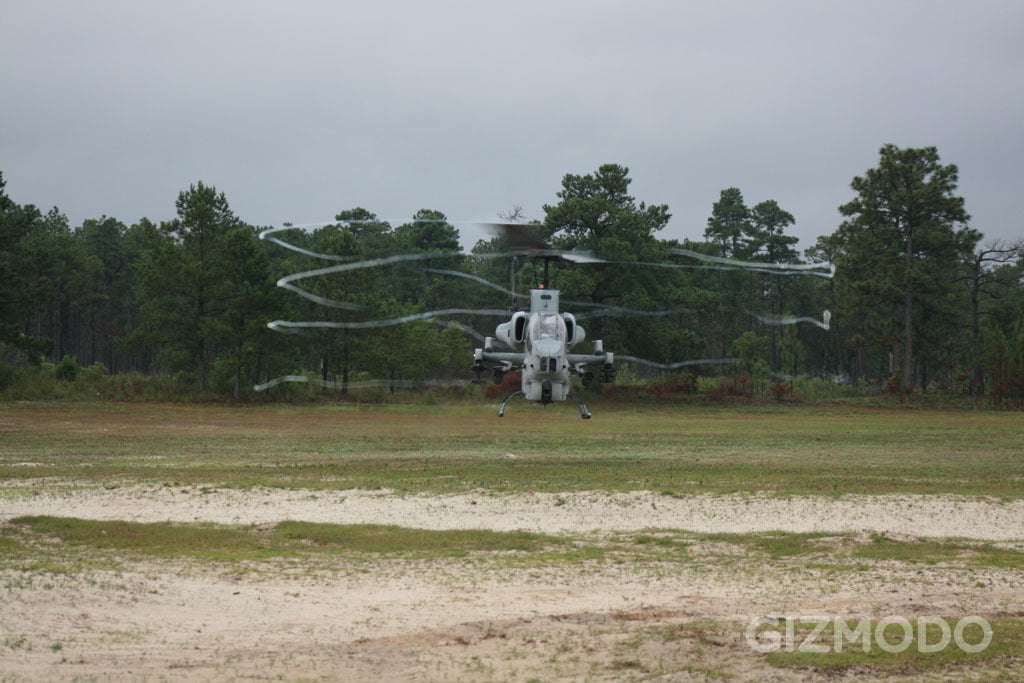
Tip Vortices
Like airplane wings, helicopter blades have tip vortices. In this photo, the air’s humidity was great enough that the acceleration caused by the passing of the blades caused a pressure drop great enough to condense the moisture, making the tip vortices visible to the naked eye. (See also Prandlt-Glauert singularity.)
Photo credit: Gizmodo.