Search results for: “wingtip vortices”

  • Featured Video Play Icon

    Quad Copter Schlieren

    Schlieren photography is a classic method of flow visualization that utilizes small variations in density (or temperature) to make otherwise unseen air motion visible. Because changing air’s density or temperature changes its index of refraction, variations in either quantity show up as dark and light regions. Here researchers use it to reveal some of the airflow around a small quadcopter, including the vortices that spiral off each propeller and help generate the lift necessary for take-off. The full video includes a couple of neat demos, including what happens when the blades are wet (shown below). In that case, the wingtip vortices are somewhat disrupted by strings of water droplets being flung off the blades by centrifugal force. Beautiful!  (Video and image credit: K. Nolan et al., source; submitted by J. Stafford)

  • Crow Instability

    Crow Instability

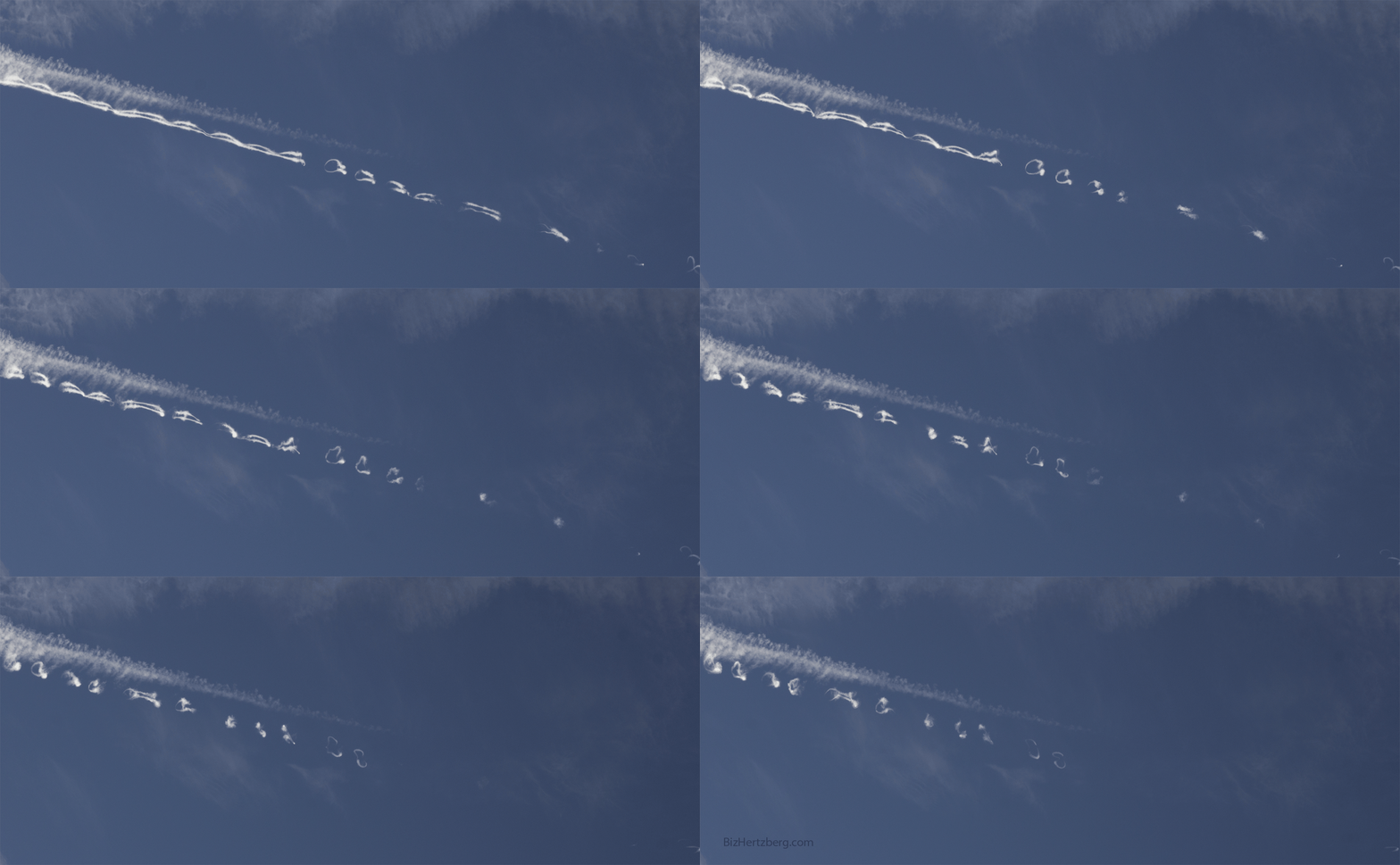
    Watching airplane contrails overhead, you may have noticed them transform into a daisy chain of distorted rings. This is an effect known as the Crow instability. The contrails themselves are the airplane’s wingtip vortices, made visible by water vapor condensed out of the engine exhaust. These two initially parallel vortex lines spin in opposite directions. A slight crosswind can disturb the initially straight lines, causing them to become wavy. This waviness increases over time until the vortex lines almost touch. Then the vortices pinch off and reconnect into a line of vortex rings that slowly dissipate. Be sure to check out the full-resolution version of this animation for maximum effect. (Image credit: J. Hertzberg, source)

  • Top 10 FYFD Posts of 2014

    Top 10 FYFD Posts of 2014

    It’s only fitting to take a moment to look back at 2014 as we step into the New Year. It was a big year in many respects – we hit 1000 posts and broke 200,000 followers; I started producing FYFD videos on our YouTube channel; and, on a personal note, I finished up my PhD. But since we’re all about the science around here, I will give you, without further ado, the top 10 FYFD posts of 2014:

    1. Bioluminescent crustaceans use light for defense
    2. What happens when you step on lava
    3. Flapping flight deconstructed
    4. Wingtip vortices demonstrated
    5. Saturn’s auroras
    6. Raindrops’ impact on sand
    7. Water spheres in microgravity
    8. The surreal undulatus asperatus cloud
    9. Inside a plunging breaker
    10. A simply DIY Marangoni effect demo

    I can’t help but notice that 9 out of the 10 posts feature animated GIFs. Oh, Tumblr, you rascals. Happy New Year! (Image credits: BBC; A. Rivest; E. Lutz; Nat. Geo/BBC2; ESA/Hubble; R. Zhao et al.; D. Petit; A. Schueth; B. Kueny and J. Florence; Flow Visualization at UC Boulder)

  • Featured Video Play Icon

    Crow Instability

    Behind airplanes in flight, water vapor from the engine exhaust will sometimes condense in the wingtip vortices, thereby forming visible contrails.  The two initially parallel vortex lines are unstable and any small perturbation to them–a slight crosswind, for example–will cause an instability known as the Crow instability. The contrails become wavy, with the amplitude of the wave growing exponentially in time due to interactions between the two vortices. Eventually, the vortex lines can touch and pinch off into vortex rings. The effect is also quite noticeable when smoke generators are used on a plane, and there are some great examples in this air show video between 3:41:00 and 3:44:00. (Video credit: M. Landy-Gyebnar; h/t to Urs)

  • Reader Question: Winglets

    Reader Question: Winglets

    Reader tvargo writes:

    First off… love your blog! I know very little about physics, but love reading about it. Could you potentially explain what the little upturned ends of wings do? looking on wikipedia is see this: “There are several types of wingtip devices, and although they function in different manners, the intended effect is always to reduce the aircraft’s drag by partial recovery of the tip vortex energy.” huh?

    Thanks! That’s a great question. Winglets are very common, especially on commercial airliners. To understand what they do, it’s helpful to first think about a winglet-less airplane wing. Each section of the wing produces lift. For a uniform, infinite wing, the lift produced at each spanwise location would be the same. In reality, though, wings are finite and wingtip vortices at their ends distort the flow. The vortices’ upward flow around the ends of the wing reduces the lift produced at the wing’s outermost sections, making the finite wing less efficient (though obviously more practical) than an infinite wing.

    Adding a winglet modifies the end conditions, both by redirecting the wingtip vortices away from the underside of the wing and by reducing the strength of the vortex. Both actions cause the winglet-equipped wing to produce more lift near the outboard ends than a wing without winglets.

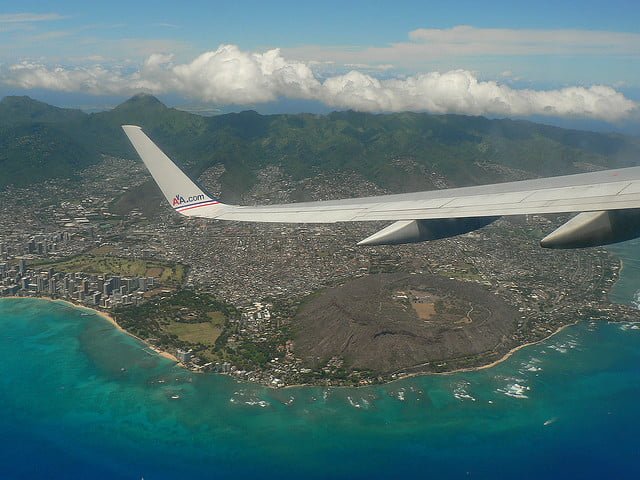
    But why, you might ask, does the Wikipedia explanation talk about reducing drag? Since a finite wing produces less lift than an infinite one, finite wings must be flown at a higher angle of attack to produce equivalent lift. Increasing the angle of attack also increases drag on the wing. (If you’ve ever stuck a tilted hand out a car window at speed, then you’re familiar with this effect.) Because the winglet recovers some of the lift that would otherwise be lost, it allows the wing to be flown at a lower angle of attack, thereby reducing the drag. Thus, overall, adding winglets improves a wing’s efficiency. (Photo credit: C. Castro)

  • The Physics of a Flying-V

    The Physics of a Flying-V

    New research using free-flying northern bald ibises shows that during group flights the birds’ positioning and flapping maximize aerodynamic efficiency. In flight, a bird’s wings generate wingtip vortices, just as a fixed-wing aircraft does. These vortices stretch in the bird’s wake, creating upwash in some regions and downwash in others as the bird flaps. According to theory, to maximize efficiency a trailing bird should exploit upwash and avoid downwash by flying at a 45-degree angle to its leading neighbor and matching its flapping frequency. The researchers found that, on average, this was the formation and timing the flock assumed. In situations where the birds were flying one behind the next in a straight line, the birds tended to offset their flapping by half a cycle relative to the bird ahead of them–another efficient configuration according to theory. Researchers don’t yet know how the birds track and match their neighbors; perhaps, like cyclists in a peloton, they learn by experience how to position themselves for efficiency. For more information, see the researchers’ video and paper. (Photo credit: M. Unsold; research credit: S. Portugal; via Ars Technica; submitted by M. Piedallu van Wyk)

  • Featured Video Play Icon

    Falcon vs. Raven

    Earth Unplugged has posted some great high-speed footage of a peregrine falcon and a raven in flight. Notice how both birds draw their wings inward and back on the upstroke. By doing so, they decrease their drag and thus the energy necessary for flapping. On the downstroke, they extend their wings fully and increase their angle of attack, creating not only lift but thrust. The falcon boasts an incredibly streamlined shape, not only along its body but also along its wings. In contrast, the raven has broader wings with large primary feathers that fan out near the tips. Splaying these large feathers out decreases the strength of the bird’s wingtip vortices, thereby reducing downwash and increasing lift, much the same way winglets do on planes. That extra lift and control the big primaries provide is important for the raven’s acrobatic skill. (Video credit: Earth Unplugged; via io9)

  • Fluids Round-up – 11 August 2013

    Fluids Round-up – 11 August 2013

    Time for another fluids round-up! Here are your links:

    • Back in January 1919, a five-story-high metal tank full of molasses broke and released a wave of viscous non-Newtonian fluid through Boston’s North End. Scientific American examines the physics of the Great Molasses Flood, including how to swim in molasses. If you can imagine what it’s like to swim in molasses, you’ll know something of the struggle microbes experience to move through any fluid. They also discusses some of the strange ways tiny creatures swim.
    • In sandy desert environments, helicopter blades can light up the night with so-called helicopter halos. The effect is similar to what causes sparks from a grinding wheel. Learn more about this Kopp-Etchells effect.
    • Check out this ominous footage of a tornadic cell passing through Colorado last week.
    • If you want more of a science-y look to your drinkware, you should check out the Periodic TableWare collection over on Kickstarter.
    • Finally, wingsuits really take the idea of gliding flight to some crazy extremes. Check out this video of in-flight footage. Watch for the guy’s wingtip vortices at 3:16 (screencap above)! (submitted by Jason C)

    (Photo credit: Squirrel)

  • Vapor Cone

    Vapor Cone

    This stunning National Geographic photo contest winner shows an F-15 banking at an airshow and a array of great fluid dynamics. A vapor cloud has formed over the wings of the plane due to the acceleration of air over the top of the plane. The acceleration has dropped the local pressure enough that the moisture of the air condenses.  Some of this condensation has been caught by the wingtip vortices, highlighting those as well. Finally, the twin exhausts have a wake full of shock diamonds, formed by a series of shock waves and expansion fans that adjust the exhaust’s pressure to match that of the ambient atmosphere. (Photo credit: Darryl Skinner/National Geographic; via In Focus; submitted by jshoer)

  • Aircraft Contrails

    [original media no longer available]

    Under the right atmospheric conditions, condensation can form, even at low speeds, as moist air is accelerated over airplane wings. This acceleration causes a local drop in pressure and temperature, which can cause water vapor in the air to condense. The condensation can sometimes get pulled into the wingtip vortices shed off of the wings, tail, and ailerons of an aircraft, as in the video above, making the aerodynamics of the airplane visible to the naked eye.