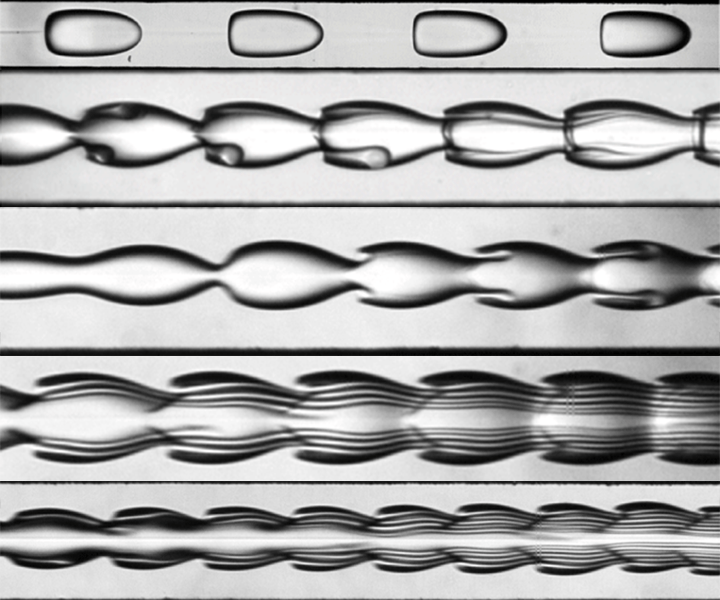
Microfluidic channels are excellent at creating a steady supply of droplets. But depending on the characteristics of the two viscous fluids being used, as well as factors like flow rate and channel geometry, the results can be anything from well-defined and separated drops to steady jets to wild instabilities. The image above shows a series of different outcomes, including waves that break on the edges of drops and ligaments that stretch around the central fluid. (Image and research credit: X. Hu and T. Cubaud)
Search results for: “waves”

“Otherworld, Vol. 1”


Roman De Giuli’s “Otherworld, Volume 1” is a beautiful exploration of color and flow. Glittery particulates act as tracers in the flow, reminiscent of the way rheoscopic fluids do. In many sequences, the glitter lends a sense of texture to the flow. Without context, I cannot say whether those are true flow features, but they certainly remind me of instabilities like Tollmien-Schlichting waves. (Image and video credit: R. De Giuli)

The Best of FYFD 2019



2019 was an even busier year than last year! I spent nearly two whole months traveling for business, gave 13 invited talks and workshops, and produced three FYFD videos. I also published more than 250 blog posts and migrated all 2400+ of them to a new site. And, according to you, here are the top 10 FYFD posts of the year:
- The perfect conditions make birdsong visible
- Pigeons are impressive fliers
- The water anole’s clever method of breathing underwater
- 100 years ago, Boston was flooded with molasses
- The BZ reaction is some of nature’s most beautiful chemistry
- The labyrinthine dance of ferrofluid
- 360-degree splashes
- The extraordinary flight of dandelion seeds
- Dye shows what happens beneath a wave
- Bees do the wave to frighten off predators
Nature makes a strong showing in this year’s top posts with five biophysics topics. FYFD videos also had a good year: both my Boston Molasses Flood video and dandelion flight video made the top 10!
If you’d like to see more great posts like these, please remember that FYFD is primarily supported by readers like you. You can help support the site by becoming a patron, making a one-time donation, or buying some merch. Happy New Year!
(Image credits: birdsong – K. Swoboda; pigeon take-off – BBC Earth; water anole – L. Swierk; Boston molasses flood – Boston Public Library; BZ reaction – Beauty of Science; ferrofluid – M. Zahn and C. Lorenz; splashes – Macro Room; dandelion – N. Sharp; dyed wave – S. Morris; bees – Beekeeping International)

Creating Star Wars-Like Volumetric Displays


Despite their ubiquity in science fiction, volumetric displays — three-dimensional displays visible from any angle — have been tough to create in real life. But a team from the University of Sussex has made impressive strides using a system based on acoustic levitation.
Here’s how it works: an array of ultrasonic speakers levitates and moves small plastic beads at up to 9 m/s. Simultaneously, LED lights project colors onto the sphere. Thanks to the human brain’s ability to create persistent images from the motion, we’re able to see simple displays like the figure-8 and smiley face above with the naked eye. To form something more complicated, like the spinning globe seen in the final image, the bead must be filmed using a camera with a slow shutter speed. But with that, the display looks incredible.
There’s obviously a ways to go before your R2 unit can project holographic messages for you, but all the basic ingredients for that technology are here. Check out the coverage on Scientific American and the original research paper for more. (Image credit: Star Wars – Lucasfilm; others – E. Jankauskis; research credit: R. Hirayama et al.; via SciAm)

Inside the Earth’s Mantle
Plate tectonics is a relatively young scientific theory, only gaining traction among geologists in the late 60s and early 70s. One key tenet of the theory is subduction where plates meet and one is forced down into the mantle, like in this illustration of the subduction zone near Japan. In early incarnations of the theory what happens to that subducting slab of rock once it’s in the mantle were ignored. But over the decades, geologists have built maps of the interior of our planet through the seismic waves they record. What they’ve found is that the continental chunks that break off and sink can have long-lasting effects.
Beneath the Earth’s crust, the mantle behaves like an extremely slow-moving fluid under incredibly high temperatures and pressures. It can take tens of millions of years, but those broken slabs sink through the mantle, dragging fluid with them. This creates a large-scale flow known as a mantle wind, which can have far-reaching effects at the Earth’s surface. Through modeling and simulation, geologists have found these deep mantle flows may explain why mountain ranges like the Himalayas and Andes didn’t grow until millions of years after their plates collided and why earthquakes sometimes occur far from plate boundaries. For more, check out this great article from Ars Technica. (Image credit: British Geological Survey; via Ars Technica; submitted by Kam-Yung Soh)

Wave Clouds in the Front Range
Last Sunday night metro Denver was treated to a rare sight: clouds resembling breaking waves formed near sunset. These are Kelvin-Helmholtz clouds, and the comparison to ocean waves is apt, since the same physics is behind both. Winds were unusually calm near the ground Sunday night, but strong winds blew at the altitude just above the lower cloud layer. That velocity difference created strong shear where the two air layers met. With the cloud layer in place to differentiate the slower-moving air from the faster, we can what’s normally invisible: how the two air layers mix.
The Denver Post has several more views of the wave clouds from around the area, and you can learn lots more about the Kelvin-Helmholtz instability here. (Image credit: R. Fields; via the Denver Post)
“Mocean”
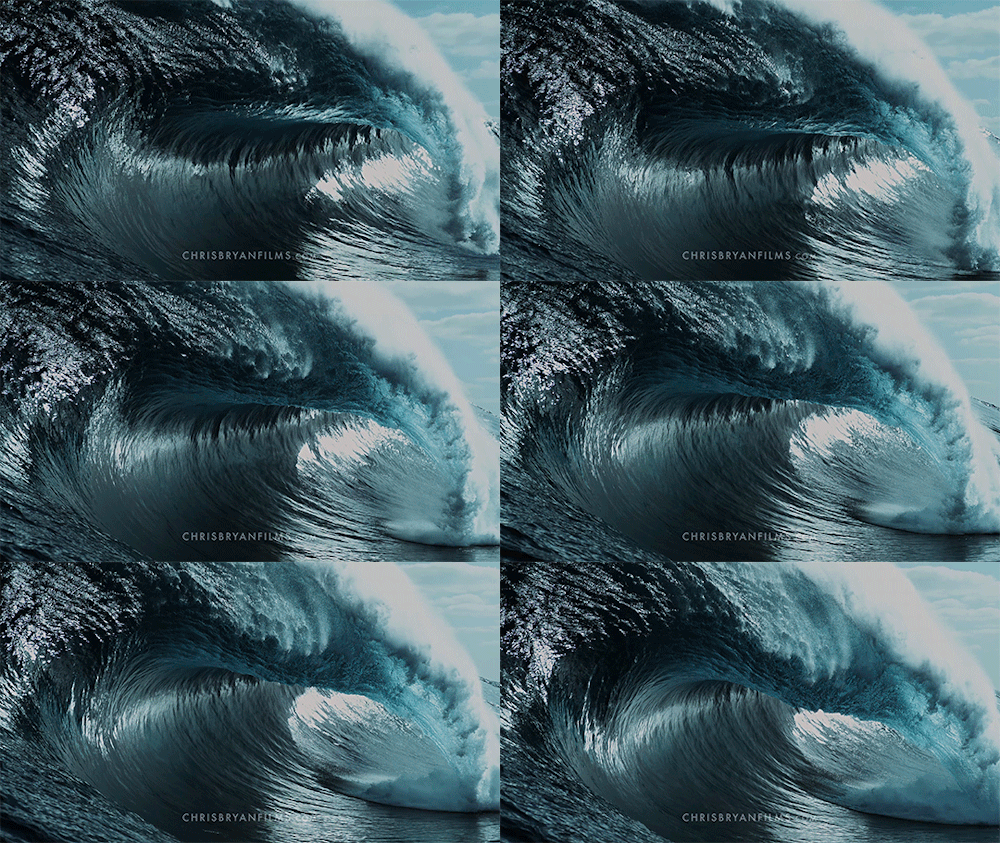


Ocean waves are endlessly fascinating to watch. In “Mocean,” cinematographer Chris Bryan captures them in ways few ever see, thanks to his high-speed camera. Honestly, this film is so gorgeous that I don’t want to distract you with the science, so just go watch!
…
All done? Pretty wonderful, right? There’s nothing quite like seeing those holes break and expand through sheets of water, tearing what looked solid into a spray of droplets that bleed salt into the atmosphere. Or how about those rib vortices underneath the waves? Or the cloud-like turbulence of the waves breaking overhead? How fortunate we are to see and capture and share such beauty! (Video and image credit: C. Bryan; via RedShark; submitted by Michael F.)
Themed Series
Occasionally, FYFD will feature a series of posts on a special theme. This page serves as an archive of these themed series. Got an idea for theme? You can always suggest one via Tumblr, Twitter, or email.

Fluid Dynamics of Plants
- Introduction: previous plant posts
- The extraordinary flight of the dandelion seed
- Bladderworts use ultra-fast suction to catch prey
- Moisture allows horsetail plant spores to walk and jump
- The structure of citrus peels sprays oil at up to 30 m/s

Collective Motion of Humans and Animals
- What makes flocks of birds and schools of fish so hard to predict?
- The solid and fluid characteristics of black aquatic worms
- What crowds of people and granular materials have in common
- The shimmering of giant honeybees
- When collective motion isn’t always beneficial…
PyeongChang Winter Olympics 2018
- What makes ice so slippery
- How moguls form and move
- The gliding flight of a ski jumper
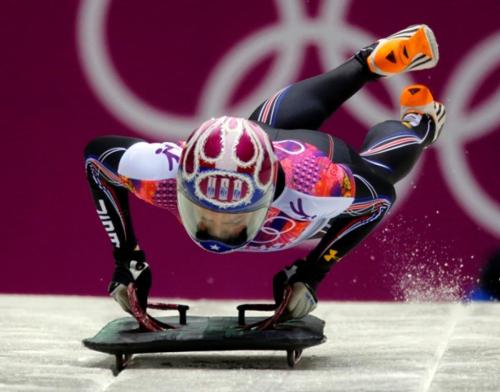
- Aerodynamics of a skeleton run
- How the newest U.S. speedskating suit beats the wind
- How artificial snow gets made
- Wind tunnel testing bobsleds for speed
- Not all Olympic ice is created equal
- Drafting in cross-country skiing
- The odd physics behind curling
Pilot-Wave Hydrodynamics
Completed in collaboration with FYP.- Introduction
- How vibration and Chladni patterns depend on fluids
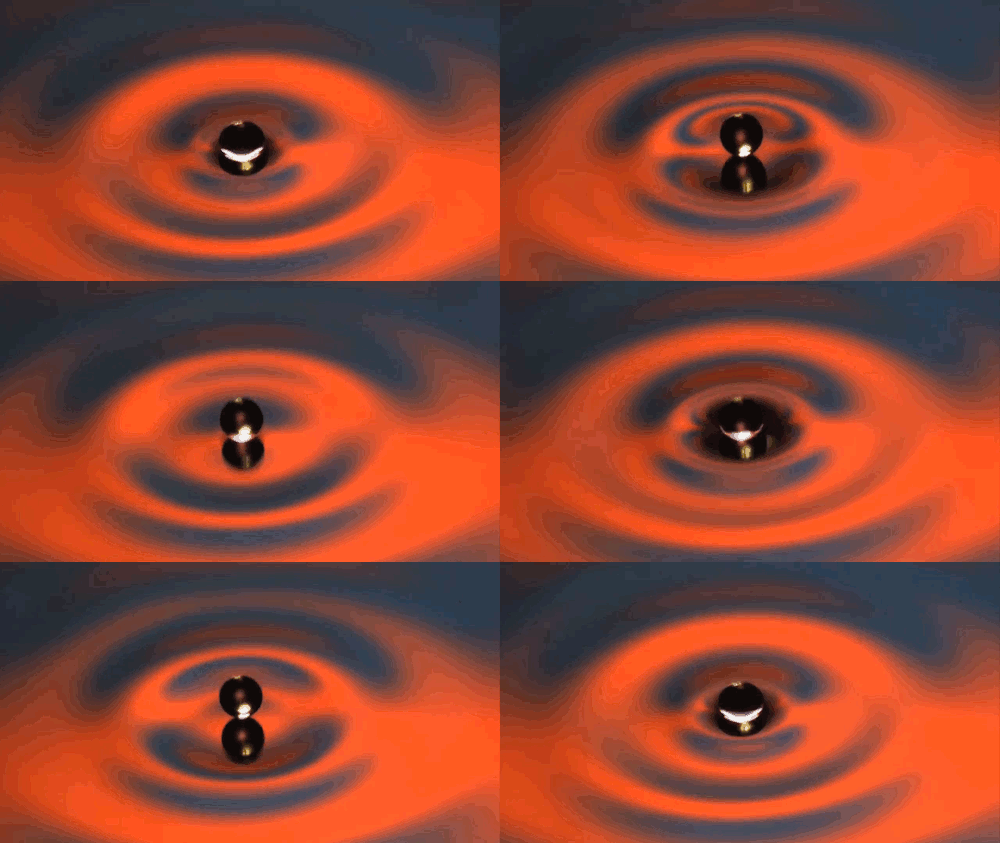
- Vibrating a liquid creates the ripple-like Faraday instability
- Droplets on a vibrating surface can bounce and even walk
- Bouncing droplets can form lattices
- Quantum double-slit experiments established wave and particle properties for light and electrons…
- …But walking droplets behave the same way in slit experiments
- Quantum tunneling allows electrons to escape…
- …And walking droplets can tunnel out, too!
- So what are the connections between quantum mechanics and pilot-wave hydrodynamics?
- Resources, links, and ways to learn more
(Image credit: D. Harris et al.)

Galapagos Week
- Introducing the Galapagos Islands
- How marine iguanas swim
- What makes the tiny pistol shrimp so loud
- Learning about lava flows: a’a versus pahoehoe
- How blue-footed boobies dive at 20 m/s without breaking their necks
- Sea turtles are aquatic fliers
- Bonus related posts: how frigatebirds cruise the seas without getting wet; the aerodynamics of flying fish; hydrodynamics of humpback whales; incredible bioluminescent plankton; and leaping mobula rays.
(Image credit: N. Sharp and J. Shoer)

Rio Summer Olympics 2016
- How motorbikes can unfairly influence cycling races
- Why swimmers can be faster underwater
- The aerodynamics of rugby
- How to design and build a whitewater course
- The spinning physics of table tennis
- The aerodynamic tactics of track cycling
- How water polo players and synchronized swimmers stay afloat
- How wind and altitude affect the long jump
- Rule 42 and why rocking the boat in sailing is cheating
- The high-speed science of badminton
- Was there a current in the Rio swimming pool?
- What commentators don’t tell you about the perfect diving splash
(Image credit: Getty Images)
A Day in the Life of a Fluid Dynamicist
(Image credit: S. Reckinger et al.)

Walking on Water
- Introduction
- The common basilisk (a.k.a. Jesus Christ lizard)
- Pygmy geckos and other tiny water-walkers
- “Rushing” in Western and Clark’s grebes
- Jumping off water
- How fast does the Flash have to go to run on water?
- Bonus: Calculate what it takes to run on water in English units or metric
(Original grebe image: W. Watson/USFWS)

Fluid Dynamics on Pluto
(Image credit: NASA/JHU APL/SwRI)
FYFD’s Fourth Birthday Celebration
(Image credit: Nat. Geo/BBC2)

Sochi Winter Olympics 2014
- Preview: Wind tunnel testing for ski jumping
- Why ice is slippery
- How lugers slide so fast
- Aerodynamics in long-track speed skating
- How ski jumpers fly farther
- Effects of wind conditions on ski jumping
- The US speedskating suit controversy
- How to make artificial snow
- How skiers glide across snow
- Aerodynamics and technology of bobsledding
- The physics of curling
- Speed skiing
- Link round-up: some of my favorite Olympic science stories
(Image credit: Exa Corp)

Holiday Fluid Dynamics 2013
- Introduction
- The structure of snowflakes
- The aerodynamics of Santa’s sleigh
- Buoyancy-driven Christmas pyramids
- Convection in cocoa
- What’s in a Yuletide fire?
- Bonus: The physics of your New Year’s champagne
(Photo credit: G. Liger-Belair)

Gallery of Fluid Motion Favorites 2013
- Fluid juggling
- Ultrasonic levitation of a droplet
- Leidenfrost droplet propulsion
- Why tapping a beer bottle makes it foam
- Magnetocappillary swimmers
(Photo credit: APS DFD)
Fluid Dynamics and the Ig Nobel Prize
- On the lack of fluid dynamics among Nobel Prize winners
- How a human can run on water
- The physics of cookie dunking
- Does a person swim faster in water or syrup?
- Why shower curtains billow
- Other Ig Nobel fluids winners
- (Added in 2016) The law of urination
(Image credit: Improbable Research)

FYFD’s Third Birthday Celebration
- Introduction
- Visible shock waves from a rocket launch
- Double-spiral so\ap film
- A soap bubble popping
- The fluid dynamic sewing machine
(Photo credit: T. Schnipper et al.)

London Summer Olympics 2012
- The Olympic torch
- What makes a pool fast?
- The aerodynamics of archery
- The physics of badminton
- How cyclists get aero
- How divers minimize splash
- Aerodynamics in running
- How rowers avoid drag
- How javelins fly far
- Why corner kicks swerve
- The aerodynamics of the discus
(Photo credit: AP/Reuters)

Fluid Dynamics of the Tour de France
- The benefits of the peloton
- Crosswinds and the echelon
- The lead-out train
- Aero gear and the time trial
- Wind tunnel testing
(Photo credit: Veeral Patel)

Reader Question: Cross Sea
Reader Matt G asks:
[What’s] going on here?
Why’s the pattern square? Just a special case of waves traveling in different directions, and this photo happened to catch some at right angles to one another?
You’re not far off, Matt! This is an example of cross sea, where wave trains moving in different directions meet. Like most ocean waves, these waves originated from wind moving over the water. As the wind blows, it transfers energy to the water, disturbing what would otherwise be a smooth surface and setting up a series of waves. Oftentimes, these waves can outlast the wind that generates them and travel over long distances of open water as a swell.
Cross seas occur when two of these wave systems collide at oblique angles. They’re most obvious in shallow waters like those seen here, where the depth makes their criss-cross pattern clearer. Another name for them is square waves, and although the pattern isn’t a perfect square, it’s usually fairly close. If the waves aren’t separated by a large angle, they’re more likely to merge than to create this sort of pattern.
Neat as cross seas look, they’re quite dangerous, both to ships and swimmers. Ships are built to tackle waves head-on and don’t fare well when they’re forced to take waves from the side. For swimmers, the danger is a little different. Cross seas create intense vorticity under the surface and can generate stronger than usual riptides that sweep the unwary out to sea. (Image credit: M. Griffon)

Avoiding Shear Thickening
Many substances – like the cornstarch and water mixture above – exhibit a property called shear-thickening. In these fluids, deforming them quickly causes the viscosity to increase dramatically. That shear-thickening occurs when particles inside the fluid jam together, creating large chains able to resist the force being applied. That’s why the oobleck on this vibrating speaker can sustain these “cornstarch monsters”.
Shear-thickening is useful in many contexts, but it’s problematic during manufacturing, when pumping these substances can become incredibly difficult due to the fluid’s innate resistance to flowing. A new study, though, finds that it’s possible to temporarily suppress shear-thickening using acoustic waves. The researchers used piezoelectric devices to generate acoustic waves at a frequency around 1 MHz while shearing the cornstarch mixture. The acoustic waves disrupt the formation of particle chains inside the mixture, keeping its viscosity 10 times lower than during regular shear-thickening. (Image credit: bendhoward, source; research credit: P. Sehgal et al.; submitted by Brian K.)
