Search results for: “viscous”

  • Martian Viscous Flow

    Martian Viscous Flow

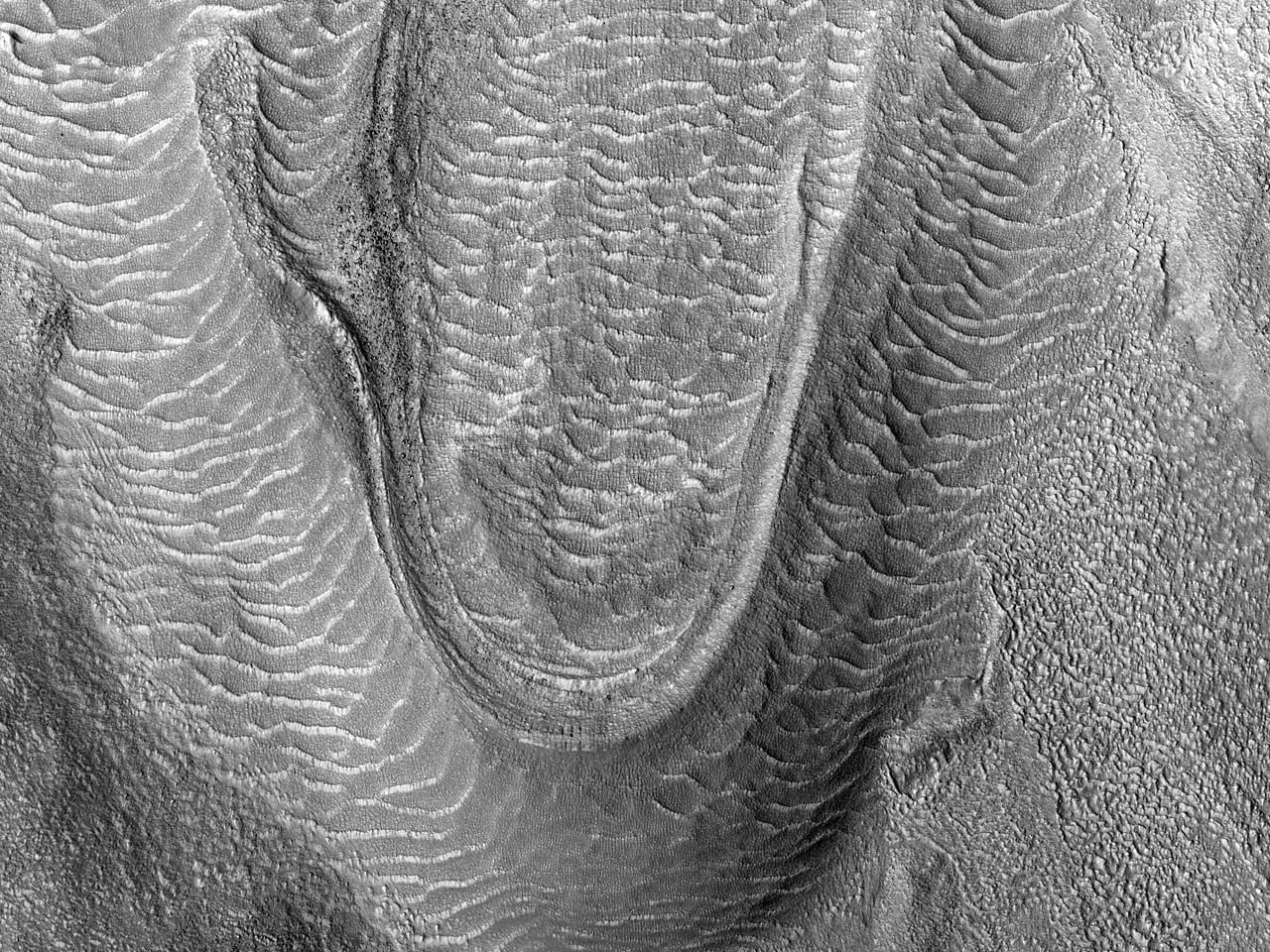
    These images from the Mars Reconnaissance Orbiter show what are called viscous flow features. They are the Martian equivalent of glacial flow. Such features are typically found in Mars’ mid-latitudes.

    Ground-penetrating radar studies of Mars have shown that some of these features contain water ice covered in a protective layer of rock and dust, making them true glaciers. Another study of similar Martian surface features found that their slope was consistent with what could be produced by a ~10 m thick layer of ice and dust flowing superplastically over a timescale equal to the estimated age of the surface features. Superplastic flow occurs when solid matter is deformed well beyond its usual breaking point and is one of the common regimes for glacial ice flow on Earth. (Image credit: NASA/JPL/U. of Arizona; via beautifulmars)
  • Viscous Fingers

    Viscous Fingers

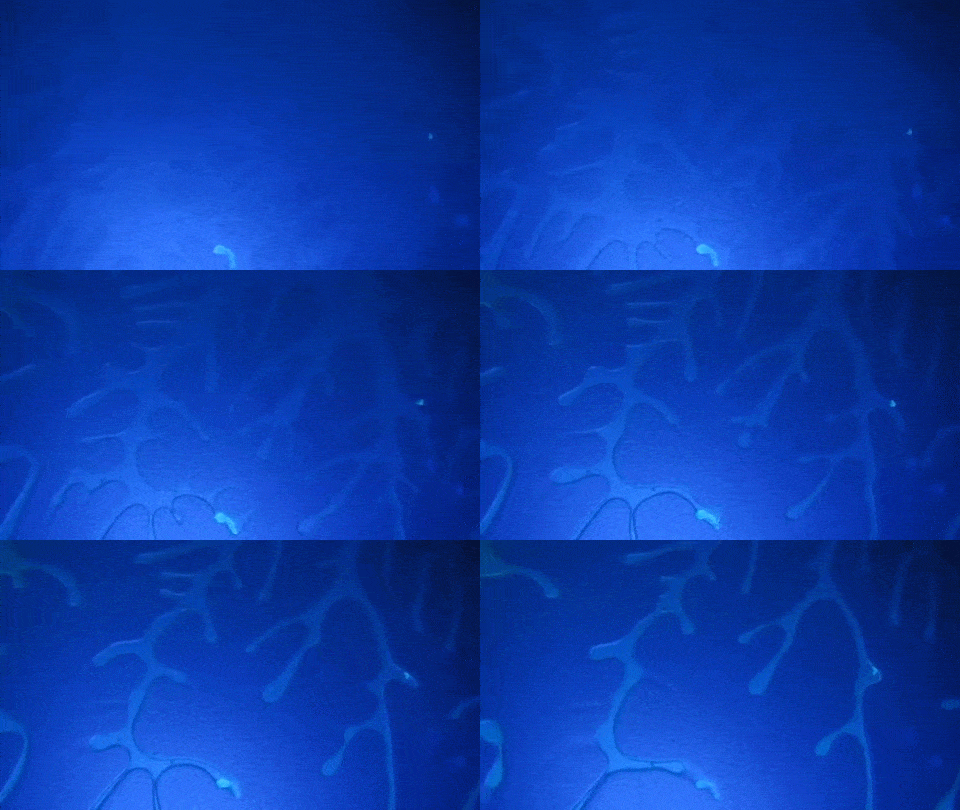
    Take a viscous fluid, like laundry detergent, and sandwich it between two plates of glass. Fluid dynamicists call this set-up a Hele-Shaw cell. If you then inject a less viscous fluid, like air, between the plates–or if you try to pry them apart–you’ll see a distinctive pattern of dendritic fingers form. This viscous fingering, also known as the Saffman-Taylor instability, occurs because the interface between the two fluids is unstable. Invert the problem, though–inject a more viscous fluid into a less viscous one–and no special shapes will form because the interface will remain stable. (Image credit: Random Walk Studios, source)

  • Viscous Droplet Impacts

    Viscous Droplet Impacts

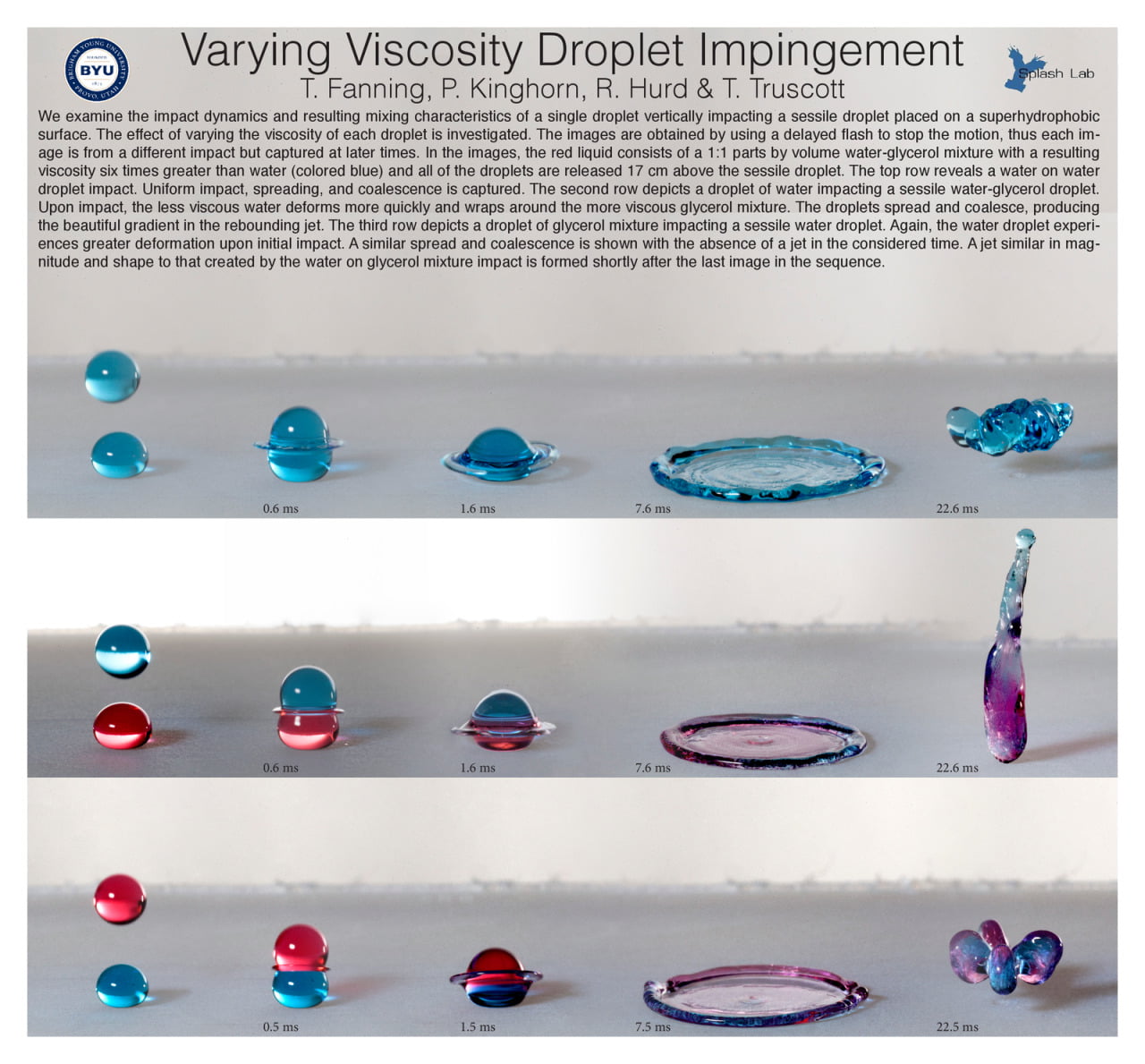
    Viscosity can have a notable effect on droplet impacts. This poster demonstrates with snapshots from three droplet impacts. The blue drops are dyed water, and the red ones are a more viscous water-glycerol mixture. When the two water droplets impact, a skirt forms between them, then spreads outward into a sheet with a thicker, uneven rim before retracting. The second row shows a water droplet impacting a water-glycerol droplet. The less viscous water droplet deforms faster, wrapping around and mixing into the other drop before rebounding in a jet. The last row switches the impacts, with the more viscous drop falling onto the water. As in the previous case, the water deforms faster than the water-glycerol. The two mix during spreading and rebound slower. In the last timestep shown, the droplet is still contracting, but it does rebound as a jet thereafter. (Image credit: T. Fanning et al.)

  • Featured Video Play Icon

    Hydrophobicity and Viscous Flow

    Hydrophobic surfaces are great for creating some wild behaviors with water droplets, but they make neat effects with other liquids, too. The viscous honey in the first segment of this Chemical Bouillon video is a great example. Because the honey doesn’t adhere to the hydrophobic surface, the viscoelastic fluid does not maintain the form it had when drizzled on the surface. Instead, the honey contracts, with surface tension driving Plateau-Rayleigh-like instabilities that break the contracting ligaments apart to form nearly spherical droplets of honey on the surface.  (Video credit: Chemical Bouillon)

  • Viscous Fingers

    Viscous Fingers

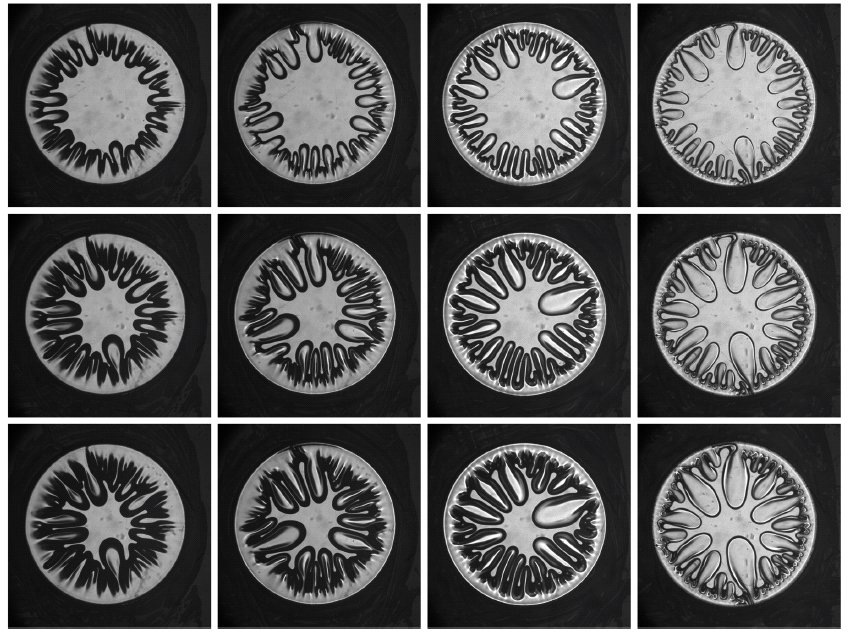
    Viscous liquid placed between two plates forms a finger-like instability when the top plate is lifted. The photos above show the evolution of the instability for four initial cases (top row, each column) in which the initial gap between the plates differs. Each row shows a subsequent time during the lifting process. As the plate is pulled up, the viscous liquid adheres to it and air from the surroundings is entrained inward to replace the fluid. This forms patterns similar to the classic Saffman-Taylor instability caused when less viscous fluid is injected into a more viscous one.   (Photo credit: J. Nase et al.)

  • Impacting a Viscous Pool

    Impacting a Viscous Pool

    Whenever a hollow cavity forms at the surface of a liquid, the cavity’s collapse generates a jet–a rising, high-speed column of liquid. The composite images above show snapshots of the process, from the moment of the cavity’s greatest depth to the peak of the jet. The top row of images shows water, and the bottom row contains a fluid 800 times more viscous than water. The added viscosity both smooths the geometry of the process and slows the jet down, yet strong similarities clearly remain. Focusing on similarities in fluid flows across a range of variables, like viscosity, is key to building mathematical models of fluid behavior. Once developed, these models can help predict behaviors for a wide range of flows without requiring extensive calculation or experimentation. (Image credit: E. Ghabache et al.)

  • Elastic Walls and Viscous Fingers

    Elastic Walls and Viscous Fingers

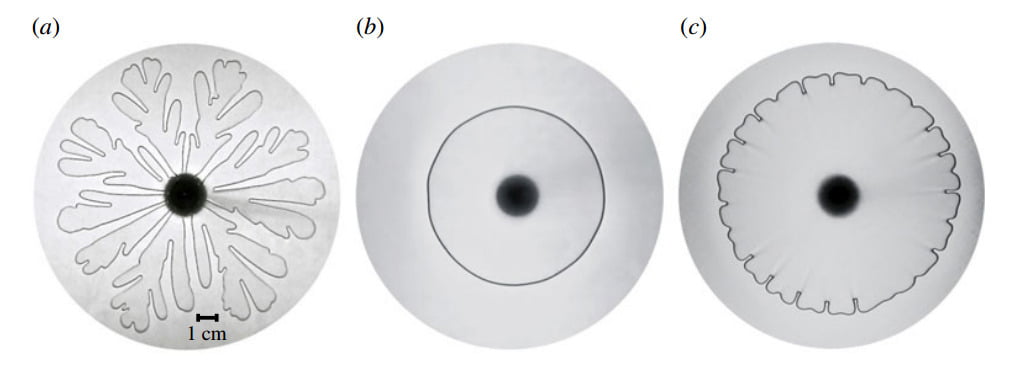
    The Saffman-Taylor instability, characterized by the branchlike fingers formed when a less viscous fluid is injected into a more viscous one, is typically demonstrated between two rigid walls, as in part (a) of the figure above. But what happens if one of the rigid walls forming the Hele-Shaw cell is replaced with an elastic wall? This is the case for (b) and (c) in the figure. The flexibility of the wall causes the expansion of the air-fluid interface to slow down relative to the rigid wall case and causes the interface to move toward a narrowing fluid-filled gap (as opposed to a constant thickness one). Both of these effects reduce the viscous instability mechanism that drives the fingering instability. With a high enough mass flow rate as in ©, there is still some instability in the interface, but it is dramatically reduced. (Photo credit: D. Pihler-Puzovic et al.)

  • Featured Video Play Icon

    Entering a Viscous Liquid

    When a solid object impacts on a liquid a cavity typically forms, entraining air into the pool. But this behavior varies widely according to the surface of the solid as well as the fluid’s properties. This video shows a sphere impacting a highly viscous liquid. The sphere stops shortly after impact while the cavity continues expanding in its wake. With a fluid like water, a long and thin cavity will typically pinch off before the object is decelerated, causing bubbles to form. No such behavior here. Instead the wide cavity pinches off at the surface of the motionless sphere and begins its rebound upwards. It even appears to pull the sphere partially back towards the surface! (Video credit: A. Le Goff et al.)

  • Viscous Fingers

    Viscous Fingers

    High viscosity silicon oil is sandwiched between two circular plates.  As the upper plate is lifted at a constant speed, air flows in from the sides. The initially circular interface develops finger-like instabilities, due to the Saffman-Taylor mechanism, as the air penetrates. Eventually the fluid will completely detach from one plate. (Photo credit: D. Derks, M. Shelley, A. Lindner)

  • Viscous Dripping

    Viscous Dripping

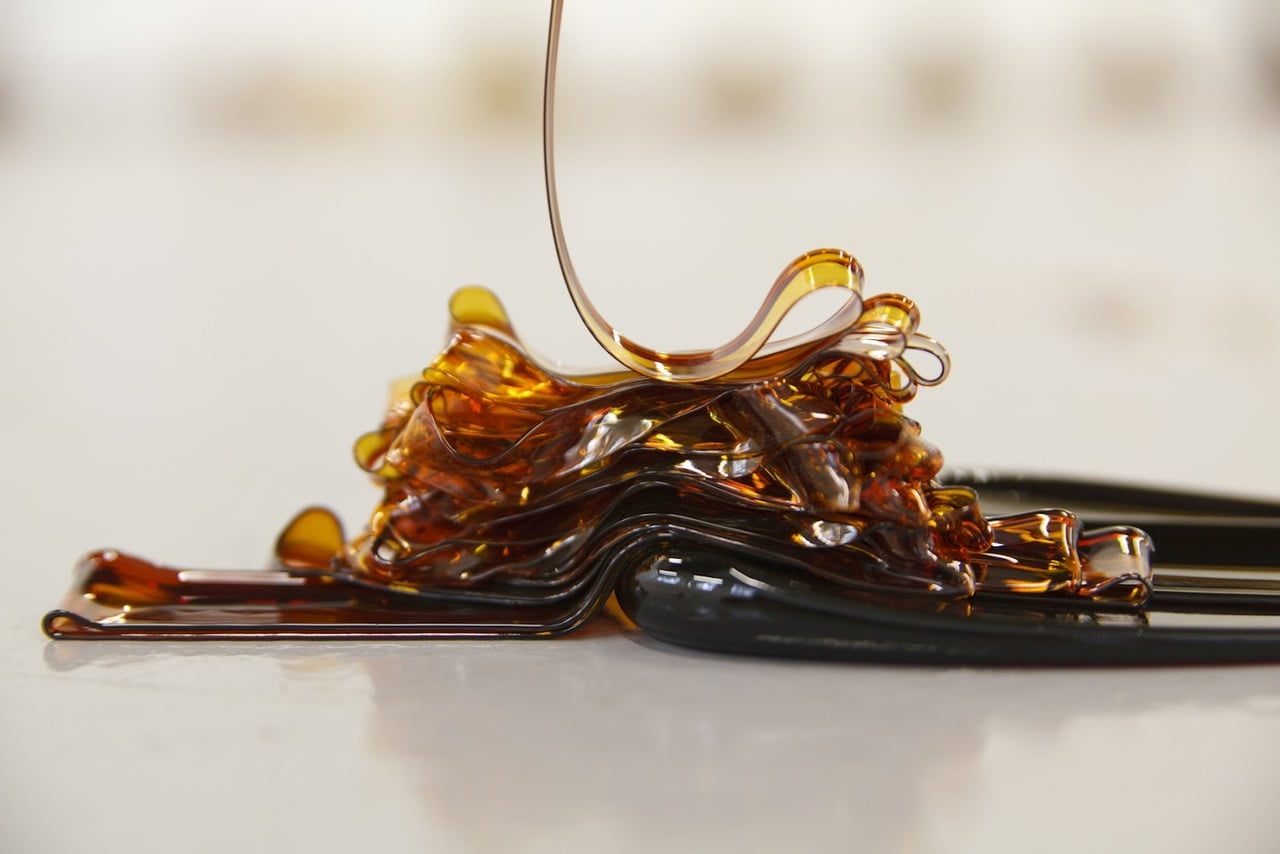
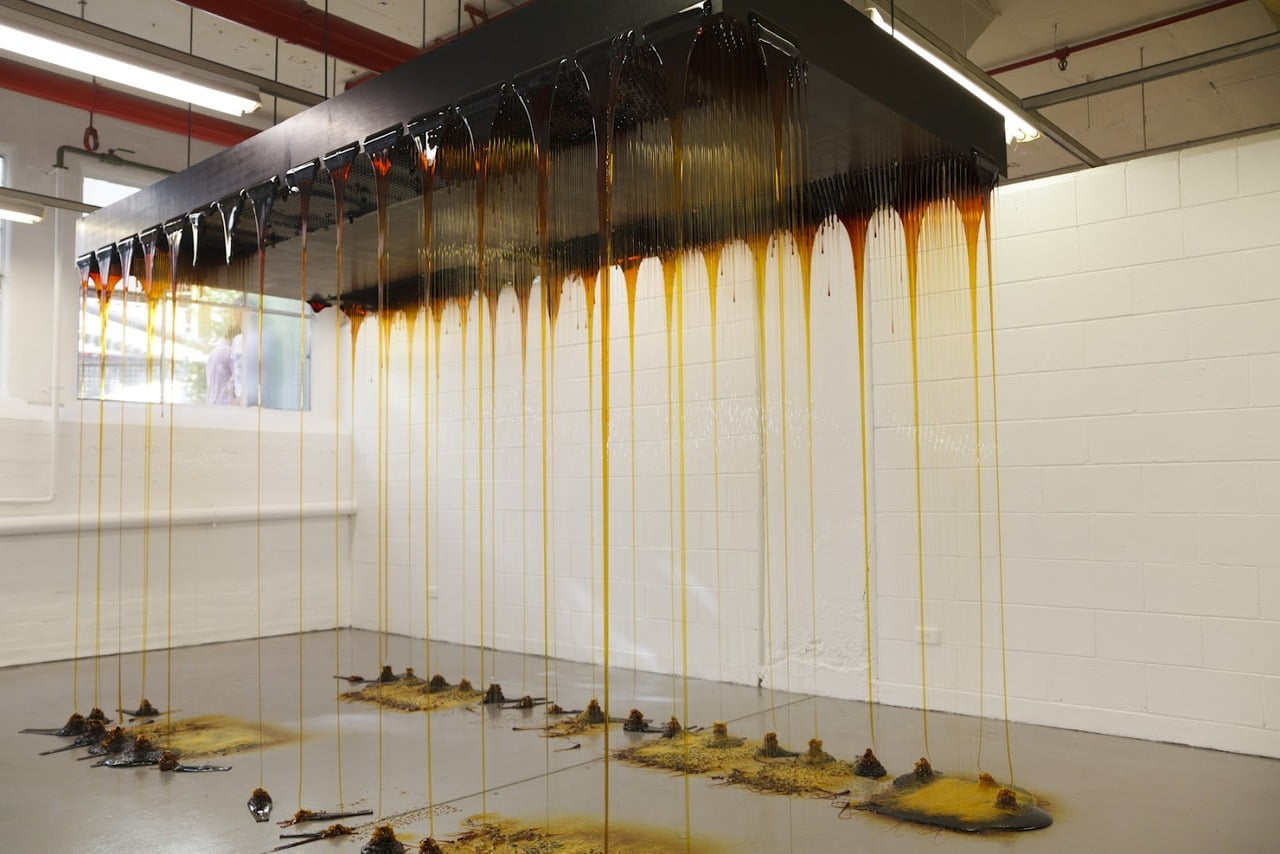
    Artist Skye Kelly’s “Creep (strain)” sculpture shown above is made from toffee. The viscous fluid deforms under the force of gravity, resulting in elongated drips and slow jets that buckle and coil upon reaching the floor. (Photo credits: Skye Kelly; via freshphotons)