
In the collage above, successive frames showing the bouncing and break-up of liquid droplets impacting a solid inclined surface coated with a thin layer of high-viscosity fluid have been superposed. This allows one to see the trajectory and deformation of the original droplet as well as its daughter droplets. The impacts vary by Weber number, a dimensionless parameter used to compare the effects of a droplet’s inertia to its surface tension. A larger Weber number indicates inertial dominance, and the Weber number increases from 1.7 in (a) to 15.3 in (d). In the case of (a), the impact of the droplet is such that the droplet does not merge with the layer of fluid on the surface, so the complete droplet rebounds. In cases (b)-(d), there is partial merger between the initial droplet and the fluid layer. The impact flattens the original droplet into a pancake-like layer, which rebounds in a Worthington jet before ejecting several smaller droplets. For more, see Gilet and Bush 2012. (Photo credit: T. Gilet and J. W. M. Bush)
Search results for: “surface tension”

Saffman-Taylor Demo
In this video, a thin film of viscous glycerin sits between two glass plates. As the plates are forced apart, air gets entrained from either side, causing finger-like instabilities to form between the two fluids. This is a result of the Saffman-Taylor mechanism. The final dendritic pattern depends on the fluid viscosities, surface tension, and any non-uniformities in the apparatus. (Video credit and submission by M. Goodman)
Perpetual Motion?
In the 17th century, scientist Robert Boyle proposed a perpetual motion machine consisting of a self-filling flask. The concept was that capillary action, which creates the meniscus of liquid seen in containers and is responsible for the flow of water from a tree’s roots upward against gravity, would allow the thin side of the flask to draw fluid up and refill the cup side. In reality, this is not possible because surface tension will hold it in a droplet at the end of the tube rather than letting it fall. In the video above, the hydrostatic equation is used to suggest that the device works with carbonated beverages (it doesn’t; the video’s apparatus has a hidden pump) because the weight of the liquid is much greater than that of the foam. Of course, the hydrostatic equation doesn’t apply to a flowing liquid! The closest one can come to the hypothetical perpetual fluid motion suggested by Boyle is the superfluid fountain, which flows without viscosity and can continue indefinitely so long as the superfluid state is maintained. (Video credit: Visual Education Project; submission by zible)
Reader Question: Snow from Boiling Water?
[original media no longer available]
Reader kylewpppd asks:
Have you seen the post of a man in Siberia throwing boiling water off of his balcony? Can you provide a better explanation of what’s going on?
As you can see in the video (and in many similar examples on YouTube), tossing near boiling water into extremely cold air results in an instant snowstorm. Several effects are going on here. The first thing to understand is how heat is transferred between objects or fluids of differing temperatures. The rate at which heat is transferred depends on the temperature difference between the air and the water; the larger that temperature difference is the faster heat is transferred. However, as that temperature difference decreases, so does the rate of heat transfer. So even though hot water will initially lose heat very quickly to its surroundings, water that is initially cold will still reach equilibrium with the cold air faster. Therefore, all things being equal, hot water does not freeze faster than cold water, as one might suspect from the video.
The key to the hot water’s fast-freeze here is not just the large temperature difference, though. It’s the fact that the water is being tossed. When the water leaves the pot, it tends to break up into droplets, which quickly increases the surface area exposed to the cold air, and the rate of heat transfer depends on surface area as well! A smaller droplet will also freeze much more quickly than a larger droplet.
What would happen if room temperature water were used instead of boiling water? In all likelihood, a big cold bunch of water would hit the ground. Why? It turns out that both the viscosity and the surface tension of water decrease with increasing temperature. This means that a pot of hot water will tend to break into smaller droplets when tossed than the cold water would. Smaller droplets means less mass to freeze per droplet and a larger surface area (adding up all the surface area of all the droplets) exposed. Hence, faster freezing!

Tears of Wine
Physicist Richard Feynman once famously ended a lecture by describing how the whole universe can be found in a glass of wine. And there is certainly plenty of fluid dynamics in one. In the photo above, we see in the shadows how a film of wine drips down into the main pool below. This effect is known by many names, including tears of wine and wine legs; it can also be found in other high alcohol content beverages. Several effects are at play. Capillary action, the same effect that allows plants to draw water up from their roots, helps the wine flow up the wall of the glass. At the same time, the alcohol in this wine film evaporates faster than the water, raising the surface tension of the wine film relative to the main pool of wine below. Because of this gradient in surface tension, the wine will tend to flow up the walls of the glass away from the area of lower surface tension. This Marangoni effect also helps draw the wine upward. When the weight of the wine film is too great for capillary action and surface tension to hold it in place, droplets of wine–the legs themselves–flow back downward. (Photo credit: Greg Emel)

Bouncing Jet
For the right flow speeds and incidence angles, a jet of Newtonian fluid can bounce off the surface of a bath of the same fluid. This is shown in the photo above with a laser incorporated in the jet to show its integrity throughout the bounce. The walls of the jet direct the laser much the way an optical fiber does. The jet stays separated from the bath by a thin layer of air, which is constantly replenished by the air being entrained by the flowing jet. The rebound is a result of the surface tension of the bath providing force for the bounce. (Photo credit: T. Lockhart et al.)
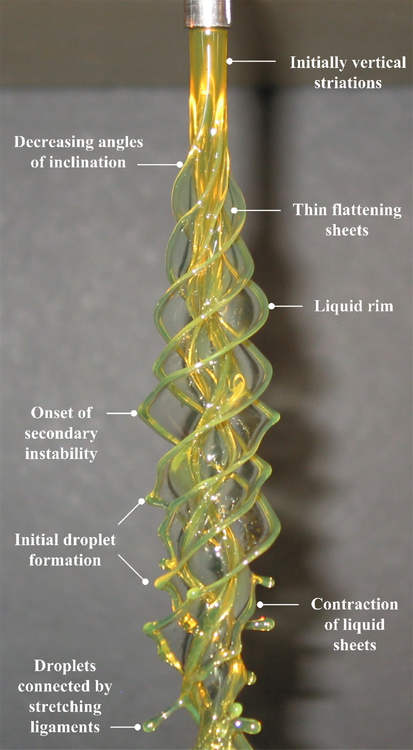
Swirling Jets
In fluid dynamics, we like to classify flows as laminar–smooth and orderly–or turbulent–chaotic and seemingly random–but rarely is any given flow one or the other. Many flows start out laminar and then transition to turbulence. Often this is due to the introduction of a tiny perturbation which grows due to the flow’s instability and ultimately provokes transition. An instability can typically take more than one form in a given flow, based on the characteristic lengths, velocities, etc. of the flow, and we classify these as instability modes. In the case of the vertical rotating viscous liquid jet shown above, the rotation rate separates one mode (n) from another. As the mode and rotation rate increase, the shape assumed by the rotating liquid becomes more complicated. Within each of these columns, though, we can also observe the transition process. Key features are labeled in the still photograph of the n=4 mode shown below. Initially, the column is smooth and uniform, then small vertical striations appear, developing into sheets that wrap around the jet. But this shape is also unstable and a secondary instability forms on the liquid rim, which causes the formation of droplets that stretch outward on ligaments. Ultimately, these droplets will overcome the surface tension holding them to the jet and the flow will atomize. (Video and photo credits: J. P. Kubitschek and P. D. Weidman)
Self-Healing Soap Films
Some soap films are capable of self-healing after a solid object passes through them, as shown in the video above. The behavior is primarily dependent on Weber number–a nondimensional ratio of the film’s inertia to its surface tension. Although demonstrated for positive curvature in the video, the same behavior is observed in negatively curved soap films as well. For a look at how the behavior varies with projectile velocity and size, check out this video. (Video credit: J. Bryson, BYU Splash Lab)

“Kusho”


Artist Shinichi Maruyama uses photography to freeze the transient motion of fluids into water sculptures. Inertia, gravity, and surface tension are at war in each piece. Plateau-Rayleigh instabilities break long filaments of liquid into droplets that splash, collide, and reform. To see how he makes this art, check out his videos. (Photo credits: Shinichi Maruyama)

Green Fingers
Differences in surface tension between two layers of fluid can cause fascinating finger-like instabilities. Here glycerol is spread in a thin film on a silicon wafer. Then a wire coated in oleic acid, which has a lower surface tension than glycerol, was touched to the wafer. As the oleic acid spreads across the film surface, Marangoni and capillary stresses cause variations in the film thickness, which results in the dendritic patterns seen here. (Photo credit: B. Fischer et al.)