Search results for: “surface tension”

  • Surface Jets in Coalescing Droplets

    Surface Jets in Coalescing Droplets

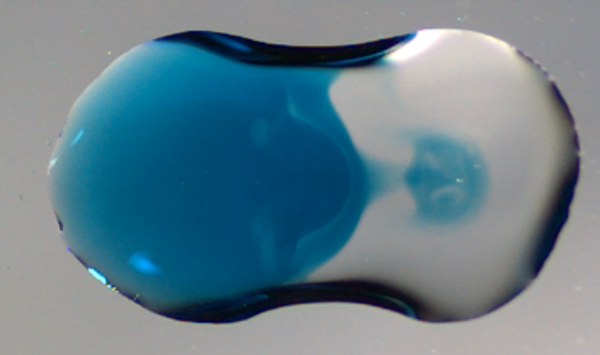
    What goes on when droplets merge is tough to observe, even with a high-speed camera. There are many factors at play: any momentum in the droplets, surface tension, gravity, and Marangoni forces, to name a few. A new study that simultaneously records multiple views of coalescence is shedding some light on these dynamics.

    The results are particularly interesting for droplets that are somewhat physically separated so that they only coalesce after one drop impacts near the other. In this situation, with droplets of equal surface tension, researchers observed a jet that forms after impact (Image 1) and runs along the top surface of the coalescing drops (Image 2). That location is a strong indication that the jet is created by surface tension and not other forces.

    To test that further, the researchers repeated the experiment but with droplets of unequal surface tension. They found that when the undyed droplet’s surface tension was higher (Image 3), Marangoni forces enhanced the surface jet, as one would expect for a surface-tension-driven phenomenon. But if the dyed droplet had the higher surface tension (Image 4), it was possible to completely suppress the jet’s formation. (Image, research, and submission credit: T. Sykes et al., arXiv)

  • Featured Video Play Icon

    Agnes Pockels: Surface Science Pioneer

    Todayโ€™s FYFD video tells a story Iโ€™ve wanted to share for a couple of years now. Itโ€™s about the life and work of Agnes Pockels, a woman born in the mid-nineteenth century who, despite a lack of formal scientific training, made major contributions to the understanding of surface tension and to the experimental apparatuses and methodologies used in surface chemistry in general. She accomplished all of this not in a scientific lab, but from her kitchen.

    Pockelsโ€™ story is one of curiosity, determination, and meticulous scientific inquiry. Chances are that youโ€™ve never heard of her, but you really should. Check out the full video below to learn more! (Image and video credit: N. Sharp)

  • Bouncing Off The Surface

    Bouncing Off The Surface

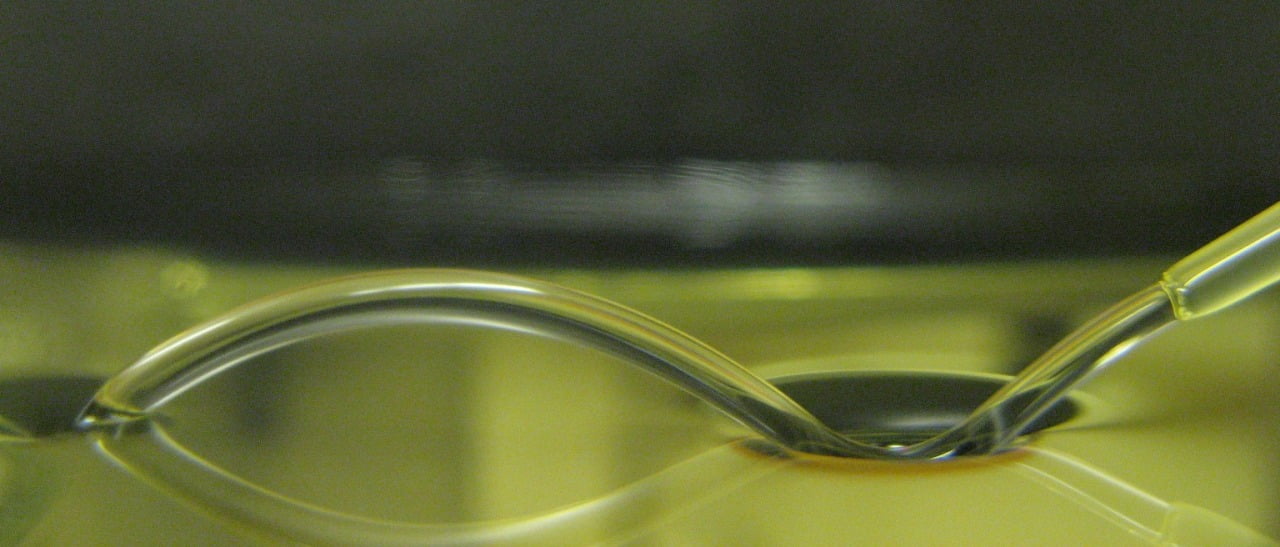
    For the right angles and flow rates, itโ€™s possible to bounce a fluid jet off a pool of the same fluid. As the jet flows, it pulls a thin layer of air with it, entraining the air. This air film is what keeps the jet separate from the pool when it initially hits. In the photo above, the jet is flowing right to left; notice how it maintains its integrity within the dimple during the bounce. The poolโ€™s surface tension acts almost like a trampoline, redirecting the jetโ€™s momentum into the bounce. Itโ€™s even possible to get a double bounce. In this video, the mechanism is the same, although the apparatus is different. In the photo above, the jet is introduced with a horizontal velocity to induce air entrainment and bouncing. In the video, the pool is spinning, which provides the necessary horizontal velocity between the jet and the liquid pool. (Photo credit: J. Bomber and T. Lockhart)

  • Featured Video Play Icon

    Droplet Impact on Superhydrophobic Surfaces

    High-speed video of water droplets impacting on superhydrophobic surfaces demonstrates the impressive elasticity and surface tension of the droplets. Impacts vibrate and reflect through the droplet, but only a drop from the largest height actually causes breakup.

  • Featured Video Play Icon

    Bursting an Oobleck Bubble

    When soap bubbles burst, the hole grows as an expanding circle. But not every fluid bursts this same way. Here, researchers let air rise through oobleck–a fluid made from cornstarch suspended in water–to form a bubble. In time, as with all bubbles, the oobleck bubble bursts. But–in keeping with oobleck’s solid-like properties–the film tears open and fractures. As it sinks back into the liquid, it wrinkles before it slowly relaxes back into fluid form. (Video and image credit: X. Zhang et al.)

    Fediverse Reactions
  • Making a Star-Shaped Droplet

    Making a Star-Shaped Droplet

    We usually think of surface tension turning droplets into spheres in order to minimize their area. But spheres aren’t the only shape surface tension can enforce. Here, researchers suspend tiny droplets of oil in a soapy fluid. At the right temperature, these droplets form a crystalline surface while the fluid within remains liquid. As in the fully liquid droplet, surface tension tries to minimize the shell’s surface energy, enabling it to take on many different shapes.

    Video showing the droplet's transition from hexagon to star and back. The shape changes occur as the liquid's temperature changes, thereby affecting its surface tension.
    The droplet’s transition from hexagon to star and back. The shape changes occur as the liquid’s temperature changes, thereby affecting its surface tension.

    In this study, researchers demonstrate that the shell-enclosed droplets can even change, reversibly, from a hexagon to a six-pointed star and back. The transformation is shown above, in an experiment that gradually changes the droplet’s temperature–and, thus, its surface tension.

    Although shape changes similar to these have been described before, this experiment was the first where the shell’s defects–the vertices of the hexagon–don’t shift during the transformation. (Video, image, and research credit: C. Quilliet et al.; via APS)

    Fediverse Reactions
  • Featured Video Play Icon

    Drag Reduction Via Bubbles

    To help reduce greenhouse emissions, businesses are exploring systems that reduce a container ship’s drag by releasing bubbles beneath them. But how do bubbles reduce drag? To find out, researchers simulated a bubbly flow that mimics the underside of a moving ship. By playing with the balance between inertial forces, buoyancy, and surface tension, they were able to sweep through conditions that the bubbles could experience.

    The best performance comes when bubbles stick together and coat the entire underside of the surface. In that case, they measured a nearly 40% reduction in the drag. But other conditions were not so fortuitous; in fact, with poorly chosen conditions, adding bubbles could actually increase the drag. (Video and image credit: S. Di Georgio et al.)

  • “Frozen”

    “Frozen”

    For tiny invertebrates like this one, water is a very different substance than we’re used to. At this scale, surface tension is a force as powerful–or more so–than gravity. Droplets remain spherical, caught on long, spike-like hairs. Even the surface of a pond is different, forming a trampoline creatures can skim but that requires special techniques to escape. (Image credit: N. Baumgartner/CUPOTY; via Colossal)

  • A Drop of Algae

    A Drop of Algae

    Spheres of a Volvox colonial algae glow green inside a droplet in this award-winning microphotograph by Jan Rosenboom. Pinned on an inclined surface, the droplet is frozen in a balance between gravity and surface tension that keeps its shape–and its contact angles–asymmetric. Droplets will also take on a shape similar to this when air is blowing past them. (Image credit: J. Rosenboom; via Ars Technica)

    Fediverse Reactions
  • Marangoni Effect in Biology

    Marangoni Effect in Biology

    For decades, biologists have focused on genetics as the key determiner for biological processes, but genetic signals alone do not explain every process. Instead, researchers are beginning to see an interplay between genetics and mechanics as key to what goes on in living bodies.

    For example, scientists have long tried to unravel how an undifferentiated blob of cells develops a clear head-to-tail axis that then defines the growing organism. Researchers have found that, rather than being guided purely by genetic signals, this stage relies on mechanical forces–specifically, the Marangoni effect.

    The image above shows a mouse gastruloid, a bundle of stem cells that mimic embryo growth. As they develop, cells flow up the sides of the gastruloid, with a returning downward flow down the center. This is the same flow that happens in a droplet with higher surface tension in one region; the Marangoni effect pulls fluid from the lower surface tension region to the higher one, with a returning flow that completes the recirculation circuit.

    The same thing, it turns out, happens in the gastruloid. Genes in the cells trigger a higher concentration of proteins in one region of the bundle, creating a lower surface tension that causes tissue to flow away, helping define the head-to-tail axis. (Image credit: S. Tlili/CNRS; research credit: S. Gsell et al.; via Wired)

    Fediverse Reactions