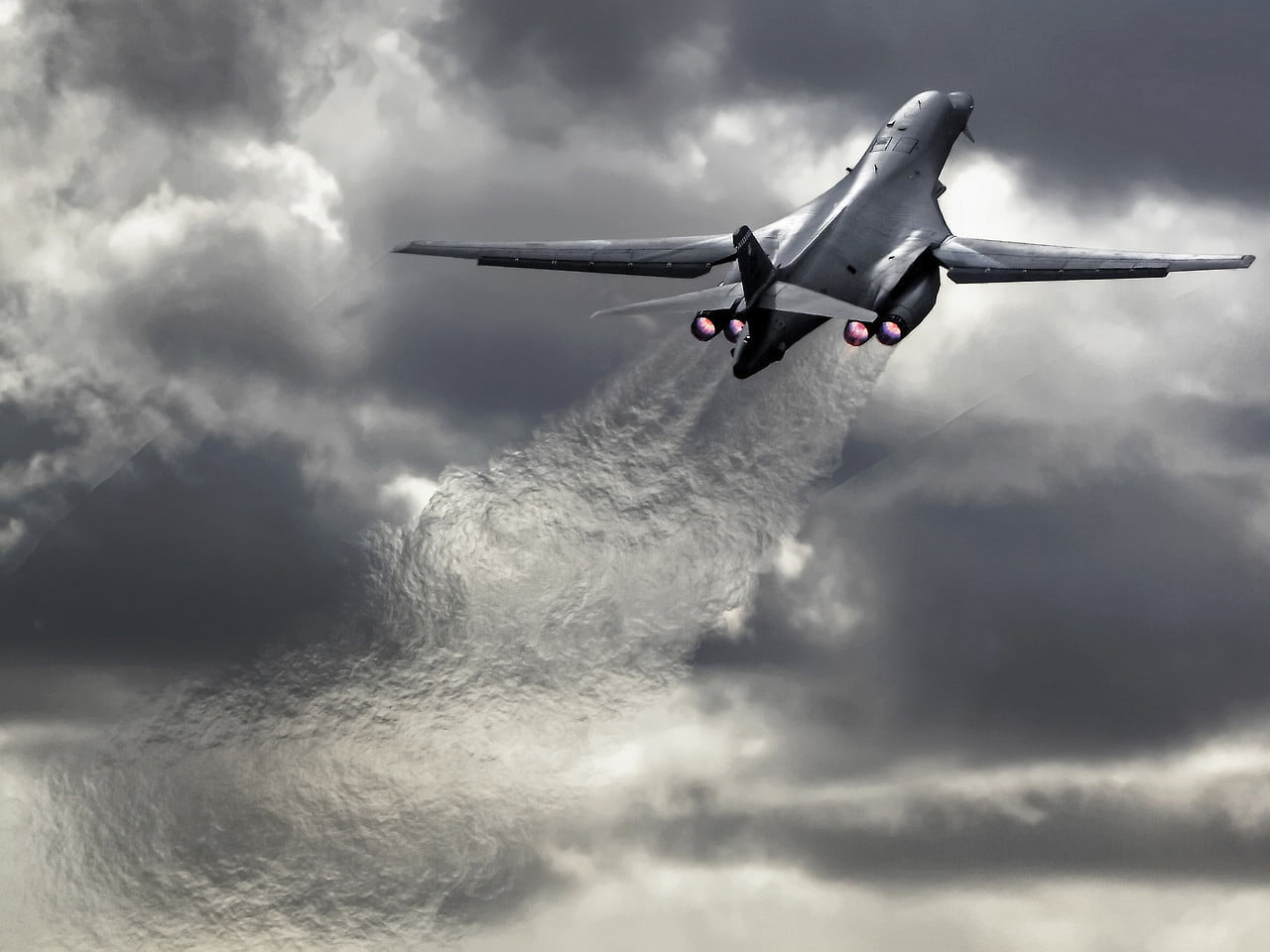
Hot exhaust gases churn in the wake of this climbing B-1B Lancer. The high temperature of the exhaust changes the density and, thus, the refractive index of the gases relative to the atmosphere. Light traveling through the exhaust gets distorted, making the highly turbulent flow visible to the human eye. Note how the four individual engine exhaust plumes quickly combine into one indistinguishable wake. This is typical for turbulence; it’s hard to track where any given fluctuations originally came from. The airplane’s wingtip vortices are just visible as well, if you look closely. (Image credit: T. Rogoway; submitted by Mark S.)
Search results for: “shock wave”

Tendrils of Fog
Fog snakes its way from the ocean into the Strait of Juan de Fuca in this animation constructed from satellite imagery. The strait lies between Vancouver Island and the Olympic Peninsula in the Pacific Northwest. Fogs like this form when skies are clearer and heat from the surface is able to escape upward. The surface air then cools and condenses into fog. Steady winds pushed fog into the strait over the course of about 9 hours. There’s a remarkable level of detail in the satellite images, taken by the new GOES-16 satellite that launched in late 2016. Notice the ragged wave front as the fog stretches eastward and the shock-wave-like lines behind it in the strait. Both result from interactions between the fog cloud and the shape of the land masses it’s encountered. (Image credit: NASA Earth Observatory)

Underwater Explosions in Slow Mo
The Slow Mo Guys bring their high-speed skills to underwater explosions in this new video. The physics of such explosions is very neat (but also incredibly destructive). When the fuse ignites, a blast wave travels outward in a sphere, creating a bubble filled with gas. Eventually, the pressure of the surrounding water is too great for the bubble to expand against. When its expansion slows, that much larger pressure from the surrounding water starts to crush the bubble back down. Decreasing the volume of the bubble raises its pressure and its temperature again, and this often reignites any leftover fuel and oxidizer left in the bubble. The secondary shock bubble will re-expand, kicking off another round of expansion and collapse. (Video credit: The Slow Mo Guys; submitted by potato-with-a-moustache)
What Sound Looks Like
NPR’s Skunk Bear Tumblr has a great new video on the schlieren visualization technique. The schlieren optical set-up is relatively simple but very powerful, as shown in the video. The technique is sensitive to variations in the refractive index of air; this bends light passing through the test area so that changes in fluid density appear as light and dark regions in the final image. Since air’s density changes with temperature and with compressibility, the technique gets used extensively to visualize buoyancy-driven flows and supersonic flows. Since sound waves are compression waves which change the air’s density as they travel, schlieren can capture them, too. (Video credit: A. Cole/NPR’s Skunk Bear)
Aurora From Space
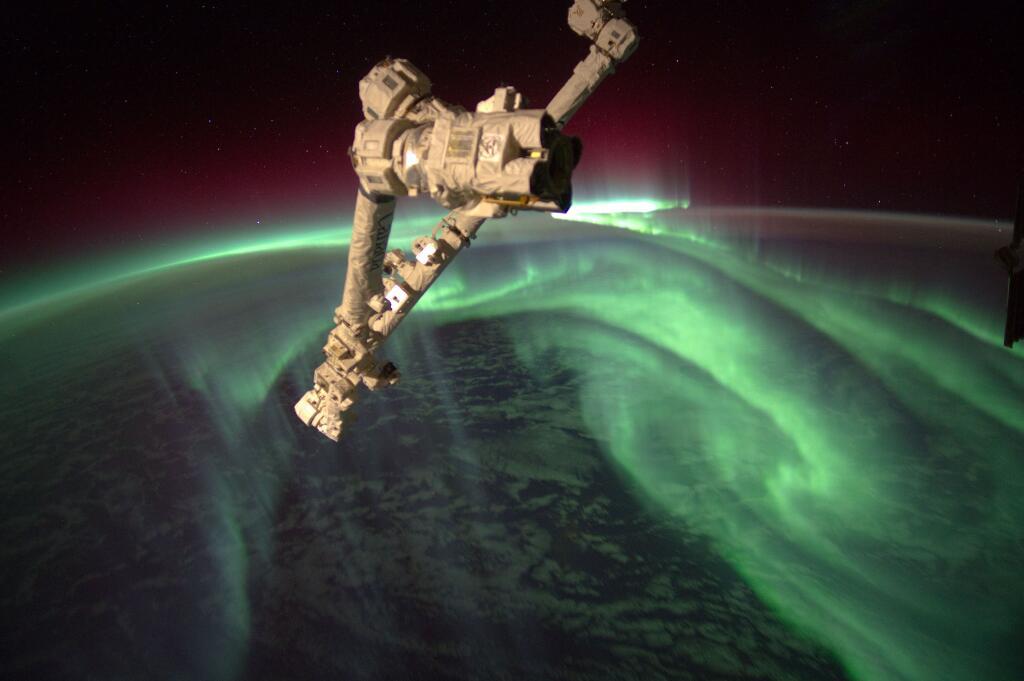
An aurora, as seen from the International Space Station, glows in green and red waves over the polar regions of Earth. These lights are the result of interactions between the solar wind–a stream of hot, rarefied plasma from the sun–and our planet’s magnetic field. A bow shock forms where they meet, about 12,000-15,000 km from Earth. The planet’s magnetic field deflects much of the solar wind, but some plasma gets drawn in along field lines near the poles. When these energetic particles interact with nitrogen and oxygen atoms in the upper atmosphere, it can excite the atoms and generate photon emissions, creating the distinctive glow. Similar auroras have been observed on several other planets and moons in our solar system. (Photo credit: NASA)
Rocket Sonic Boom
Originally posted: 22 July 2010 This video of the NASA Solar Dynamics Observatory’s launch is such a favorite of mine that it was part of the original inspiration for FYFD and was the very first video I posted. Watch closely as the Atlas V rocket climbs. At 1:51 you’ll see a rainbow-like cloud in upper right corner of the screen. This effect is created by sunlight shining through ice crystals of the cloud. A couple seconds later you see pressure waves from the rocket propagate outward and destroy the rainbow effect by re-aligning the ice crystals. Just after that comes the announcement that the vehicle has gone supersonic. The atmospheric conditions of the launch happened to be just right to make those pressure waves coming off the rocket visible just before they coalesced into a leading shockwave. (Video credit: B. Tomlinson)
Reminder: If you haven’t already, please fill out our reader survey and help us improve FYFD!

Fluids Round-up – 13 July 2013
Prepare yourselves for lots of links in today’s fluids round-up!
- Longtime FYFD favorite Mark Stock (see here, here, and here) and his collaborator James Susinno have unveiled a new interactive art piece, “Everything is Made of Atoms” that utilizes some impressive real-time fluids simulation. NVIDIA’s blog has some details on the computing.
- ScarbsF1 takes a detailed look at the F-duct used to stall an F1 car’s rear wing to reduce drag. (submitted by Vinnie)
- Just in time for summer fun, National Geographic talks about the physics of water slides.
- SpaceX’s reusable Grasshopper rocket has set a new altitude test of over 1000 ft. Check out this feat of aerodynamic control over at io9.
- Stanford engineers are using high-speed video of birds in the wild to study the mechanics of flapping flight. If you check out their video, you’ll notice how the birds rotate their wings as they flap in order to maximize lift throughout the flapping cycle. (via io9)
- Speaking of io9, they highlighted a couple of great examples of meteorological fluid dynamics recently: roll clouds and water spouts.
- New research suggests that thresher sharks may whip their tails quickly enough to produce cavitation-induced shockwaves to stun their prey. If so, they join the pistol and mantis shrimp in utilizing this technique for hunting.
- If you’re looking for some casual games, Liquid Sketch is a fun fluids puzzle game for iOS (submitted by Keri B)
- Finally, congratulations to Toronoto’s AeroVelo for capturing the AHS Sikorsky Prize with their human-powered helicopter. Check out this video from their historic flight (submitted by Chris R).
(Photo credit: AeroVelo)

Supersonic Oil Flow Viz
This image shows oil-flow visualization of a cylindrical roughness element on a flat plate in supersonic flow. The flow direction is from left to right. In this technique, a thin layer of high-viscosity oil is painted over the surface and dusted with green fluorescent powder. Once the supersonic tunnel is started, the model gets injected in the flow for a few seconds, then retracted. After the run, ultraviolet lighting illuminates the fluorescent powder, allowing researchers to see how air flowed over the surface. Image (a) shows the flat plate without roughness; there is relatively little variation in the oil distribution. Image (b) includes a 1-mm high, 4-mm wide cylinder. Note bow-shaped disruption upstream of the roughness and the lines of alternating light and dark areas that wrap around the roughness and stretch downstream. These lines form where oil has been moved from one region and concentrated in another, usually due to vortices in the roughness wake. Image © shows the same behavior amplified yet further by the 4-mm high, 4-mm wide cylinder that sticks up well beyond the edge of the boundary layer. Such images, combined with other methods of flow visualization, help scientists piece together the structures that form due to surface roughness and how these affect downstream flow on vehicles like the Orion capsule during atmospheric re-entry. (Photo credit: P. Danehy et al./NASA Langley #)
Schlieren Montage
Dr. Gary Settles, a world-reknown expert in schlieren photography, shows here a montage of some of his lab’s results, including shockwaves from musical instruments, dogs sniffing, guns firing (both sub- and supersonic), and even snapping a wet towel going supersonic. As Settles jokes, schlieren is all mirrors and hot air. Mirrors are used to shine collimated light on the object to be imaged; then the light focused with a lens. By placing a knife-edge at the focal point, part of the light is blocked and the density variations in the final image become visible, thanks to their differing refractive indices. (Video credit: G. Settles et al.)
Particle Jets
During explosions, solid particles and liquids packed around the explosive charges can form jets, making a blast wave appear more porcupine-like than spherical. The instability mechanisms that cause this behavior are not well-understood, but researchers suspect the jets are formed due to perturbations in the particle bed on the timescale of the initial shock propagation. The presence of these jets can affect the blast wave’s subsequent growth as well as the mixing in its wake. The number of jets produced depends on many factors, including particle type, the geometry of the charge, the ratio of explosive to particles, and even whether the particles are wet or dry. Note the very different natures of the explosions in the video when shown side by side. (Video credit: D. Frost et al)
