This video shows how the installation of a dam can affect river flow and sediment transport. Before the dam is added, the flow is shallow and the sediment transport is uniform. The installation of the dam creates deep subcritical flow upstream and supercritical flow downstream. This means that wave information–like ripples–can propagate upstream on the subcritical side; on the supercritical side, the wave velocity is lower than the flow velocity and ripples cannot propagate upstream. This is analogous to sub- and supersonic flow in air. The critical flow over the dam is analogous to a shock wave. The lower velocity upstream of the dam is unable to carry sediment downstream and transport essentially ceases until the sediment builds up to a height where the depth of the water above the dam is roughly equal to that below the dam and sediment transport resumes, scouring the downstream supercritical section. Around 0:40, a gate is closed on the downstream side (off frame), creating a hydraulic jump. In the final section of the video, after sediment has built up on both sides of the dam, the downstream gate is re-opened and the jump reforms as sediment is blown out below the dam. (Video credit: Little River Research and Design, with funding from the Missouri Department of Natural Resources)
Search results for: “shock wave”

Supersonic Flow
This video shows a sphere in a small supersonic wind tunnel at Mach 2.7. Once the tunnel starts, a curved bow shock forms in front of the sphere, close to but not touching the model’s surface. Areas of low pressure are visible behind the sphere, as is a weak shock wave caused by overexpansion in those low pressure areas. Contrast this with a sharp cone in the same tunnel at the same Mach number. In the case of the cone, the shock wave is attached at the nose of the model. The attached shock follows the body more closely, resulting in a shock that impacts the walls of the tunnel further downstream than in the sphere’s case.
Supersonic Flow Around a Cylinder
This numerical simulation shows unsteady supersonic flow (Mach 2) around a circular cylinder. On the right are contours of density, and on the left is entropy viscosity, used for stability in the computations. After the flow starts, the bow shock in front of the cylinder and its reflections off the walls and the shock waves in the cylinder’s wake relax into a steady-state condition. About halfway through the video, you will notice the von Karman vortex street of alternating vortices shed from the cylinder, much like one sees at low speeds. The simulation is inviscid to simplify the equations, which are solved using tools from the FEniCS project. (Video credit: M. Nazarov)
Supersonic Stellar Jets
Astronomers studying stellar jets–massive outflows of gases and particles pouring from the poles of newborn stars–are finding reasons to turn to fluid dynamicists to understand the timelapse videos they’ve stitched together from multiple exposures from the Hubble telescope. Usually astronomical events unfold on such a slow timescale that our only view of them is as a snapshot frozen in time. Stellar jets can move relatively quickly, though, with portions of the jet flowing at supersonic speeds. Over the course of Hubble’s lifetime, these jets have been imaged multiple times, allowing astronomers to create movies that reveal swirling eddies and shock wave motion previously unseen. (submitted by sakalgirl)
The Invisible Forces Behind a Lighter
This high-speed schlieren video reveals the ignition of a butane lighter. The schlieren optical technique exaggerates differences in refractive index caused by density variations, enabling experimentalists to see thermal eddies, shock waves, and other phenomena invisible to the naked eye. Here a jet of butane shoots upward from the lighter as a valve is released. Then the spark from the lighter ignites the butane gas near the bottom of the jet. A flame front the propagates outward and upward, completing the lighting process. (submitted by @Mark_K_Quinn)
Rocket Engine Testing
Rocket engine tests usually feature a distinct and steady pattern of Mach diamonds in their exhaust. This series of reflected shock waves and expansion fans forms as a result of the exhaust pressure of the rocket nozzle being lower or higher than ambient pressure. A rocket will be most efficient if its exhaust pressure matches the ambient pressure, but since atmospheric pressure decreases as the rocket gets higher, engines are usually designed with an optimal performance at one altitude.
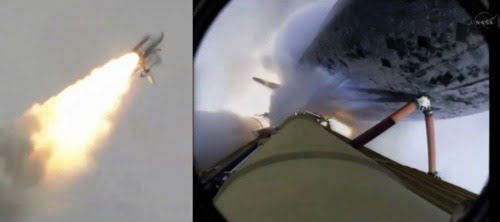
STS-135: The Final Shuttle Flight
Condensation clouds form around sections of Atlantis as STS-135–the final space shuttle flight–launches from Cape Canaveral this morning. These clouds, also called Prandtl-Glauert singularities or vapor cones, form at transonic speeds when air accelerates around the vehicle. The area just behind these shock waves experiences a drop in pressure and temperature that brings a localized portion of the flow below the dew point. Rapid condensation of the moisture in the air results. Miss the launch? Watch it here.

Rocket Diamonds
The exhaust of a Pratt and Whitney J58 shines with Mach diamonds, a series of shock waves and expansion fans that form to equalize the exhaust and ambient pressures. This pattern can occur any time an engine nozzle operates at its non-ideal altitude.

X-51A Scramjet Test Flight
The X-51A Waverider hypersonic aircraft had its second test flight earlier this week. Unfortunately, its supersonic combustion ramjet (scramjet) engine failed to transition from its start-up fuel to its primary fuel. According to the US Air Force Research Laboratory:
A US Air Force B-52H Stratofortress released the experimental vehicle from an altitude of approximately 50,000 feet. After release the X-51A was initially accelerated by a solid rocket booster to a speed just over Mach 5. The experimental aircraft’s air breathing scramjet engine lit on ethylene and attempted to transition to JP7 fuel operation when the vehicle experienced an inlet un-start. The hypersonic vehicle attempted to restart and oriented itself to optimize engine start conditions, but was unsuccessful. The vehicle continued in a controlled flight orientation until it flew into the ocean within the test range. #
Un-starting is the term used when supersonic flow is lost in an engine or wind tunnel. If the pressure or temperature in the engine deviates too far from the ideal conditions, the upstream mass flow through the engine will be greater than the downstream mass flow and the engine will choke (video). A shock wave forms and travels upstream, leaving subsonic flow in its wake. Loss of supersonic flow inside the engine would likely also result in losing ignition of the fuel/air mixture, resulting in flameout. #
If you haven’t guessed already, engineers like to make up words.

Space Shuttle Flow Viz
When a space shuttle lands, a lucky few will hear twin sonic booms as it passes overhead. The double boom occurs due to the shock waves from in front of the shuttle and just behind it passing the observer on the ground. The colorized schlieren photograph above shows shock waves on a model of an early shuttle prototype. The fore and aft shocks that run from the craft to the ground are even clearer on this photo of a T-38 in flight. (Photo credit: Gary Settles)