Search results for: “shock wave”

  • Featured Video Play Icon

    Mach Diamonds

    Joe asks:

    Why does this rocket have that repeating pattern in its exhaust? I’m amazed that it’s so stable for so far as distance from the nozzle.

    Excellent question! The diamond-shaped pattern seen in the rocket’s exhaust is actually a series of reflected shock waves and expansion fans. The rocket’s nozzle is designed to be efficient at high altitudes, which means that, at its nominal design altitude, the shape of the nozzle is such that the exhaust gases will be expanded to the same pressure as the ambient atmosphere. At sea level, the nozzle is overexpanded, meaning that the exhaust gases have been expanded to a lower pressure than the ambient. The supersonic exhaust has to reach ambient pressure, and it does so through an oblique shock right at the exit of the nozzle. However, the oblique shock, in addition to raising the pressure, turns the gases toward the exhaust centerline. To ensure flow symmetry, two additional oblique shocks form. But then the exhaust is at a higher pressure than ambient. Expansion fans form to reduce the pressure, but those, too, affect the direction the exhaust gases flow. The pattern, then, is a series of progressively weaker oblique shocks and expansion fans that raise the exhaust gas pressure to that of the ambient atmosphere.

  • Featured Video Play Icon

    Seeing the Invisible

    Schlieren photography is a common experimental flow visualization technique, especially in supersonic flows (where it enables one to see shock waves). Here the Science Channel’s “Cool Stuff: How It Works” show explains the technique and shows some examples from everyday life.

  • Featured Video Play Icon

    Supersonic

    Moving supersonically–faster than the local speed of sound–can cause some awesome effects. Among these are vapor cones (a.k.a. Prandlt-Glauert singularities), shock waves, and, of course, the sonic boom.

  • Featured Video Play Icon

    Breaking the Sound Barrier

    The shock waves propagating in front of an Atlas V rocket after launch decimate a rainbow-like effect called a sun dog. #

  • Featured Video Play Icon

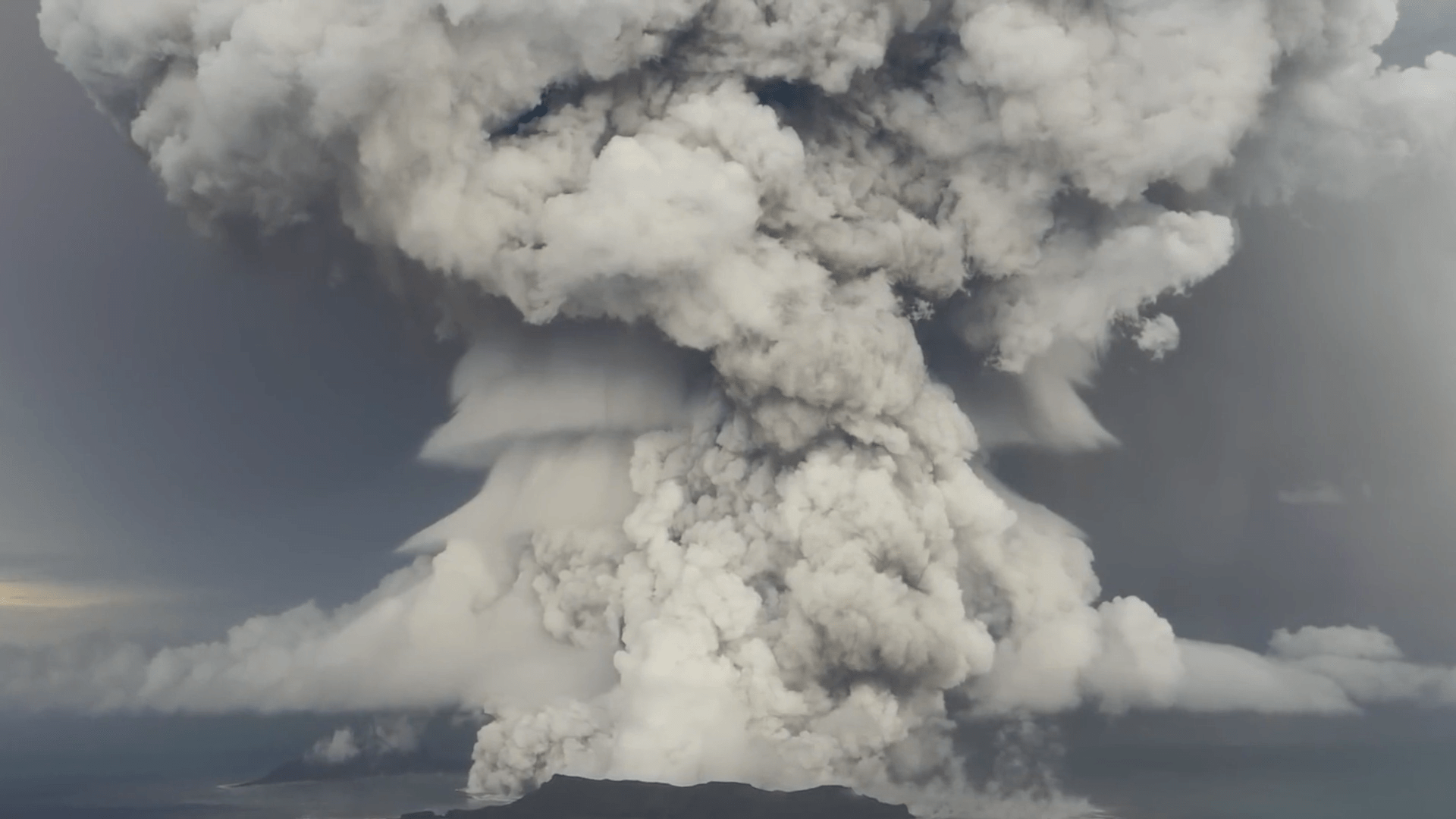
    Tongan Eruption

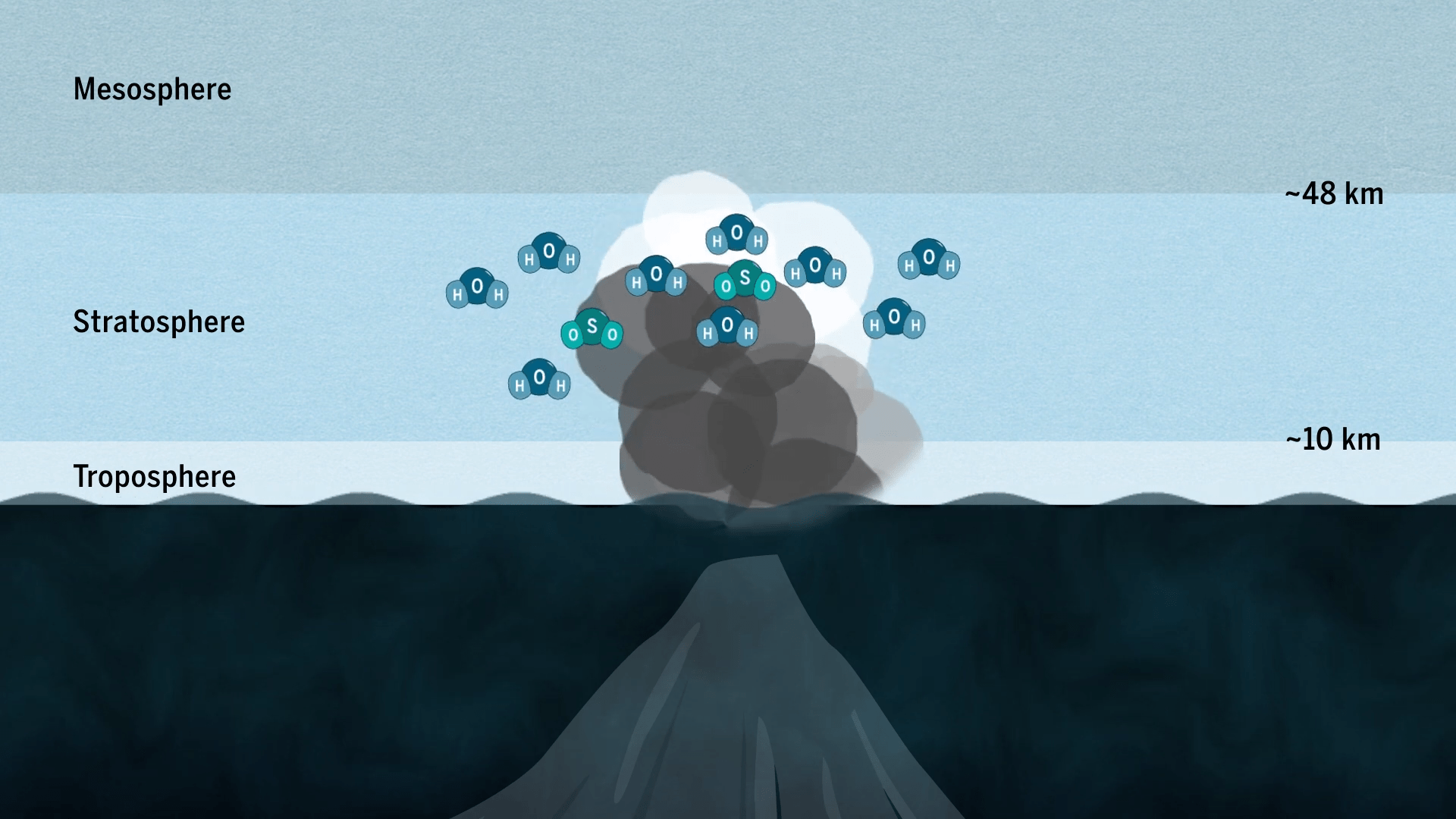
    In January 2022, the Hunga Tonga-Hunga Ha’apai volcano erupted spectacularly, sending waves around the world through the air, water, and ground. In many ways, it was unlike any eruption scientists have observed, though they think it bears similarities to the 1883 eruption at Krakatoa. This video summarizes some of the research to come out of the eruption, looking at how waves propagated, what aerosols the volcano pushed high into the atmosphere, and what the long-term effects of the eruption may be. (Video credit: Science)

  • Landslide-Triggered Tsunamis

    Landslide-Triggered Tsunamis

    After the 2018 Anak Krakatoa eruption, a tsunami that ricocheted through the surrounding waters, killing hundreds on nearby islands. The source of that tsunami was a small landslide. Once the air cleared and researchers could assess how much material slid into the ocean, they were shocked that such a small volume created so much destruction.

    Now new efforts are revealing the linkage between landslides and the waves they make. Researchers released glass beads into a tank of water, observing the waves that form as the beads run out. Depending on the relative initial height of the beads compared to the water depth, they observed three different kinds of waves. Not only that, they were able to connect the granular mechanics of the landslide to the hydrodynamic formation of waves, allowing predictions of the waves that will form for a given landslide.

    Currently, the predictive model isn’t sophisticated enough to handle a geometry as complex as that of the Anak Krakatoa landslide, but it’s an important step toward understanding — and potentially mitigating the damage of — future oceanside landslides. (Image and research credit: W. Sarlin et al.; via APS Physics; submitted by Kam-Yung Soh)

  • Turbulence and Star Formation

    Turbulence and Star Formation

    Space, as I’ve discussed previously, is surprisingly full of matter, especially clouds of dust. And yet the rate of star formation we observe is bizarrely low; the Milky Way, for example, produces only about one solar mass worth of new stars every year. If gravity were the sole force driving star formation, we’d see far more stars forming. Recent research suggests that turbulence plays a major role in regulating the star formation process, both by countering gravity’s attempts to collapse gases into a proto-star and by creating supersonic shocks that drive material together to jump-start star formation. There seem to be other important ingredients as well: young stars tend to form jets that blow material back into the interstellar clouds they’re forming in, feeding the turbulent background. For more, check out Physics Today. (Image credit: ESA/NASA/Hubble/ESO, via APOD; research credit: C. Federrath)

  • Seeing the Wake

    Seeing the Wake

    Hot exhaust gases churn in the wake of this climbing B-1B Lancer. The high temperature of the exhaust changes the density and, thus, the refractive index of the gases relative to the atmosphere. Light traveling through the exhaust gets distorted, making the highly turbulent flow visible to the human eye. Note how the four individual engine exhaust plumes quickly combine into one indistinguishable wake. This is typical for turbulence; it’s hard to track where any given fluctuations originally came from. The airplane’s wingtip vortices are just visible as well, if you look closely. (Image credit: T. Rogoway; submitted by Mark S.)

  • Tendrils of Fog

    Tendrils of Fog

    Fog snakes its way from the ocean into the Strait of Juan de Fuca in this animation constructed from satellite imagery. The strait lies between Vancouver Island and the Olympic Peninsula in the Pacific Northwest. Fogs like this form when skies are clearer and heat from the surface is able to escape upward. The surface air then cools and condenses into fog. Steady winds pushed fog into the strait over the course of about 9 hours. There’s a remarkable level of detail in the satellite images, taken by the new GOES-16 satellite that launched in late 2016. Notice the ragged wave front as the fog stretches eastward and the shock-wave-like lines behind it in the strait. Both result from interactions between the fog cloud and the shape of the land masses it’s encountered. (Image credit: NASA Earth Observatory)

  • Featured Video Play Icon

    Underwater Explosions in Slow Mo

    The Slow Mo Guys bring their high-speed skills to underwater explosions in this new video. The physics of such explosions is very neat (but also incredibly destructive). When the fuse ignites, a blast wave travels outward in a sphere, creating a bubble filled with gas. Eventually, the pressure of the surrounding water is too great for the bubble to expand against. When its expansion slows, that much larger pressure from the surrounding water starts to crush the bubble back down. Decreasing the volume of the bubble raises its pressure and its temperature again, and this often reignites any leftover fuel and oxidizer left in the bubble. The secondary shock bubble will re-expand, kicking off another round of expansion and collapse. (Video credit: The Slow Mo Guys; submitted by potato-with-a-moustache)