
xkcd identifies a very common misconception about how airfoils work! (via Vinnchan and jasonas14) #
Search results for: “lift”

How Wings Create Lift
One of the topics in fluid dynamics almost everyone has come across is the explanation of how airplanes produce lift. Using Bernoulli’s principle–which relates velocity and pressure–and a picture of an airfoil, your average science text will say that a bit of air going over the top of the airfoil has to travel farther than a bit of air going under the airfoil, and that, therefore, the air over the top travels faster than the air under the airfoil.
Unfortunately, this is misleading and, depending on the wording, outright wrong! The hidden assumption in this explanation is that air that goes over the top and air that goes under the bottom have to reach the trailing edge of the airfoil at the same time. But why would that be? (As one of my profs once said, “There is nothing in physics that says there is Conservation-Of-Who-You-Were-Sitting-Next-To-When-You-Started.”)
Take a look at the video above. It shows an airfoil in a wind tunnel using smoke visualization to show how the air moves. Around the 0:25 mark, the video slows to show a pulse of smoke traveling over the airfoil. What happens at the trailing edge? The smoke going over the top of the airfoil is well past the trailing edge by the time the smoke going under the airfoil reaches the trailing edge!
It’s true that air goes faster over the top of the airfoil than the bottom and that this causes a lower pressure on top of the airfoil (as Bernoulli tells us it should) and that this causes an upward force on the airfoil. But which causes which is something of a chicken-and-egg problem.
A more straightforward way, in my opinion, of explaining lift on an airplane is by thinking about Newton’s 3rd law: for every action, there is an equal and opposite reaction. Take a look at the air’s movement around the airfoil as the angle of attack is increased around 1:00 on the video. Just in front of the airfoil, the air is moving upward. Just after the airfoil, the air is pointed downward. A force from the airfoil has pushed the air down and changed its direction. By Newton’s 3rd law, this means that the air has pushed the airfoil up by the same amount. Voila! Lift!
Convection Inside the Mantle
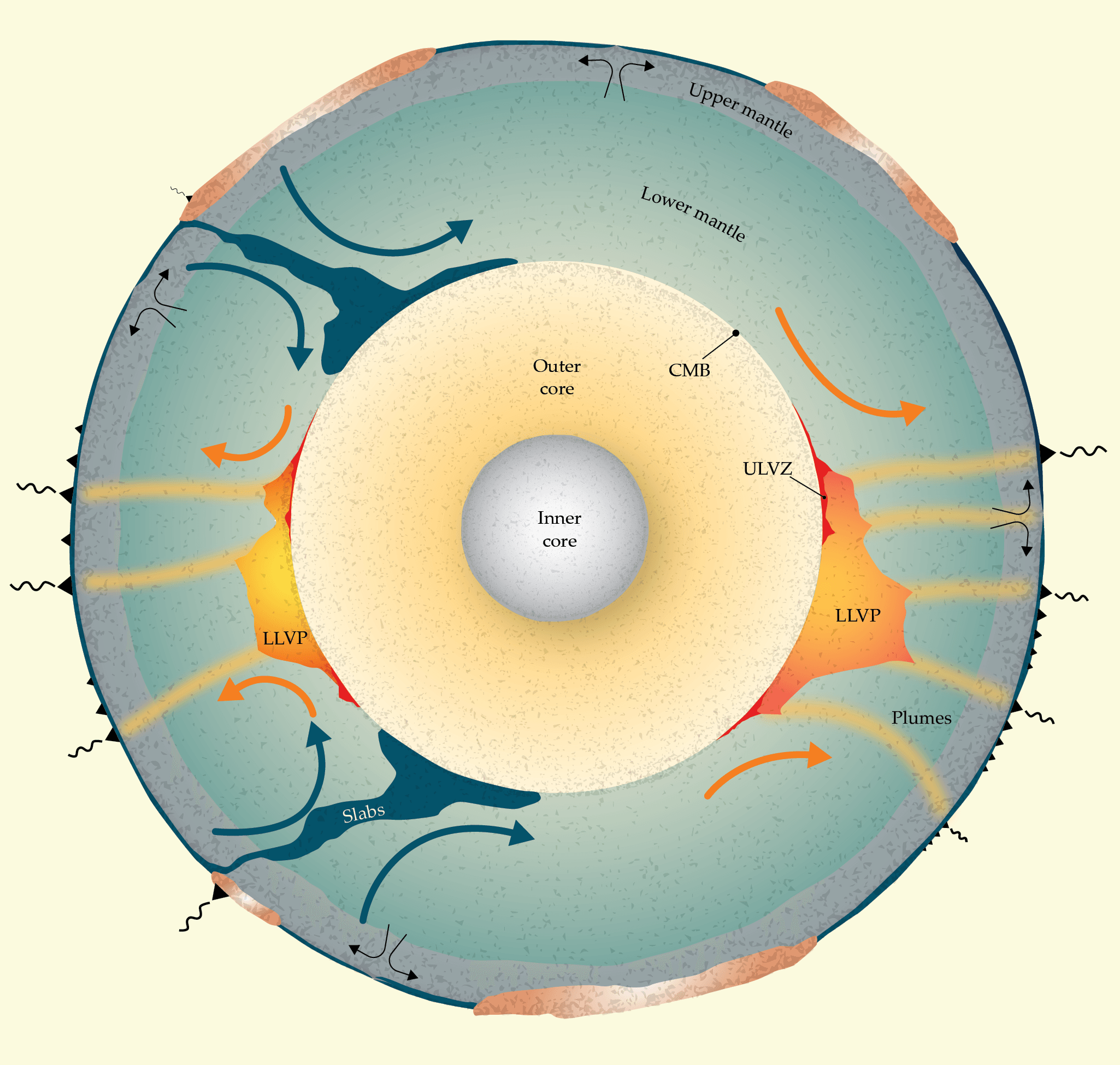
Most of what we know about Earth’s interior comes from observing how seismic waves–mostly from earthquakes–bounce around. As our observations have gotten better–more seisometers, better imaging techniques–scientists have identified two large anomalies sitting near the bottom of the mantle. Known as large low-velocity provinces, or LLVPs, these zones take up continent-sized areas beneath parts of Africa and the Pacific.
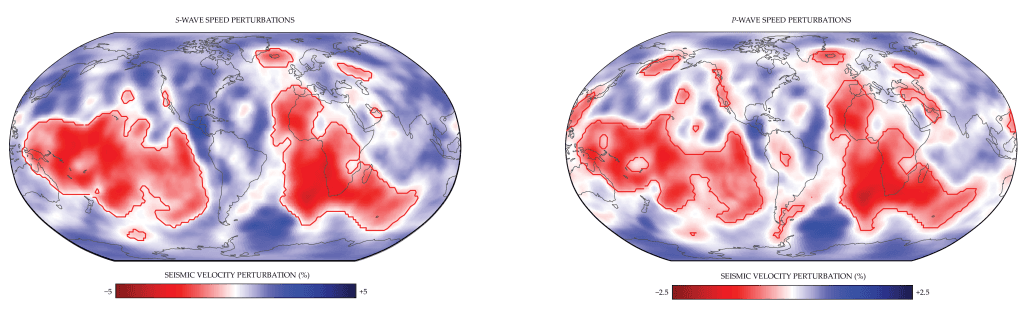
Seismic waves show lower speeds in large, continent-sized zones that sit beneath Africa and the Pacific. These large low-velocity provinces (LLVPs) are outlined in red. The LLVPs are hot, which would normally make them buoyant, but their stationary nature suggests they are made up of extremely dense material. Narrow plumes of hot material make their way up from the LLVPs to form volcanic hotspots like those that made the Hawaiian and Galapagos Islands. Balancing that upward convection is the downward convection of former tectonic material carried into the mantle at subduction zones.
What the LLVPs are made of remains an active research question. One suggestion is that they contain remnants of Theia, the planet thought to have impacted the proto-Earth to form our Moon. (Image credits: E. Garnero and C. Richardson; see also Physics Today)
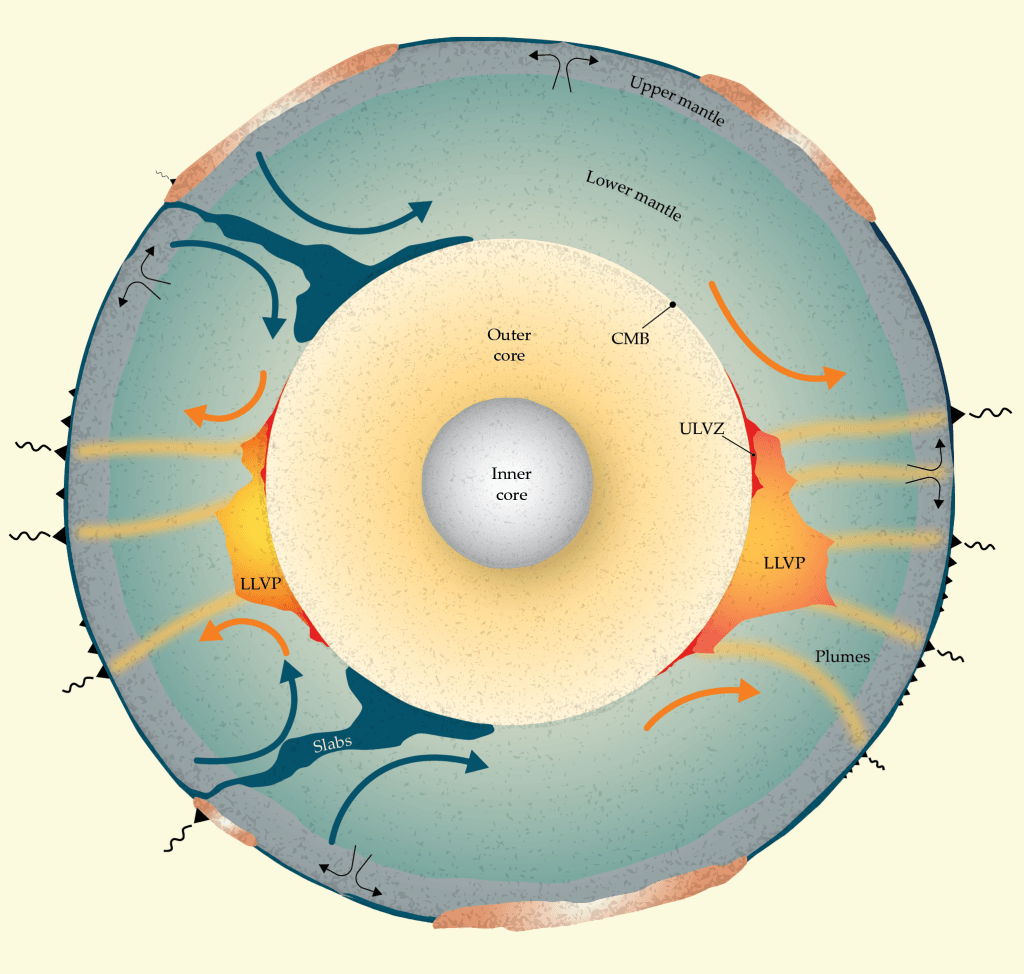
Illustration showing convection in the Earth’s inner mantle. Former tectonic material subducts downward in dark blue zones. The large low-velocity provinces (LLVPs) are shown in orange. Hot-spot volcanic activity is seen at the surface (black triangles) above narrow plumes that lift material from the LLVPs toward the surface. Fediverse Reactions
-
The Disappearing Great Salt Lake
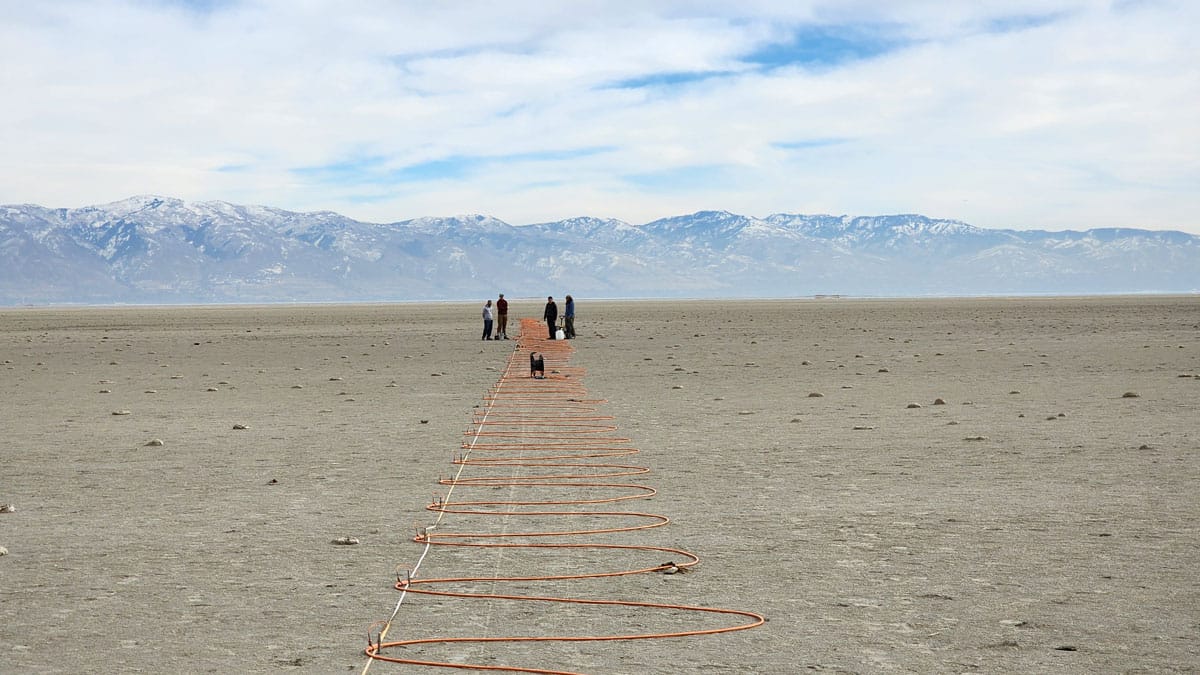
Since 1989, Utah’s Great Salt Lake has lost some 70% of its surface area. The exposed lakebed left behind is a source of toxic dust that gets lifted into the air. Researchers are trying to understand what water sources exist beneath the lake and whether they might save the saline lake and its ecosystem from disappearing entirely.
A recent study pinpoints underground water by measuring the electrical resistance between electrodes placed meters apart in the ground (photo above). Because salty water is more electrically conductive than fresh water, the researchers can distinguish between them. So far, they’ve found quite a lot of fresh water, sometimes only a couple meters below the surface. But those patches are often quite close to saline water, too.
The group also described to Eos that they found mounds of invasive reeds lying atop concentrations of fresh water. The invasive species seems to be sucking up water that would otherwise feed back into the lake or support native plants that provide habitat to native birds. (Image credit: M. Thorne; research credit: M. Jacketta et al.; via Eos)
Fediverse Reactions
-
Moths Taking Flight


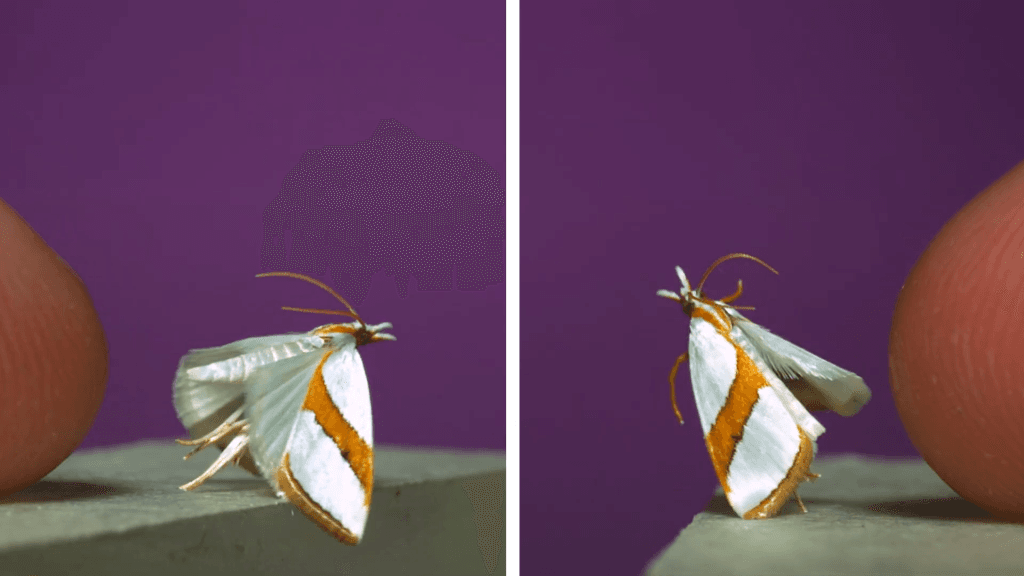


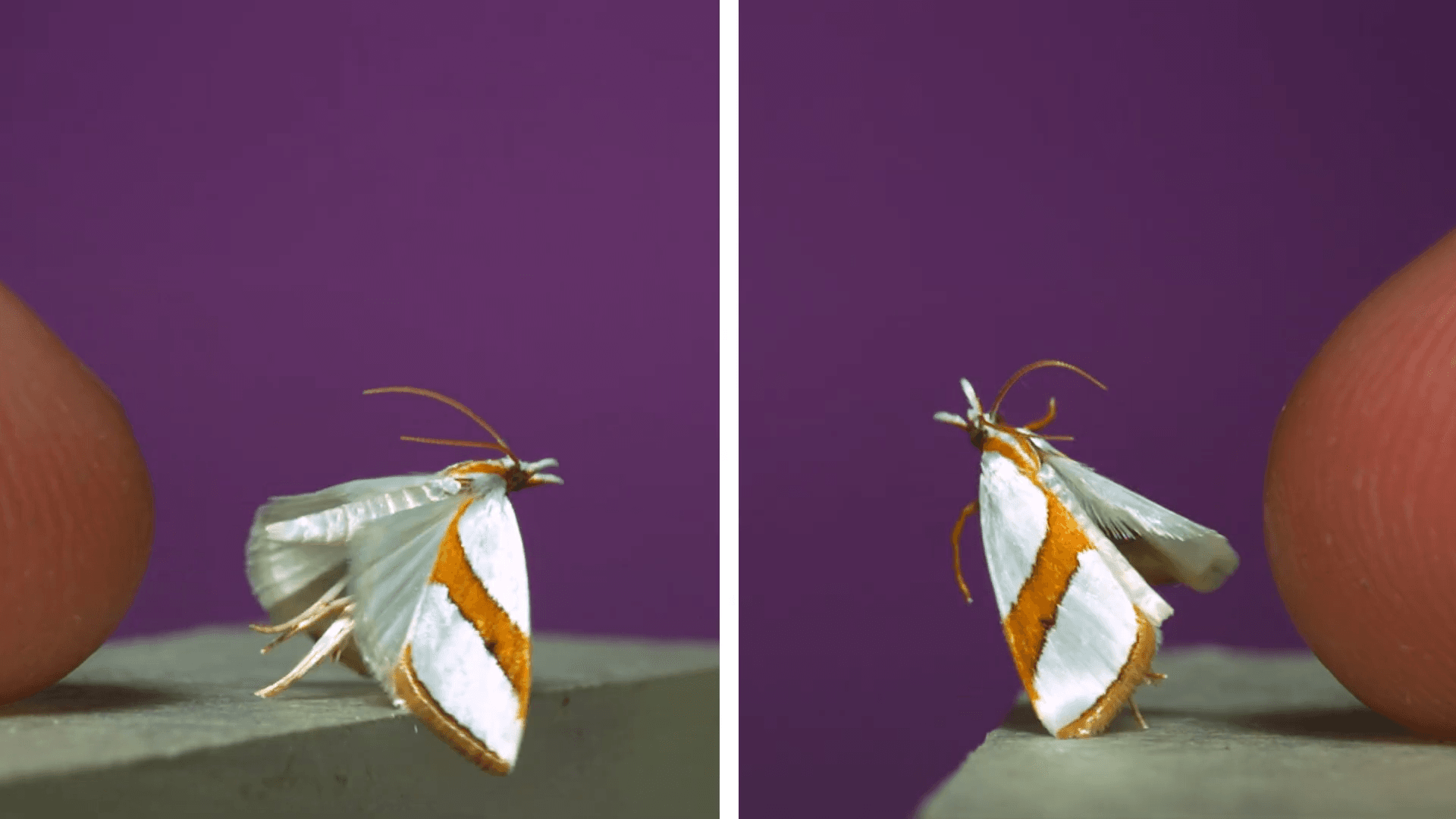
Insect flight is vastly different than the aerodynamics engineers learn around aircraft. That’s particularly apparent looking at these tiny moths taking off and flying in slow motion. Almost every feature seems, at first glance, aerodynamically wasteful. Hairy, scaly surfaces instead of smooth ones? Relatively small wings for their body size? Moths break our engineering intuition.
For moths, flight is an inherently unsteady process. Every stroke of its wings cups and flings fluid away in an effort to generate enough lift to stay aloft. Notice how the wings flex with each stroke. Part of the moth’s efficiency comes from that flexibility, even though keeping wings relatively stiff is the norm for engineering larger fixed-wing craft. And those hairy surfaces? Not only can they help camouflage insects; they keep them hydrophobic so that water bounces off them. (Video and image credit: Ant Lab/A. Smith)
Fediverse Reactions
-

NASA Testing Supersonic Rotors for Mars
NASA’s Ingenuity helicopter was the first aircraft humanity has flown on another planet, and engineers are looking to make the next generation of Martian helicopters bigger and more capable. That’s challenging in Mars‘ thin atmosphere, which is only 1% as dense as Earth’s. To get adequate lift, the rotors need to spin faster there.
During Ingenuity’s mission, the team intentionally designed the craft to keep the rotor tips below supersonic speeds. But for the next mission–SkyFall–they’re looking to push the rotorcraft further. In recent tests in a Mars simulator chamber, they successfully spun the new rotors to tip speeds as high as Mach 1.08, significantly increasing the loads SkyFall could carry. (Image and video credit: NASA/JPL-Caltech; via Ars Technica)
Fediverse Reactions
-
Seeking Quieter Supersonic Flight
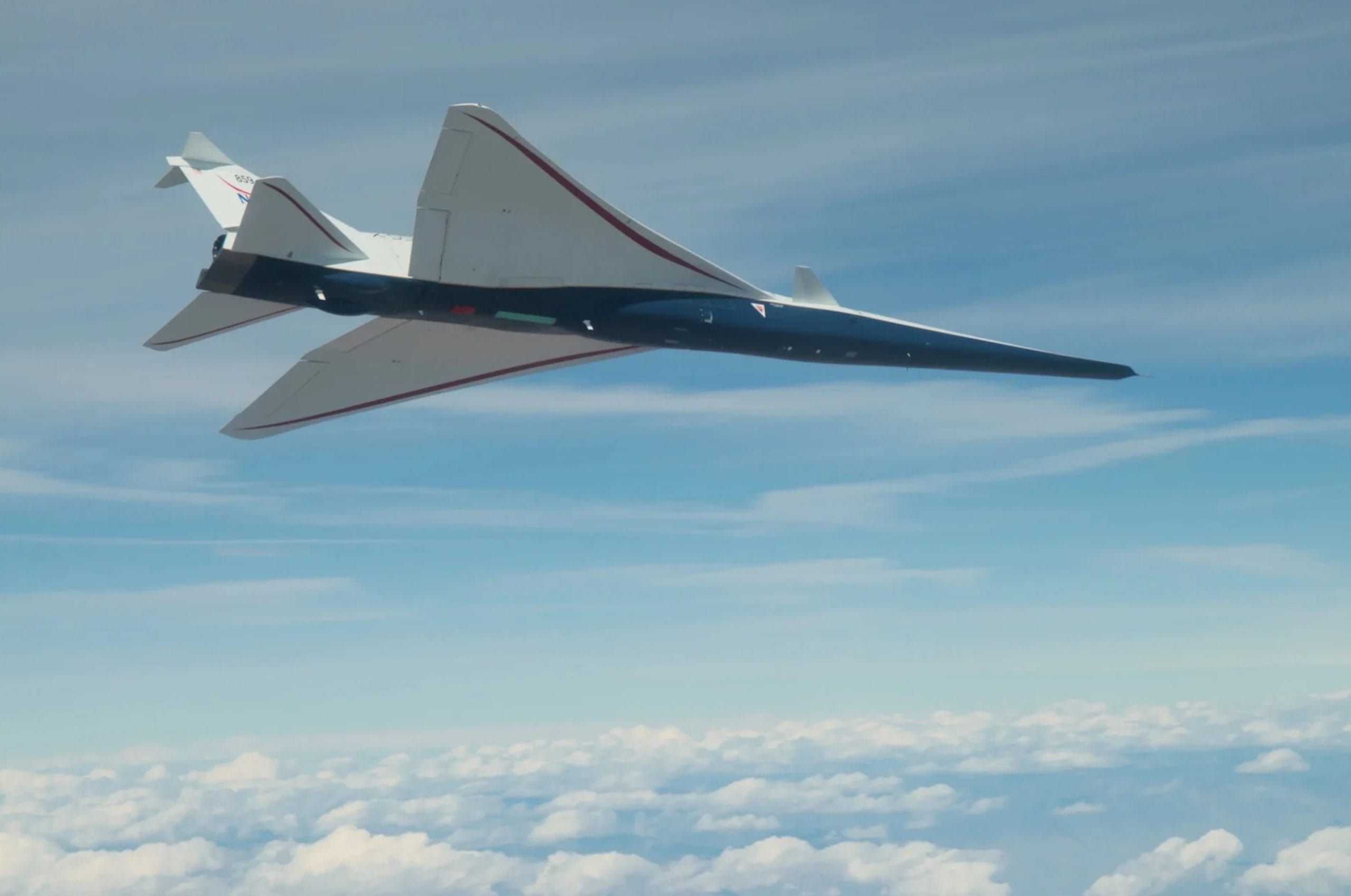
Supersonic flight over the U.S. has been banned by all non-military aircraft for more than fifty years. The ban gained momentum in the 1960s after test programs over St. Louis and Oklahoma provoked public outcry. But NASA’s X-59 aircraft is working to lift the ban by softening the sonic booms that encouraged the ban in the first place. Although it hasn’t been tested at supersonic speeds yet, pilots are putting the sharp and skinny X-59 through its paces, slowly widening the flight envelope.
In the video above, NASA shares footage of some of the recent test flights, including various maneuvers like phugoids, banking rolls, flutter, and landing gear tests. Pay close attention to the pilot’s view and the radio chatter, and you’ll hear that they’re hovering around Mach 0.98 in some cases–just underneath the point of generating a shock wave around the aircraft. It will be neat to see what happens when they finally do go supersonic. Will it be as quiet as promised? (Video credit: NASA; image credit: NASA/L. Losey; see also NASA; via Gizmodo)
Fediverse Reactions
-
Fire From Below
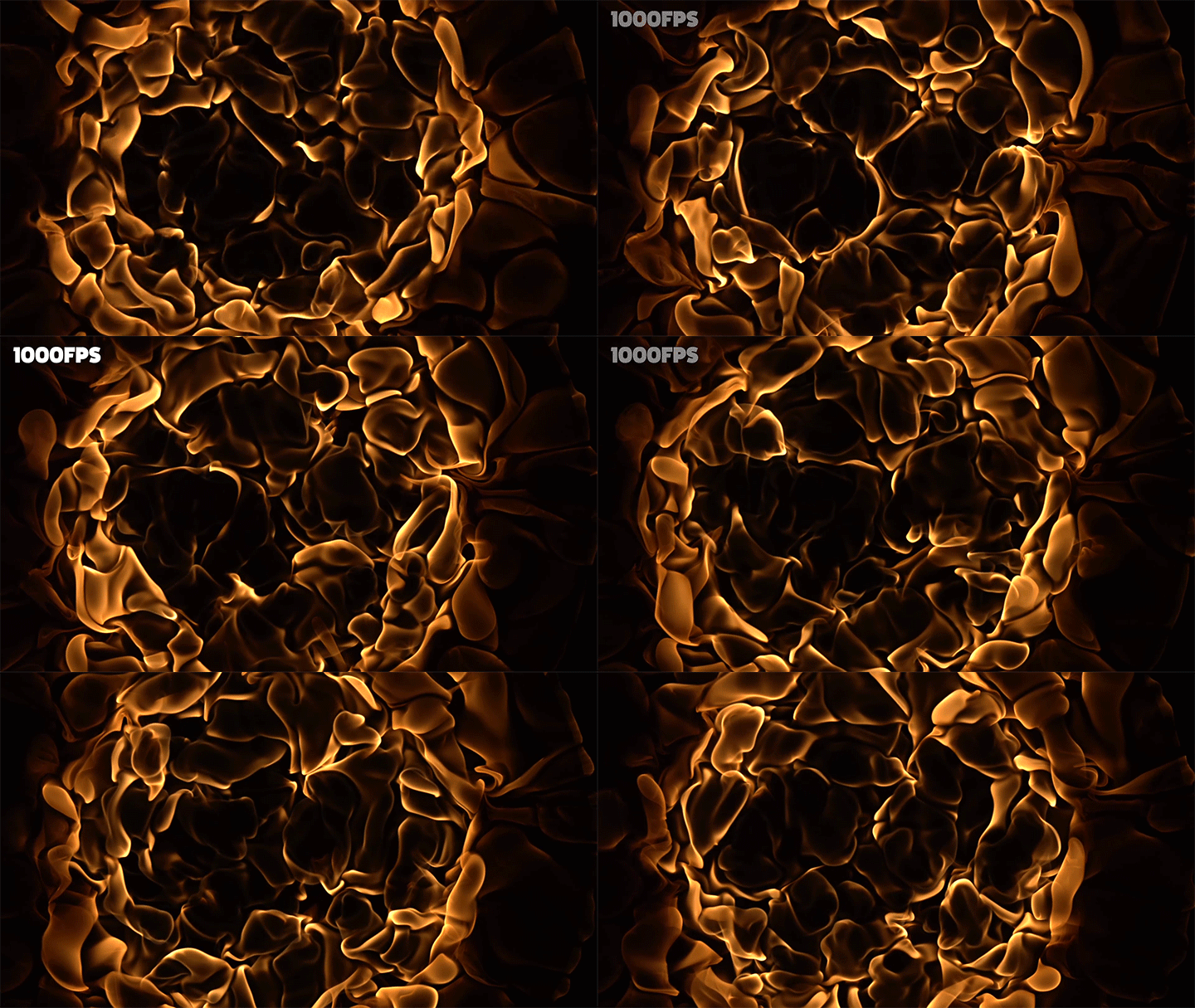

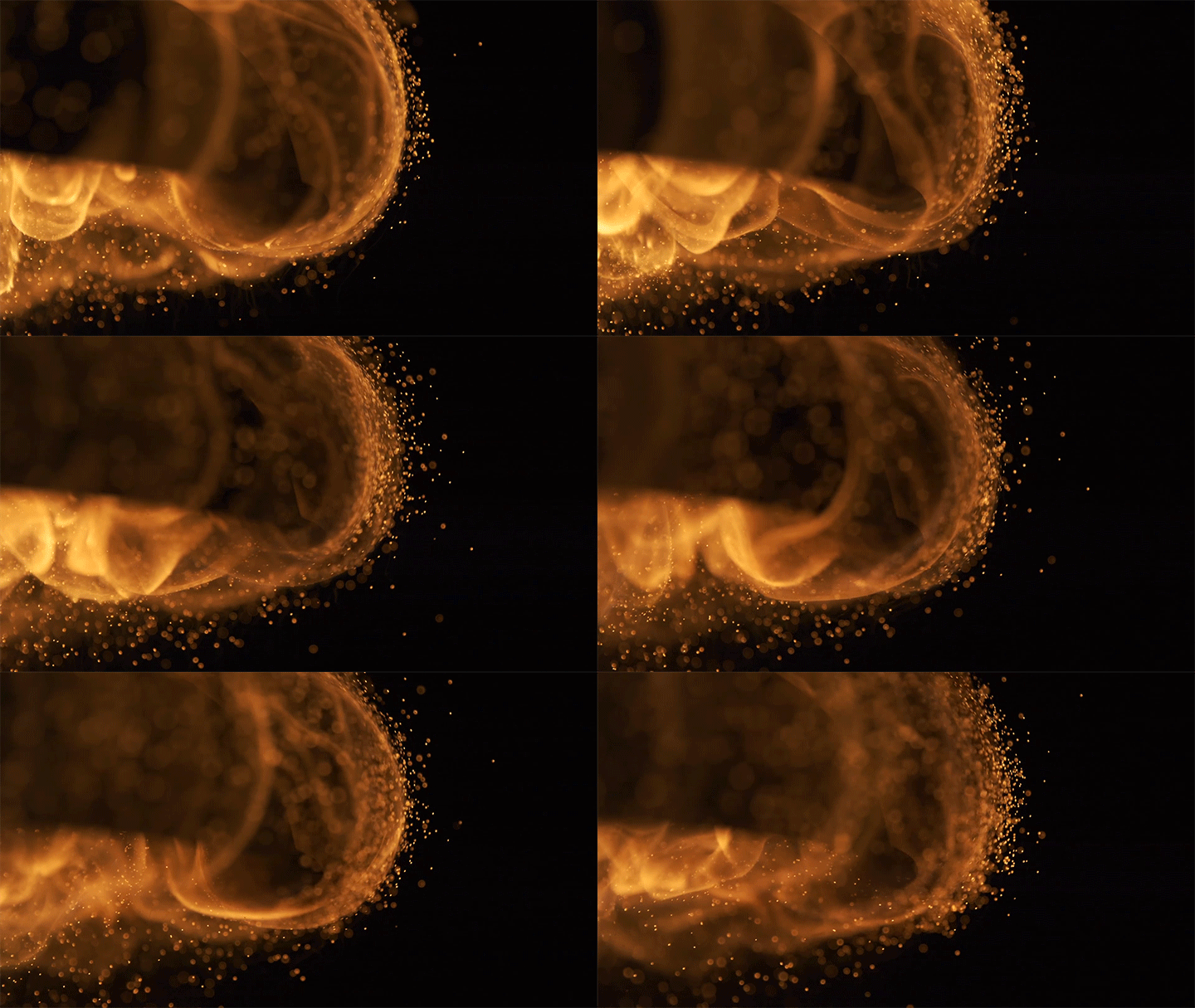
A slight change in perspective can do wonders. In this video, the Slow Mo Guys look at a burning flame from below. They accomplish this by mounting a gas grill upside-down. This small change means that buoyancy can’t simply lift heat and exhaust gases away from the flame source. Instead, the flow pushes out and around the edges of the grill.
The views are, as always, amazing. The billowing flames are mesmerizing–often closer to laminar than turbulent. And the added spectacle of cinnamon combusting in the later segments really does make for the kind of visuals you’d expect in a sci-fi movie. (Video and image credit: The Slow Mo Guys)
Fediverse Reactions
-
Particles Separate When Flowing Downhill


When particle-laden fluids like a mudslide flow downhill, even well-mixed particles can wind up separating. To explore how this works, researchers put glass spheres–of two different sizes but equal density–into silicone oil and let it flow down an incline. Their initially well-mixed oil soon turned red as the larger red particles overtook the smaller blue particles near the front. Looking at the flow from the side, the team observed a Brazil-nut-effect-like behavior where the larger particles move toward the top of the flow. That’s where the flow speed is fastest, and the particles are congregating there despite being denser than the oil carrying them! (Video and image credit: Y. Ba et al.)

Milano Cortina 2026: Ski Jumping Suits
Ski jumping is in the news this Olympic cycle after rumors that male competitors may be cheating in order to wear larger suits. In particular, the suggestion is that male athletes are injecting fillers into their genitals before their pre-season 3D body scan in order to appear large enough to allow them to wear a larger suit. This comes after two Norwegian ski jumpers were punished for illegally restitching the crotches of their suits to make them larger.
Ski jumping is a sport that relies heavily on aerodynamics; during the flight phase, jumpers try to maximize their lift-to-drag ratio so that they stay aloft as long as possible. A 2025 study underscores the importance of suit size in this calculus. In the work, the researchers used a baseline suit that was 4 centimeters larger in circumference than their jumper–the loosest configuration that regulations allow. They compared that suit’s flight performance (in wind tunnels and simulation) to a suit 2 cm larger and one 2 cm smaller. The extra 2 centimeters of circumference made a notable difference: the larger suit increased the drag by ~4% and lift by ~5%. That was enough, in their simulation, to let a jumper fly an extra 5.8 meters.
It’s worth noting, though, that the study was looking at the effects of adjusting the suit’s circumference along the entire length between the arm pits and the knees; they never changed anything about the suit’s crotch. I don’t think there’s enough scientific data to say that packing a bit more there would really offer aerodynamic advantages. And the risks of such injections are non-negligible. (Image credit: T. Trapani; research credit: M. Virmavirta et al.; via Ars Technica)

Fediverse Reactions
-