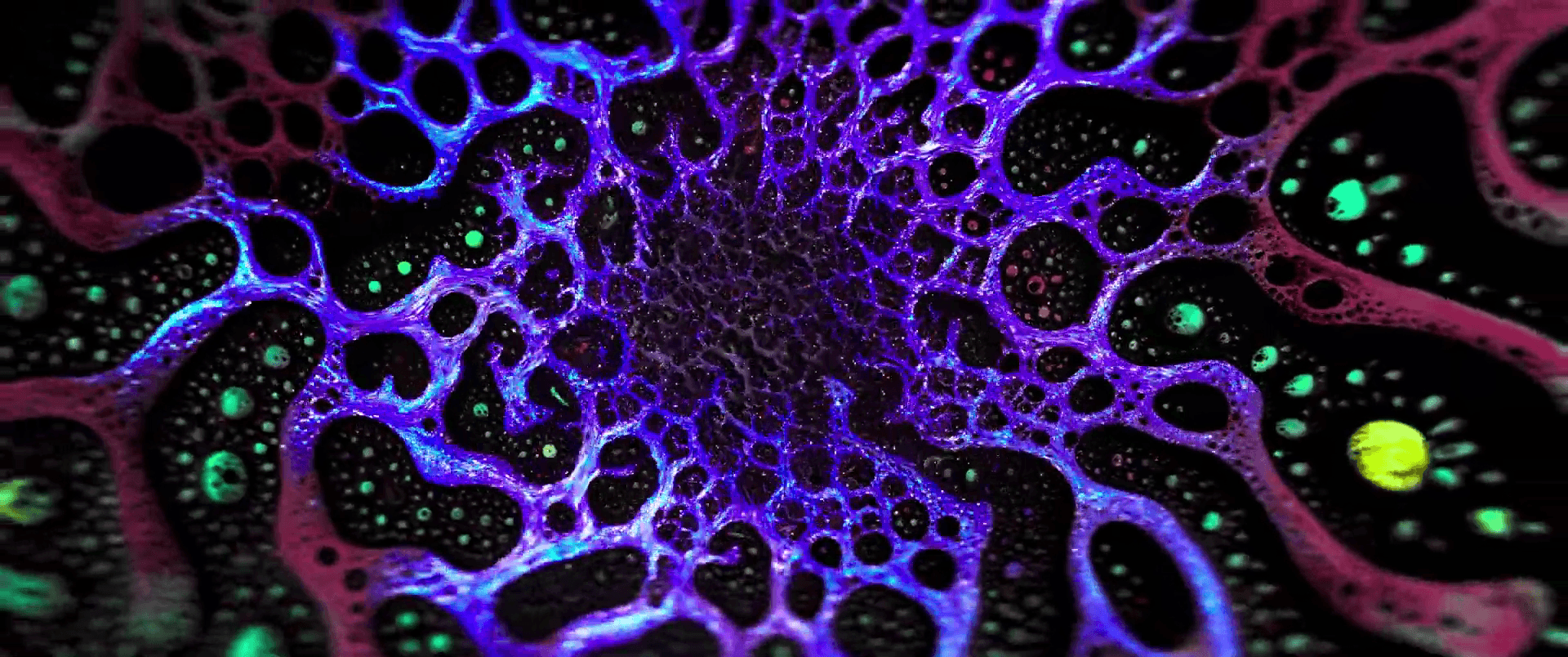
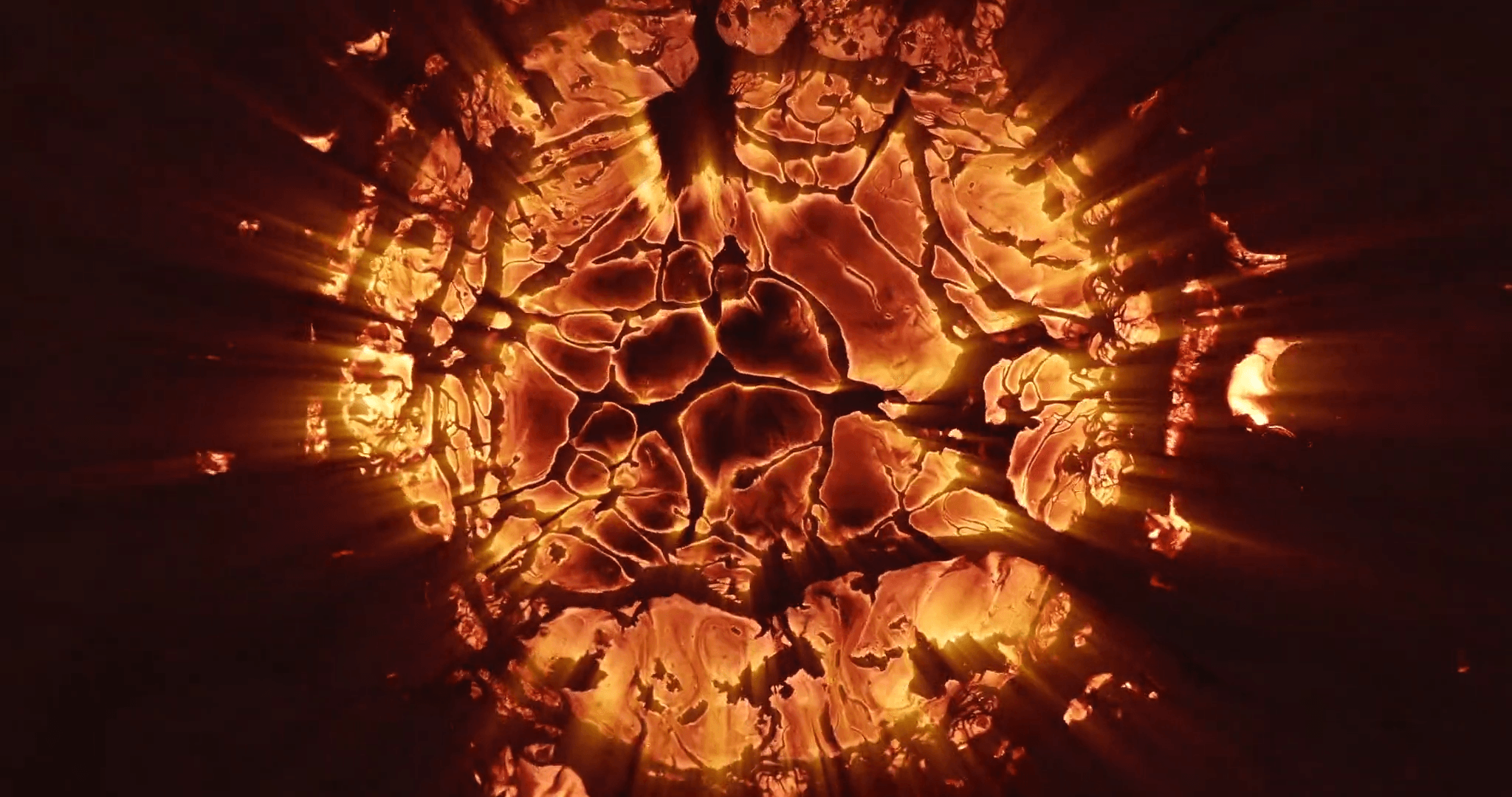
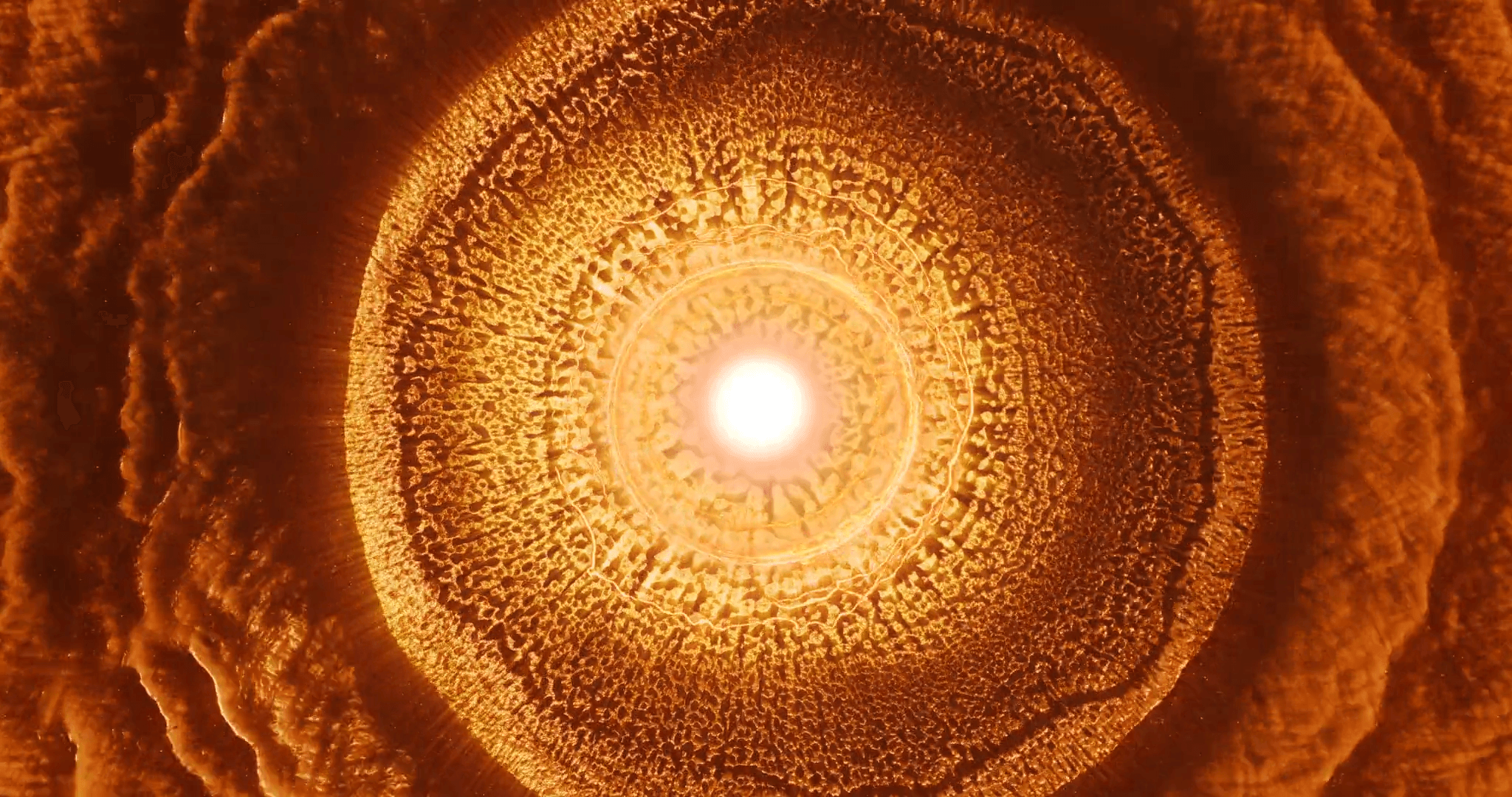
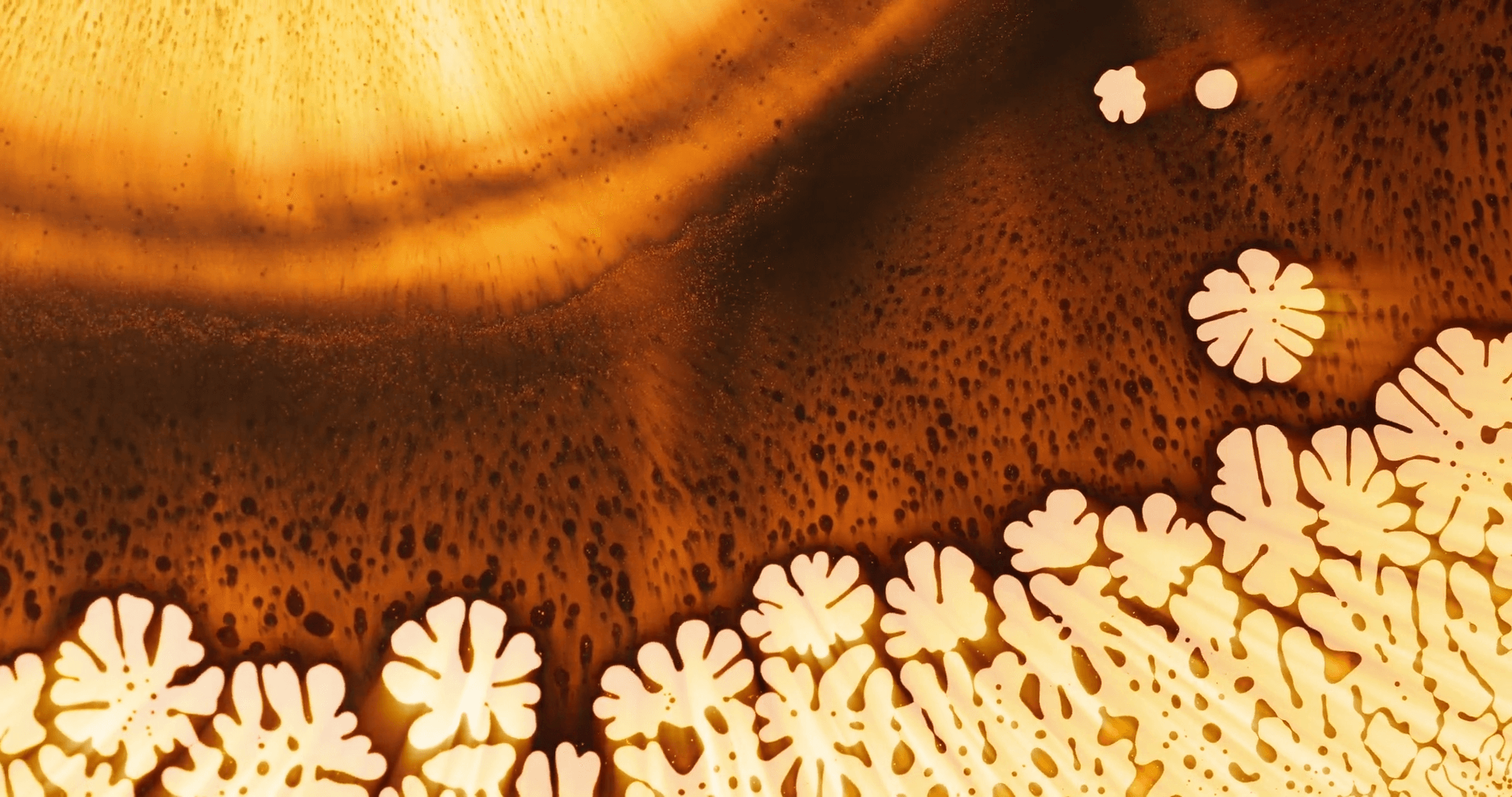
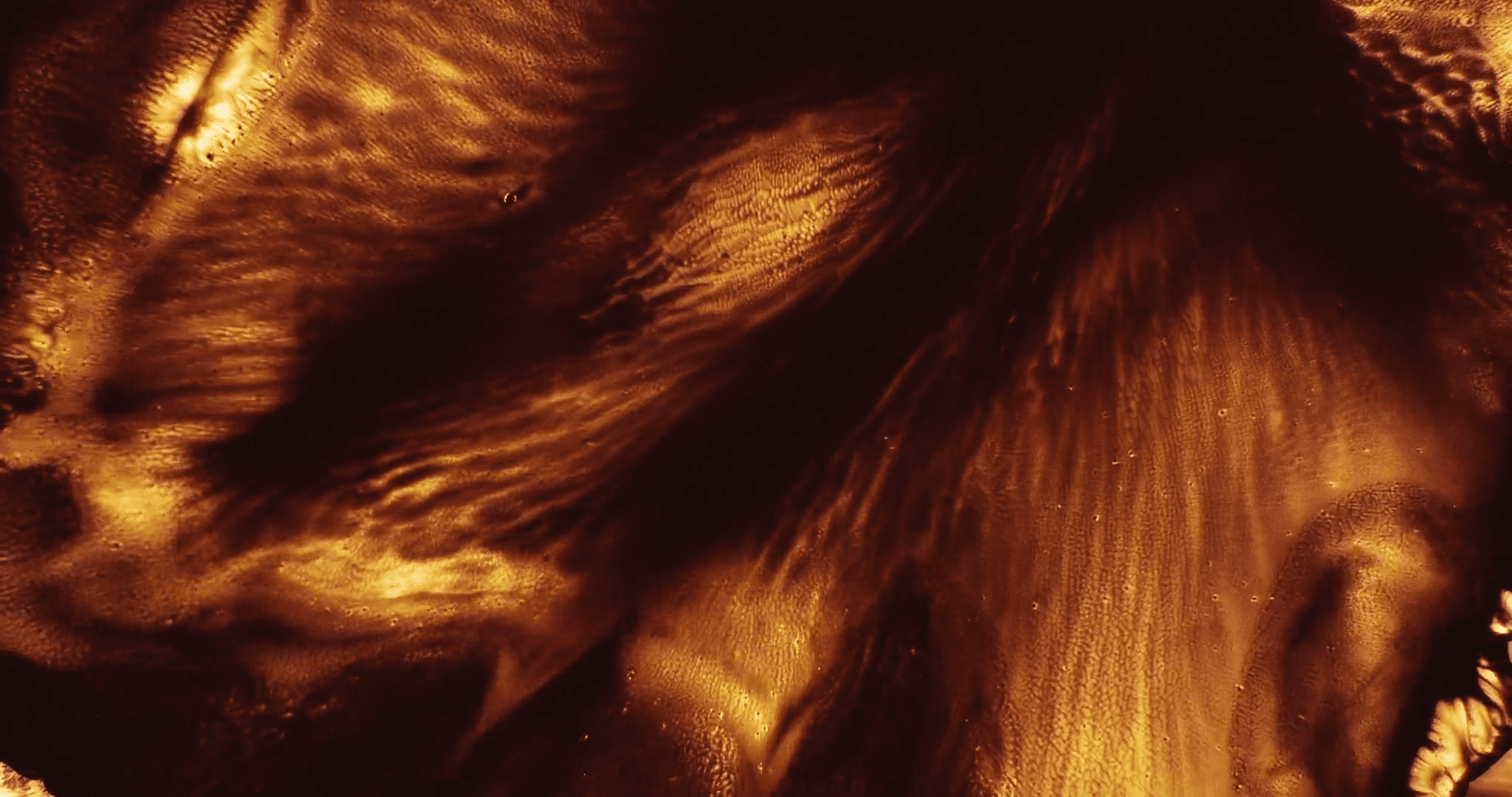
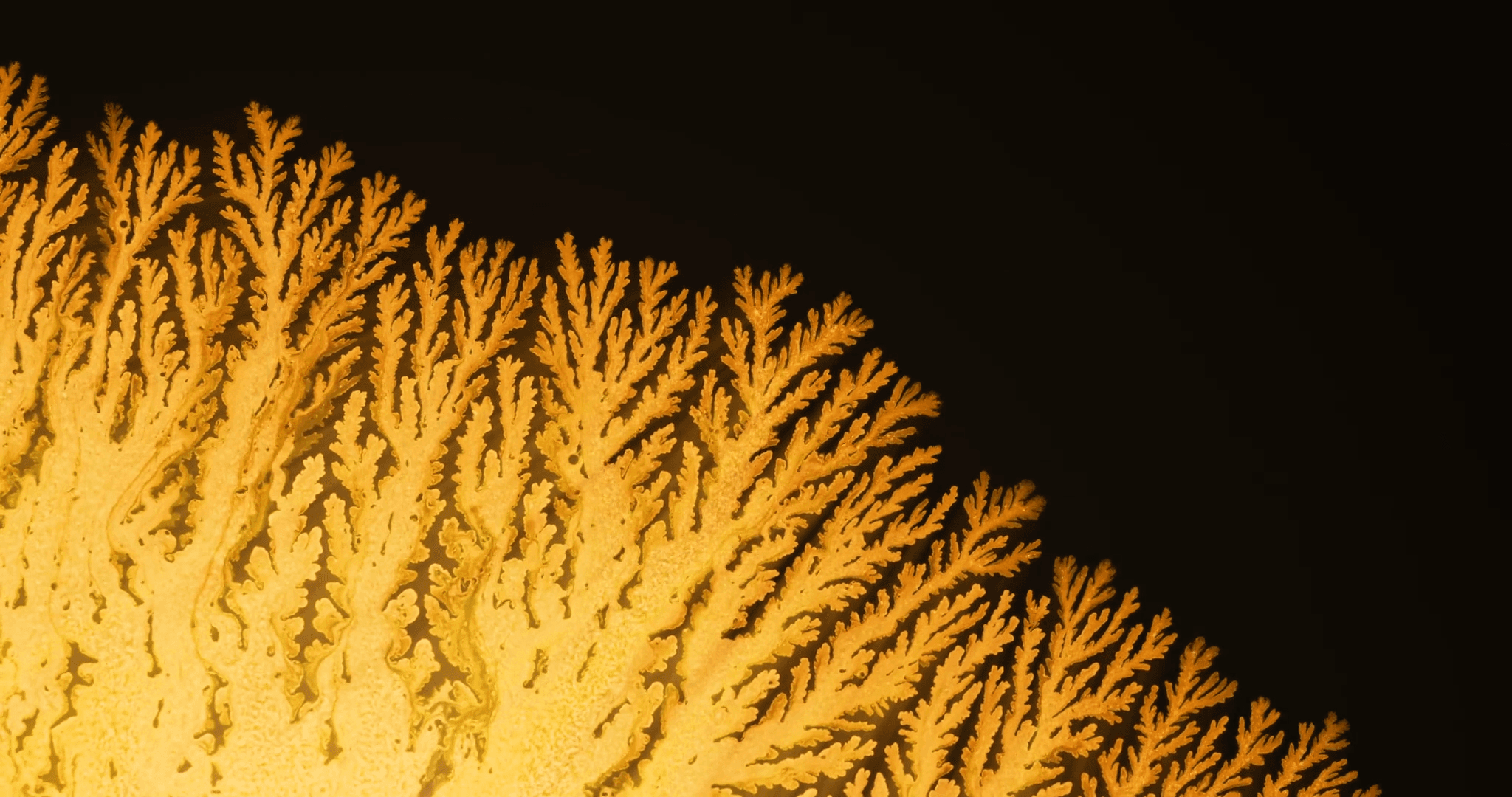
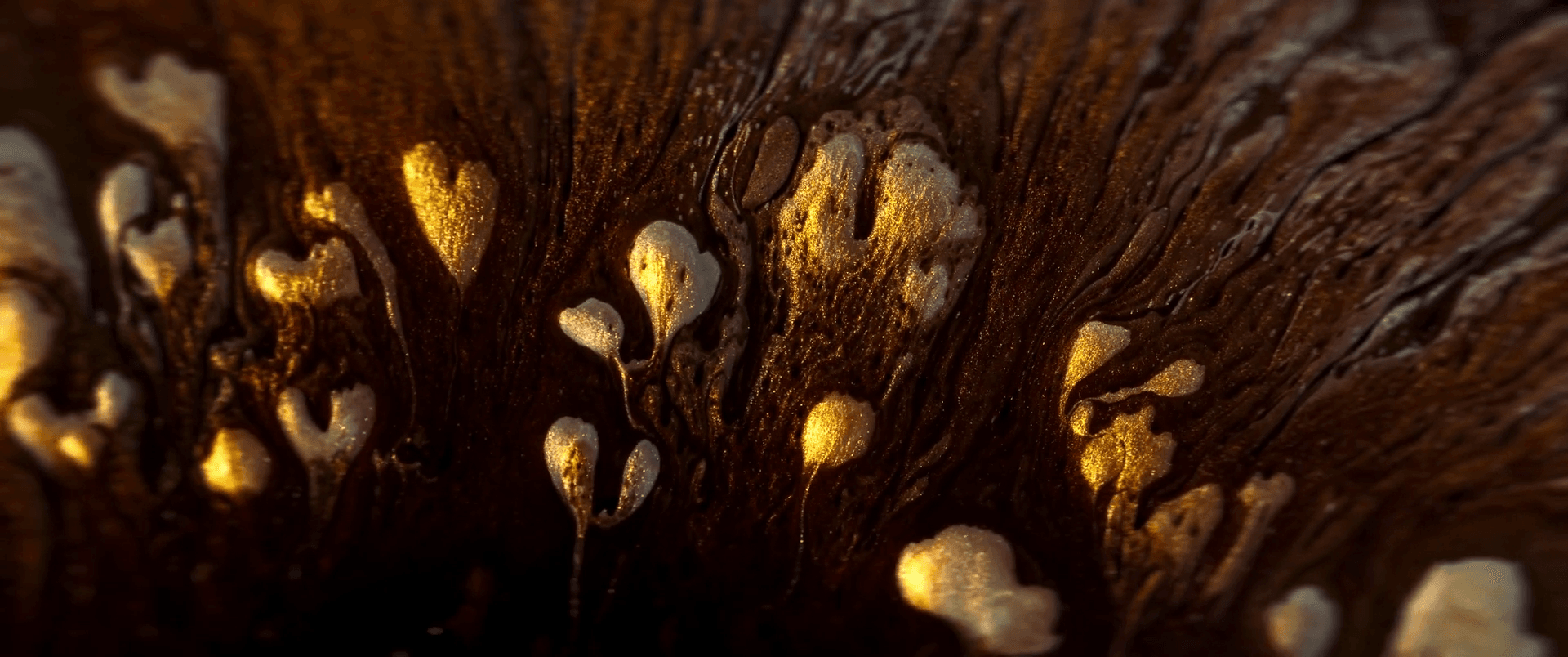
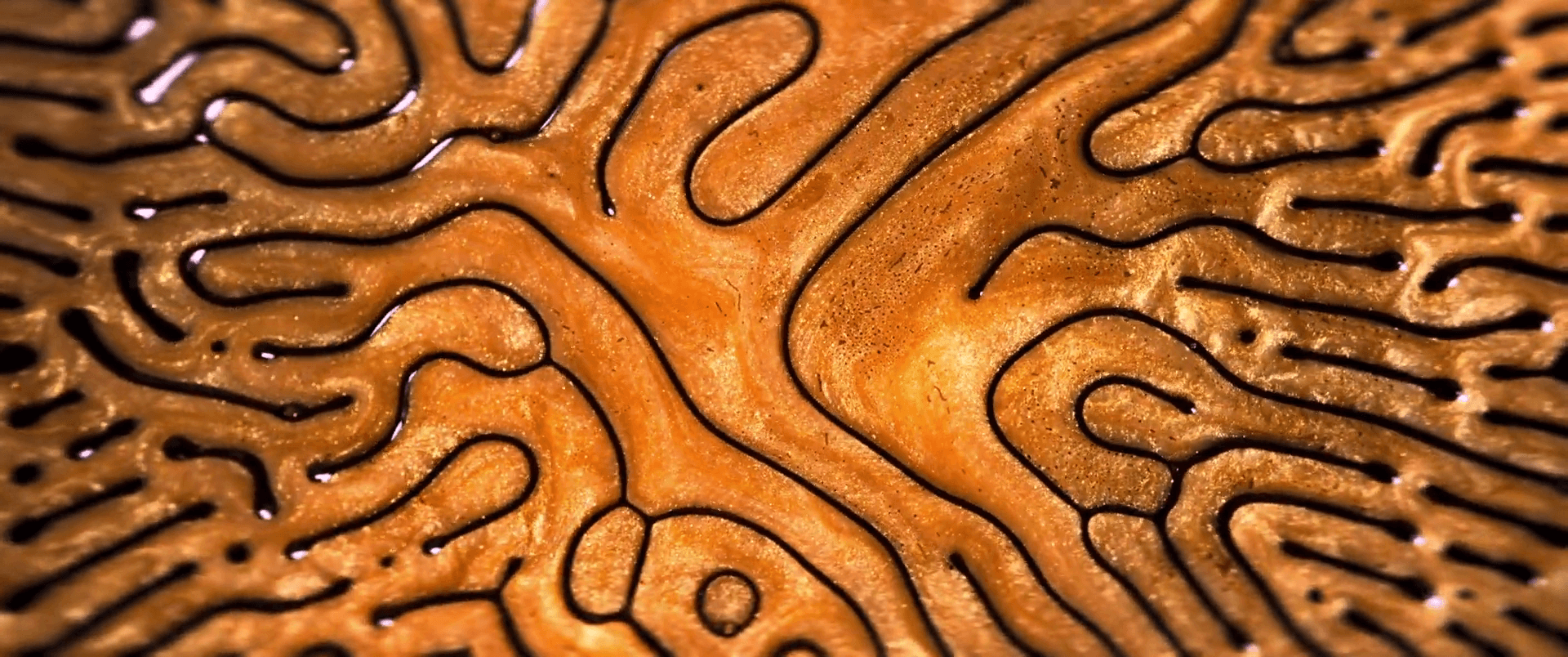
In “Re:Birth,” videographer Vadim Sherbakov explores the fascinating patterns of ferrofluids, which suspend tiny ferrous particles in another liquid, often oil. When this magnetic liquid is mixed with ink or paint, its black lines take on a labyrinthine appearance. The result is rather psychedelic, especially with Sherbakov’s bold colors. (Video and image credit: V. Sherbakov)
Search results for: “ferrofluid”

“Black”
In “Black,” filmmaker Susi Sie combines her visuals of shifting ferrofluids with the music and soundscape of Clemens Haas to create an ominous, almost claustrophobic vibe. With fast cuts and shallow focus, the sharpened points of the normal-field instability appear as flashes of brightness in the dark. At times, the liquid’s surface looks almost like a speaker cone, which is appropriate since ferrofluids are frequently used in speakers to provide cooling and enhance performance. (Video and image credit: Susi Sie)

“Ferro Field”
Ferrofluid forms a labyrinth of blobs and lines against a white background in this award-winning photo by Jack Margerison. Ferrofluids are a magnetically-sensitive fluid, typically created by suspending magnetic nanoparticles in oil. Depending on the ferrofluid’s surroundings that and the applied magnetic field, all sorts of patterns are possible from spiky crowns to wild mazes. (Image credit: J. Margerison from CUPOTY; via Colossal)

The Best of FYFD 2021
A year ago I observed what a strange year 2020 had been, and in many ways, I could say the same of 2021. Before the pandemic, I spent quite a lot of time traveling. In 2021, the only nights I slept outside my own bed came on a long weekend up to the mountains with my family. But 2021 also saw a bit of a return to normalcy – I was giving keynote addresses and workshops again, albeit virtually. What will 2022 hold? Who knows?!
As per tradition, here are the top FYFD posts of 2021:
- A superior mirage leaves a ship floating in mid-air
- Drone videos of sheep herding are mesmerizing
- Permeable pavement allows water to drain
- The slow and dreamy fluid landscape of “Le Temps et l’Espace”
- What do you do when you’re an insect researcher with a high-speed camera?
- Satellite images… or paint?
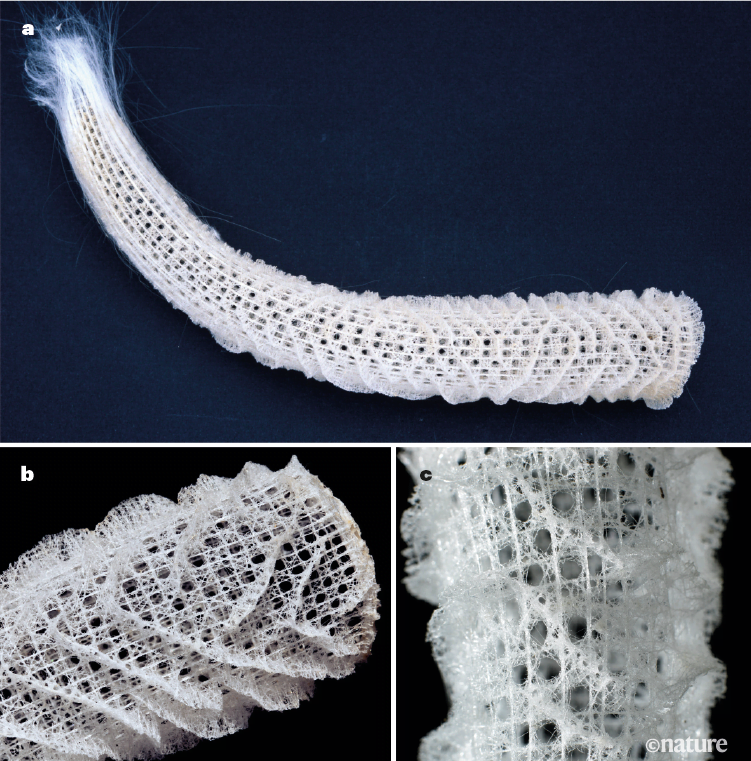
- The intricate lacework of the Venus’s flower basket sea sponge
- Building a Bluetooth speaker with ferrofluid music visualization
- Finding the acoustics of Stonehenge
- Making butter by traditional French methods
It’s an eclectic mix of topics this year: bizarre phenomena, stunning art, archaeological exploration, and a touch of biophysics!
If you enjoy FYFD, please remember that it’s primarily reader-supported. You can help support the site by becoming a patron, making a one-time donation, buying some merch, or simply by sharing on social media. And if you find yourself struggling to remember to check the website, remember you can get FYFD in your inbox every two weeks with our newsletter. Happy New Year!
(Image credits: mirage – D. Morris, sheep – L. Patel, pavement – Practical Engineering, Le Temps – T. Blanchard, insects – Ant Lab, Satellike – R. De Giuli, sea sponge – G. Falcucci et al., speaker – DAKD Jung, Stonehenge – T. Cox et al., butter – Art Insider)

Pumping Through Liquid Tubes
As the tubes carrying a liquid get smaller, it becomes harder and harder to keep fluids flowing. Friction between the fluid and the wall brings flow there to a standstill and means that moving fluid through tiny tubes requires enormous forces. To alleviate this issue, a new study uses a clever arrangement of magnets to create a tube with ferrofluid walls instead of solid ones.
The researchers call their liquid-walled pipes “antitubes” and show off just how useful they can be. Because the ferrofluid allows liquid to slip by it, flow through the antitubes is nearly frictionless. As seen in the last animation, honey flows about as easily through the antitube as it does with no tube in place at all!
The antitubes are also easy to modify into valves and pumps just by applying (and/or moving) a magnet (Images 1 and 2). Combined with their low friction, these features make antitubes perfect for applications like pumping blood outside the human body without damaging delicate cells. You can see a demonstration of that in the video above. (Video, image, and research credit: P. Dunne et al.; via Physics World; submitted by Kam-Yung Soh)

“The Other Side”
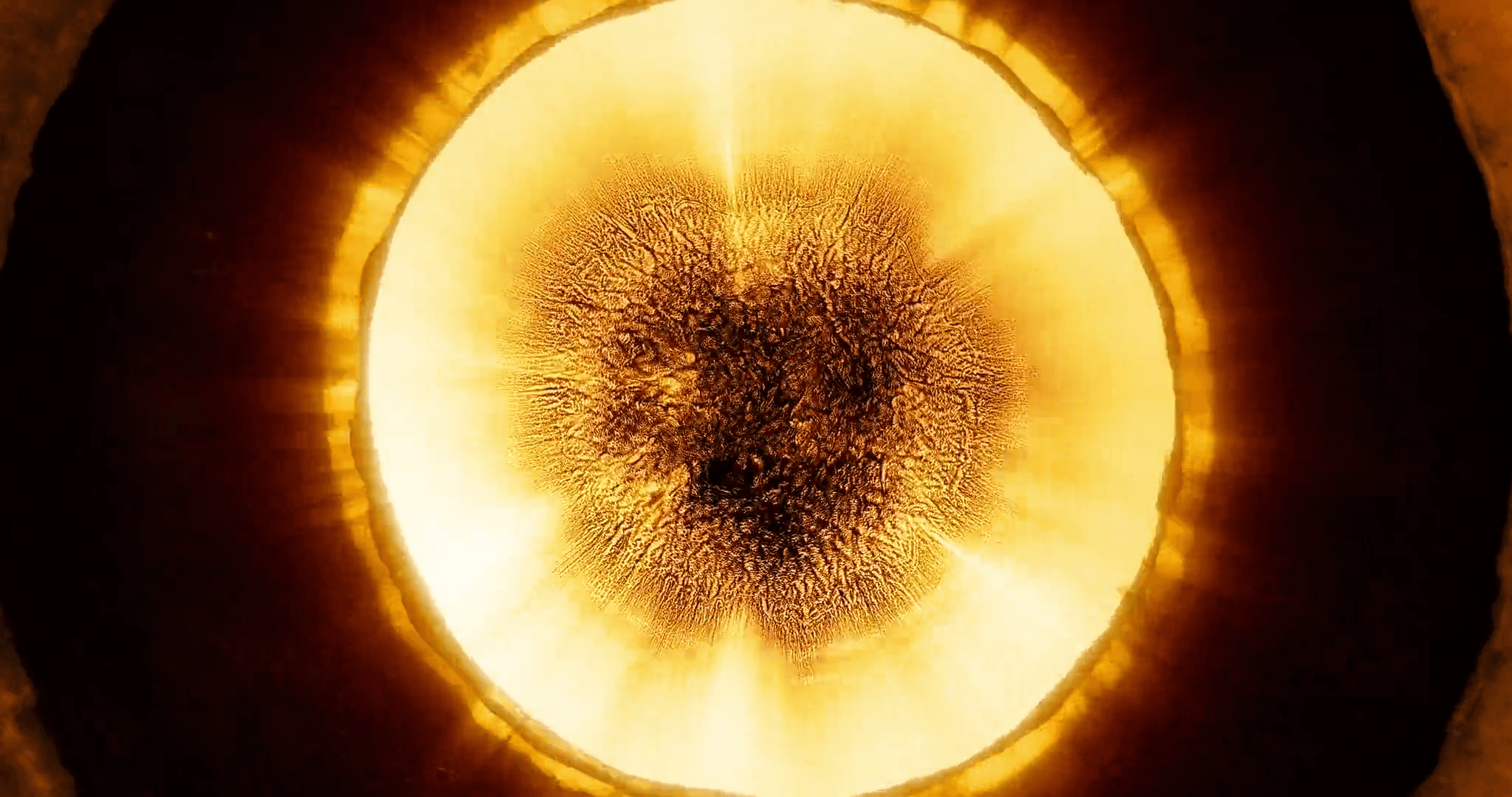
“The Other Side” is a short film imagining fluids on the other side of people’s eyes. The fast-paced editing makes this one feel rather different from Thomas Blanchard’s other films, which often take the time to linger on the mixing of soaps, inks, and paints that form the bulk of the imagery. There are hints of ferrofluids here, too, but like much of the action, if you blink you’ll miss it.
Strange as it may sound, there’s actually a strong connection between eyes and fluid dynamics, whether you’re considering the optimal length for eyelashes, the way a tear film coats the eye, or how vision changes in microgravity. (Image and video credit: T. Blanchard)

The Best of FYFD 2019
2019 was an even busier year than last year! I spent nearly two whole months traveling for business, gave 13 invited talks and workshops, and produced three FYFD videos. I also published more than 250 blog posts and migrated all 2400+ of them to a new site. And, according to you, here are the top 10 FYFD posts of the year:
- The perfect conditions make birdsong visible
- Pigeons are impressive fliers
- The water anole’s clever method of breathing underwater
- 100 years ago, Boston was flooded with molasses
- The BZ reaction is some of nature’s most beautiful chemistry
- The labyrinthine dance of ferrofluid
- 360-degree splashes
- The extraordinary flight of dandelion seeds
- Dye shows what happens beneath a wave
- Bees do the wave to frighten off predators
Nature makes a strong showing in this year’s top posts with five biophysics topics. FYFD videos also had a good year: both my Boston Molasses Flood video and dandelion flight video made the top 10!
If you’d like to see more great posts like these, please remember that FYFD is primarily supported by readers like you. You can help support the site by becoming a patron, making a one-time donation, or buying some merch. Happy New Year!
(Image credits: birdsong – K. Swoboda; pigeon take-off – BBC Earth; water anole – L. Swierk; Boston molasses flood – Boston Public Library; BZ reaction – Beauty of Science; ferrofluid – M. Zahn and C. Lorenz; splashes – Macro Room; dandelion – N. Sharp; dyed wave – S. Morris; bees – Beekeeping International)

CU Flow Vis 2019
I love when science and art come together, which is why I’ve long been a fan of the Flow Vis course at CU Boulder. Some of my earliest posts on FYFD date from previous editions of the course. Here are a few of my favorite images from the Fall 2019 class, from the top:
- Ferrofluid and India ink merge in this colorful photo. A magnet underneath the mixture on the left side causes the dark spikes of ferrofluid, but without magnetic influence, the ink and ferrofluid form cell-like droplets.
- Although it looks like a shower head, this is actually fluorescent oobleck dripping through a strainer. A relatively long exposure time means that it’s impossible to tell whether the oobleck is falling in a fluid stream or broken-up chunks.
- These colorful water droplets are sitting on a hydrophobic surface, hence their extremely rounded edges. I particularly like how this makes each one like a little lens for the light shining through them and into their shadows.
- A thin layer of ferrofluid reacts to the magnet beneath. Gotta love those little streaks left behind the flow.
For those in the Front Range area, the Flow Vis class will be showcasing their work on Saturday, December 14th at the Fiske Planetarium. Snacks are at 4:30 pm and the show starts at 5 pm. For those not nearby, you can peruse the art from this semester and previous ones at your leisure online. (Image credits: colorful ferrofluid – R. Drevno; falling oobleck – A. Kumar; droplets – A. Barron; macro ferrofluid – A. Zetley)

“Emergence”
Artist Susi Sie explores fluidic worlds through her macro lens. In “Emergence,” her focus is on ferrofluids immersed in other liquids. Beginning with tiny droplets traversing the thin fluid channels of a foam, she allows the unique qualities of ferrofluids to slowly take center stage. Dark blobs grow into curvy labyrinths as a magnetic fields come into play. Until ultimately the magnetic nature of the fluid becomes undeniable as scattered droplets elongate into miniature compass needles and swing around to follow the field lines. (Video and image credit: S. Sie)

Liquid Magnets
Ferrofluids – those distinctively spiky liquids – are made up of magnetically sensitive nanoparticles in a carrier liquid, and although they respond to applied magnetic fields, they retain no magnetism outside of that field. But researchers have now succeeded in making actual liquid magnets. Shown above, these drops also contain ferromagnetic nanoparticles. But unlike traditional ferrofluids, in these drops the nanoparticles are not entirely free to move. They’re jammed together at the interface, so when a magnetic field is applied, the nanoparticles will align like tiny bar magnets. When that magnetic field is removed, though, the nanoparticles cannot easily reconfigure, so they remain aligned and the drops continue being magnetic.
Researchers hope these ultrasoft magnets, which can be manipulated remotely through magnetic fields, will be useful in the future for applications like targeted drug delivery. In theory one could introduce, say, chemotherapy drugs into one of these liquid magnets, then use magnetic fields to guide it directly to a cancerous tumor. (Image and research credit: X. Liu et al.; via Science News; submitted by Kam-Yung Soh)