
Fizzy drinks like soda and champagne have many bubbles which rise to the surface before bursting. When the film separating the bubble and the air drains and bursts, it leaves a millimeter-sized cavity that collapses on itself. That collapse creates an upward jet of fluid which can break into tiny aerosol droplets that disperse the aroma and flavor of the drink. Similar bubble-bursting events occur in sea spray and industrial applications, too. Researchers find that droplet ejection depends on bubble geometry and fluid properties such as viscosity. More viscous liquids, for example, generate smaller and faster droplets. Learn more and see videos of bubble-bursts at Newswise. (Image credit: E. Ghabache et al.)
Search results for: “droplet”

Raindrops on Sand
Here is a high-speed look at the impact of a raindrop on a sandy beach. In this case, a water droplet is falling on a bed of uniform glass beads, but the situation is effectively the same. Depending on the speed of the drop at impact, many types of craters are possible. The higher the impact velocity, the greater the momentum of the drop at impact and the more likely the drop is to tear apart when surface tension can no longer hold it together. Interestingly, there is remarkable similarity between the shape and behavior of these liquid drop impacts and those of a catastrophic asteroid impact. (Video credit: R. Zhao et al.)
Supercooling Water
Supercooling is the process of lowering a fluid’s temperature below its freezing point without the fluid becoming solid. Though this may sound bizarre, it’s an effect you can recreate easily in your refrigerator, as detailed in the video above. Supercooling shows up in nature as well, particularly with water droplets at high altitudes. If a plane flies through supercooled water droplets, it can create icing problems on the aircraft’s wings. Alternatively, flying through supercooled water vapor can cause a hole-punch cloud to form when the vapor flash-freezes into snow. (Video credit: SciShow)
Coalescence in Microgravity
Microgravity is a wonderful playground for fluid dynamics. Here astronaut Reid Wiseman demonstrates the interplay of forces involved in coalescence. When smaller droplets hit with insufficient force, they bounce off the water sphere. But if they hit hard enough to overcome surface tension, they coalesce with the sphere. I think the space station needs a high-speed video camera; I’d like to see this behavior at a few thousand frames per second! (Video credit: R. Wiseman/NASA)
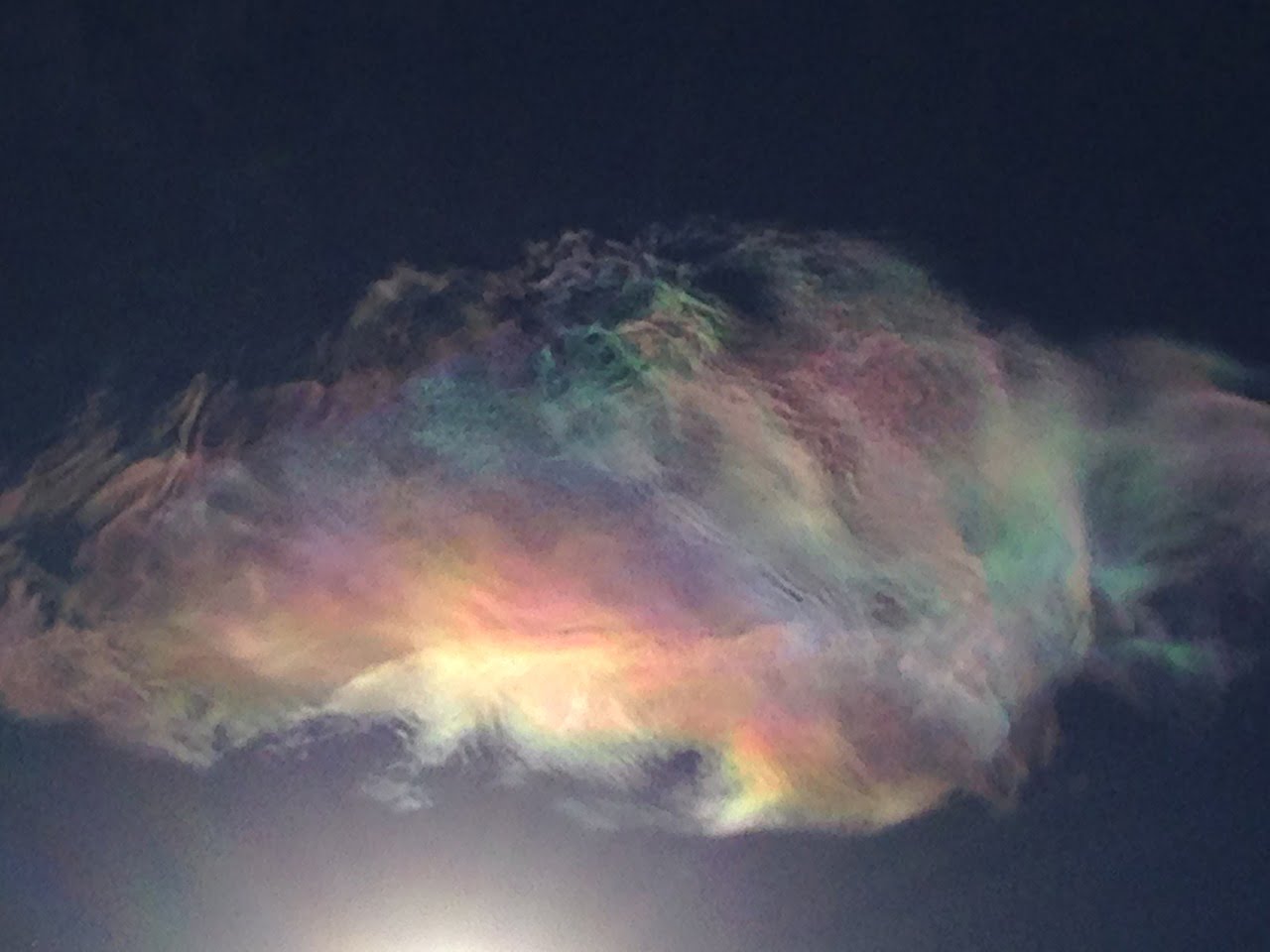
Iridescent Clouds
Look up at the clouds on the right day and you may catch a glimpse of a rainbow-like phenomenon known as cloud iridescence. These colors occur when sunlight is diffracted through small water droplets or ice crystals. For the effect to be apparent, the cloud must be optically thin, meaning that most of the rays of sunlight must pass through only a single droplet or ice crystal. This means the effect is usually visible only near the edges of clouds or as new clouds are forming. You can see more photos of the phenomenon here, and there’s a great video where cloud iridescence makes an appearance during a rocket launch in this previous entry. (Photo credit and submission: C. Havlin)
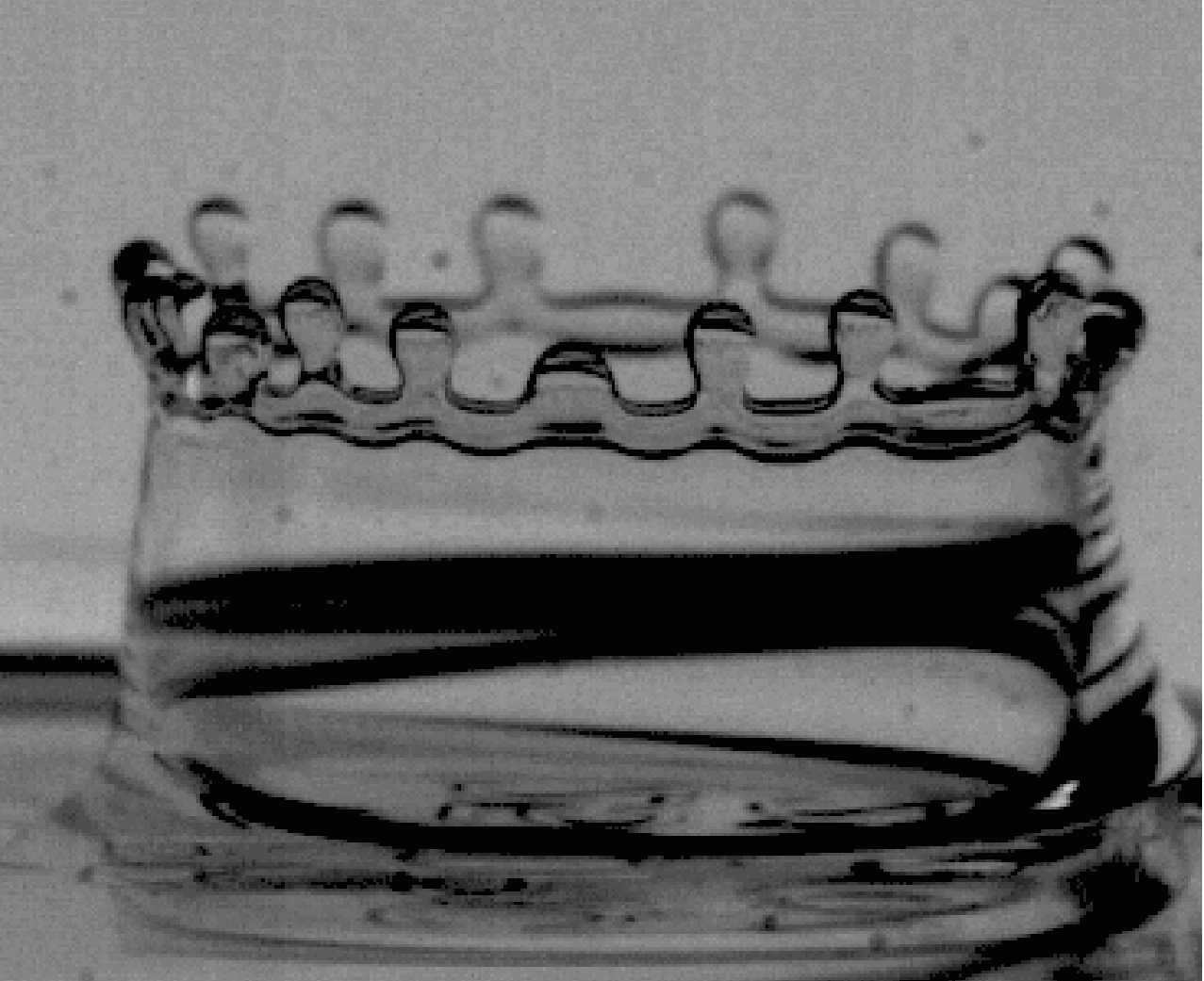
Momentary Crown
When a drop falls on a liquid film, its impact drives a thin liquid sheet called the ejecta upward and outward from the point of impact. Within milliseconds, tiny perturbations develop in the ejecta and begin growing exponentially. These become the distinctive spikes of the crown. The momentum from the impact drives the ejecta and spikes further outward until it overcomes surface tension’s ability to hold the liquid crown together. Tiny droplets escape the crown before the ejecta comes crashing down. The whole process takes only a few hundred milliseconds from start to finish. (Photo credit: S. Jung et al.)

Plume Stratification
Clean-up of accidents like the 2010 Deepwater Horizon oil spill can be complicated by what goes on beneath the ocean surface. Variations in temperature and salinity in seawater create stratification, stacked layers of water with differing densities. When less dense layers are on top, the fluid is said to be stably stratified. Since oil is less dense than water, one might assume that buoyancy should make an oil plume should rise straight to the ocean surface. But the presence of additives or surfactants in the oil mixture plume can prevent that. With surfactants present, an oil mixture tends to emulsify, breaking into tiny droplets like a well-mixed salad dressing. Even if the density of the emulsion is smaller than the surrounding fluids, such a plume can get trapped at a density boundary, as seen in the photo above. Researchers report a critical escape height, which depending on the plume’s characteristics and stratification boundary, determines whether a plume escapes or becomes trapped. (Image credit: R. Camassa et al.)
Bounce or Freeze?
Icing is a major problem for aircraft. When ice builds up on the leading edge of a wing it creates major disruptions in flow around the wing and can lead to a loss of flight control. One of the important factors in predicting and controlling ice building up is knowing when and where water droplets will freeze. The video above shows how surface conditions on the wing affect how an impacting droplet freezes. On a subzero hydrophilic surface, a falling droplet spreads and freezes over a wide area, which would hasten ice buildup. A hydrophobic surface is slightly better, with the droplet freezing over a smaller area, whereas a superhydrophobic surface shows no ice buildup. Unfortunately, at present superhydrophobic surfaces and surface treatments are extremely delicate, making them unsuitable for use on aircraft leading edges. (Video credit: G. Finlay)
Zesty Fireballs
Zesting the skin of a citrus fruit like oranges releases a spray of tiny oil droplets. Citrus oil has several volatile components, meaning that it evaporates quickly at room temperature. It is also a liquid with a relatively low flash point, meaning that only modest temperatures (~40-60 degrees Celsius) are needed to generate enough vapor to ignite a vapor/air mixture. With volatile and flammable liquid fuels, a spray of droplets is an ideal platform for combustion because the essentially spherical droplets have a high surface area from which they can evaporate and provide vaporous fuel. (Video credit: ChefSteps)

Beading Fluids
Adding just a few polymers to a liquid can substantially change its behavior. The presence of polymers turns otherwise Newtonian fluids like water into viscoelastic fluids. When deformed, viscoelastic fluids have a response that is part viscous–like other fluids–and part elastic–like a rubber band that regains its initial shape. The collage above shows what happens to a thinning column of a viscoelastic fluid. Instead of breaking into a stream of droplets, the liquid forms drop connected with a thin filament, like beads on a string. In a Newtonian fluid, surface tension would tend to break off the drops at their narrowest point, but stretching the polymers in the viscoelastic fluid provides just enough normal stress to keep the filament intact. If the effect looks familiar, it may be because you’ve seen it in the mirror. Human saliva is a viscoelastic liquid! (Image credit: A. Wagner et al.)