Search results for: “art”

  • Wet Masks Block Droplets Better

    Wet Masks Block Droplets Better

    As wearing face masks for long periods has become more typical, you may have wondered whether a soggy mask offers less protection. All masks — cloth, surgical, and N-95s — get moist from their wearer’s breath. A recent study indicates this isn’t a cause for alarm, though.

    Researchers looked at how relatively high-speed droplets (like those from a cough or sneeze) impact dry and wet masks. These high-speed droplets can break into smaller droplets upon impact with a mask layer. The more layers a mask has, the fewer droplets make it through. But even for single-layer masks*, a moistened mask layer lets fewer droplets through. So you don’t have to worry if it’s a little humid in there. Your mask is still working! (Image credit: top – V. Davidova, other – S. Bagchi et al.; research credit: S. Bagchi et al.; via APS Physics)

    * To be clear, you should be wearing masks that are more than a single layer thick. Personally, I’m still only going into indoor public spaces in an N-95 at this point.

    Droplet penetration through a mask. Top row: dry, single layer mask. Middle row: wet, single layer mask. Bottom row: wet, triple layer mask.
    Droplet penetration through a mask. Top row: dry, single layer mask. Middle row: wet, single layer mask. Bottom row: wet, triple layer mask. When wet, masks permit fewer droplets through.
  • Triple Leidenfrost Effect

    Triple Leidenfrost Effect

    Droplets can skitter across a hot surface on a layer of their own vapor, thanks to the Leidenfrost effect. If two Leidenfrost droplets of the same liquid collide, they merge immediately. But that doesn’t always happen with two dissimilar liquids. A new study looks at how dissimilar Leidenfrost droplets collide. The researchers found that these drops can bounce off one another repeatedly before their eventual merger (Image 1).

    Just as a vapor layer prevents the drops from touching the hot plate, a vapor layer forms between them when they collide, preventing contact (Image 2). Because of these three distinct areas of Leidenfrost vapor (one beneath each drop and one between the drops), the researchers call this the triple Leidenfrost effect.

    Eventually, the more volatile (in other words, easily evaporated) drop shrinks to a size similar to its capillary length, at which point the drops merge. If the boiling points of the two liquids are vastly different, the merger can be explosive (Image 3). (Image and research credit: F. Pacheco-Vázquez et al.; via APS Physics)

  • Jovian Circulation

    Jovian Circulation

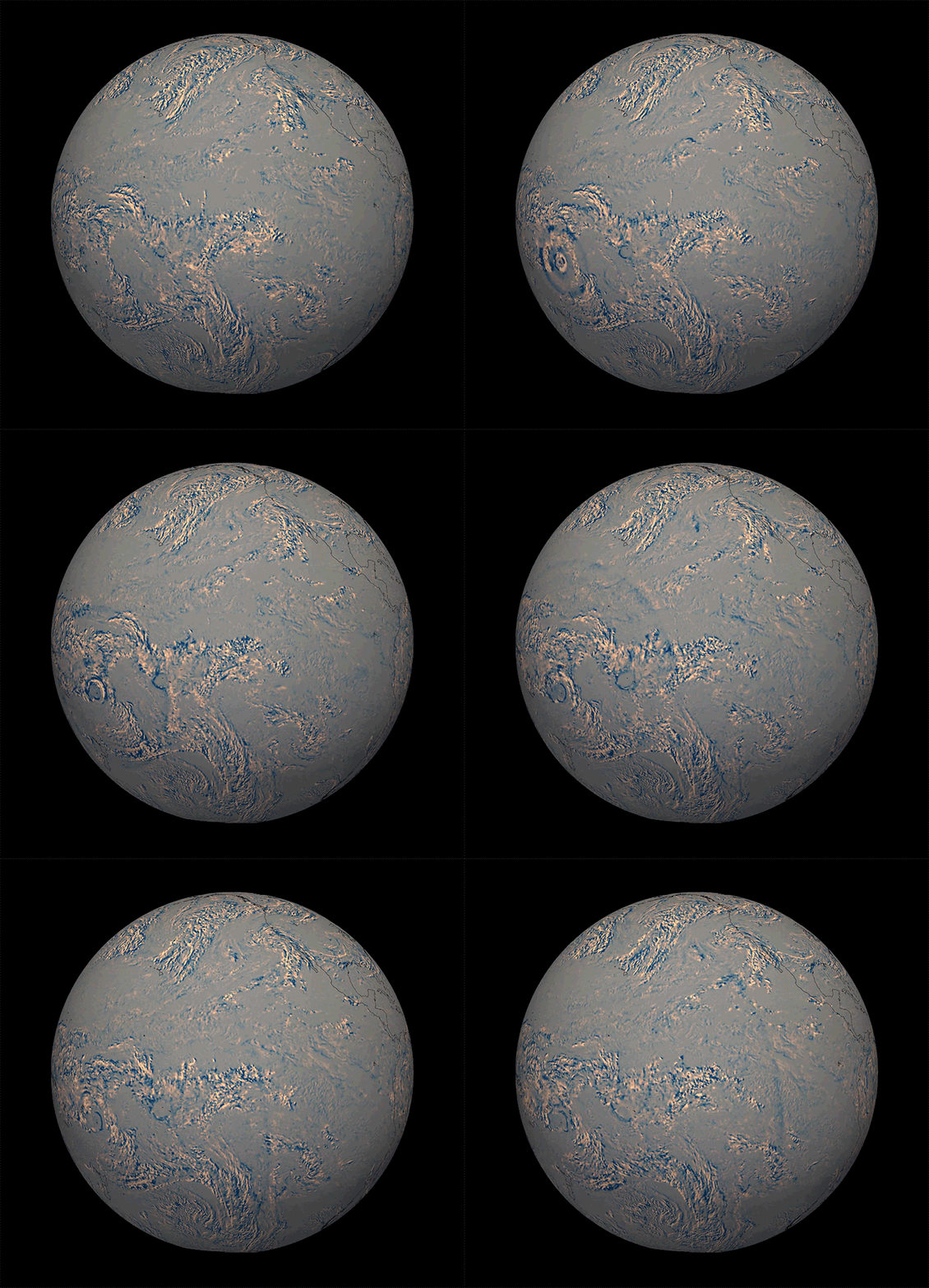
    Jupiter‘s atmosphere remains quite mysterious, due to our limited ability to measure the depths of the gas giant’s clouds. But measurements from the Juno spacecraft are continuing to shape researchers’ understanding of our massive neighbor. By tracking ammonia distributions in Jupiter’s belts and zones, a team has found a series of circulation cells similar to the Ferrel cells of Earth’s midlatitudes.

    Unlike the stronger Hadley cells and polar cells, Earth’s Ferrel cells are relatively weak. They’re driven by turbulence and the motion of the circulation cells to the north and south. The Northern and Southern hemispheres each have one Ferrel cell. In contrast, Jupiter — with its larger size and higher rotation rate — boasts eight Ferrel-like cells in each hemisphere! (Image and research credit: K. Duer et al.; via Universe Today; submitted by Kam-Yung Soh)

  • Featured Video Play Icon

    “The Green Reapers”

    This short film from artist Thomas Blanchard focuses on carnivorous plants and their prey. These plants — including Venus fly traps, sundews, and pitcher plants — rely on fluids both to attract and capture their prey. Plants like the Venus fly trap build turgor pressure in their cells to move and prop open their leaves. Once triggered, a mechanical release allows the fluid pressure to snap the trap closed. Sweet-smelling fluids invite insects in, only to become nightmarishly difficult to escape once prey try to unstick themselves from the highly viscoelastic liquids. (Video and image credit: T. Blanchard; via Colossal)

  • Ice and Dunes

    Ice and Dunes

    Although dunes are usually associated with scorching climates, they can form in any desert, including in the frozen steppes of western Mongolia. This sunrise photo, taken by an astronaut aboard the ISS, shows Ulaagchinii Khar Nuur. The ice-covered Khar Nuur Lake surrounds two islands, Big and Small Avgash, and cold dunes form textured streaks on either side. The low sun angle accentuates the dunes, making every rippling crest clear. (Image credit: NASA; via NASA Earth Observatory)

  • Falling Pancake Drops

    Falling Pancake Drops

    Despite their round appearance, the droplets you see here are actually shaped like little pancakes. They’re sandwiched inside a Hele-Shaw cell, essentially two plates with a viscous fluid between them. As these droplets fall through the cell, some remain steady and rounded (Image 1), while others experience instabilities (Images 2 and 3). By varying the ratio of the ambient fluid’s viscosity relative to the drop, the authors found two different kinds of breakup. In the first type (Image 2), droplet breakup occurred due to perturbations inside the drop itself. In the second type (Image 3), the viscosity of the ambient fluid is closer to that of the drop and intrusions of the ambient fluid into the drop break it apart. (Image and research credit: C. Toupoint et al.)

  • Swimming in Line

    Swimming in Line

    When swimming in open waters, it pays to keep your ducks (or your goslings!) in a row. A recent study examined the waves generated behind adult water fowl and found that babies following directly behind them benefit from their wake. In the right spot behind its mother, a duckling sees 158% less wave-drag than it would when swimming solo. That’s such a large reduction that the duckling actually gets pulled along! And the advantage doesn’t just help one duckling; a properly-placed duckling passes the benefit on to its siblings as well. So any duckling that stays in line has a much easier time keeping up, but those who slip out of the ideal spot will have a much tougher time. (Image credit: D. Spohr; research credit: Z. Yuan et al.; via Science News; submitted by Kam-Yung Soh)

  • Featured Video Play Icon

    “Beyond the Horizon”

    Shifting bubbles and psychedelic colors abound in this abstract video from artist Rus Khasanov. He provides no specifics as to the materials he uses for this video, but my guess is they likely include oil, soap, and polarizing filters. It’s a fun and funky video! See more of Khasanov’s work on his website and Instagram. (Image and video credit: R. Khasanov)

  • Mountains in the Sky

    Mountains in the Sky

    Our skies can sometimes presage the weather to come. In thunderstorms, a cirrus plume above an anvil cloud will often appear (visible by satellite) about half an hour before severe conditions are reported on the ground. A new study delves into the origins of these plumes and finds that they result from an internal hydraulic jump in the storm that acts a bit like an artificial mountain, driving air — and the moisture it contains — higher in the stratosphere than normal. Once the jump is established, the authors found it could drive 7 tonnes per second of water vapor into the stratosphere! (Image credit: jplenio; research credit: M. O’Neill et al.; via Science)

  • Dune Invasion

    Dune Invasion

    Migrating sand dunes can encounter obstacles both natural and manmade as they move. Dunes — both above ground and under water — have been known to bury roads, pipelines, and even buildings. A recent experimental study looks at which obstacles a dune will cross and which will trap it in place. Their set-up consists of a narrow channel built in a ring, essentially a racetrack for dunes. Flow is driven by a series of paddles that rotate opposite the tank’s rotation.

    The team studied obstacles of different shapes and sizes relative to their dunes, and they found that dunes were generally able to cross obstacles that were smaller than the dune. Obstacles larger than the dune would trap it in place, and, for obstacles close to the same size as the dune, round obstacles were easier to cross whereas sharp-angled ones tended to trap the dune.

    The idealized nature of their experiment means that their results aren’t immediately applicable to the complex dunes of the outside world, but the study will be an important touchstone for those predicting dune behavior through numerical simulation. Studies like those require experimental cases to validate their baseline simulations. (Image credit: top – J. Bezanger, figure – K. Bacik et al.; research credit: K. Bacik et al.; via APS Physics)

    A quasi-2D underwater dune interacts with an obstacle.