Ever wonder what would happen if every person on earth jumped into a lake at the same time? Wonder no more! Physicist Rhett Allain breaks it down over at Dot Physics.
Search results for: “art”
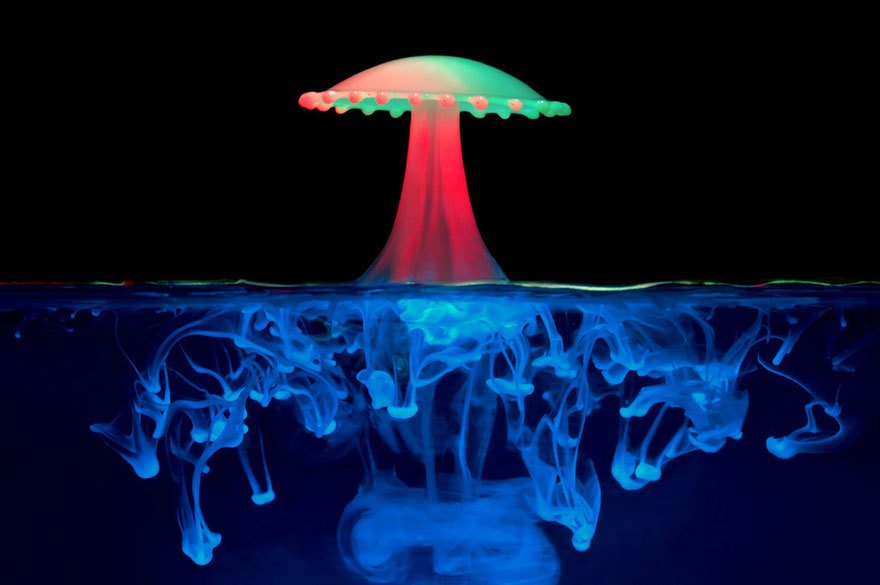
Liquid Sculptures
Artist Corrie White uses dyes and droplets to capture fantastical liquid sculptures at high-speed. The mushroom-like upper half of this photo is formed when the rebounding jet from one droplet’s impact on the water is hit by a well-timed second droplet, creating the splash’s umbrella. In the lower half of the picture, we see the remains of previous droplets, mixing and diffusing into the water via the Rayleigh-Taylor instability caused by their slight difference in density relative to the water. There’s also a hint of a vortex ring, likely from the droplet that caused the rebounding jet. (Photo credit: Corrie White)
Stalling
[original media no longer available]
At high angles of attack, the flow around the leading edge of an airfoil can separate from the airfoil, leading to a drastic loss of lift also known as stall. Separation of the flow from the surface occurs because the pressure is increasing past the initial curve of the leading edge and positive pressure gradients reduce fluid velocity; such a pressure gradient is referred to as adverse. One way to prevent this separation from occurring at high angle of attack is to apply suction at the leading edge. The suction creates an artificial negative (or favorable) pressure gradient to counteract the adverse pressure gradient and allows flow to remain attached around the shoulder of the airfoil. Suction is sometimes also used to control the transition of a boundary layer from laminar to turbulent flow.

Happy Valentine’s Day!
Here’s a potential flow field with heart-shaped streamlines, made just for you. Thank you to everyone for having helped made FYFD such a success over these 700 posts, whether by liking, reblogging, tweeting, or telling a friend. Happy Valentine’s Day!
For the curious among you, the flow is a superposition of uniform flow, two sources, and two sinks. The Matlab code is here. Have fun!

Truck Vortices
The video above shows vortex rings of smoke ejected from the burning tire of a moving truck. Without seeing the damaged tire, it’s tough to pinpoint the cause with certainty, but here are a couple of ideas. Typically vortex rings are formed with a burst of air through a narrow orifice; this is, for example, how humans, dolphins, vortex cannons, and volcanoes all make smoke rings. If air is escaping the tire through small holes, this could cause rings. Unlike in those situations, though, the tire is spinning, which means its motion is already imparting vorticity to the flow, so that any air escaping the tire forms a vortex ring. (Video credit: The Armory; submitted by eruditebaboon)
ETA: Others are suggesting the vortex rings are due to a failure of the engine, with unsteady exhaust velocities resulting in the vortex structures. I think this might still depend on the exhaust pipe’s geometry. Regardless of the exact cause, the video remains an interesting bit of fluid dynamics.

Spiraling Ferrofluid
Here a ferrofluid climbs a spiral steel structure sitting on an electromagnet. Magnetic field lines emanating from the sculpture’s edges tend to push the ferrofluid out into long spikes–part of the normal field instability–but surface tension resists. The short, somewhat squat spikes we see are the balance struck between these opposing forces. Though known for their wild appearance, ferrofluids appear many in common applications, including hard drives, speakers, and MRI contrast agents. Researchers have also recently suggested they might help understand the behavior of the multiverse. (Photo credit: P. Davis et al.)
Hummingbirds Singing with their Tail Feathers
Aeroelastic flutter occurs when fluid mechanical forces and structural forces get coupled together, one feeding the other. Usually, we think of it as a destructive mechanism, but, for hummingbirds, it’s part of courtship. When a male hummingbird looks to attract a mate, he’ll climb and dive, flaring his tail feathers one or more times. As he does so, air flow over the feathers causes them to vibrate and produce noise. Researchers studied such tail feathers in a wind tunnel, finding a variety of vibrational behaviors, including a tendency for constructive interference–in other words two feathers vibrating in proximity is much louder than either individually. For more, check out the original Science article or the write-up at phys.org. (Video credit: C. Clark et al.)

Supersonic Oil Flow Viz
This image shows oil-flow visualization of a cylindrical roughness element on a flat plate in supersonic flow. The flow direction is from left to right. In this technique, a thin layer of high-viscosity oil is painted over the surface and dusted with green fluorescent powder. Once the supersonic tunnel is started, the model gets injected in the flow for a few seconds, then retracted. After the run, ultraviolet lighting illuminates the fluorescent powder, allowing researchers to see how air flowed over the surface. Image (a) shows the flat plate without roughness; there is relatively little variation in the oil distribution. Image (b) includes a 1-mm high, 4-mm wide cylinder. Note bow-shaped disruption upstream of the roughness and the lines of alternating light and dark areas that wrap around the roughness and stretch downstream. These lines form where oil has been moved from one region and concentrated in another, usually due to vortices in the roughness wake. Image © shows the same behavior amplified yet further by the 4-mm high, 4-mm wide cylinder that sticks up well beyond the edge of the boundary layer. Such images, combined with other methods of flow visualization, help scientists piece together the structures that form due to surface roughness and how these affect downstream flow on vehicles like the Orion capsule during atmospheric re-entry. (Photo credit: P. Danehy et al./NASA Langley #)
Ink Drops
This super high resolution video (check the original on YouTube) by filmmaker Jacob Schwarz features slow motion diffusion of ink into water. The subtle differences in density between the ink and the water promote instabilities such as the Rayleigh-Taylor instability and its distinctive cascade of mushroom- or umbrella-like shapes. The mixing of two fluids seems like a simple concept, but the reality is beautiful, complex, and always fascinating. (Video credit: J. Schwarz; submitted by Rebecca S.)
Spitting Droplets
Any phenomenon in fluid dynamics typically involves the interaction and competition of many different forces. Sometimes these forces are of very different magnitudes, and it can be difficult to determine their effects. This video focuses on capillary force, which is responsible for a liquid’s ability to climb up the walls of its container, creating a meniscus and allowing plants and trees to passively draw water up from their roots. Being intermolecular in nature, capillary forces can be quite slight in comparison to gravitational forces, and thus it’s beneficial to study them in the absence of gravity.
In the 1950s, drop tower experiments simulating microgravity studied the capillary-driven motion of fluids up a glass tube that was partially submerged in a pool of fluid. Without gravity acting against it, capillary action would draw the fluid up to the top of the glass tube, but no droplets would be ejected. In the current research, a nozzle has been added to the tubes, which accelerates the capillary flow. In this case, both in terrestrial labs and aboard the International Space Station, the momentum of the flow is sufficient to invert the meniscus from concave to convex, allowing a jet of fluid out of the tube. At this point, surface tension instabilities take over, breaking the fluid into droplets. (Video credit: A. Wollman et al.)